THE EMIRATES COMPLIANCE SUMMARY: 2026 UPDATE
To legally import, sell, or operate an industrial air compressor in the United Arab Emirates (UAE) in 2026, the equipment must hold a valid Emirates Conformity Assessment Scheme (ECAS) Certificate of Conformity (CoC) issued by the Ministry of Industry and Advanced Technology (MOIAT). While “ESMA” remains the historical term known to many, MOIAT is now the central authority managing all industrial standards. For high-performance screw air compressors, compliance involves meeting safety standards (LVE), pressure equipment regulations, and increasingly, Energy Efficiency Standardization and Labeling (EESL) requirements. In 2026, “wildcard” model numbers have been phased out, meaning every specific model must be clearly identified on your certification to clear Jebel Ali or Khalifa Port customs.
10 COMMON HEADACHES FOR UAE COMPRESSOR IMPORTERS
- Customs Rejection: Shipments being held at Jebel Ali because the ECAS certificate has expired or doesn’t match the HS code (8414.80).
- The “Heat Tax”: Standard compressors from budget suppliers tripping during 50°C Dubai summers because they aren’t rated for T3 ambient conditions.
- Language Barriers: Technical manuals being rejected by MOIAT auditors because they lack a proper Arabic translation.
- Star Rating Confusion: Confusion over whether an industrial compressor requires a 1-to-5 star EESL label (it depends on the integrated motor capacity).
- Certificate Validity: The 1-year shelf life of an ECAS CoC, which often expires before the next maintenance cycle or shipment arrives.
- Notified Body Delays: Waiting 6-8 weeks for a MOIAT-approved notified body (like Intertek or SGS) to review the technical file.
- Model Number Phasing: Having certificates rejected in 2026 because they use generic “Series” names instead of discrete model IDs.
- Voltage Mismatch: Importing 60Hz units into 50Hz grids (or vice versa in specific private industrial zones) without proper VFD tuning.
- Missing CB Reports: Discovering that the manufacturer’s test reports are older than 3 years, rendering them invalid for ECAS.
- Trade License Issues: Importers lacking the specific “Trading” or “Industrial” license activity required to act as the Applicant of Record in the MOIAT portal.
UNDERSTANDING THE UAE REGULATORY ARCHITECTURE: MOIAT AND ECAS
The United Arab Emirates has positioned itself as the premier logistics and manufacturing hub of the Middle East. However, this status comes with a robust regulatory gatekeeping system designed to ensure that only safe, energy-efficient, and high-quality industrial equipment enters the market.
At the heart of this is MOIAT (Ministry of Industry and Advanced Technology). MOIAT has consolidated the functions of the former ESMA (Emirates Authority for Standardization and Metrology). If you are looking for “ESMA Certification,” you are effectively looking for an ECAS Certificate of Conformity issued under the MOIAT framework.
ECAS (Emirates Conformity Assessment Scheme)
ECAS is the mandatory product certification scheme for regulated products. It is a pre-market requirement, meaning you cannot clear customs or list the product for sale without it. For air compressors, the ECAS certification confirms that the unit complies with UAE.S IEC standards for electrical safety and machinery.
EQM (Emirates Quality Mark)
The EQM is a premium, often voluntary mark of excellence. While ECAS is a product-level certification valid for one year, the EQM involves a comprehensive audit of the manufacturing facility and its Quality Management System (QMS). The EQM is valid for three years and is highly regarded by government procurement agencies in Abu Dhabi and Dubai.
THE EESL REVOLUTION: ENERGY LABELING FOR THE FOURTH UTILITY
At AirSpace Machinery, we refer to compressed air as “The Fourth Utility.” In the UAE, where energy costs and sustainability goals (like UAE Vision 2031) are high priorities, energy efficiency is no longer optional.
The Energy Efficiency Standardization and Labeling (EESL) program is the UAE’s method of grading energy-consuming products. For industrial air compressors, the efficiency of the integrated Permanent Magnet (PM) motor is the primary focus.
The 1-to-5 Star Rating System
Products falling under EESL are assigned a star rating based on their energy performance. A 5-star rating represents the pinnacle of efficiency. In 2026, MOIAT has tightened the “Minimum Energy Performance Standards” (MEPS). Units that would have been 3-star in 2022 are now often 1-star or non-compliant.
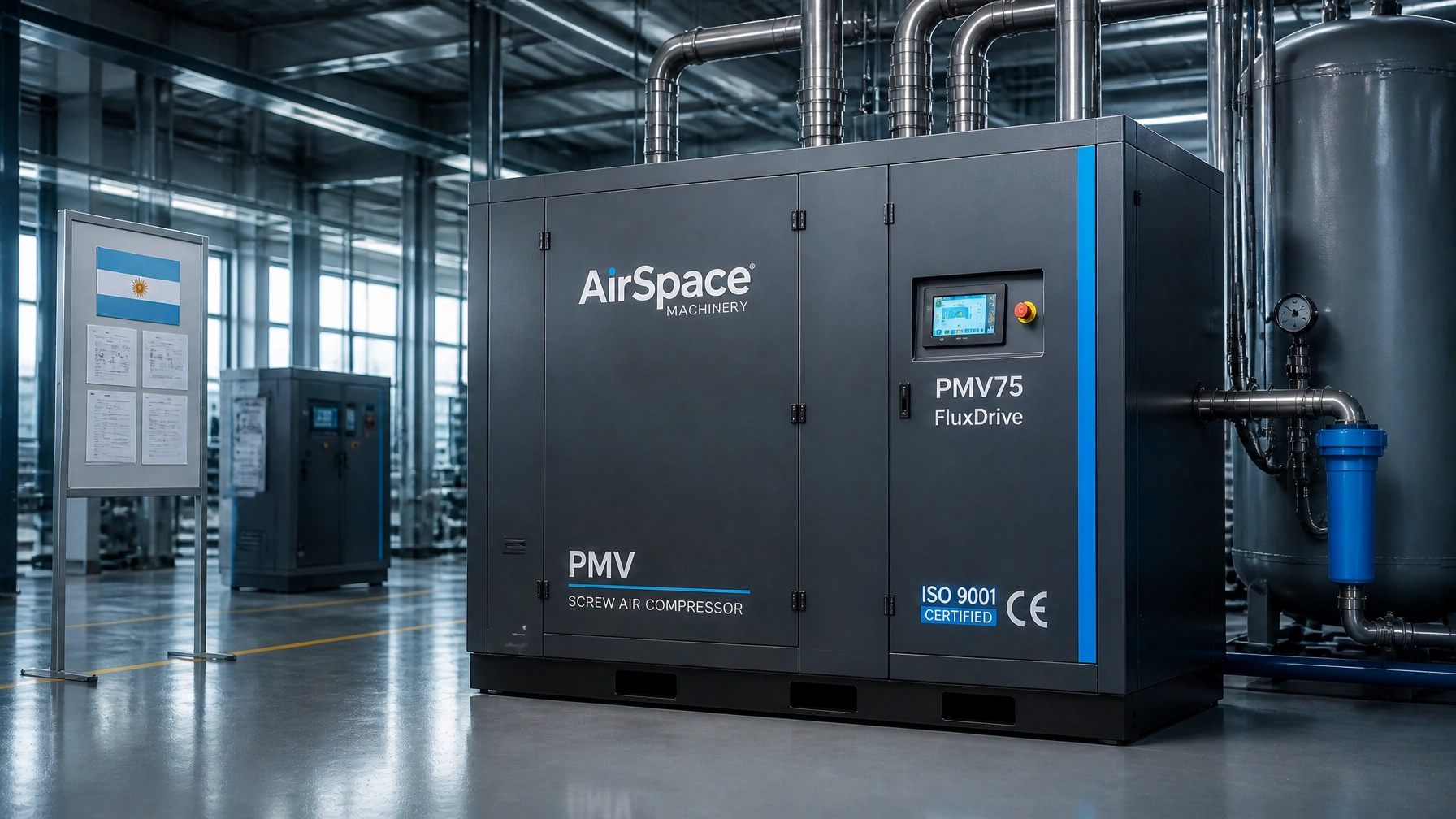
AirSpace Machinery’s PMV (Permanent Magnet Variable Frequency) technology is specifically engineered to hit the 5-star efficiency bracket. By utilizing a “35% Energy Delta” framework, where our PMV systems consume significantly less power than fixed-speed legacy brands, we ensure our UAE clients avoid the “Unload Tax” common in standard industrial setups.
STEP-BY-STEP: THE 2026 UAE COMPLIANCE PROCESS
Navigating the MOIAT portal can be complex. Here is the streamlined path to securing your ECAS Certificate:
- Portal Registration: The importer (who must have a valid UAE Trade License) registers on the MOIAT digital platform.
- HS Code Verification: Confirm the HS code (typically 8414.80 for screw compressors) and identify the applicable Technical Regulation (TR).
- Technical File Preparation: Compile the dossier, including CB Test Reports (safety), Energy Efficiency Reports (EESL), and the Declaration of Conformity.
- Notified Body Engagement: Assign a MOIAT-approved Notified Body (such as RACS, TUV, or Intertek) to review the file.
- Document Review: The Notified Body audits the technical specs, ensuring the equipment meets UAE.S standards.
- CoC Issuance: Upon successful review, MOIAT issues the ECAS Certificate of Conformity.
- Product Registration: The specific models are registered in the MOIAT database, enabling customs clearance.
ECAS VS. EQM: A COMPARISON FOR INDUSTRIAL BUYERS
| Feature | ECAS (Mandatory) | EQM (Premium/Voluntary) |
|---|---|---|
| Focus | Product Safety & Compliance | Product + Factory Quality System |
| Validity | 1 Year (Annual Renewal) | 3 Years |
| Factory Audit | Not usually required (unless Type 3) | Mandatory Factory Audit |
| Market Perception | Entry-level legal requirement | High-tier quality assurance |
| Customs Speed | Standard clearance | Priority/Fast-track potential |
| 2026 Requirement | Mandatory for all regulated units | Mandatory for high-risk/specific bids |
TECHNICAL SPECIFICATIONS: THE “DESERT-READY” STANDARD
The UAE climate is one of the most demanding in the world. A “China made screw air compressor” that works perfectly in temperate climates will fail in the UAE if not properly winterized… or in this case, “summerized.”
T3 Ambient Condition Rating
UAE testing standards (UAE.S) often refer to T3 conditions, which require equipment to operate reliably at an ambient temperature of 46°C. However, in the height of July and August, temperatures in non-conditioned compressor rooms in the UAE can easily reach 50°C to 55°C.
AirSpace Machinery engineers our “Extreme Climate” series with oversized cooling packages and high-performance lubricants that maintain ISO 8573-1 Class 0 integrity even when the outside world is melting. This prevents the “Heat Tax”, the hidden cost of downtime and thermal derating that plagues cheaper, under-engineered units.
Voltage and Frequency Standards
- Grid Standard: 230V (Single Phase) / 400V (Three Phase) at 50Hz.
- Industrial Variations: Some free zones or specific manufacturing sites (like those using US-spec machinery) may require 380V or 460V at 60Hz.
Our PMV systems are dual-frequency compatible through advanced VFD programming, allowing for seamless integration into any UAE industrial grid.
THE TECHNICAL FILE: DOCUMENTATION CHECKLIST
Missing even one document can delay your shipment by weeks. Your Technical File for MOIAT must include:
- CB Test Report and Certificate: Must be from an IECEE-recognized lab and not older than 3 years.
- Energy Efficiency Test Report: ISO 17025 accredited reports demonstrating the power consumption per m3/min.
- Arabic User Manuals: A non-negotiable requirement. The manual must cover safety, operation, and maintenance.
- Nameplate Artwork: Must show the Model, Serial Number, Pressure (Bar), Flow (m3/min), and Power (kW) clearly.
- UAE Trade License: Of the local importer or distributor.
- Electronic Declaration of Conformity: Signed and stamped by the manufacturer.
COMMON PITFALLS: WHY MOIAT REJECTS APPLICATIONS
- Wildcard Models: In 2026, you can no longer apply for “AS-PMV Series.” You must list “AS-PMV-10”, “AS-PMV-20”, etc.
- Old Test Reports: Using 4-year-old safety reports is the number one cause of rejection.
- Translation Errors: Using Google Translate for your Arabic manuals will lead to an immediate “RFI” (Request for Information) from the auditor.
- IP Rating Inadequacy: For outdoor or sandy environments (like KIZAD), units with lower than IP54 protection are often flagged.
HOW AIRSPACE MACHINERY SUPPORTS YOUR UAE EXPANSION
We don’t just sell compressors; we sell compliance and reliability.
Compliance Readiness
AirSpace Machinery maintains an up-to-date library of CE, ISO 9001, and international test reports that align perfectly with MOIAT requirements. We provide the “Technical File” as part of our standard export package for the UAE.
Engineering for the Region
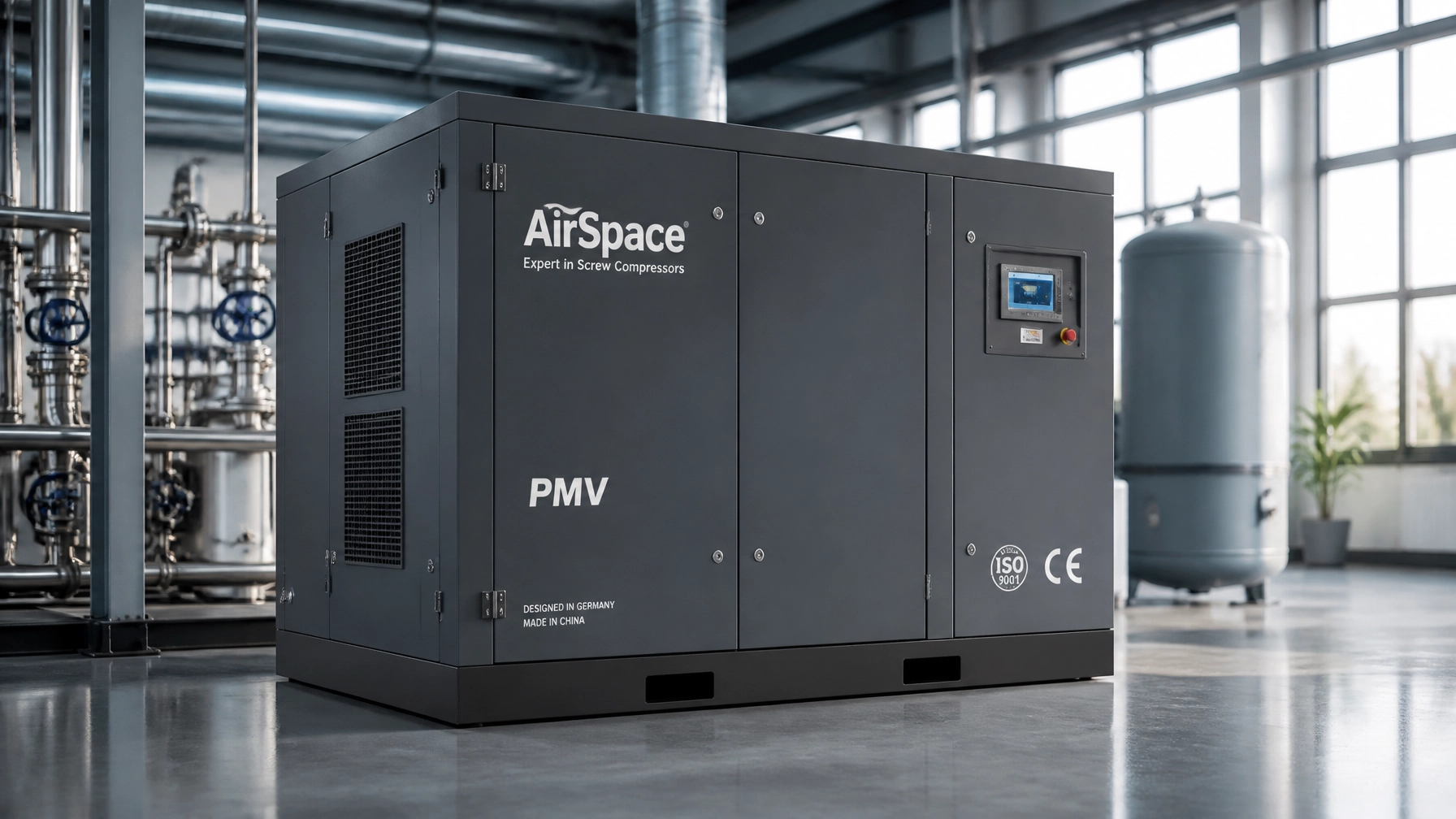
Our PMV screw air compressors are designed for 55°C ambient stability. With 100 million yuan in annual sales and a 4,000m² manufacturing facility, we have the scale to produce UAE-spec units with a neutral lead time tailored to your project timeline.
The 35% Energy Delta
By switching from legacy fixed-speed units to an AirSpace PMV system, UAE factories typically save AED 15,000 to AED 45,000 annually in electricity costs per 50HP unit. This effectively “plugs the money leak” caused by the “Unload Tax.”
FREQUENTLY ASKED QUESTIONS (FAQ)
Q: Is ECAS mandatory for air compressors in JAFZA or other Free Zones?
A: Yes. While Free Zones have some autonomy, federal safety and energy regulations managed by MOIAT apply to all industrial equipment imported into the UAE.
Q: How long does it take to get an ECAS Certificate?
A: If all documents (CB reports, manuals) are ready, the process typically takes 2 to 4 weeks. If new testing is required, it can extend to 8 weeks.
Q: Can I use my CE certificate instead of ECAS?
A: No. CE certification is excellent supporting evidence, but it is not a substitute for the UAE-specific ECAS CoC. You must use your CE/CB reports to apply for the ECAS certificate.
Q: What is the import duty for air compressors in the UAE?
A: Generally, the import duty is 5% of the CIF value. However, certain industrial exemptions may apply if the unit is for a local manufacturing facility.
Q: Is Arabic labeling mandatory on the compressor itself?
A: While the main nameplate is often English, safety warning stickers and the user manual must be in both Arabic and English.
Q: What happens if I ship without an ECAS certificate?
A: The shipment will be detained at the port. You will face mounting demurrage charges and potentially a fine of up to AED 30,000, or the requirement to re-export the goods.
CONCLUSION: SECURING THE EMIRATES GATE
The UAE market represents a massive opportunity for industrial growth, but it is a “protected gate.” Compliance with MOIAT and the ECAS scheme is the only way to ensure your facility stays online and your investments are protected. By focusing on 5-star EESL efficiency and T3 climate durability, AirSpace Machinery ensures that your compressed air system isn’t just a machine: it’s a compliant, high-performance asset.
For a detailed UAE-spec proposal or to review our compliance documentation for your next project in Dubai, Abu Dhabi, or Sharjah, contact our technical team today.
Get a Proposal
AUTHOR BOX
Penny Winston
Technical Writer at AirSpace Machinery Co., Ltd.
Penny Winston is an expert in industrial compliance and the “Fourth Utility Concept.” She specializes in helping global manufacturing firms navigate the complex regulatory landscapes of the Middle East and Southeast Asia. Her work focuses on “The 35% Energy Delta” and ensuring ISO 8573-1 Class 0 integrity across diverse industrial applications.
REVIEWED BY ENGINEERING
INFINITE LOOP: GLOBAL COMPLIANCE SERIES
- India BIS Compliance Guide for Air Compressors
- Saudi Arabia SABER and SASO Certification Guide
- Nigeria SONCAP Certification for Air Compressors
- South Africa NRCS Compliance Guide for Air Compressors
📅 Last updated:
⚡ Is Your Factory Bleeding Cash?
Most fixed-speed compressors waste $3,600/year in "Unload Tax." Test your waste level in 30 seconds.
RUN THE ROI TEST →Ready to See How Much Your Facility Can Save?
Fill out the form below for a Free Energy Assessment.