What Is an Oil-Free Air Compressor and When Do You Actually Need One?
An oil-free air compressor is the right choice when your process cannot tolerate hydrocarbon contamination in the compressed air stream. In plain English: if oil in the air could spoil product, fail an audit, damage instruments, create scrap, or trigger a recall, you should start with a true oil-free screw compressor, not an oil-injected machine plus a stack of filters.
This guide explains what oil-free really means under ISO 8573-1 Class 0, how oil-free screw compressors compare with oil-injected systems, where each technology fits, how PMV technology cuts energy use, and how to estimate total cost with real numbers. It also explains what buyers should verify before placing an order: CE documentation, ISO 9001 quality management evidence, ambient rating, dew point planning, and export support.
Before we go deeper, here are 10 buyer headaches this guide is built to solve:
- You need Class 0 air but suppliers keep selling filtered oil-injected systems.
- You are not sure whether ISO 8573-1 Class 0 is truly necessary for your process.
- You want to compare oil-free vs oil-injected on risk, energy, maintenance, and life-cycle cost.
- You need reliable performance in hot rooms and want to know whether 55°C ambient is real.
- You want proof behind the “35% energy savings” claim, not brochure fog.
- You need a machine that can survive global factory conditions, not just showroom conditions.
- You need pressure and flow matched to the application, not a guessed compressor size.
- You need help checking CE and ISO 9001 paperwork before shipment.
- You need logistics and export support, not a supplier that vanishes after payment.
- You need a practical ROI conversation, not a marketing lecture.
What Oil-Free Means Under ISO 8573-1 Class 0
Oil-free means no lubricating oil is introduced into the compression chamber. That is the engineering definition that matters. In a true oil-free screw compressor, the air path is designed so the compressed air does not rely on oil sealing or oil cooling inside the compression chamber.
Under ISO 8573-1:2010, compressed air quality is classified by contaminants including solid particles, water, and oil. For oil content:
- Class 2 allows up to 0.1 mg/m3
- Class 1 allows up to 0.01 mg/m3
- Class 0 is more stringent than Class 1 and must be specified by the equipment supplier or end user
That last point is where a lot of confusion starts. Class 0 is not a vague marketing phrase. It is a defined performance level that must be validated with testing and declared more stringent than Class 1. If a supplier claims “oil-free” but cannot explain the test basis, the declaration method, and the scope of the claim, that is a red flag.
A useful buyer rule is simple:
If oil is used inside the compression chamber, the machine is not a true oil-free compressor.
If oil is removed later by filters, that is oil removal, not oil-free compression.
Johnny Wayne puts it this way:
“Putting filters behind an oil-injected compressor and calling it oil-free is like calling tap water sterile because you added one more screen. It may look fine until the day it doesn’t.”
Why Filters Are Not Enough for Real Class 0
If your process requires very low contamination risk, filters are not a substitute for oil-free compression. Filters are necessary accessories in many systems, but they are not magic.
Here is the practical problem. Oil-injected compressors carry three oil risks downstream:
- Liquid oil carryover
- Oil aerosol carryover
- Oil vapor carryover
A filter train may reduce those contaminants, but its performance depends on sizing, maintenance, differential pressure, temperature, flow stability, and service condition. Coalescing elements age. Pressure drop rises. Hotter air increases vapor challenge. Drain failures happen. Maintenance gets delayed. The result is simple: your process purity is riding on consumables.
That is why critical sectors usually prefer source-level risk removal. If no oil enters the compression chamber, there is no hydrocarbon source there to break through later.
For contamination-sensitive factories, that changes the conversation from “How many filters do I need?” to “How do I remove oil risk at the source?”
Two Types of True Oil-Free Screw Compressor
Industrial buyers usually compare two true oil-free screw paths:
- Dry screw oil-free compressors
- Water-injected PMV oil-free screw compressors
Dry Screw Oil-Free Compressors
Dry screw machines keep rotor contact under control through precision timing gears. Because there is no injected liquid doing the cooling inside the chamber, the compression process runs hotter. That usually means a more complex design, higher thermal stress, and higher sensitivity to maintenance condition.
Typical buyer concerns with legacy dry screw platforms include:
- Higher discharge temperatures
- More complicated overhaul requirements
- More demanding internal tolerances
- Two-stage designs for common industrial pressures
- Higher part and service cost over time
Water-Injected PMV Screw Compressors
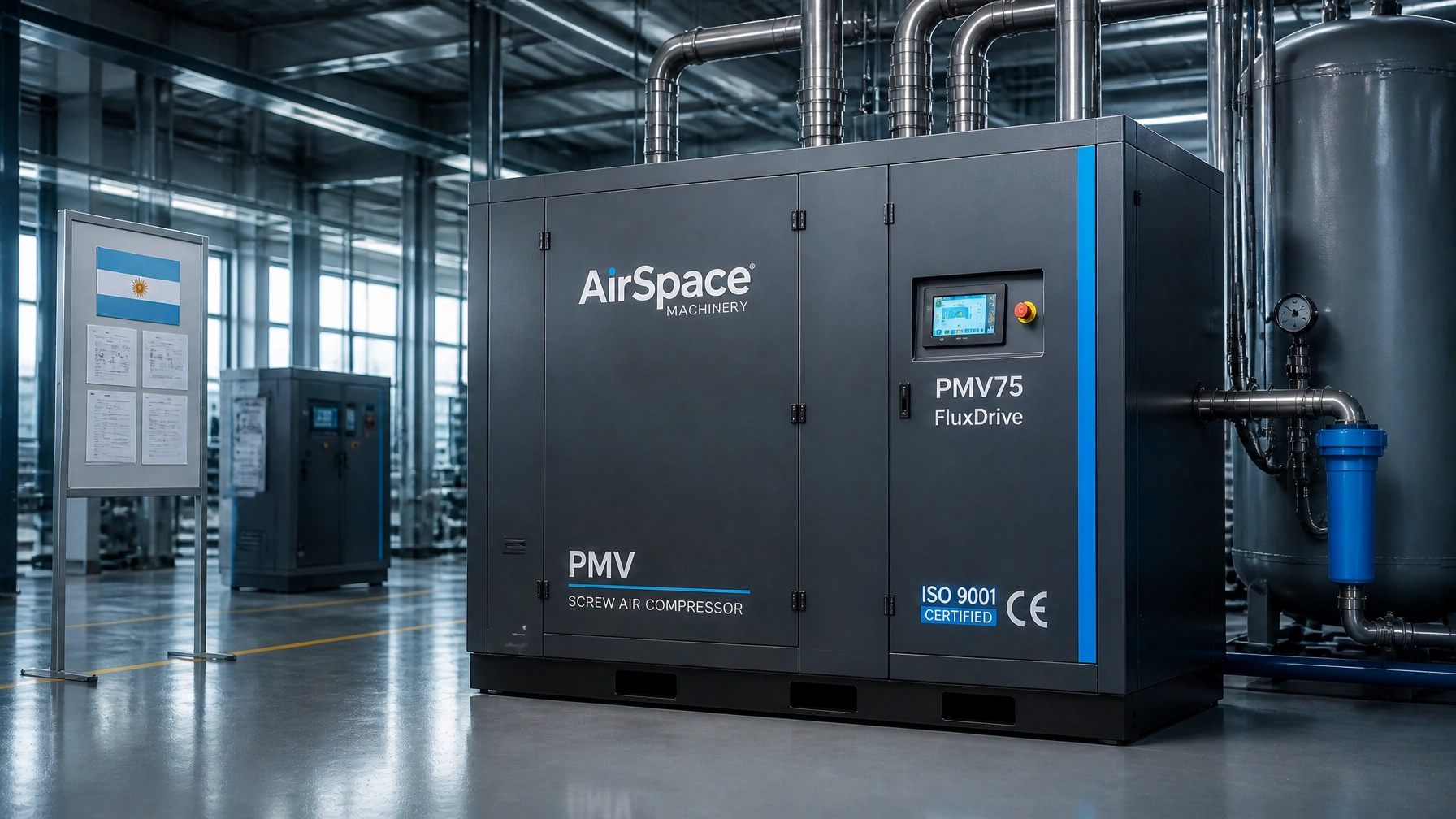
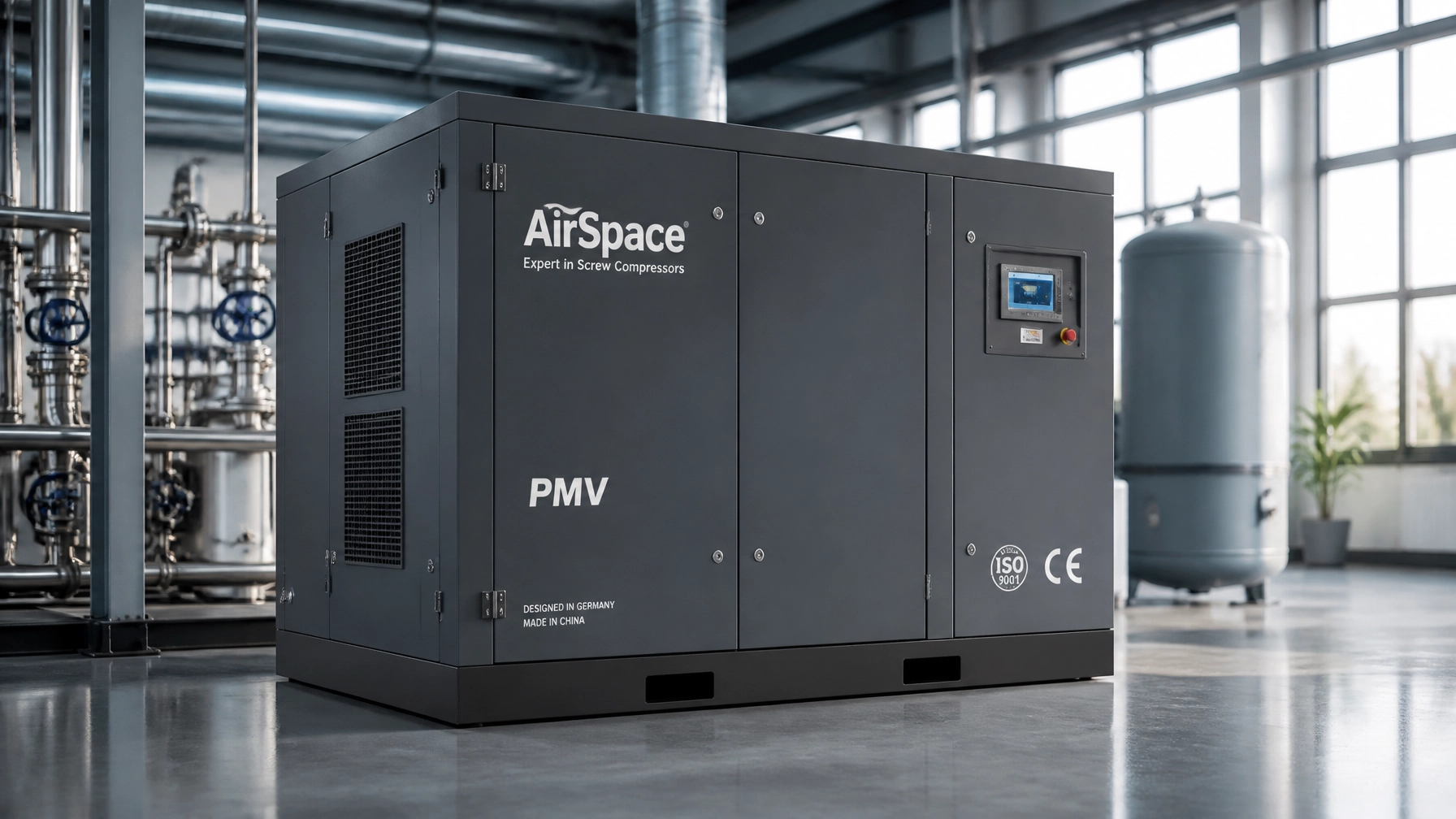
AirSpace Machinery focuses on water-injected Permanent Magnet Variable Frequency oil-free screw compressors. In this design, purified water supports sealing and cooling inside the compression process, while the PMV drive adjusts motor speed to actual air demand.
That gives four practical advantages.
- Lower compression temperature
Water removes heat efficiently, so discharge temperatures are typically much lower than dry screw designs. Lower heat means lower stress on the machine and downstream equipment. - Better part-load efficiency
A PMV system does not have to run full speed when your plant only needs part flow. That matters because most factories do not run at one flat demand point all day. - Stable purity approach
Because the machine is oil-free in the compression chamber, you are not depending on post-treatment alone to remove hydrocarbon risk. - Easier fit for hot and variable-duty factories
AirSpace oil-free PMV systems are built with a 55°C ambient rating. That matters in compressor rooms that are closer to boiler rooms than office space.
Our Oil-Free PMV Technology With 55°C Ambient Rating
This is the section many buyers skip until summer arrives and the alarms start.
A compressor that looks good on a datasheet at 25°C may behave very differently in a real plant at 45°C or above. Ambient temperature affects cooling margin, motor loading, control stability, and component life. In the Middle East, South Asia, parts of Africa, Latin America, and poorly ventilated workshops everywhere, heat is not a side issue. Heat is a cost multiplier. We call that the Heat Tax in the Industrial Tax Series.
AirSpace Machinery oil-free PMV technology is rated for up to 55°C ambient conditions, which gives buyers a bigger operating safety window in extreme-heat installations. That is especially relevant for:
- Rooftop-adjacent compressor rooms
- Summer-loaded factories with weak ventilation
- High-dust industrial compounds where doors stay closed
- Export markets with long hot seasons
- Sites where utility power quality causes additional thermal stress
Why the 55°C rating matters in plain factory language:
- More stable operation in hot rooms
- Lower nuisance shutdown risk
- Better reliability margin during seasonal peaks
- Better fit for export markets with extreme climate exposure
- Less chance that your compressor becomes the weak link in production
A compressor is a lot like a truck engine. It is easy to promise performance on a cool day. The real test is whether it still pulls when the road gets steep and the weather turns nasty.
The 35% Energy Delta, With Real Math
Yes, the 35% Energy Delta needs math. Here it is.
The headline claim is not that every factory in every condition will save exactly 35%. The correct statement is this: under variable-demand conditions, when a PMV oil-free compressor replaces a fixed-speed or thermally inefficient legacy setup, total compressor energy use can often drop by up to 35%, depending on load profile, pressure band, control method, and system condition.
Assumptions for an example calculation:
- Plant requires average delivered air equal to 70% of peak flow
- Existing legacy oil-free or fixed-speed package draws 110 kW on average across the shift because of unload losses, poor turn-down, and higher thermal losses
- AirSpace PMV oil-free package for the same delivered demand draws 71.5 kW on average
- Operating time is 8,000 hours per year
- Electricity cost is USD 0.12 per kWh
Annual energy use:
Legacy system:
110 kW × 8,000 h = 880,000 kWh/year
AirSpace PMV oil-free system:
71.5 kW × 8,000 h = 572,000 kWh/year
Annual energy saved:
880,000 – 572,000 = 308,000 kWh/year
Annual cost saved:
308,000 × USD 0.12 = USD 36,960/year
Energy reduction percentage:
308,000 ÷ 880,000 = 35%
That is the 35% Energy Delta in plain numbers.
If electricity cost is higher, the savings rise.
If your demand profile is flatter, the savings may shrink.
If your current system spends a lot of time unloaded, the savings may improve.
If your plant has leaks, oversized equipment, or unstable pressure bands, system correction can change the result either way.
The point is not the slogan. The point is the bill.
Oil-Free vs Oil-Injected: When Should You Choose Each?
Short answer:
Choose oil-free when contamination risk has real product, compliance, or patient consequences.
Choose oil-injected when the process can tolerate controlled residual oil and the economics clearly support it.
Choose oil-free when:
- Compressed air can contact product directly
- Product recall risk is high
- Audit exposure is serious
- Scrap cost is high
- Cleaning contamination after the fact is expensive or impossible
- You need a clear Class 0 strategy
- You are supplying pharma, food, medical, biotech, electronics, or sensitive packaging lines
Choose oil-injected when:
- Air is used for general plant utility only
- End-use risk is low
- Proper filtration and maintenance are acceptable controls
- Life-cycle contamination cost is genuinely lower than oil-free
- The process does not require Class 0
What buyers often get wrong is assuming oil-free is “always better” or oil-injected is “always cheaper.” Neither statement is reliable without process context.
For example:
A metal fabrication shop using compressed air for non-contact blow-off may run an oil-injected screw compressor very successfully.
A pharmaceutical packaging room with direct or incidental product contact should not play roulette with downstream oil filtration.
This is why the right question is not “Which compressor is better?”
The right question is “What does contamination cost at my site?”
Applications Where Oil-Free Is Non-Negotiable
Pharmaceutical Manufacturing
In pharmaceutical plants, compressed air may contact powders, tablets, capsules, coatings, blisters, transfer systems, actuators, filling equipment, or clean process areas. The issue is not just visible contamination. Trace hydrocarbons can affect product integrity, process validation, and audit readiness.
Typical pharma concerns include:
- Product contact risk
- Batch rejection cost
- GMP compliance exposure
- Documentation and validation burden
- Downtime during investigation and cleaning
In pharma, one contamination event can cost more than the premium for a proper oil-free system.
Food Processing and Beverage
Food plants use compressed air for packaging, conveying, filling, sorting, knife actuation, blow-off, fermentation support systems, and PET-related operations. Oil contamination can create odor, taste, shelf-life, hygiene, and recall problems.
Common food plant issues include:
- Oil taint in packaging zones
- Hygiene control in washdown or humid environments
- Condensate handling
- Audit pressure from brand owners and regulators
- Cross-contamination risk in multi-line production
In food factories, “probably fine” is not a risk policy. It is a future headache.
Medical and Laboratory Use
Medical air systems, medical device manufacturing, and laboratory operations demand stable, clean compressed air because the downstream consequence of failure is serious. Depending on the application, compressed air may support manufacturing, testing, packaging, instrument operation, or sterile process environments.
Buyers in this sector typically focus on:
- Reliability
- Clean air integrity
- Documentation
- Low noise
- Maintenance predictability
For medical manufacturing, the compressor is not just an equipment purchase. It is part of the quality system.
Electronics and Semiconductor Manufacturing
Electronics and semiconductor production lines are sensitive to microscopic contamination. Oil aerosols or vapors can interfere with precision assembly, clean processing, pneumatic instruments, valves, and high-value surfaces.
Typical pain points include:
- Fine contamination causing reject rates
- Cleaning cost after line incidents
- Instrument drift
- Yield loss on high-value parts
- Environmental control consistency
At micro scale, contamination that is invisible to the eye can still be expensive enough to ruin your weekly KPI report.
Other Strong Oil-Free Use Cases
- Medical equipment manufacturing
- High-grade packaging
- Textile finishing where stains are unacceptable
- Paint and coating lines where fisheyes destroy finish quality
- Specialty chemicals with process air sensitivity

Low Pressure Oil-Free Screw Compressor: Why It Matters at 2-5 Bar
Low-pressure applications deserve more attention than they usually get. Food conveying, fermentation support systems, textile air-jet processes, and some packaging lines may only need 2 to 5 bar, but they often need a lot of volume. That combination changes the cost picture.
When flow is high, even small contamination or pressure-drop penalties get magnified across the year. If an oil-injected low-pressure system relies on filters to maintain air quality, you are paying for that decision every hour through:
- Pressure drop
- Filter replacement
- Drain maintenance
- Oily condensate handling
- Risk concentration across high total air volume
In low-pressure, high-flow duty, a true oil-free screw compressor can make especially strong sense because the plant is moving large air mass with little room for wasted energy or contamination drama.
The Cost of “Fake” Oil-Free
When buyers rely on oil-injected compression plus filters instead of choosing true oil-free at the source, they often inherit three hidden costs:
- Filter replacement cost
High-efficiency filters are consumables, not permanent guarantees. - Pressure-drop cost
Every added filter stage creates resistance. That forces the compressor to work harder to maintain the same delivered pressure. - Condensate disposal cost
Oil-injected systems create oily condensate that may require regulated handling. Water-injected oil-free systems simplify that burden.
This is why fake oil-free often looks cheap at quotation stage and expensive at operating stage.
Comparison Table: Legacy Brands vs AirSpace PMV Oil-Free
| Feature | Legacy brands dry oil-free screw | AirSpace PMV oil-free water-injected screw |
|---|---|---|
| Compression chamber oil | No | No |
| ISO 8573-1 Class 0 path | Yes, depending on model and declaration | Yes, designed for Class 0 applications |
| Cooling approach | Dry compression, higher thermal load | Water-injected cooling and sealing |
| Typical operating heat profile | Higher | Lower |
| Variable-speed efficiency advantage | Limited on older or fixed configurations | Strong PMV part-load performance |
| Ambient rating discussion | Often model-specific and easy to gloss over | 55°C ambient rating highlighted for hot climates |
| Unload waste exposure | Higher on fixed-speed configurations | Lower with PMV demand matching |
| Maintenance complexity | Higher overhaul complexity | Simpler operating concept |
| Fit for extreme-heat export markets | Can require closer review | Strong fit for Heat Tax environments |
| Buyer value angle | Proven legacy architecture, often higher operating burden | Clean air plus lower energy and better hot-room margin |

What Buyers Should Verify Before Ordering
If you are sourcing globally, ask for the boring documents first. They save the most money later.
- CE documentation
Ask the supplier to provide the CE declaration and supporting technical file scope relevant to the equipment configuration. - ISO 9001 evidence
Ask for a current ISO 9001 certificate covering the manufacturing entity and verify certificate validity and scope. - Class 0 claim basis
Ask how the Class 0 claim is defined, tested, and documented for the model family you are considering. - Ambient rating
Ask whether the published flow and power data are valid at your site temperature, especially if your compressor room runs hot. - Pressure and flow sizing
Always specify required pressure in bar or psi and required flow in m3/min or CFM. Without those numbers, quotations are guesswork. - Export and logistics support
Ask whether the supplier can support export packing, documentation, parts planning, and destination-market communication.
AirSpace Machinery supports global buyers with equipment documentation, configuration-based lead time discussion, and export coordination. Lead time depends on configuration. That is the honest answer.
Get Your Free ROI Calculator
If you are comparing oil-free vs oil-injected, stop arguing in generalities and run the numbers for your actual site.
Use this checklist for a proper ROI review:
- Required Pressure: bar / psi
- Required Flow: m3/min or CFM
- Operating hours per year
- Electricity cost per kWh
- Ambient temperature range
- Application type
- Current compressor control method
- Estimated cost of contamination or downtime events
Get Your Free ROI Calculator
Form fields:
- Pressure (bar/psi) — required
- Flow (m3/min or CFM) — required
- Operating Hours per Year
- Electricity Cost
- Application
- Country
CTA: Get a Proposal
Frequently Asked Questions
Is an oil-free air compressor always required for food or pharma?
Not every point in a plant requires the same air quality, but any compressed air stream with direct or meaningful incidental product contact should be reviewed against contamination risk, audit exposure, and applicable quality requirements. In many pharma and food processes, a true oil-free compressor is the safer decision.
What does ISO 8573-1 Class 0 actually guarantee?
Class 0 means a compressed air quality level more stringent than Class 1 for oil content, specified by the supplier or user. Buyers should ask how that claim is tested and documented for the exact machine family.
Is oil-injected plus filtration good enough?
Sometimes, yes, for non-critical utility applications. But for contamination-sensitive processes, filtered oil-injected air still depends on consumables and maintenance discipline. It is risk control, not source elimination.
How does PMV technology save energy?
A PMV system varies motor speed to match air demand. That reduces unload waste, improves part-load efficiency, and lowers unnecessary power draw during variable operation. Savings depend on site conditions, but the energy math can be substantial.
Why does a 55°C ambient rating matter?
Because real compressor rooms get hot. A stronger ambient rating gives more operating margin in extreme climates and poorly ventilated industrial spaces, reducing shutdown risk and helping reliability.
Do I still need an air dryer with an oil-free compressor?
Yes. Oil-free describes oil content, not moisture content. You still need the right dryer and dew point strategy for your process. For humid Southeast Asia sites, this matters even more because the Humidity Tax can overload underspecified dryer packages.
How do I verify CE and ISO 9001 documentation?
Ask for the supplier’s CE declaration and current ISO 9001 certificate, then verify scope, legal entity, date validity, and whether the paperwork matches the offered equipment configuration.
Can AirSpace help with export logistics?
Yes. AirSpace Machinery supports global buyers with export coordination and documentation support. Exact lead time depends on configuration.
Conclusion: Choose the Air Strategy That Matches Your Process Risk
If contamination would cost you product, audits, downtime, or customer trust, a true oil-free screw compressor is usually the right call. If your process is general utility and contamination risk is low, an oil-injected screw compressor may still be appropriate. The difference is not ideology. It is consequence.
AirSpace Machinery’s oil-free PMV approach combines Class 0 application logic, lower operating temperatures, PMV demand matching, and a 55°C ambient rating for tougher real-world conditions. That is why it fits buyers who care about purity and operating cost at the same time.
A good compressor decision should survive three tests:
- It protects the process
- It survives the climate
- It makes financial sense on the power bill

Get a Proposal for your required pressure and flow, and request the free ROI calculator to compare your current system against a Class 0 PMV oil-free alternative.
Author: Penny Winston
The 35% Energy Delta | The Fourth Utility Concept | ISO 8573-1 Class 0 Integrity
Reviewed by Engineering
Internal Resources:
- Learn how to avoid The Compliance Trap in your next audit.
- Explore our full range of ISO 8573-1 Class 0 Oil-Free systems.
- Read more about Why Your Factory Needs Class 0 Air.
- Review our oil-free screw air compressor product solutions for pharma, food, and electronics plants.
- See the full compressed air quality guide before choosing filtration or dryer strategy.
- Compare the process case in what is class 0 oil free air and why does your factory need it to decide whether your line truly needs source-level oil-free compression.
📅 Last updated:
⚡ Is Your Factory Bleeding Cash?
Most fixed-speed compressors waste $3,600/year in "Unload Tax." Test your waste level in 30 seconds.
RUN THE ROI TEST →Ready to See How Much Your Facility Can Save?
Fill out the form below for a Free Energy Assessment.