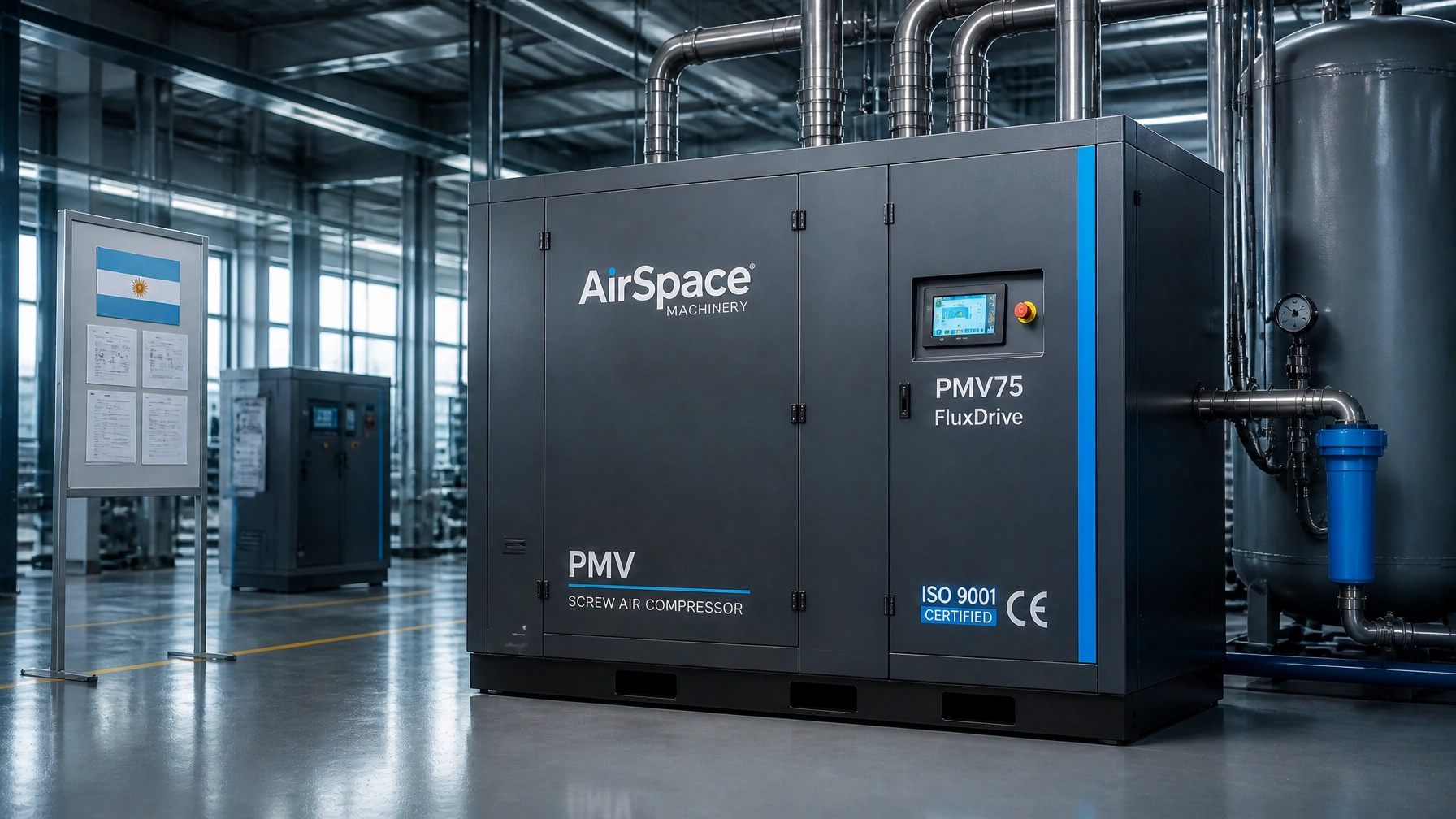
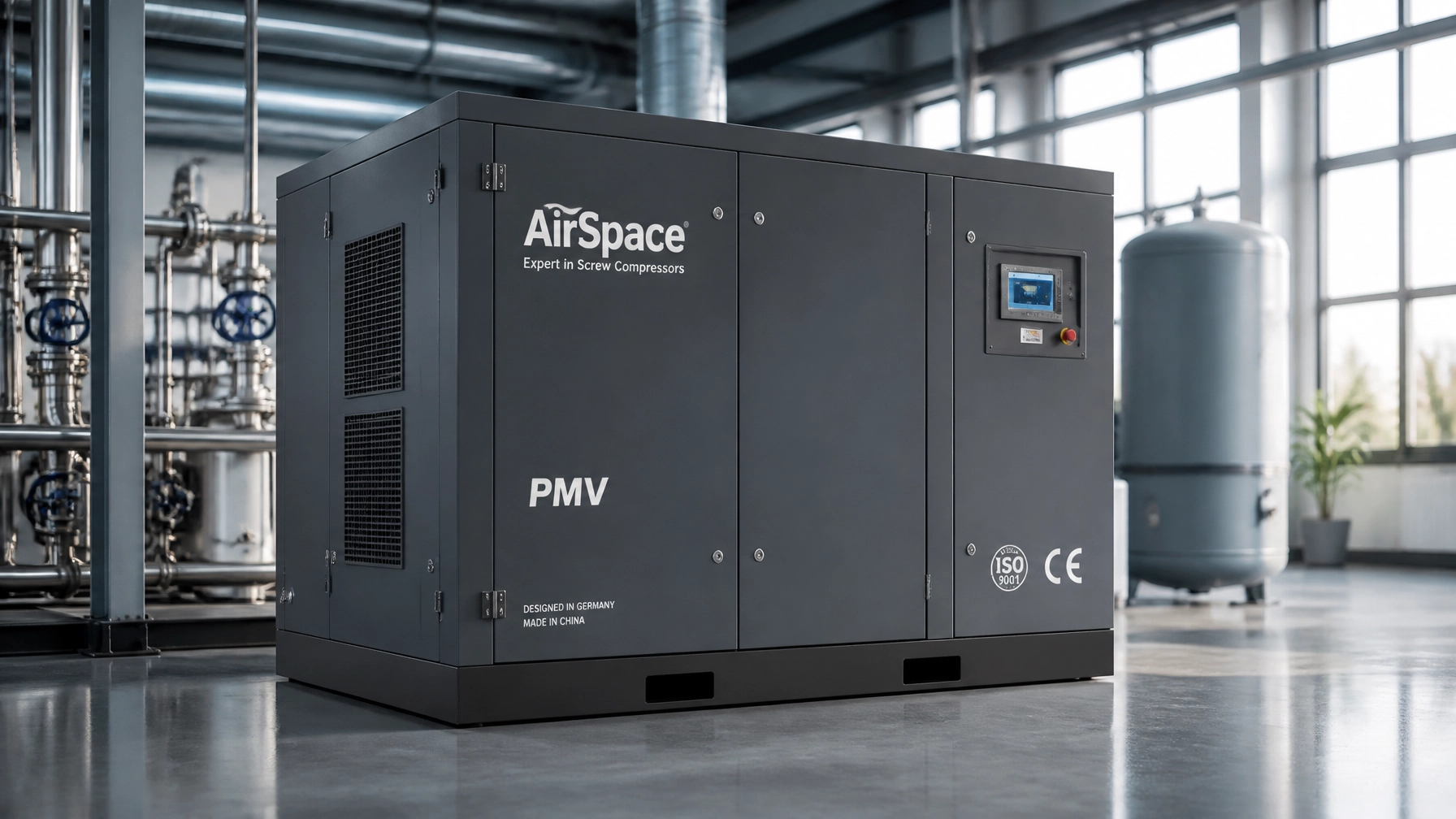
Excessive moisture in compressed air is the physical result of ambient water vapor condensing into liquid during the compression process, which can lead to catastrophic equipment failure and product contamination. To eliminate water downstream, you must ensure your auto-drains are functioning, your aftercooler is dropping the air temperature below the dew point, and your refrigerated air dryer is correctly sized for peak summer humidity loads.
At AirSpace Machinery, we view compressed air as the Fourth Utility. Just like electricity or water, it must be delivered with consistent quality. When moisture infiltrates your lines, it is no longer a utility; it is a liability. For a typical 100HP system, the cost of ruined product, rusted pneumatic tools, and emergency downtime can exceed $8,700 annually, a financial leak we call the Humidity Tax.
The Physics of the Humidity Tax: Where Does the Water Come From?
Ambient air contains water vapor. When a China made screw air compressor pulls in 1,000 cubic feet of air, it also pulls in the humidity present in that air. As that air is compressed into a smaller volume, its ability to hold water vapor decreases.
Imagine squeezing a soaked sponge. The compression process literally squeezes the water out of the air. If your system is running at 100 PSI (approx. 7 bar), the air is roughly 1/8th of its original volume. Without proper treatment, this liquid water travels through your piping, washing away tool lubricants, corroding steel pipes, and providing a breeding ground for bacteria in food or pharmaceutical applications.
The 4-Step Field Diagnostic: Tracking Down the Moisture Leak
If you find liquid water at your point-of-use tools, follow this technician-level diagnostic guide to identify the failure point.
Step 1: The Auto-Drain Audit
The most common cause of water downstream is a failed auto-drain. These small components are responsible for 90% of moisture issues.
Check the drain on your compressor’s internal moisture separator, the bottom of your air receiver tank, and the refrigerated dryer itself.
- Is the drain stuck closed? If the reservoir is heavy or makes a “sloshing” sound, the drain is clogged with scale or oily sludge.
- Is the timer set correctly? For electronic timed drains, ensuring the “open” duration is long enough to purge all liquid is vital.
- Is it powered? Check for green status lights. A dead solenoid means no drainage.
Step 2: The Aftercooler Efficiency Check
The aftercooler is the radiator-like component that cools the air immediately after compression. If the aftercooler fails, the air enters your refrigerated dryer too hot (above 120°F / 50°C), overwhelming the dryer’s cooling capacity.
Technician Tip: Feel the discharge pipe leaving the compressor. It should be warm, not “burning hot.” If it is too hot to touch, your aftercooler fins are likely clogged with dust or the cooling fan has failed. This temperature spike is a major contributor to the Humidity Tax in high-heat environments.
Step 3: Refrigerated Dryer Troubleshooting
Your refrigerated dryer should maintain a pressure dew point (PDP) of roughly 3°C to 10°C (37°F to 50°F).
- Check the Gauge: Most dryers have a color-coded gauge. If the needle is in the red or yellow zone, the refrigeration circuit is failing or the unit is overloaded.
- Clean the Condenser: Just like a home AC, the dryer has a condenser coil. If it is covered in factory dust, the refrigerant cannot cool the air effectively.
- Check the Bypass Valve: Ensure the bypass valve is fully closed. We often find that after maintenance, the bypass is left partially open, allowing “wet” air to mix with “dry” air downstream.
Step 4: The Seasonal Sizing Reality
If you see moisture in the summer but not in the winter, your dryer is undersized. This is a common engineering oversight. Air at 35°C (95°F) can hold nearly twice as much water vapor as air at 21°C (70°F). If your system was designed for “average” conditions, it will fail during the humid summer months. This is why AirSpace Machinery recommends sizing dryers for the “worst-case” humidity scenario to maintain ISO 8573-1 Class 4 moisture levels year-round.
Fixing the Flow: Engineering Solutions for Dry Air
Once you have diagnosed the root cause, implementing these fixes will plug the profit leak.
- Install Drip Legs and Goosenecks: In your piping layout, never take a branch line from the bottom of the main header. Always pull from the top (a “gooseneck”). Install a vertical “drip leg” with an auto-drain at the lowest point of your piping run to catch any residual condensate.
- Add a Coalescing Filter: A high-efficiency coalescing filter placed before the dryer can remove bulk liquid and oil aerosols, preventing the dryer’s heat exchanger from becoming fouled.
- Implement The 35% Energy Delta: Switching to an AirSpace PMV (Permanent Magnet Variable Frequency) screw air compressor ensures that your air production matches your demand. This stability prevents the rapid “cycling” of air through the treatment system, which can sometimes lead to moisture “slugs” bypassing the dryer.
The AirSpace Advantage: Engineered for Purity
At AirSpace Machinery, we don’t just sell compressors; we provide Engineering Freedom. Our refrigerated air dryers are specifically matched to our PMV compressor range, ensuring that even in extreme climates, your air meets the strict requirements of ISO 8573-1.
Whether you are in the electronics industry requiring clean air for precision assembly or a food processing plant where moisture means bacteria, our systems are designed to deliver 99.9% uptime. By integrating high-performance auto-drains and oversized heat exchangers, we help you avoid the Humidity Tax and focus on production.
Infinite Loop: More Technical Insights
To further optimize your facility, explore our other technical guides:
- Learn the difference between Oil-Free vs. ISO Class 0 Integrity to see if you need more than just dry air.
- Discover how Double-Stage Screw Compressors can further reduce your energy robbery.
- Read our case study on how an Automotive Plant saved $47,200/year by upgrading their air treatment and compression strategy.
Frequently Asked Questions
Q: Why do I still have water in my pipes even though my dryer is running?
A: This usually indicates a failed auto-drain or a bypass valve that is partially open. Even a high-performing dryer cannot remove water if the purged liquid isn’t actually leaving the system through a functional drain.
Q: How often should I service my air dryer?
A: At a minimum, you should clean the condenser coils weekly and test the auto-drains daily. A full refrigeration check by a technician should be performed annually to ensure the system is holding its charge.
Q: Can a China made screw air compressor handle high-humidity environments like SEA or LATAM?
A: Yes, provided the system is engineered for the “Humidity Tax.” AirSpace Machinery units for these regions feature upgraded aftercoolers and higher-capacity dryers to maintain dry air even in 90% relative humidity.
Q: What is the difference between a refrigerated dryer and a desiccant dryer?
A: A refrigerated dryer is standard for most industrial shop air, reaching a dew point of +3°C. A desiccant dryer is used for specialized applications (like medical or outdoor cold weather) and can reach -40°C.
Q: Does moisture affect the energy efficiency of my compressor?
A: Indirectly, yes. Moisture causes corrosion, which leads to pipe leaks. A 1/4 inch leak can cost thousands in wasted electricity, compounding the Humidity Tax.
Author Box
Penny Winston is a Technical Writer at AirSpace Machinery, specializing in the “35% Energy Delta” and the “Fourth Utility Concept.” With a focus on ISO 8573-1 Class 0 Integrity, she helps industrial facility managers eliminate the hidden “taxes” of inefficient air systems through practical engineering and field-tested diagnostic strategies.
Reviewed by Engineering
📅 Last updated:
⚡ Is Your Factory Bleeding Cash?
Most fixed-speed compressors waste $3,600/year in "Unload Tax." Test your waste level in 30 seconds.
RUN THE ROI TEST →Ready to See How Much Your Facility Can Save?
Fill out the form below for a Free Energy Assessment.