The Altitude Tax: How High Elevation Steals 30% of Your Compressor's Capacity (And How PMV Fixes It)
At high elevations, a standard industrial air compressor is effectively a smaller machine than the one you paid for. If you operate at 3,000 meters (10,000 feet), you are paying what we call the Altitude Tax, a hidden penalty that robs up to 30 percent of your machine’s free air delivery (FAD) while simultaneously increasing its operating temperature. The air is thinner, the cooling is less effective, and the physics of compression change completely.
The direct answer to solving this capacity theft is transitioning to Permanent Magnet Variable Frequency (PMV) technology. While a fixed-speed compressor is physically limited by its gear ratio and motor speed, an AirSpace PMV system can compensate for lower air density by adjusting its RPM to maintain mass flow, effectively clawing back the performance stolen by the atmosphere.
The Physics , Why Altitude Kills Compressor Performance
The atmosphere at sea level exerts a pressure of approximately 1.013 bar (14.7 psi). As you move higher, the column of air above you shortens, and the atmospheric pressure drops. By the time you reach 3,000 meters, that pressure has fallen to roughly 0.70 bar.
For an industrial air compressor, this creates three distinct engineering headaches:
Reduced Mass Flow: Compressors are volumetric machines, they take in a fixed volume of air per cycle. Because high-altitude air is less dense, that same volume contains fewer air molecules. You get less "mass" of air at the discharge end, which means your pneumatic tools and machines lack the power they were designed for.
Increased Compression Ratio: To reach a target discharge pressure of 7 bar (approx. 100 psi) from sea level, the compressor must multiply atmospheric pressure by a factor of 7. At 3,000 meters, it must multiply the local 0.70 bar atmosphere by a factor of 10 to reach the same 7 bar. This higher ratio generates more heat and reduces volumetric efficiency.
The Cooling Gap: Air is not just the product; it is also the cooling medium. Thinner air has a lower heat-carrying capacity. This means your fans and heat exchangers become roughly 3% less effective for every 305 meters (1,000 feet) of elevation. This is the Heat Tax of high altitude, often leading to nuisance thermal trips and shortened lubricant life.
The Derating Formula , The Altitude Tax Table
Engineers use a standard derating factor to calculate how much "free air" a machine will actually deliver at elevation. The general rule of thumb is a 3% loss in flow for every 1,000 feet (approx. 305 meters) of altitude.
Below is the standard AirSpace Altitude Tax table showing the impact on a typical 100 CFM sea-level rated unit:
Altitude (Feet / Meters) | Atmospheric Pressure (Bar) | Delivered Flow (CFM) | The Altitude Tax (Capacity Loss)
0 ft / 0 m | 1.013 bar | 100 CFM | 0% (Baseline)
3,000 ft / 915 m | 0.910 bar | 91 CFM | 9% Loss
5,000 ft / 1,524 m | 0.830 bar | 85 CFM | 15% Loss
7,500 ft / 2,286 m | 0.760 bar | 77.5 CFM | 22.5% Loss
10,000 ft / 3,048 m | 0.690 bar | 70 CFM | 30% Loss
13,000 ft / 3,962 m | 0.620 bar | 61 CFM | 39% Loss
As shown, at the elevation of La Paz, Bolivia (3,640m), a 100 CFM compressor performs like a 65 CFM unit. If you didn't account for this during procurement, your factory will suffer from chronic pressure drops and "starvation" of critical equipment.
How Much Are You Actually Losing? Real-World Examples
The Altitude Tax isn't just a theoretical problem; it is an operational reality for thousands of facilities in LATAM and Africa.
Mexico City (2,250m / 7,380 ft):
In the automotive and electronics hubs surrounding Mexico City, the Altitude Tax is roughly 22%. A standard fixed-speed compressor rated for 50m³/min will only deliver 39m³/min. This often forces plant managers to purchase a larger, more expensive unit (e.g., jumping from 75HP to 100HP) just to meet the base requirement.
Bogotá, Colombia (2,640m / 8,660 ft):
At this elevation, the tax rises to 26%. Beyond the flow loss, the 60Hz grid common in Colombia adds a layer of complexity to motor cooling. Without specific high-altitude engineering, standard motors will run 10-15 degrees hotter than their sea-level specifications.
Johannesburg, South Africa (1,750m / 5,740 ft):
The 17% loss here is enough to turn a correctly-sized system into a bottleneck. Many mines and processing plants in the Highveld region experience premature bearing failure because the air is too thin to properly cool the internal components of the screw airend.
Denver, USA (1,600m / 5,280 ft):
Commonly known as the Mile High City, the 15% loss means a 100HP unit is effectively an 85HP unit. In manufacturing settings, this 15% delta is exactly what leads to the Unload Tax, where a machine is forced to work harder and cycle more frequently to keep up with demand, wasting thousands in energy every year.
Single-Stage vs Two-Stage vs PMV , Which Handles Altitude Best?
When choosing a China made screw air compressor for high-altitude work, the architecture of the machine matters.
Legacy Single-Stage Units:
These suffer the most. Because they must achieve the entire pressure jump in one compression cycle, the internal "slip" or air leaking back across the rotors increases significantly at altitude. Their efficiency falls off a cliff once you pass 1,500 meters.
Two-Stage Compression:
This is a superior choice for elevation. By splitting the compression into two steps, the compression ratio for each stage remains lower. This improves volumetric efficiency and helps keep temperatures manageable. However, two-stage units are traditionally more expensive and complex to maintain.
AirSpace PMV (Permanent Magnet Variable Frequency):
The modern solution. Our PMV technology uses a variable speed drive coupled with a high-efficiency permanent magnet motor. At high altitude, the intelligent controller can increase the RPM of the motor (within safe engineering margins) to pull in more of the thinner air, maintaining the mass flow required by the plant. This "Dynamic Compensation" allows a smaller PMV unit to often outperform a larger fixed-speed unit in mountainous regions.
The Cooling Problem , Why Thinner Air Overheats Your Compressor
Most operators focus on the flow loss, but the cooling failure is what actually kills the machine. Forced-air cooling relies on the mass of air moving across the radiator fins to carry heat away. Since the air is 30% less dense at 10,000 feet, each cubic meter of air moved by the fan carries 30% less heat.

At AirSpace Machinery, we solve this by applying our Tropical Rating standards to our altitude units. This includes:
Oversized Heat Exchangers: We utilize 30% more surface area in our aluminum radiators compared to legacy brands. This ensures that even with thinner air, the thermal exchange remains sufficient to keep the oil temperature below 90°C.
IP55 High-Efficiency Motors: Standard motors are often derated by 1% for every 300 meters above 1,000 meters. We use oversized motor frames and high-efficiency permanent magnet motors that maintain a 1.15 service factor, ensuring they don't burn out in the thin, poorly-cooling air.
55°C Ambient Rating: Our systems are engineered to run in 55°C (131°F) environments at sea level. When moved to a 25°C environment at 3,000 meters, this "thermal headroom" acts as a buffer against the loss of cooling efficiency.
How AirSpace PMV Compensates for Altitude
The Fourth Utility Concept dictates that compressed air should be as reliable as electricity or water. To achieve this at high elevation, we integrate specific high-altitude logic into our controllers.
35% Energy Delta: While the Altitude Tax steals capacity, our PMV technology recovers energy. By eliminating the Unload Tax, where fixed-speed units waste power running in idle, we ensure that even if you have to run the machine slightly faster to get your required CFM, you are still consuming 35% less energy than a legacy fixed-speed unit.
VSD Speed Compensation: Our controllers allow for localized tuning. If a customer in Quito, Ecuador (2,850m) needs 10 bar pressure, we can calibrate the PMV motor to run at an optimal frequency that compensates for the air density without exceeding the thermal limits of the airend.
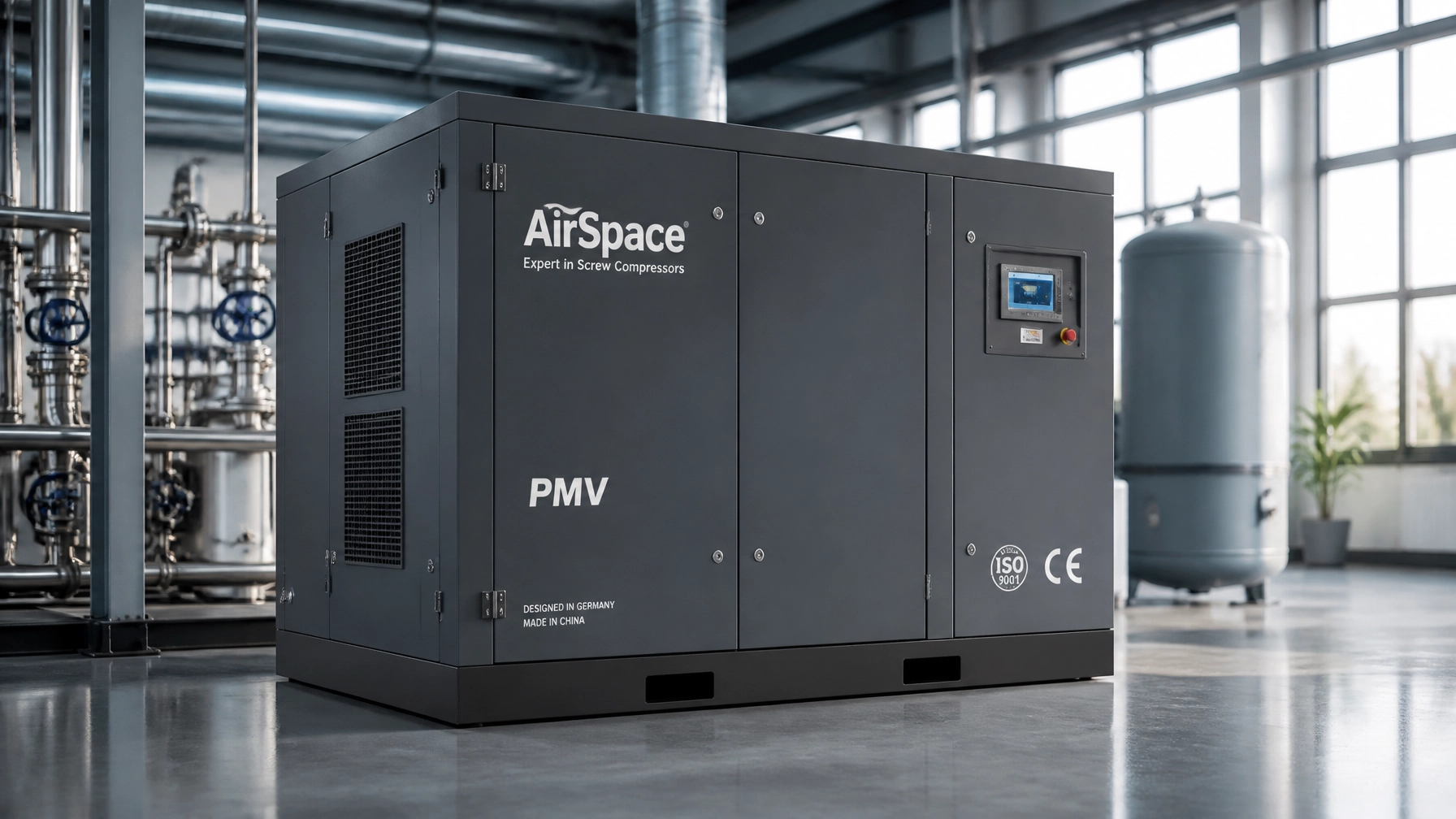
Rugged "Extreme Climate" Aesthetic: AirSpace compressors aren't just pretty to look at. Our dark gray matte finish and robust cabinet design are built for the rugged environments often found in high-altitude mining and industrial zones.
FAQ Section , Understanding Your High-Elevation Needs
Does altitude affect the quality of the air?
Altitude itself does not affect air purity, but the thinner air can make moisture separation more difficult. Because the air is hotter, it holds more water vapor. We recommend pairing high-altitude units with a high-performance refrigerated air dryer and ensuring your system meets ISO 8573-1 Class 0 Integrity for sensitive applications like electronics or pharmaceuticals.
Can I just buy a bigger compressor to solve the altitude problem?
You can, but it is the most expensive way to solve the problem. A larger fixed-speed compressor will have a massive Unload Tax, wasting electricity every second it isn't at full load. An AirSpace PMV unit allows you to get the performance of a larger machine without the massive energy bill.
Do diesel portable compressors have the same problem?
Yes, and it is actually worse for diesel units. Not only does the compressor lose capacity, but the diesel engine also loses power because it can't get enough oxygen. This double-penalty makes AirSpace diesel-driven portable units: which utilize turbo-charged engines: essential for high-altitude construction sites.
How do I verify the CE and ISO 9001 documentation for an AirSpace unit?
All our equipment ships with verified CE and ISO 9001 certifications. You can verify these documents during the proposal stage. We provide full transparency on all engineering metrics and performance data.
What is the lead time for a high-altitude spec compressor?
Lead times are neutral and depend on your specific configuration. Because we manufacture in our own 4,000m² facility with 100 million yuan in annual sales capacity, we maintain a robust supply chain for both 50Hz and 60Hz high-altitude motors.
Conclusion: Altitude-ready doesn't mean more expensive : it means engineered right
The Altitude Tax is an inescapable law of physics, but it doesn't have to be a permanent drain on your factory's bottom line. By understanding that a 30% capacity loss is the baseline for legacy systems, you can make a more informed decision to move toward PMV technology.
At AirSpace Machinery, we don't just sell you a machine; we provide a high-performance engineering solution tailored to your environment. Whether you are battling the Humidity Tax in Southeast Asia, the Heat Tax in the Middle East, or the Altitude Tax in the Andes, our 20 years of engineering excellence ensure that your "Fourth Utility" remains stable, efficient, and clean.
Don't let the thin air thin out your profits.
Get a Proposal for an altitude-optimized AirSpace PMV system today.
Reviewed by Engineering
Author Box
Penny Winston
Technical Writer at AirSpace Machinery Co., Ltd.
Penny is a leading voice in the 'Industrial Tax Series,' specializing in 'The 35% Energy Delta' and 'The Fourth Utility Concept.' With a focus on ISO 8573-1 Class 0 Integrity, she helps global manufacturers eliminate hidden energy costs in complex industrial climates.
📅 Last updated:
⚡ Is Your Factory Bleeding Cash?
Most fixed-speed compressors waste $3,600/year in "Unload Tax." Test your waste level in 30 seconds.
RUN THE ROI TEST →Ready to See How Much Your Facility Can Save?
Fill out the form below for a Free Energy Assessment.