Semiconductor wafer fabrication is the most unforgiving industrial environment on Earth. For 14nm, 7nm, and 5nm lithography processes, a single hydrocarbon molecule can translate into catastrophic yield loss and millions of dollars in scrapped silicon. Achieving the mandated Clean Dry Air (CDA) and Nitrogen (N₂) purity levels requires more than a generic oil-free label. It requires strict adherence to the 2026 SEMI F58 standards. This guide provides fab managers and facilities engineers with the technical framework for implementing Class 0 oil-free compression systems that exceed SEMI F58 compliance while securing the 35% Energy Delta in high-demand fab environments.
Why Semiconductor Fabs Require Class 0 Oil-Free
In a modern 300mm wafer fab, compressed air is not just a utility; it is a critical process chemical. Whether it is used for pneumatic valve actuation in the tool gallery, wafer handling in the EFEM (Equipment Front End Module), or as a feedstock for Nitrogen (N₂) generation, the purity of this air directly dictates the defect density of the finished product. See our complete ISO 8573-1 Class 0 oil-free guide for a broader breakdown of purity classes, contamination control, and buyer-side verification points.
Wafer Contamination and Hydrocarbon Sensitivity
At the 28nm node and below, semiconductor processes are sensitive to total hydrocarbons (THC) at levels below 1 part per billion (PPB). Standard industrial compressors, even those marketed as "oil-free", often fail to account for the trace hydrocarbons present in the intake air or the microscopic aerosols generated during high-speed compression. When these hydrocarbons reach the wafer surface during photoresist development or etching, they cause carbon-based defects that cannot be easily cleaned. This leads to immediate yield loss and tool downtime.
The Role of CDA in AMC Control
Airborne Molecular Contamination (AMC) is a silent yield killer. CDA systems must act as a barrier against AMCs, including volatile organic compounds (VOCs), dopants, and condensable hydrocarbons. For a fab to maintain its ISO 14644-1 Cleanroom classification, the compressed air system must meet or exceed ISO 8573-1 Class 0. However, in the semiconductor world, Class 0 is only the baseline. The real target is SEMI F58.
SEMI F58 Compliance: What It Actually Requires
While ISO 8573-1 provides a general framework for compressed air quality, the semiconductor industry relies on the SEMI F58 standard to define the "Fourth Utility" with precision. SEMI F58 is significantly more stringent than generic industrial standards, focusing on the trace contaminants that specifically impact wafer chemistry.
The 1 PPB Hydrocarbon Threshold
The most critical distinction of SEMI F58 is the requirement for Total Hydrocarbons (THC) to be less than 1 PPB. To put this in perspective, a standard "Class 1" oil-free specification under ISO 8573-1 allows for 0.01 mg/m³ of oil. That is roughly equivalent to 10,000 PPB. To achieve SEMI F58 compliance, a fab must employ a system that is 10,000 times cleaner than the industry's standard "Class 1" definition.
Pressure Dew Point (PDP) of -70°C
Semiconductor tools utilize ultra-fine air bearings and high-precision optics that are sensitive to even a single molecule of water vapor. SEMI F58 mandates a Pressure Dew Point (PDP) of -70°C (-94°F). This level of dryness is essential to prevent condensation within the tool's internal pneumatic lines and to ensure that N₂ generation membranes operate at peak efficiency without moisture-induced degradation.
Particle and AMC Monitoring
Compliance also requires 0.01 μm sterile filtration at the point of use. Furthermore, modern 2026 fab designs integrate active AMC monitoring systems to detect trace levels of ammonia, acidic gases, and volatile dopants that could bypass standard filtration.
Water-Injected PMV Oil-Free vs Dry Screw for Wafer Fabs
When selecting a compressor for a semiconductor fab, the choice typically narrows down to two technologies: Water-Injected PMV Screw or Traditional Dry Screw. In the context of 2026 efficiency mandates and SEMI F58 compliance, the differences are stark.
| Parameter | Water-Injected PMV (AirSpace) | Traditional Dry Screw | Oil-Injected + Massive Filtration |
|---|---|---|---|
| Contamination Risk | Zero (Water as lubricant) | Minimal (Air-cooled) | High (Risk of filter breakthrough) |
| Energy Efficiency | 35% Delta (Near-Isothermal) | Standard (High Heat Loss) | Low (Pressure Drop across filters) |
| Heat Output | Low (Water-cooled) | Very High | Moderate |
| Maintenance | Simplified (No oil filters) | High (Gearbox/Coating wear) | High (Frequent filter changes) |
| Ambient Tolerance | 55°C (Extreme Climate) | 40°C – 45°C | 40°C |
| Lead Time | 35 Days Factory-Direct | 46+ Weeks | 12-16 Weeks |
The Water-Injected Advantage
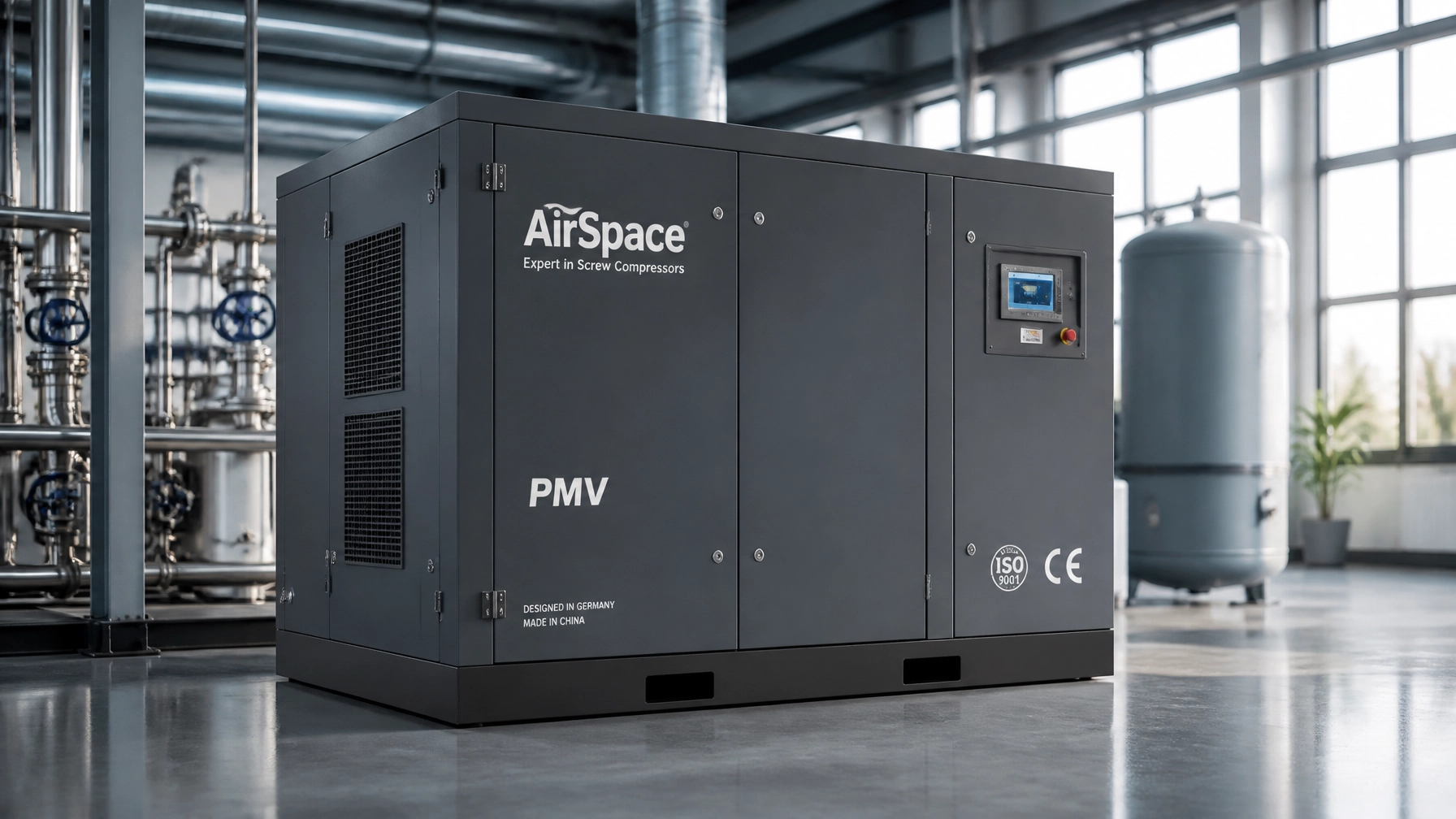
AirSpace Machinery utilizes water-injected technology where high-purity water acts as both the lubricant and the cooling medium. This allows for near-isothermal compression, keeping internal temperatures significantly lower than dry screw alternatives. Lower temperatures mean less thermal stress on the air end, higher volumetric efficiency, and a 35% energy delta compared to legacy fixed-speed units.

The 35% Energy Delta for Semiconductor Fabs
In a semiconductor environment, the "Fourth Utility" is often the single largest consumer of electricity after the process tools and HVAC. For a fab running 24/7/365, energy waste is a massive "Unload Tax" that erodes profitability.
The Real Math of Fab Efficiency
Consider a typical 75kW (100HP) oil-free compressor system. In a wafer fab, this unit runs approximately 8,000 hours per year. With average industrial electricity rates in semiconductor hubs reaching $0.12/kWh, the cost of operation is substantial.
- Standard Fixed-Speed Dry Screw: Uses approximately 600,000 kWh annually. Annual Cost: $72,000.
- AirSpace PMV Water-Injected Screw: Leveraging the 35% Energy Delta, the consumption drops to 390,000 kWh. Annual Cost: $46,800.
- The Result: $25,200 per year, per unit, in direct electricity savings.
For a large-scale campus like those found in the US, Taiwan, or South Korea, where dozens of 160kW units are networked together, the 35% Energy Delta translates into millions of dollars in annual OPEX reduction. This is not just "green energy", this is raw engineering freedom. Read more about the 35% Energy Delta framework if you want the wider math behind why PMV systems cut the "Unload Tax" so aggressively in continuous-process plants.
Why 35-Day Delivery Changes Fab Construction Timelines
One of the greatest headaches for fab construction managers is the "Lead Time Tax." Legacy brands often cite 46 to 52 weeks for semiconductor-grade oil-free compressors. In a fast-moving industry where fab construction is a race against market demand, a one-year wait for a compressor is a project-killing bottleneck.
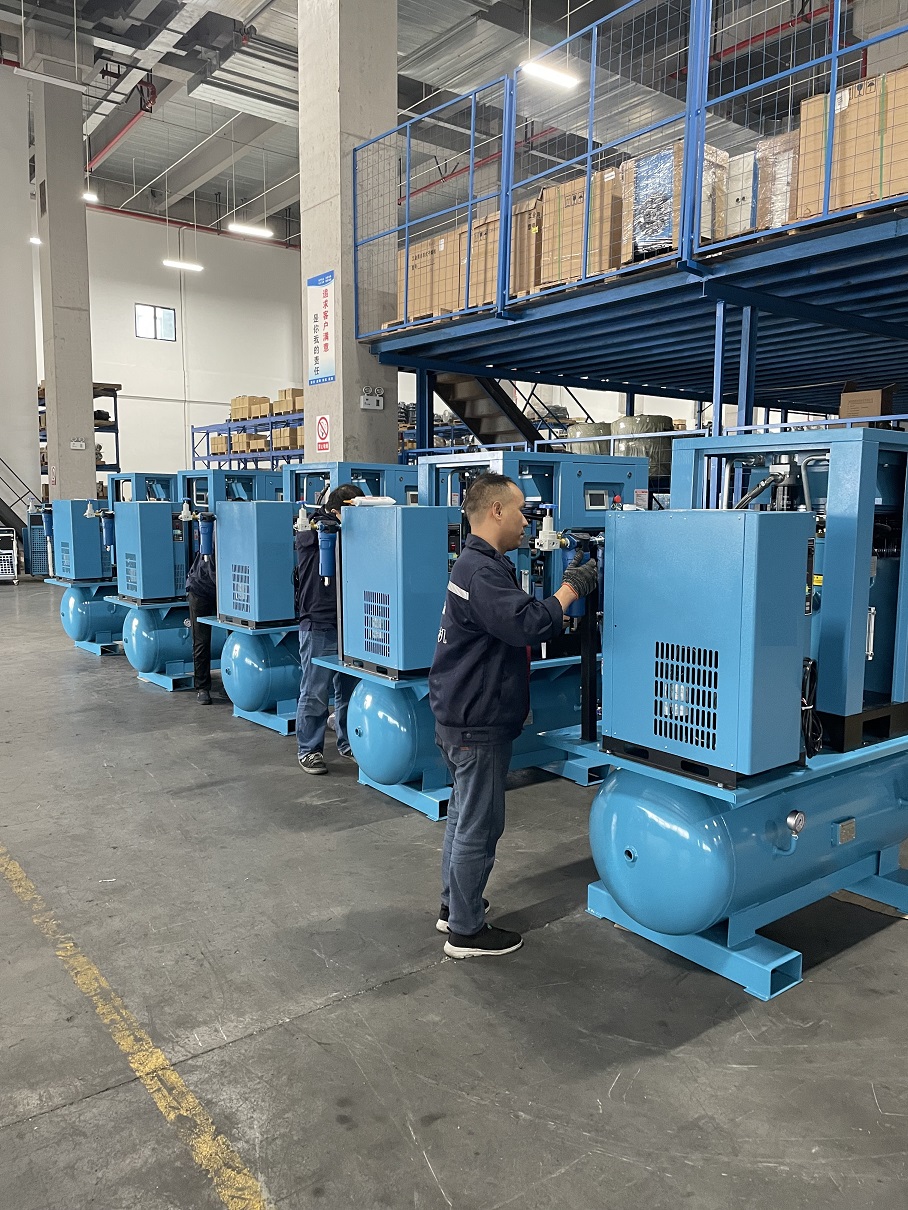
AirSpace Machinery has restructured the industrial supply chain to offer 35-day delivery for factory-direct configurations. By maintaining a 4,000m² facility with advanced manufacturing protocols, we eliminate the 11-month wait. This allows fab engineers to order equipment much closer to the "hook-up" phase of construction, freeing up capital and reducing the risk of project delays.
CDA and N₂ Integration for Wafer Fabs
Oil-free compressors are the heart of the CDA and N₂ generation plants. In most modern fabs, the compressed air is split: one stream for Clean Dry Air and another as feed-air for Pressure Swing Adsorption (PSA) or Membrane Nitrogen generators.
Protecting N₂ Membranes
Nitrogen membranes are extremely sensitive to oil vapor. Even trace aerosols from an "oil-lubricated" compressor can coat the membrane fibers, leading to a rapid decline in N₂ purity and eventual system failure. By using a Class 0 water-injected system, fabs eliminate the "Oil Tax" and extend the life of their nitrogen generation infrastructure.
The -70°C Dew Point Challenge
To achieve the SEMI F58 requirement of -70°C PDP, AirSpace integrates its compressors with high-efficiency twin-tower desiccant dryers. These systems utilize a heatless or heated-purge regeneration cycle to ensure that every cubic meter of air delivered to the fab is bone-dry. To maintain this purity, we mandate the use of 304 or 316L stainless steel piping for all downstream distribution, preventing the rust and particulate contamination common in carbon steel lines.

Technical Specifications for Fab Engineers
For engineering teams evaluating equipment for a 2026 fab expansion, the following specifications represent our core semiconductor-grade offerings.
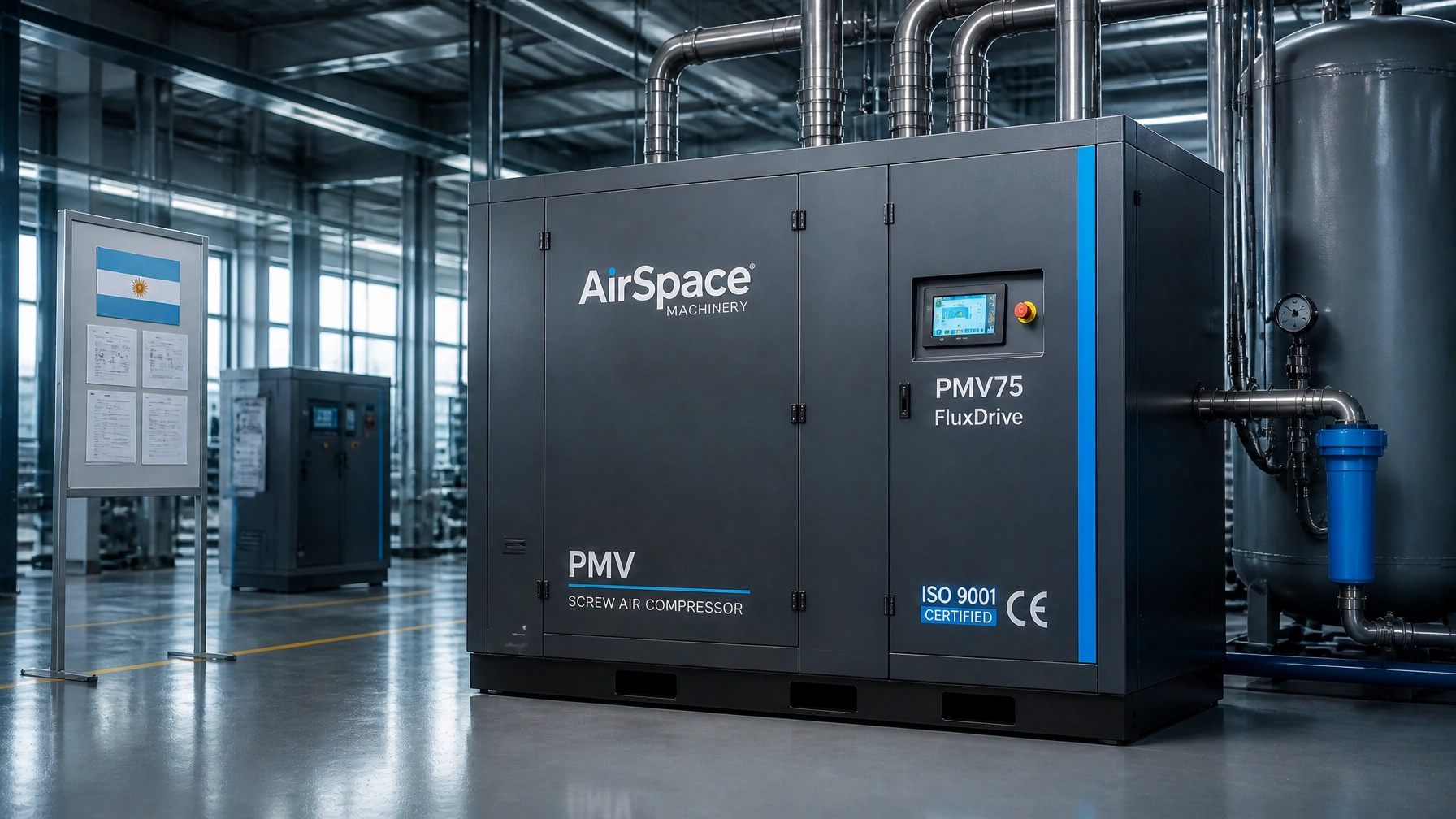
Model: LY-75DRYPM (75kW / 100HP)
🟢 Technology: Water-Injected PMV Screw
🟢 Purity: ISO 8573-1 Class 0 Certified
🟢 Pressure Range: 7 – 10 Bar (101 – 145 PSI)
🟢 Ambient Rating: 55°C (Extreme Climate Ready)
🟢 Cooling: Water-cooled or Air-cooled options
🟢 Control: Advanced PLC with remote fab monitoring integration
Model: LY-160DRYPM (160kW / 215HP)
🟢 Technology: Large-Scale Water-Injected PMV
🟢 Purity: Guaranteed < 1 PPB Hydrocarbons (with filtration)
🟢 Efficiency: Permanent Magnet Variable Frequency (35% Energy Delta)
🟢 Certifications: CE, ISO 9001:2015
🟢 Lead Time: 35 Days
These units utilize BAOSI air ends and high-tier universal components, ensuring that while the pricing is factory-direct from China, the performance meets the most rigorous international standards. For model-level details, View LY-75DRYPM and LY-160DRYPM specifications, and review the larger platform at LY-160DRYPM.
FAQ: Semiconductor Compressed Air & SEMI F58
Q: What is SEMI F58 and why does it matter for my fab?
A: SEMI F58 is the specific semiconductor industry standard for Clean Dry Air and Nitrogen purity. Unlike generic standards, it mandates total hydrocarbons below 1 PPB and a pressure dew point of -70°C. It is the only way to ensure that your "Fourth Utility" does not become a source of wafer contamination.
Q: Can a water-injected compressor really achieve < 1 PPB hydrocarbons?
A: Yes. Because the compression chamber uses water as the only lubricant, there is no oil to leak into the air stream. Combined with standard intake air filtration and a high-efficiency desiccant dryer, our water-injected systems consistently meet the most stringent SEMI F58 hydrocarbon limits.
Q: How does the 35-day delivery work for fab projects?
A: We bypass the traditional distributor markups and lead-time bottlenecks. By managing the entire manufacturing process in our 4,000m² facility, we can configure and ship a semiconductor-grade unit in approximately 35 days, providing a massive advantage for fab construction timelines.
Q: Do I still need a dryer with an oil-free compressor for fab use?
A: Absolutely. While the compressor provides the Class 0 oil-free air, the dryer is responsible for removing moisture to reach the -70°C PDP required by SEMI F58. For semiconductor applications, a twin-tower desiccant dryer is mandatory.
Q: What's the ROI difference between water-injected PMV and dry screw for fabs?
A: The water-injected PMV system offers a 35% Energy Delta. On a single 75kW unit, this translates to over $25,000 in annual savings. In a large fab campus, the ROI is usually achieved in less than 18 months through reduced energy and maintenance costs.
Q: Can AirSpace support fab-scale multi-unit installations?
A: Yes. We regularly provide multi-unit systems for large-scale manufacturing facilities. Our engineering team can assist with master-controller setups to synchronize multiple compressors for optimal load sharing and redundancy.
Q: How does the 55°C ambient rating help in fab environments?
A: Even in clean-rooms, mechanical galleries can become hot. Many standard compressors trip or lose efficiency at 40°C. Our "Extreme Climate" engineering ensures continuous operation up to 55°C, preventing the "Heat Tax" from causing unplanned fab downtime.
Conclusion
The semiconductor industry is entering a new era of 14nm and below manufacturing where the margins for error are non-existent. Relying on legacy air compression technology with 11-month lead times and high energy waste is no longer a viable strategy for competitive wafer fabs.
By adopting AirSpace Machinery’s Class 0 water-injected PMV systems, fab managers can secure SEMI F58 compliance, capture the 35% Energy Delta, and compress their construction timelines with 35-day delivery. This is the new standard for the Fourth Utility in the semiconductor world.
Request a Fab-Specific ROI Comparison
Ready to eliminate the "Unload Tax" and the "Lead Time Tax" in your facility? Contact AirSpace Machinery today for a technical proposal tailored to your fab’s CDA and N₂ requirements.
Visit our LinkedIn for more industry insights
Author: Penny Winston, Technical Writer
Penny Winston is an expert in industrial air compression strategies, focusing on 'The 35% Energy Delta,' 'The Fourth Utility Concept,' and 'ISO 8573-1 Class 0 Integrity.' She helps global manufacturing leaders navigate the complexities of high-efficiency, clean-air solutions for contamination-sensitive environments.
Reviewed by Engineering
📅 Last updated:
⚡ Is Your Factory Bleeding Cash?
Most fixed-speed compressors waste $3,600/year in "Unload Tax." Test your waste level in 30 seconds.
RUN THE ROI TEST →Ready to See How Much Your Facility Can Save?
Fill out the form below for a Free Energy Assessment.