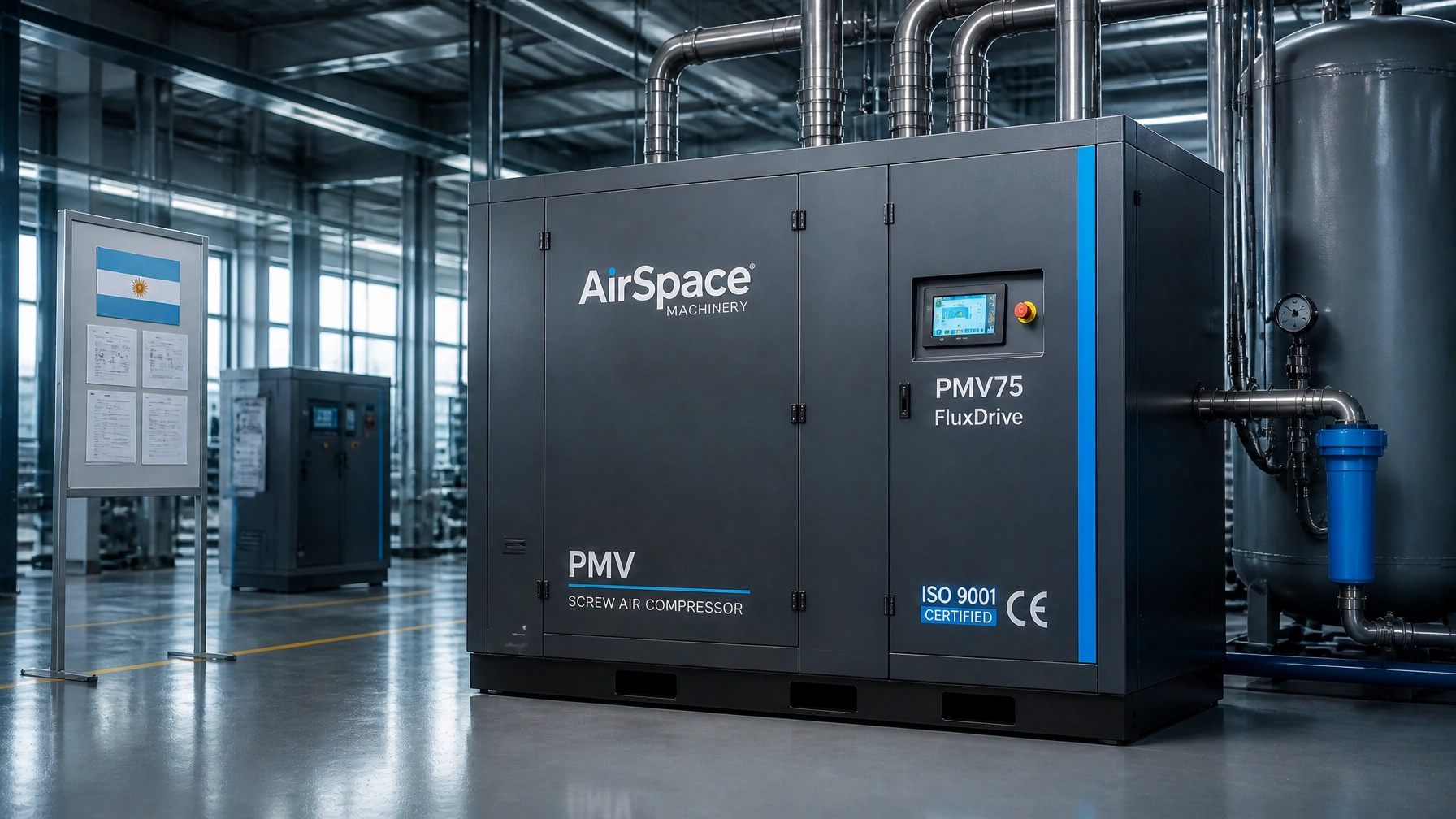
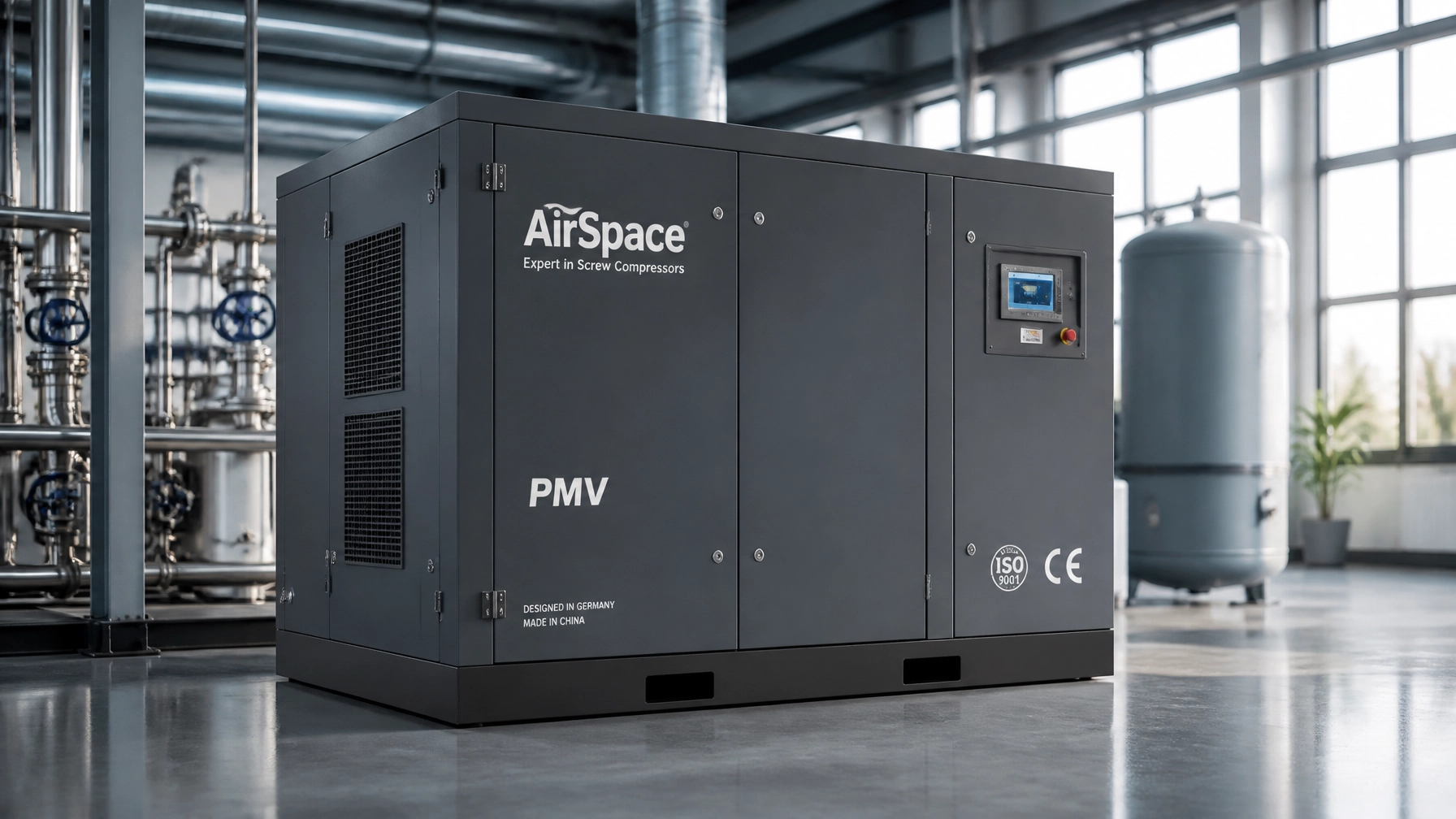
Industrial textile mills in high-humidity regions like Bursa, Turkey, are often victims of a silent financial drain. In this case study, a 24/7 weaving operation recovered $31,500 per year by addressing two primary “taxes” on their production: the Unload Tax of fixed-speed legacy compressors and the Humidity Tax caused by PTA powder corrosion. By replacing three aging, oil-injected units with two AirSpace PMV 75kW systems, the facility achieved a 189,000 kWh annual reduction and a 16-month ROI.
The Answer: How the Textile Industry Plugs the Energy Leak
Modern textile production, specifically air-jet loom operation, requires massive, consistent air volumes at precise pressures (typically 6-7 bar). Traditional legacy compressors waste up to 35% of their energy during “unload” cycles: running without producing air while still consuming significant power. By switching to Permanent Magnet Variable Frequency (PMV) technology, mills can match air production exactly to loom demand, eliminating the “Unload Tax” entirely. Furthermore, integrating 304 stainless steel (304SS) internal piping and high-ambient 55°C cooling systems protects the equipment from the corrosive effects of PTA powder ingress and high-humidity mill environments, slashing maintenance intervals.
10 Specific Headaches Facing Textile Procurement Managers
- Excessive Energy Bills: High-capacity air-jet looms consume vast amounts of air, often making compressed air the single largest utility cost in the mill.
- Frequent Airend Failures: Ingress of Purified Terephthalic Acid (PTA) powder combined with high humidity creates a mildly acidic slurry that eats through standard carbon steel components.
- Pressure Fluctuations: Legacy fixed-speed units cause pressure drops during loom startups, leading to weft insertion errors and fabric defects.
- High Maintenance Overheads: Changing oil and filters every 2,000 hours in a 24/7 environment leads to constant downtime and labor costs.
- Heat Sensitivity: Many compressors shut down during the peak Turkish summer when ambient temperatures inside the mill rise above 40°C.
- Oil Contamination: Even slight oil carryover can stain delicate fabrics, leading to entire batches of textiles being scrapped.
- Noise Pollution: Older units create a high-decibel environment that affects worker safety and violates local regulations.
- Unpredictable Spare Part Lead Times: Reliance on proprietary-focused manufacturers often results in weeks of downtime while waiting for specific components.
- Complex CE/ISO Compliance: Verifying that imported equipment meets strict European and international quality standards for export-grade textiles.
- The “Altitude Tax” and Climate Impact: Performance degradation in high-altitude or high-humidity regions that hasn’t been factored into the original equipment sizing.
The Industrial Tax Series: Understanding the Hidden Costs in Bursa
At AirSpace Machinery, we identify the specific environmental and operational factors that drain your profits as “Industrial Taxes.” For this Turkish mill, two taxes were particularly high:
The Unload Tax (Fixed-Speed Waste)
Before the upgrade, the mill operated three legacy oil-injected units. Because these units could only run at 100% or 0% (unload), they spent nearly 30% of their run-time in “unload” mode. In this state, they still consumed approximately 35% of their full-load power while producing zero air. This is the “Unload Tax.” AirSpace PMV technology eliminates this by adjusting the motor speed in real-time, delivering the exact CFM needed and ensuring the energy delta between production and consumption stays at zero.
The Humidity Tax (The PTA Corrosion Factor)
In Bursa’s textile district, the combination of high humidity and ambient PTA powder acts as a corrosive catalyst. Standard internal piping in budget-grade compressors began to pit and leak within 24 months. By upgrading to AirSpace units with 304SS piping and a reinforced cooling system capable of handling 55°C ambient temperatures, the mill effectively “untaxed” its maintenance budget, extending the life of the airend and reducing filter replacement frequency by 37%.
Quantifying the Transformation: Before vs. After
The following table outlines the hard stats verified by the mill’s engineering team after 12 months of continuous operation.
Energy Performance Metrics
| Metric | Before (3x Legacy Units) | After (2x AirSpace PMV75) | Impact |
|---|---|---|---|
| Annual Energy Consumption | 720,000 kWh | 531,000 kWh | 🟢 189,000 kWh Saved |
| Annual Energy Cost ($0.167/kWh) | $120,240 | $88,677 | 🟢 $31,563 Savings |
| Maintenance Events (Annual) | 12 | 4 | 🟢 67% Frequency Drop |
| Maintenance Cost Reduction | Baseline | -37% | 🟢 Significant Savings |
| System Pressure Stability | ±0.5 bar | ±0.1 bar | 🟢 Improved Fabric Quality |
Engineering Freedom: The Technical Hooks of AirSpace Machinery
Johnny Wayne, Managing Director of AirSpace Machinery, often refers to compressed air as “The Fourth Utility.” Just like electricity, water, and gas, air must be reliable, clean, and efficient.
“Textile mills don’t just need air; they need ‘Fourth Utility’ reliability,” says Wayne. “When an air-jet loom stops because of a pressure drop, that’s not just a compressor problem: it’s a production failure. Our PMV technology provides ‘Engineering Freedom’ by ensuring that ±0.1 bar pressure stability is a constant, not a variable.”
Every AirSpace PMV system is built to ISO 8573-1 standards, ensuring that air purity is maintained even in harsh industrial settings. For this Turkish mill, we implemented our “Extreme Climate” rugged aesthetic: a dark gray matte look that isn’t just for show. The enclosure is designed for superior airflow, mitigating the “Heat Tax” that often plagues Mediterranean industrial zones.
ROI Breakdown: The 16-Month Payback
For the procurement board, the decision came down to the numbers. The total investment for the two AirSpace PMV75 systems, including international logistics and installation support, was approximately $42,000.
- Annual Energy Savings: $31,500
- Maintenance Labor & Parts Savings: $4,200
- Total Annual Benefit: $35,700
- Payback Period: $42,000 / $35,700 = 1.17 years (approx. 14-16 months)
Beyond the 16-month mark, every dollar saved is pure profit added back to the mill’s bottom line. This is the power of a high-performance china made screw air compressor designed specifically for the rigors of textile manufacturing.
Advanced Cooling and 304SS: Why It Matters
Standard compressors often use copper or standard steel for internal lines. In a textile mill, moisture is the enemy. The AirSpace PMV75 units installed in Bursa featured:
— 304 Stainless Steel (304SS) Piping: Eliminates internal rust and prevents PTA-slurry corrosion from entering the air stream.
— 55°C Ambient Cooling: Oversized aluminum heat exchangers and high-static pressure fans ensure the unit remains cool even when the factory floor is sweltering.
— PMV Motor Efficiency: Rated for IE4 efficiency levels, our permanent magnet motors maintain high torque at low speeds, perfect for fluctuating loom demands.
For more technical details on how our systems handle extreme pressures, view our guide on 16-bar fiber laser compressors.
Conclusion: Moving Toward ISO 9001 Excellence
The success in Bursa proves that energy efficiency and reliability are not mutually exclusive. By choosing a partner that understands the “Industrial Tax” landscape, textile manufacturers can transform their compressed air system from a cost center into a competitive advantage.
Are you ready to plug the energy robbery in your facility? AirSpace Machinery provides comprehensive export and logistics support, ensuring our energy-efficient industrial air compression systems arrive on-site with full CE and ISO 9001 documentation.
Get a Proposal
Contact our engineering team today for a custom evaluation of your facility’s energy delta.
FAQ: Compressed Air in Textile Manufacturing
How do I verify CE and ISO documentation for a China made screw air compressor?
AirSpace Machinery provides original, verifiable CE and ISO 9001:2015 certificates with every shipment. These documents are issued by internationally recognized accreditation bodies and can be cross-checked using the certificate’s unique serial number on the respective registry websites.
What is the typical lead time for a 75kW PMV system to Turkey?
Lead times are neutral and depend on the specific configuration (such as 304SS piping or high-ambient cooling packages). Generally, standard units are ready for shipment within 3-4 weeks, with logistics to the Port of Ambarlı or Gemlik taking an additional 4-6 weeks depending on the shipping line.
Does the 35% energy delta apply to all systems?
The 35% Energy Delta is the typical efficiency gap between a legacy fixed-speed unit and an AirSpace PMV system. Actual savings depend on your specific load profile; mills with highly fluctuating demand see the highest returns, while those with very stable 24/7 peak demand still benefit from the IE4 motor efficiency and lack of unload cycles.
How does the PMV system handle high humidity in Bursa?
Our units are equipped with oversized refrigerated air dryers and multi-stage filtration to manage the “Humidity Tax.” The 304SS piping ensures that any condensation formed within the unit does not cause internal corrosion, protecting the airend’s 99.9% uptime record.
Can these compressors integrate with existing mill monitoring systems?
Yes. Every AirSpace PMV unit features an intelligent control cabinet with RS485/Modbus connectivity. This allows factory managers to monitor kWh consumption, pressure, and temperature in real-time from their central control room or via a mobile dashboard.
Author: Penny Winston
Technical Writer & Specialist in The 35% Energy Delta, The Fourth Utility Concept, and ISO 8573-1 Class 0 Integrity. Penny has spent over a decade documenting the intersection of engineering excellence and industrial efficiency for global manufacturing leaders.
Reviewed by Engineering
LinkedIn: Connect with AirSpace Machinery
📅 Last updated:
⚡ Is Your Factory Bleeding Cash?
Most fixed-speed compressors waste $3,600/year in "Unload Tax." Test your waste level in 30 seconds.
RUN THE ROI TEST →Ready to See How Much Your Facility Can Save?
Fill out the form below for a Free Energy Assessment.