Short answer: The following project options should be stated clearly in the quotation: 35% Energy Delta target, with assumptions listed. 50°C high-ambient rating where the selected package is configured for it.
Written by Penny Winston, Blog Writer, AirSpace Machinery Co., Ltd. — a 4,000 m² compressor manufacturing facility in Shanghai, ISO 9001:2015 certified and CE marked.
Reviewed by Richard Moore, Field Technical Manager.
Bilingual structure note: English is the primary publication language. The same section order can be used for a secondary-language landing page, while pressure, flow, purity, and dew-point values must remain subject to engineering approval.
SEO Title: Integrated Nitrogen Gas Station for Fiber Laser Cutting | 16 Bar Engineering Guide
Meta Description: Design a nitrogen generator for laser cutting with a china made screw air compressor, filtration, storage, and project-verified pressure and purity.
URL Slug Proposal: integrated-nitrogen-gas-station-fiber-laser-cutting-china-made-screw-air-compressor
Focus Keyword: compressor
Conclusion First: An integrated nitrogen gas station can reduce dependence on bottled gas or liquid nitrogen deliveries, but only when the compressor, air treatment, nitrogen module, storage, and control system are sized as one process. A 16-bar laser air system and 25–30 bar high-pressure variant are available according to project requirements. Final nitrogen purity, flow, dew point, and pressure must be confirmed against the laser manufacturer’s specification and verified by AirSpace engineers through an RFQ.
For fiber laser cutting shops, thick-plate stainless and aluminum processors, metal fabrication OEMs, and integration partners, the correct question is not simply “Which nitrogen generator should we buy?” The better question is: “What complete gas station will deliver the required gas quality at the lowest dependable cost?”
BUYER HEADACHES THIS GUIDE ADDRESSES
- Bottled nitrogen deliveries interrupt production planning.
- Liquid nitrogen pricing changes with logistics and regional supply.
- The laser requires more pressure than a standard compressed-air package can provide.
- Gas purity is discussed without a clear measurement or acceptance method.
- Flow demand changes when cutting thickness and material change.
- A compressor is selected before the nitrogen module is sized.
- Wet or contaminated feed air shortens filtration and generator service life.
- Thick-plate cutting creates short-duration peak demand.
- The quotation does not state receiver capacity or control logic.
- The buyer cannot compare operating cost with the current Gas Tax.
WHAT IS AN INTEGRATED NITROGEN GAS STATION?
Answer: It is a coordinated package that produces, treats, stores, and controls compressed air and nitrogen for a defined cutting process.
A typical station contains:
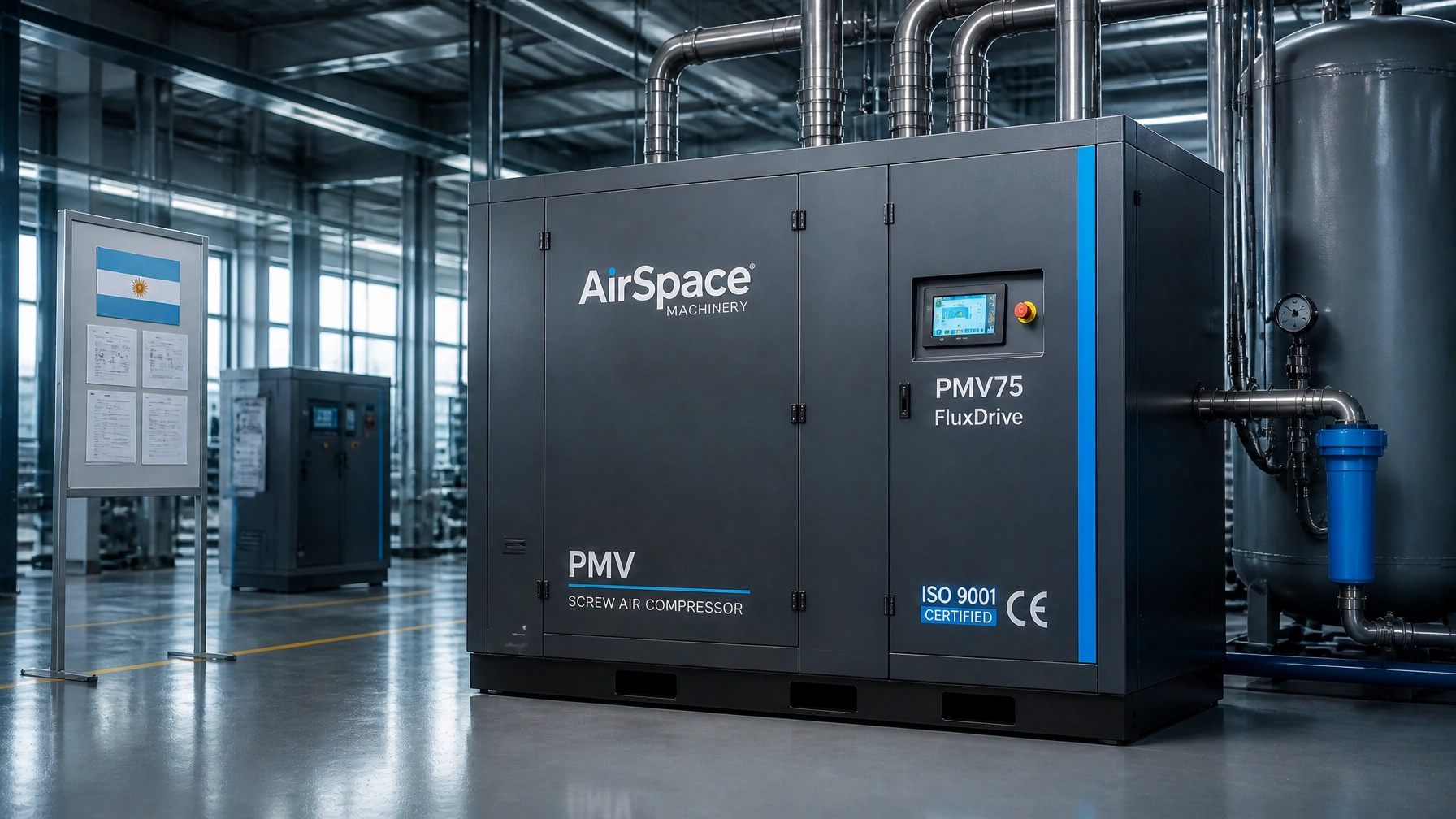
- PMV/VSD rotary screw compressor
- Air treatment and multi-stage precision filtration
- Air receiver tank
- PSA or membrane nitrogen generation module configured to project requirements
- Nitrogen buffer tank and outlet control
- Pressure, flow, dew-point, and purity monitoring as required
- PLC-based coordination and safety interlocks
This architecture is different from purchasing a standalone nitrogen generator and attempting to connect it to an undersized workshop compressor. The air side must provide suitable pressure, flow, dryness, and cleanliness. The nitrogen side must then match the laser’s actual assist-gas demand.
For related system architecture, review AirSpace Machinery’s Nitrogen Generation solution and all-in-one skid air compressor units.
SYSTEM ARCHITECTURE: FROM COMPRESSED AIR TO LASER GAS
Answer: The equipment should be designed as a process chain, with each stage protecting the next one.
- PMV/VSD rotary screw compressor
The compressor supplies compressed air to the treatment train and nitrogen module. PMV/VSD control adjusts motor speed to changing demand instead of relying only on repeated load and unload cycles.
The 35% Energy Delta is an engineering target or project result used when comparing PMV systems with legacy fixed-speed units under suitable variable-demand conditions. Actual savings depend on operating hours, pressure setpoint, leakage, load profile, electricity price, and baseline equipment condition.
AirSpace Machinery supplies industrial compression systems across multiple pressure and power ranges, supported by CE and ISO 9001 quality systems and annual sales of approximately 100 million yuan.
- Air treatment and multi-stage filtration
Feed air quality is central to nitrogen generator reliability. The treatment train may include:
- Refrigerated or desiccant drying according to the required pressure dew point
- Water separation and automatic condensate drainage
- Coalescing filtration
- Fine particulate filtration
- Activated-carbon filtration where the project specification requires additional oil-vapor control
The selected air-quality class should be documented against ISO 8573-1. ISO 8573-1 classification covers particles, water, and oil; it does not by itself target a particular nitrogen purity at the laser outlet.
See the refrigerated compressed air dryer series when reviewing dryer capacity and dew-point requirements.

- Air receiver tank
The receiver separates compressor cycling from process demand. It helps stabilize the air supply, absorb short demand peaks, and provide usable storage during control transitions.
The correct receiver capacity depends on compressor flow, nitrogen-generation technology, laser duty cycle, pressure band, and the desired reserve time. It should never be selected only by compressor horsepower.
- PSA or membrane nitrogen generation module
The nitrogen module is configured to project requirements. PSA and membrane systems have different relationships between feed-air pressure, recovery, purity, flow, and energy consumption.
PSA may be selected where the laser process requires a higher specified nitrogen purity. Membrane generation may be considered where the laser OEM accepts the available purity range and the project values a simpler or more compact arrangement. Neither technology should be assigned a fixed purity or flow target before reviewing the laser process data.
- Nitrogen buffer tank and outlet control
A nitrogen buffer tank can smooth generator output and help accommodate short-duration cutting peaks. Outlet control then manages delivery pressure and protects the laser from unsuitable pressure variation.
A 16-bar laser air system is available per project configuration. High-pressure or high-power variants in the 25–30 bar range are also available when the cutting head, material thickness, flow profile, booster arrangement, and storage design require them.
16 BAR LASER AIR SYSTEMS: THE IMPORTANT COMPRESSOR CLARIFICATION
Answer: A standard oil-free compressor should not automatically be assumed to deliver 16 bar.
True oil-free compressor packages and oil-injected screw compressor packages with multi-stage filtration are different engineering choices:
- True oil-free configuration: the compression chamber is designed to avoid oil injection into the compression process. The selected model, pressure range, certification scope, and downstream treatment still require verification.
- Oil-injected screw configuration with filtration: the compressor uses oil within the compression package, while downstream separation and multi-stage filtration are designed to meet the feed-air specification accepted by the nitrogen module.
- 16-bar requirement: this may require a compressor rated for that pressure, a dedicated pressure stage, or a nitrogen-side booster, depending on the architecture.
- ISO 8573-1 Class 0: this designation should never be inferred from the words “oil-free.” Buyers should request the relevant certificate, test scope, and operating conditions.
The practical decision is to match the air-quality strategy to the laser OEM’s nitrogen specification. It is not to make a blanket claim that one compressor category fits every laser.

CONFIGURATION DATA REQUIRED FOR ENGINEERING SIZING
Answer: AirSpace engineers need the laser process data before confirming equipment selection.
| Input | Required project information |
|---|---|
| Laser power | kW rating and number of laser cutting machines |
| Material | Carbon steel, stainless steel, aluminum, or mixed production |
| Thickness | Minimum, average, and maximum cutting thickness |
| Assist gas | Nitrogen requirement and whether air or oxygen is also used |
| Working pressure | Required bar or psi at the laser inlet |
| FAD or gas flow | Required m³/min, Nm³/h, or CFM; average and peak if available |
| Nitrogen purity | Required percentage or laser OEM specification |
| Dew point | Required pressure dew point at the relevant measurement point |
| Operating hours | Hours per day, shifts, and expected annual hours |
| Ambient temperature | Normal and maximum site temperature |
| Receiver capacity | Existing storage volume or preferred reserve requirement |
Final sizing and equipment selection must be verified by AirSpace engineers through an RFQ. Do not treat example values from a general brochure as a targeted system output.
APPLICATIONS FOR THE INTEGRATED STATION
Answer: The system is intended for metal-cutting processes where controlled assist gas is more practical than repeated cylinder or bulk-gas deliveries.
Typical applications include:
- Carbon steel fiber laser cutting
- Stainless steel and aluminum processing
- Thick-plate continuous cutting
- Laser head purge and assist gas
- Metal-processing workshops
- Fabrication OEM production lines
- Integrated machine-builder projects
- Multi-laser facilities with changing demand
The main commercial benefit is reduced dependence on external gas logistics. That can reduce the Gas Tax created by cylinder handling, delivery schedules, rental charges, storage requirements, and price volatility. The result depends on local gas pricing, utilization, purity requirements, and the final system design.
PMV CONTROL, EXTREME CLIMATE, AND MAINTENANCE
Answer: Demand-matching control is most valuable when laser gas demand changes during the production day.
The PMV/VSD compressor can adjust output to the air demand created by the nitrogen module and cutting schedule. This may reduce unload losses compared with a fixed-speed arrangement, especially where demand is variable.
The following project options should be stated clearly in the quotation:
- 35% Energy Delta target, with assumptions listed
- 50°C high-ambient rating where the selected package is configured for it
- Modular maintenance access
- Factory-direct delivery target of 7–35 days, subject to configuration
- CE documentation and ISO 9001 quality documentation
- Export packing and technical-document support
- Spare-parts and service recommendations for the destination market
COMPARISON: BOTTLED GAS, LIQUID NITROGEN, AND ON-SITE GENERATION
| Decision factor | Bottled or delivered gas | Integrated nitrogen gas station |
|---|---|---|
| Supply model | External deliveries | On-site production |
| Gas Tax exposure | Delivery and logistics volatility | Primarily electricity, maintenance, and capital cost |
| Peak demand | Depends on stored inventory | Managed through air and nitrogen receivers |
| Purity control | Supplier certificate and delivery batch | Project-defined generator and monitoring strategy |
| Expansion | Add more deliveries or storage | Add capacity through modular engineering |
| Buyer responsibility | Manage stock and delivery timing | Manage compressor, treatment, generator, and controls |
FAQ: PROCUREMENT QUESTIONS ANSWERED
Question: Can the system supply 16 bar for fiber laser cutting?
Answer: Yes, 16-bar laser air systems are available according to project configuration. A 25–30 bar high-pressure variant can also be engineered for suitable high-power or thick-plate applications. The final pressure path may include a rated compressor, booster, storage, or a combination of these.
Question: Can an oil-free compressor provide 16 bar?
Answer: Standard oil-free configurations should not be assumed to reach 16 bar. The selected oil-free package must be checked against its rated pressure. If the pressure requirement is outside the standard configuration, the project may require another pressure architecture or a booster.
Question: What nitrogen purity and flow can you target?
Answer: No fixed purity or flow should be targeted without engineering sign-off. The final values depend on the laser OEM requirement, material, thickness, assist-gas pressure, cutting cycle, feed-air quality, and storage arrangement.
Question: How do I verify CE and ISO 9001 documentation?
Answer: Request the current CE Declaration of Conformity and the supporting technical documentation for the supplied configuration. For ISO 9001, request the current certificate, scope, validity, and issuing-body information. Confirm that the documents match the manufacturing entity and equipment category.
Question: What information should be included in my RFQ?
Answer: Include laser power, material and thickness, required pressure in bar or psi, air demand in m³/min or CFM, nitrogen purity and flow if known, dew point, operating hours, ambient temperature, receiver capacity, destination country, and electrical supply.
Question: How does AirSpace support export projects?
Answer: Export support can include technical file preparation, CE documentation, ISO 9001 documentation, export packing, configuration review, shipping coordination, and spare-parts planning. Lead time depends on configuration and should be confirmed after the RFQ is reviewed.
INTERNAL LINKS AND TECHNICAL REFERENCES
Recommended internal links:
- 16-bar air compressor versus nitrogen for laser cutting
- AirSpace Machinery Solutions
- Industrial air compressor ROI calculator
- AirSpace Knowledge Base
- Refrigerated compressed air dryers
Standards and verification references:
- ISO 8573-1: Compressed air contaminants and purity classes for particles, water, and oil.
- ISO 9001: Quality management system requirements.
- CE marking: Verify the Declaration of Conformity and technical documentation for the supplied machine and applicable European requirements.
- Nitrogen purity, pressure, flow, and dew point: Confirm against the fiber laser manufacturer’s process specification and the final AirSpace engineering proposal.
REQUEST A NITROGEN + COMPRESSED AIR SYSTEM DESIGN
Send an RFQ for a project-matched design and proposal.
Required form fields:
- Name
- Company
- Laser Power
- Material and Thickness
- Air Demand and Working Pressure: bar/psi and m³/min or CFM
- Nitrogen Purity and Flow, if known
- Operating Hours
- Inquiry Type: New project, factory replacement, or distributor partnership
Get a Proposal for a complete PMV/VSD compressor, air treatment, storage, nitrogen generation, and control-system configuration. If you need air consumption calculation, energy-saving scheme and factory quotation, please send us an inquiry.
Key takeaways
- High-pressure or high-power variants in the 25–30 bar range are also available when the cutting head, material thickness, flow profile, booster arrangement, and storage design require them. 16 BAR LASER AIR SYSTEMS: THE IMPORTANT COMPRESSOR CLARIFICATION.
- A 25–30 bar high-pressure variant can also be engineered for suitable high-power or thick-plate applications.
- A standard oil-free compressor should not automatically be assumed to deliver 16 bar.
- Standard oil-free configurations should not be assumed to reach 16 bar.
- A 16-bar laser air system and 25–30 bar high-pressure variant are available according to project requirements.
⚡ Is Your Factory Bleeding Cash?
Most fixed-speed compressors waste $3,600/year in "Unload Tax." Test your waste level in 30 seconds.
RUN THE ROI TEST →Ready to See How Much Your Facility Can Save?
Fill out the form below for a Free Energy Assessment.