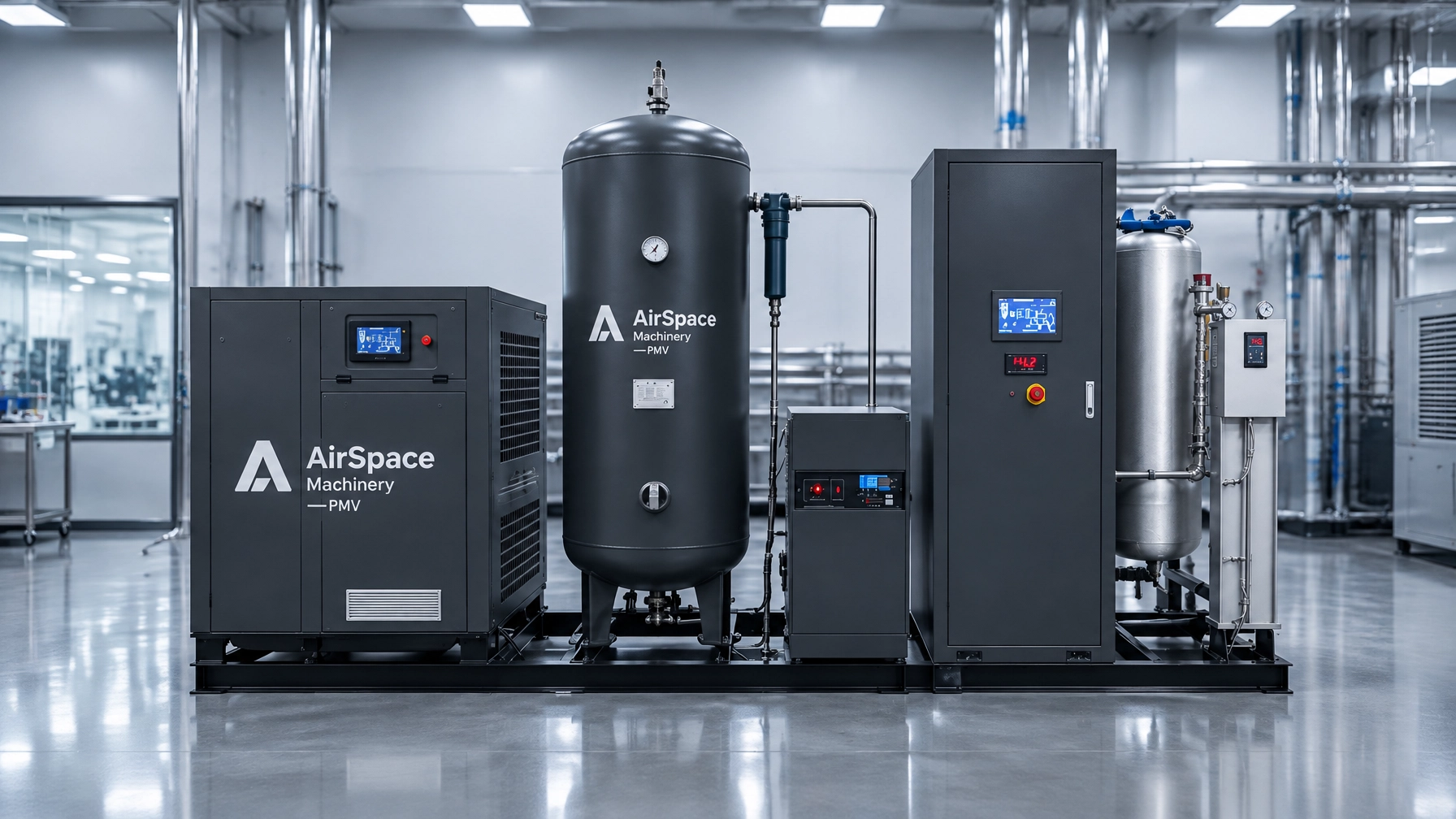
Before wiring a deposit for an oil-free screw compressor, demand six documents: an independent performance test report, an exact-model ISO 8573-1 Class 0 purity report, a leakage-rate verification, a signed declaration of conformity, factory test records with a witnessed protocol, and serial-number traceability with calibration certificates. Verify every document at its issuing source, not by its logo.
Is IEC 63349-2:2026 a real compressor standard?
We could not verify that claim in the official IEC catalogue: the record for IEC TS 63349-2:2022 describes photovoltaic appliance controllers, not oil-free rotary compressors. Before treating any claimed IEC 63349-2:2026 requirement as effective, ask the supplier for the official publication and confirm it directly with IEC.
This matters before a deposit: procurement decisions should rest on verifiable requirements, not a standard number repeated in sales material. The IEC catalogue entry reviewed for this article, IEC TS 63349-2:2022, identifies a specification for photovoltaic direct-driven appliance controllers. If a supplier says the product conforms to IEC 63349-2:2026, ask for the official IEC publication number and document title, then verify the scope yourself. Do not accept an unsupported claim or a document that simply repeats the number as evidence.
What are the six documents to demand from an oil-free compressor supplier?
Ask for six documents: an independent performance report, an exact-model air-purity report if Class 0 is specified, leakage verification, a signed declaration of conformity, factory acceptance records, and traceable serial-number and calibration documentation. These are buyer-side checks; they are not proof that IEC 63349-2:2026 applies.
- Third-party energy and performance test report
- ISO 8573-1 Class 0 purity test report for the exact model
- Leakage-rate verification report
- Signed declaration of conformity
- Factory test records and witnessed performance-test protocol
- Serial-number traceability and calibration certificates
What performance test report should you demand?
Ask for a report from a laboratory whose current accreditation scope covers the test methods used, identifying the tested model, test conditions, pressure, flow, electrical input, measurement uncertainty and results. For flow and power testing, ask whether it follows ISO 1217:2009 and Amendment 1:2016 or another clearly identified applicable method.
If a supplier presents IEER or COP, ask how the metric is defined and whether that method applies to the compressor package. For practical comparisons, request measured free air delivery (FAD) and specific power under stated conditions. A generic efficiency chart without test boundaries or a model identifier is weak evidence.
Ask: “Can you provide the full laboratory report and explain how its test conditions match our required pressure and flow?”
Does the ISO 8573-1 Class 0 report cover your exact model?
If your specification requires Class 0, request a report for the exact compressor model and configuration offered — not a related model, a component, or a general product family. ISO 8573-1 classifies purity by particles, water and total oil, and Class 0 limits are agreed between user and supplier, so define yours in writing.
The report should identify the relevant contaminant category, sampling point, test method, operating conditions and laboratory, per ISO 8573-1:2010. Class 0 is not a universal “zero contamination” label: its limits must be more stringent than Class 1 for the specified contaminant. A bare “Class 0” statement, with no defined class, test scope or supporting report, is not enough.
Ask: “Does this report cover the complete offered package and the purity class we have specified at the stated measurement point?”
How should a leakage-rate verification report look?
Request a documented leakage test for the assembled unit showing the method, acceptance limit, test pressure, measured result and date, and confirm whether the check covers the compressor package or only selected joints. A checklist marked “passed” without readings, test boundaries or a named unit is a weak version.
Ask: “What was tested, how was leakage measured, and what numerical acceptance limit did you apply?”
What makes a declaration of conformity acceptable?
Ask for the manufacturer’s signed declaration identifying the legal manufacturer, exact model or product family, applicable legislation, standards used, issue date and authorised signatory, matching the equipment offered and the destination market. If conformity to IEC 63349-2:2026 is claimed, demand the official IEC publication number and verify its scope.
CE marking also needs careful reading: the European Commission describes it as the manufacturer’s declaration that applicable EU requirements have been met, not a general certificate issued by the EU (CE marking guidance). If a notified body is cited, check its notified scope in the Commission’s NANDO database. CE documentation does not replace the performance or purity evidence your specification requires.
Ask: “Which exact legal requirements apply to this unit, and where can we verify each cited standard or assessment?”
Will the factory test records match your duty point?
Request the factory test record for the supplied unit and agree in advance on any witnessed acceptance test, with the protocol stating the test sequence, instruments, conditions, pass/fail criteria and how deviations are recorded. Tie results to your purchase specification — required pressure, FAD and controls operation — not to a generic checklist.
A video or a generic factory checklist can be useful supporting material, but it is not a substitute for a signed record with measurable acceptance criteria.
Ask: “Will the factory test verify our specified duty point, and can our representative witness the test before dispatch?”
How is serial-number traceability documented?
Ask for the final serial number and a document trail linking that unit to its test records, configuration and shipment documents, plus current calibration certificates for each acceptance instrument showing identity, dates and traceability. Make the final, serial-specific test pack a contract deliverable before shipment.
Ask: “How will the final serial number be linked to this unit’s test reports and the calibration records for the instruments used?”
How do you check that the documents are genuine?
Start with the issuing source, not the logo: search the laboratory in its national accreditation body’s directory and confirm the accreditation is current and covers the relevant method and scope. Then compare report number, laboratory, model, test date and method, and verify named notified bodies in NANDO and ISO 9001 certificates in IAF CertSearch.
ILAC’s signatory directory can help identify recognized accreditation bodies; accreditation alone does not mean every test a laboratory performs is within its accredited scope. Contact the laboratory or accreditation body through contact details from its official website if a document looks altered or the scope is unclear. A quality-management certificate is not proof of a particular compressor’s performance or air purity.
The AirSpace Machinery solutions page can help frame a system requirement, while the downloads center provides product and technical materials to compare against supplier documents. For oil-free system options, see the water-lubricated screw compressor series. Treat catalog information as a starting point; confirm the exact offered model and configuration in the purchase documents.
What can go wrong if you skip the document checks?
A paperwork gap can leave you with a machine that does not satisfy a tender, import, plant-qualification or internal QA requirement, and a serial number that does not match its report makes it hard to prove the tested configuration is the installed one. Resolve gaps before payment milestones and write acceptance criteria into the contract.
If a warranty claim later depends on operating conditions or acceptance records, incomplete documentation can complicate the discussion. Think of the document pack as the compressor’s passport: it connects the machine you ordered to the measurements, configuration and obligations you agreed to. Export packing, shipping records and delivery timing should also be confirmed in writing; lead time depends on configuration.
For broader purchasing context, review the Unload Tax planning guide. Any 35% energy figure used in planning is a planning benchmark, not guaranteed; site load profile, operating hours, pressure settings, controls and electricity tariff affect actual results.
Questions buyers ask
Does IEC 63349-2:2026 apply to oil-free rotary compressors?
We could not verify that claim in the official IEC catalogue. The IEC entry for IEC TS 63349-2:2022 concerns photovoltaic appliance controllers. Ask the supplier for an official IEC publication record and verify its title and scope before treating the cited standard as applicable.
Does “oil-free” automatically mean ISO 8573-1 Class 0?
No. “Oil-free” describes compressor design or lubrication approach; a Class 0 requirement needs a defined specification and supporting test report for the exact offered model and relevant contaminant category.
What does an accredited laboratory report prove?
It documents test results within the stated scope, methods and conditions. Check the laboratory’s accreditation scope and verify that the report covers the offered model and required operating point.
Is a CE certificate enough to approve a compressor?
No single CE-marking document replaces your technical review. Check the manufacturer’s declaration, the applicable EU requirements and any notified-body involvement, then assess performance, purity and factory acceptance evidence separately.
What should I put in the purchase contract?
List the exact model and configuration, applicable requirements, required documents, acceptance criteria, serial-number traceability, and when records must be delivered. Specify any witnessed test and what happens if the unit does not meet the agreed criteria.
Sources and standards
- IEC, IEC TS 63349-2:2022: official catalogue record identifies photovoltaic direct-driven appliance controllers, not oil-free compressors.
- ISO 8573-1:2010: compressed-air contaminants and purity classes.
- ISO 1217:2009 and Amendment 1:2016: displacement-compressor acceptance tests.
- European Commission, CE marking guidance and notified bodies.
- ILAC Signatory Search and IAF CertSearch: accreditation and management-system certificate verification resources.
- SectorVantage has published trade-press claims about IEC 63349-2:2026 and compressors. Such coverage is not an IEC publication or conformity requirement; verify the underlying claim in the official IEC catalogue.
Author: Penny Winston, technical writer associated with The 35% Energy Delta, The Fourth Utility Concept and ISO 8573-1 Class 0 integrity. Reviewed by Engineering.
For a site-specific energy review, use the Free Compressed Air kWh Forecast & System Review form. Any savings figures are planning baselines only, not guarantees; Class 0 claims require reports for the specific model.
If you need air consumption calculation, energy-saving scheme and factory quotation, please send us an inquiry.
⚡ Is Your Factory Bleeding Cash?
Most fixed-speed compressors waste $3,600/year in "Unload Tax." Test your waste level in 30 seconds.
RUN THE ROI TEST →Ready to See How Much Your Facility Can Save?
Fill out the form below for a Free Energy Assessment.