Most factory managers believe that improving their industrial air compressor ROI requires a massive capital expenditure. They look at the energy bills, see the bleeding margins, and assume the only fix is a 50,000 USD check for a new machine.
What if you could recover 18,700 USD this year without spending a single cent on hardware?
The compressed air system is often called the Fourth Utility. Unlike electricity or water, you manufacture this utility on-site. If your manufacturing process is inefficient, you are effectively burning cash in the compressor room. Before you even consider a Permanent Magnet Variable Frequency upgrade, there is a hidden goldmine in your existing system design.
This guide reveals how to stop the bleeding through zero-cost engineering adjustments, followed by how a China made screw air compressor with PMV technology creates a second layer of exponential savings.
The 4 Zero-Cost System Design Hacks to Protect Your ROI
If you want to maximize your industrial air compressor ROI, you must look beyond the machine. System design is the foundation of the 35% Energy Delta. Here are four moves you can make today with zero capital investment.
1. The Ultrasonic Leak Strike
In an average unmanaged facility, 20% to 30% of all compressed air produced is lost to leaks. On a 75kW system, that is 22kW of power literally pushing air into empty space.
- The Hack: Conduct a weekend leak audit when the factory is silent. Use an ultrasonic detector or even simple soapy water on joints, valves, and hoses.
- The ROI: Reducing leakage from 30% to 10% on a 75kW system saves roughly 10,800 USD annually in electricity alone.
2. The 2-PSI Rule for Pressure Reduction
Many factories run their system at 125 PSI simply because that is the default setting. However, every 2 PSI reduction in discharge pressure saves approximately 1% in compressor energy.
- The Hack: Identify the tool in your shop that requires the highest pressure. Set your compressor to meet that need plus a small margin for piping loss, not a PSI more. If you drop from 110 PSI to 100 PSI, you just cut your energy bill by 5%.
- The ROI: This move costs 0 USD and provides immediate utility savings.
3. Piping Loop Optimization
Dead-end piping creates pressure drops that force the compressor to work harder.
- The Hack: If your piping allows, create a loop system. This ensures that air can reach any point of use from two directions, cutting pressure drop in half without buying a larger pipe.
- The ROI: Lower pressure drop at the tool means you can lower the pressure at the compressor, triggering the 2-PSI Rule mentioned above.
4. Strategic Storage Utilization
Small air receiver tanks cause compressors to cycle rapidly, leading to the Unload Tax, where the motor runs but produces no air.
- The Hack: Adjust your pressure band settings to maximize the storage capacity you already have. Use dedicated storage near high-demand tools to prevent the entire system pressure from crashing when that tool fires.
- The ROI: Fewer starts and stops reduce mechanical wear and unnecessary idle power consumption.
Why Most Factories Bleed 30% of Their Air Before It Reaches the Tool
The inefficiency in industrial air compressor ROI usually stems from a lack of system integrity. We call this the Fourth Utility Concept: you wouldn’t leave every light on in an empty building, yet many factories leave their air systems fully pressurized with dozens of open leaks.
Common culprits include:
- Corroded pipe fittings that hiss 24/7.
- Clogged filters that create a 5-10 PSI pressure drop, forcing the compressor to over-perform.
- Inappropriate use of air, such as using high-pressure air for cleaning dust off floors.
By fixing these invisible drains, you stabilize the system. A stable system is the only way to achieve ISO 8573-1 Class 0 Integrity if you are using oil-free solutions. Without proper design, even the best machine will fail to deliver its promised efficiency.
The 7-Factor ROI Formula for Industrial Systems
To calculate the true payback of any adjustment or upgrade, we use the 7-Factor Formula. This is the same logic found in our Industrial Air Compressor ROI Calculator.
- Annual Operating Hours: (e.g., 6,000 hours for 3-shift operations).
- Average Power Rate: (e.g., 0.12 USD per kWh).
- Fully Loaded Power: The kW consumed when making air.
- Unloaded Power: The kW wasted when the motor is spinning but the inlet valve is closed.
- Load/Unload Ratio: How much time the machine spends being productive versus idling.
- System Leakage Rate: Usually 20-30% in unoptimized plants.
- Maintenance Cost: The annual budget for filters, oil, and service.
When you plug these into the formula, the math is undeniable. A standard fixed-speed unit often carries an Unload Tax of 25% or more. Upgrading to a China made screw air compressor with PMV technology eliminates this tax entirely by matching motor speed to actual demand.

When System Design Isn’t Enough: The PMV Upgrade Case
Once you have optimized your piping and fixed your leaks, you hit a ceiling. Fixed-speed compressors are fundamentally limited; they are either 100% on or 100% off.
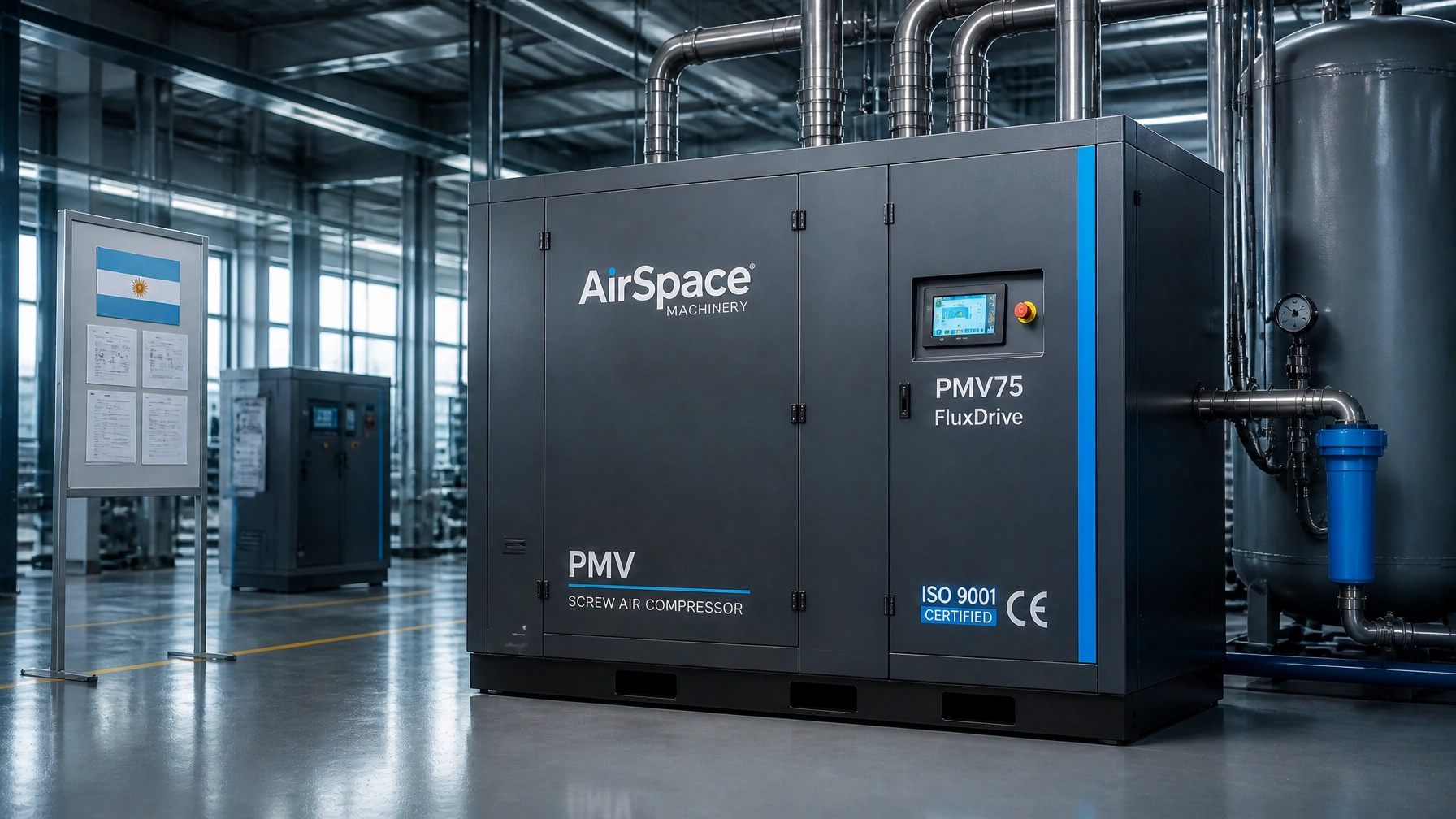
This is where the AirSpace 35% Energy Delta comes into play. Our Permanent Magnet Variable Frequency (PMV) systems use high-efficiency motors that can slow down to 15% of their rated speed without losing torque.
If your demand fluctuates, which it does in 95% of industrial applications, the PMV system stops the cycle of loading and unloading. While a legacy brand might keep a 75kW motor spinning at 30kW just to “wait” for the next demand spike, an AirSpace PMV unit drops to 5kW or shuts down entirely, restarting instantly when needed.
Real-World Simulation: 75kW System Performance
Let’s look at a typical metal processing facility running a 75kW (100HP) system for 6,000 hours a year at 0.12 USD/kWh.
- Baseline Energy Cost (Legacy Fixed Speed): 54,000 USD / Year.
- The $0 Design Fix (Leaks + Pressure): Saves 15% = 8,100 USD recovered.
- The PMV Upgrade: Saves an additional 25% through variable speed = 13,500 USD recovered.
- Total Savings Potential: 21,600 USD / Year.
By combining system design with a high-performance AirSpace PMV unit, the machine often pays for itself in less than 14 months.
Comparison Table: System Design vs. PMV Upgrade
| Factor | System Design Only (The $0 Move) | PMV Machine Upgrade | Integrated Strategy (Both) |
|---|---|---|---|
| Initial Capital Outlay | 0 USD | 15,000 – 45,000 USD | 15,000 – 45,000 USD |
| Annual Energy Savings | 10% – 15% | 20% – 35% | 35% – 50% |
| Impact on Leaks | Reduces waste from leaks | None (unless pressure drops) | Maximum Waste Elimination |
| Equipment Longevity | High (less strain) | Very High (soft starts) | Maximum Life Cycle |
| Typical ROI Payback | Immediate | 12 – 24 Months | 8 – 18 Months |
FAQ: Industrial Air Compressor ROI
How to calculate ROI of an air compressor?
Start by identifying your annual electricity spend for the compressor room. Subtract the estimated Unload Tax (the power used when the compressor is idling) and the Leakage Rate (the power used to feed holes in the pipes). The difference between your current spend and a PMV-regulated spend is your primary ROI.
What is a good payback period for an air compressor?
In the current energy climate, a payback period of 12 to 18 months is considered excellent. Anything under 24 months is a strong financial green light for industrial facilities.
Can fixing leaks really save money?
Yes. A single 3mm leak at 100 PSI can cost over 1,000 USD per year in electricity. Most factories have dozens of these. Fixing them is the fastest way to improve your industrial air compressor ROI.
Is a China made screw air compressor reliable for 24/7 ops?
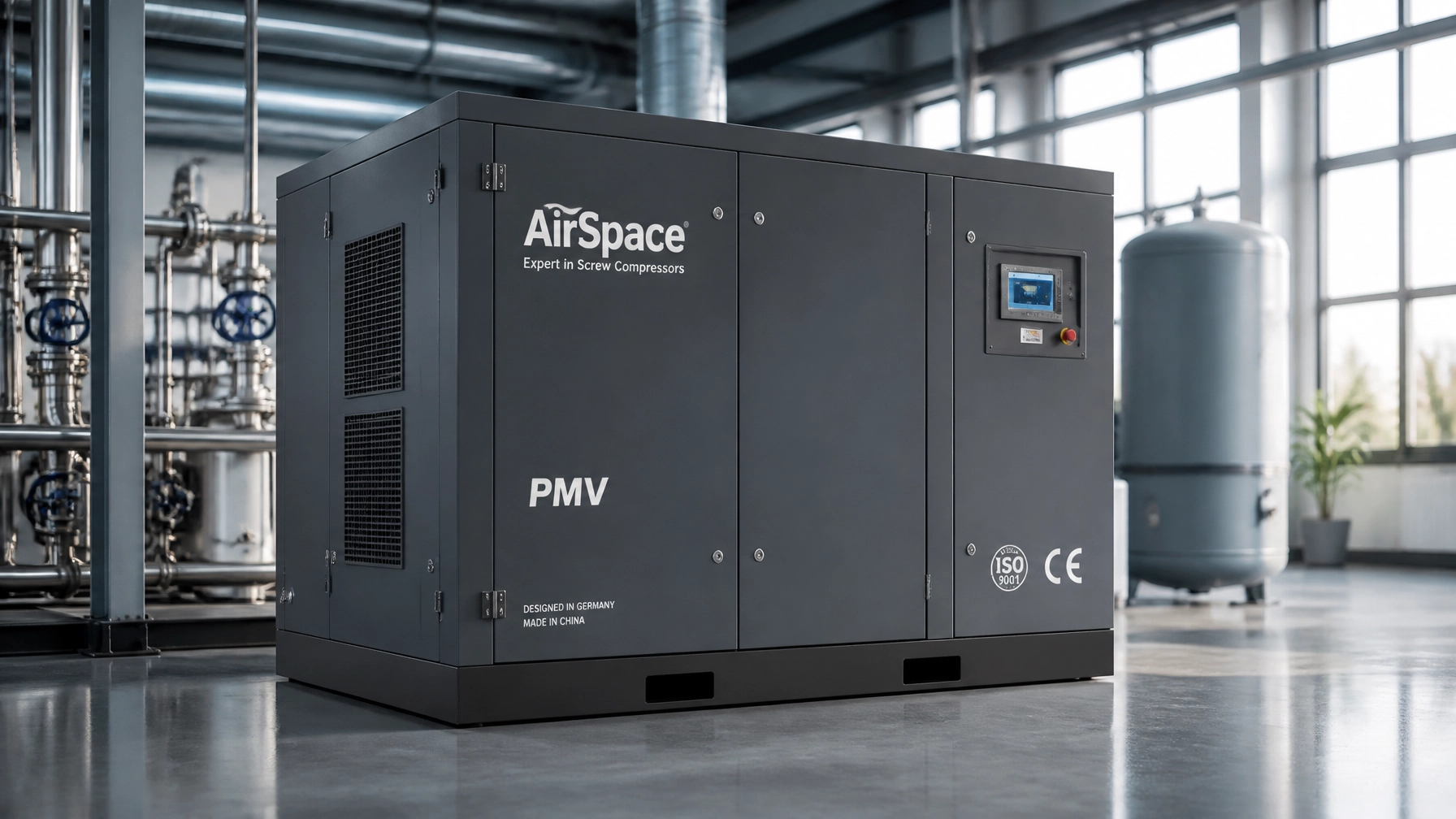
AirSpace Machinery follows CE and ISO 9001 standards, delivering 99.9% uptime. Our PMV units are specifically designed for the “Extreme Climate” aesthetic: rugged, reliable, and capable of handling 24/7 heavy industrial loads.
Get a Proposal for Your Facility
Stop guessing about your energy waste. Whether you need a low-pressure solution for textile work or an oil-free system for pharmaceutical grade air, we provide the engineering data to justify the investment.
WhatsApp: +86 139 1614 2664
Author Box
Penny Winston is a Technical Writer for AirSpace Machinery Co., Ltd. She specializes in the 35% Energy Delta and the Fourth Utility Concept, helping industrial leaders navigate ISO 8573-1 Class 0 Integrity and global export standards for high-performance compression systems.
Reviewed by Engineering
📅 Last updated:
⚡ Is Your Factory Bleeding Cash?
Most fixed-speed compressors waste $3,600/year in "Unload Tax." Test your waste level in 30 seconds.
RUN THE ROI TEST →Ready to See How Much Your Facility Can Save?
Fill out the form below for a Free Energy Assessment.