Finding oil in your compressed air lines is not just a maintenance nuisance; it is a signal of a systemic failure that threatens your product quality, equipment longevity, and bottom line. In high-precision industries like pharmaceuticals, electronics, and food processing, even a single drop of oil carryover can lead to catastrophic batch contamination.
While many facilities attempt to “fix” this issue with a daisy-chain of expensive filters, they are often just treating the symptom while the “Filter Robbery” bleeds their budget dry. The only permanent solution for guaranteed purity is the transition to a native oil-free screw compressor China Class 0 system.
The 10 Industrial Headaches of Oil Contamination
Before we dive into the technical mechanics, let’s identify the common pain points factory managers face when dealing with oil-injected systems:
- Constant fear of product contamination and total batch loss.
- Recurring $8,500+ annual costs for high-efficiency filter replacements.
- Persistent oil odors lingering on the factory floor.
- Significant pressure drops across clogged filter elements, forcing the compressor to work harder.
- Inconsistent air quality that fluctuates with ambient temperature and humidity.
- The “Unload Tax” , energy wasted by fixed-speed compressors during low-demand periods.
- Anxiety during ISO quality audits due to borderline air purity readings.
- Rapid degradation of downstream pneumatic tools and sensitive instruments.
- Unexpected production downtime caused by saturated separator elements.
- High environmental disposal fees for oily condensate and hazardous filter waste.
Summary: The Case for Native Oil-Free Integrity
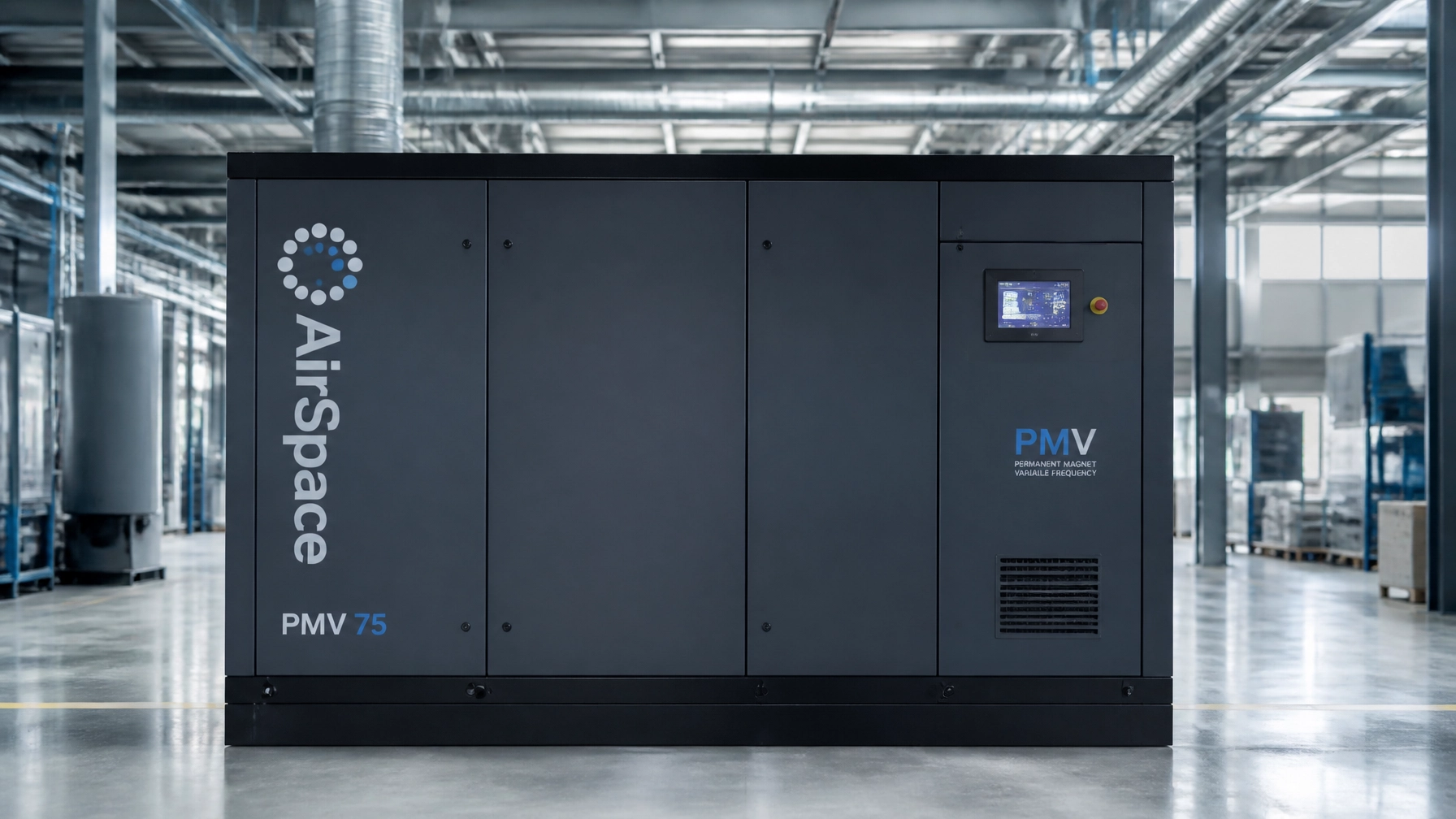
The most effective way to eliminate oil in your air lines is to never introduce it in the first place. Traditional oil-injected systems rely on a “defense-in-depth” filtration strategy that is prone to human error and mechanical bypass. By contrast, AirSpace Machinery’s native oil-free PMV technology removes the lubricant from the compression chamber entirely. This ensures “ISO 8573-1 Class 0 Integrity” from the source, delivering a 35% Energy Delta compared to legacy fixed-speed units and eliminating the hidden $8,500 annual filter tax.
Why is There Oil in My Air Lines?
The presence of oil in your distribution system usually stems from one of three primary failure modes in oil-injected compressors:
- Lubricant Carryover: Even the best oil-injected screw compressors have a natural “carryover” rate. As the oil-air separator element ages, its efficiency drops, allowing microscopic oil aerosols to bypass the primary tank and enter your piping.
- Element Breakthrough: High ambient humidity can lead to oil emulsification. When the lubricant mixes with excess water vapor, it can “blind” the separator, leading to a sudden breakthrough event where bulk oil is pushed directly into the air lines.
- Filter Bypass: Coalescing filters are designed to trap oil, but they have a finite service life. Once saturated, or if the internal bypass valve triggers due to high pressure, the trapped oil is released downstream in a single, concentrated pulse.
ISO 8573-1 Class 0 vs. Class 1: The Compliance Trap
To understand why your “clean” air might still be contaminated, we must look at the ISO 8573-1 standards. This is where many industrial buyers fall into the “Compliance Trap.”
Class 1 Air: Allows for up to 0.01 mg/m³ of total oil (liquid, aerosol, and vapor). While this sounds small, it is a cumulative contaminant. In a high-flow system running 24/7, even Class 1 air can deposit liters of oil into your piping over a year.
Class 0 Air: This is the most stringent category. It does not have a fixed numerical value but must be “stricter than Class 1” and “specified by the user or manufacturer.” For AirSpace Machinery, Class 0 means zero detectable oil introduced by the compressor.
Most “filter-based” systems claim they can reach Class 0. However, this is a “moment-in-time” measurement. As filters degrade from the moment they are installed, your air quality begins a slow slide back toward Class 1 or worse. Only a native oil-free screw compressor China Class 0 unit maintains this integrity every hour of every day, regardless of filter condition.

Why Filters Aren’t Enough: The $8,500 Annual Robbery
Many legacy brands will sell you an oil-injected compressor paired with a “hospital-grade” filter kit. While the initial purchase price might be lower, the long-term “Filter Robbery” is significant.
- Filter Service Life: High-efficiency coalescing and activated carbon filters must be changed every 6 to 12 months. In a 100HP system, a full set of high-purity filters can cost upwards of $4,000 per change.
- Energy Penalties: Every filter represents a “pressure tax.” A clean filter might cause a 2 psi drop, but a partially loaded one can easily hit 5-8 psi. To maintain 100 psi at the tool, you must run the compressor at 108 psi, which increases energy consumption by approximately 4% for the life of that filter.
- The Risk of Human Error: If a technician forgets a filter change or uses a lower-quality third-party element, the entire multi-million dollar production line is at risk.
The Fourth Utility Concept: Reliability as a Foundation
At AirSpace Machinery, we view compressed air as the “Fourth Utility” , just as vital as electricity, water, and gas. You wouldn’t accept oil in your drinking water, so why accept it in your air?
By utilizing Permanent Magnet Variable Frequency (PMV) technology in an oil-free configuration, we address the two biggest headaches in manufacturing: purity and power. Our systems deliver a 35% Energy Delta because the PMV motor only spins as fast as your demand requires. When demand drops, the motor slows down instantly, eliminating the “Unload Tax” and “Humidity Tax” associated with traditional cycles.

Cost Comparison: Filtered Oil-Injected vs. Native Oil-Free PMV
Let’s look at the hard stats for a typical 75kW (100HP) industrial installation over a 5-year period.
- Category: Oil-Injected + Filter Kit
- Annual Filter Replacements: $8,500 (2 changes/year)
- Energy Waste (Pressure Drop): $2,200/year
- Risk of Batch Contamination: High (Single point of failure)
- 5-Year Total Maintenance “Tax”: $53,500
- Category: AirSpace Oil-Free PMV
- Annual Filter Replacements: $0 (No oil filters needed)
- Energy Waste (Pressure Drop): $0 (Minimal inline filtration)
- Risk of Batch Contamination: Zero (No oil in the chamber)
- 5-Year Total Maintenance “Tax”: $0
The math is clear. While the upfront investment for an oil-free screw compressor China Class 0 system may be higher, the “Engineering Freedom” provided by eliminating the filter robbery pays for the unit itself within the first few years of operation.
The AirSpace Advantage: 20 Years of Engineering Excellence
With a 4,000m² state-of-the-art facility and 100 million yuan in annual sales, AirSpace Machinery Co., Ltd. has spent two decades refining the performance of industrial-grade compression. Our systems are built to follow CE and ISO 9001 quality standards, ensuring that when we claim “Class 0,” we have the engineering data to back it up.
Our PMV systems are designed for the most demanding environments, whether it is the extreme heat of the Middle East or the high humidity of Southeast Asia. We provide the “Extreme Climate” ruggedness that generic suppliers simply cannot match.

Frequently Asked Questions (FAQ)
Can I achieve Class 0 by just adding more filters to my current compressor?
Technically, you can achieve a “Class 0” reading on a brand-new set of filters under ideal conditions. However, it is not sustainable. The moment those filters begin to load with oil and dust, your air quality degrades. For “ISO 8573-1 Class 0 Integrity,” the only reliable method is to use a compressor that does not use oil in the compression chamber.
Is an oil-free compressor more expensive to maintain?
Actually, it is often cheaper. While the internal air-end requires specialized engineering, you completely eliminate the cost of oil, oil filters, and complex separator elements. When you factor in the energy savings from our 35% Energy Delta PMV technology, the total cost of ownership is significantly lower.
What is the lead time for a China made screw air compressor?
Lead times at AirSpace Machinery are neutral and depend entirely on your specific configuration (HP, pressure requirements, and additional drying equipment). We maintain a streamlined manufacturing process in our 4,000m² facility to ensure timely global delivery.
How does PMV technology help with oil carryover?
PMV technology itself doesn’t stop oil, but it prevents the “Heat Tax” and thermal cycling that often leads to moisture and oil emulsion issues in fixed-speed compressors. By maintaining a stable operating temperature and only running at the required load, the entire system stays cleaner and more efficient.
Get a Proposal
If you are tired of the “Filter Robbery” and want to secure your production with guaranteed Class 0 air, it is time to talk to the experts. Our engineering team will help you design a system that fits your specific needs, from 2HP to 180HP.
Please provide your requirements to receive a customized technical proposal:
- Pressure Required: (Specify bar or psi)
- Required Air Flow: (Specify m³/min or CFM)
Author: Penny Winston
Penny Winston is a Technical Writer at AirSpace Machinery, specializing in “The 35% Energy Delta” and “The Fourth Utility Concept.” With a focus on “ISO 8573-1 Class 0 Integrity,” she helps industrial leaders navigate the complexities of high-purity air systems to achieve long-term operational freedom.
Reviewed by Engineering
Internal Loop: Learn More
- Discover the hidden dangers of the Compliance Trap and how it affects your bottom line.
- Explore our full range of Oil-Free Screw Compressor Solutions.
- Read about the Humidity Tax and how it impacts air purity in tropical climates.