How do you optimize compressor air for textile manufacturing?
To achieve 24/7 reliability in textile mills, engineering teams must deploy Permanent Magnet Variable Frequency (PMV) screw compressors that handle fluctuating loom loads, implement specialized lint-filtration cooling geometries, and maintain air quality according to ISO 8573-1:2010 standards. Optimization focuses on bridging “The 35% Energy Delta” between legacy fixed-speed systems and modern PMV units while ensuring a 99.9% uptime rate for air-jet looms.
The Fourth Utility: Why Compressed Air Integrity Dictates Textile Margins
In the textile sector, compressed air is often referred to as “The Fourth Utility.” Unlike electricity or water, this utility is generated on-site, meaning the efficiency of the generation process directly impacts the cost per meter of fabric produced. Air-jet looms, the primary consumers in modern mills, require a constant, high-volume flow of air to propel the weft yarn across the shed. Any fluctuation in pressure results in “short picks” or warp breakages, leading to immediate production halts and fabric defects.
At AirSpace Machinery, we view the compressed air system as a continuous loop. If the compressor cannot keep up with the rapid-fire cycling of loom valves, the entire mill’s efficiency drops. Our engineering focus is on maintaining ISO 8573-1 Class 0 Integrity: ensuring that no oil aerosols or moisture reach the delicate pneumatic components of the looms.
How do you stabilize air pressure for air-jet looms?
Air-jet looms are characterized by high-frequency, high-flow air pulses. A standard fixed-speed compressor responds to these pulses by “unloading,” which wastes energy, or by struggling to “load” fast enough, causing a pressure drop.
The solution is the implementation of PMV (Permanent Magnet Variable Frequency) technology. By utilizing a BAOSI or Hanbell air end coupled with a high-response inverter, the compressor adjusts its motor speed in real-time to match the loom’s demand.
Key Engineering Metrics for Loom Air:
- Response Time: PMV systems can adjust motor frequency within milliseconds to prevent “pressure sag.”
- Flow Consistency: Stabilizing pressure within ±0.1 bar prevents mechanical wear on loom solenoids.
- The 35% Energy Delta: By eliminating the “unload” cycle, PMV systems reduce energy consumption by up to 35% compared to fixed-speed alternatives.
For a deeper dive into how these systems integrate into broader industrial setups, refer to our 2026 Industrial Air Compression Master Hub.
Why is lint the leading cause of compressor failure in textile mills?
The atmospheric environment of a spinning or weaving mill is saturated with micro-particulates: specifically cotton lint and synthetic fibers. In standard industrial compressors, these fibers bypass basic intake filters and lodge in the cooling fins of the oil cooler and aftercooler.
The Lint Problem Engineering Solution:
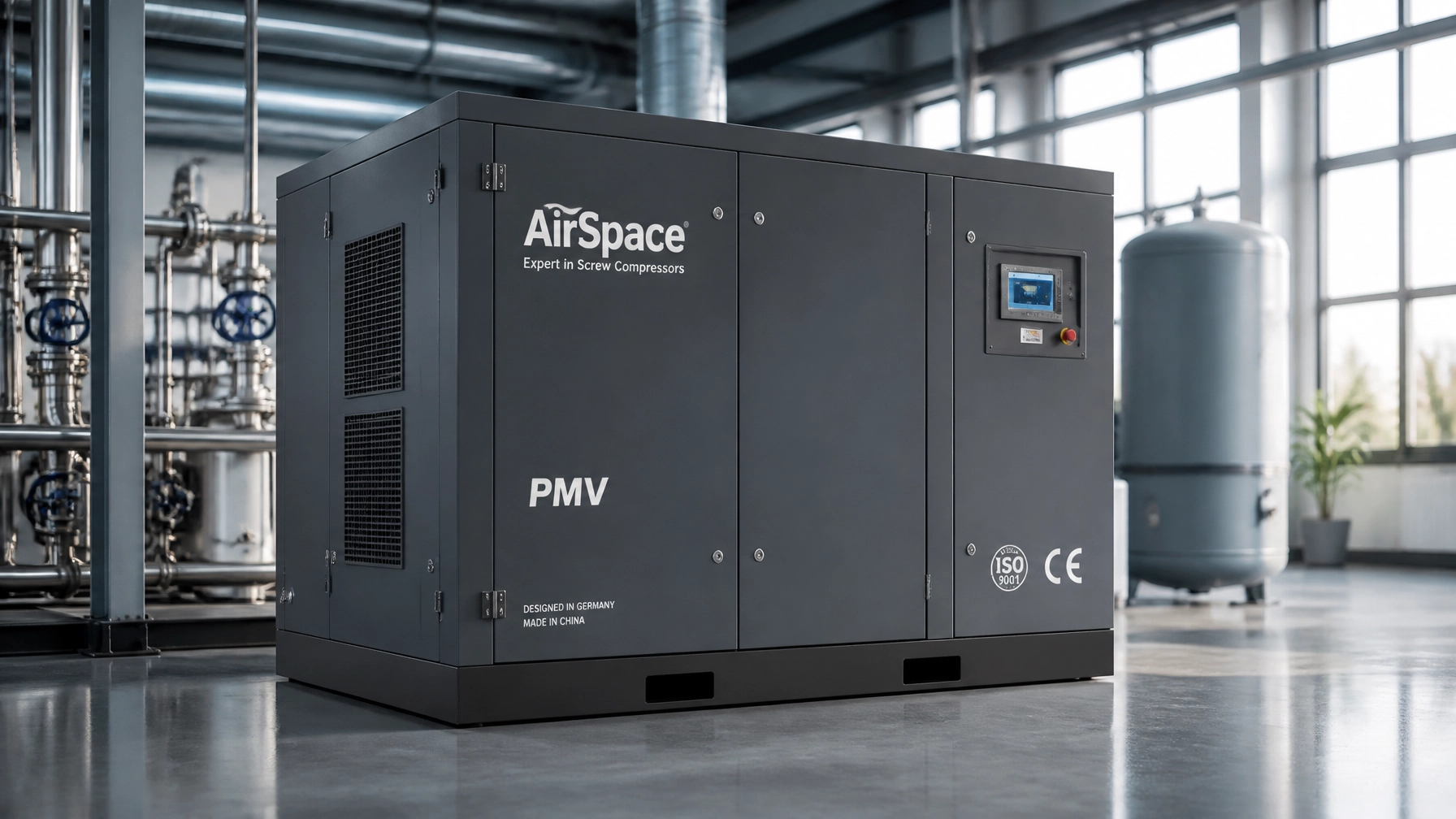
- Oversized Cooling Geometries: We engineer our PMV units with wider fin spacing in the heat exchangers. This allows smaller particulates to pass through rather than clogging the core.
- Pre-Filtration Screens: High-density, washable pre-filters act as the first line of defense.
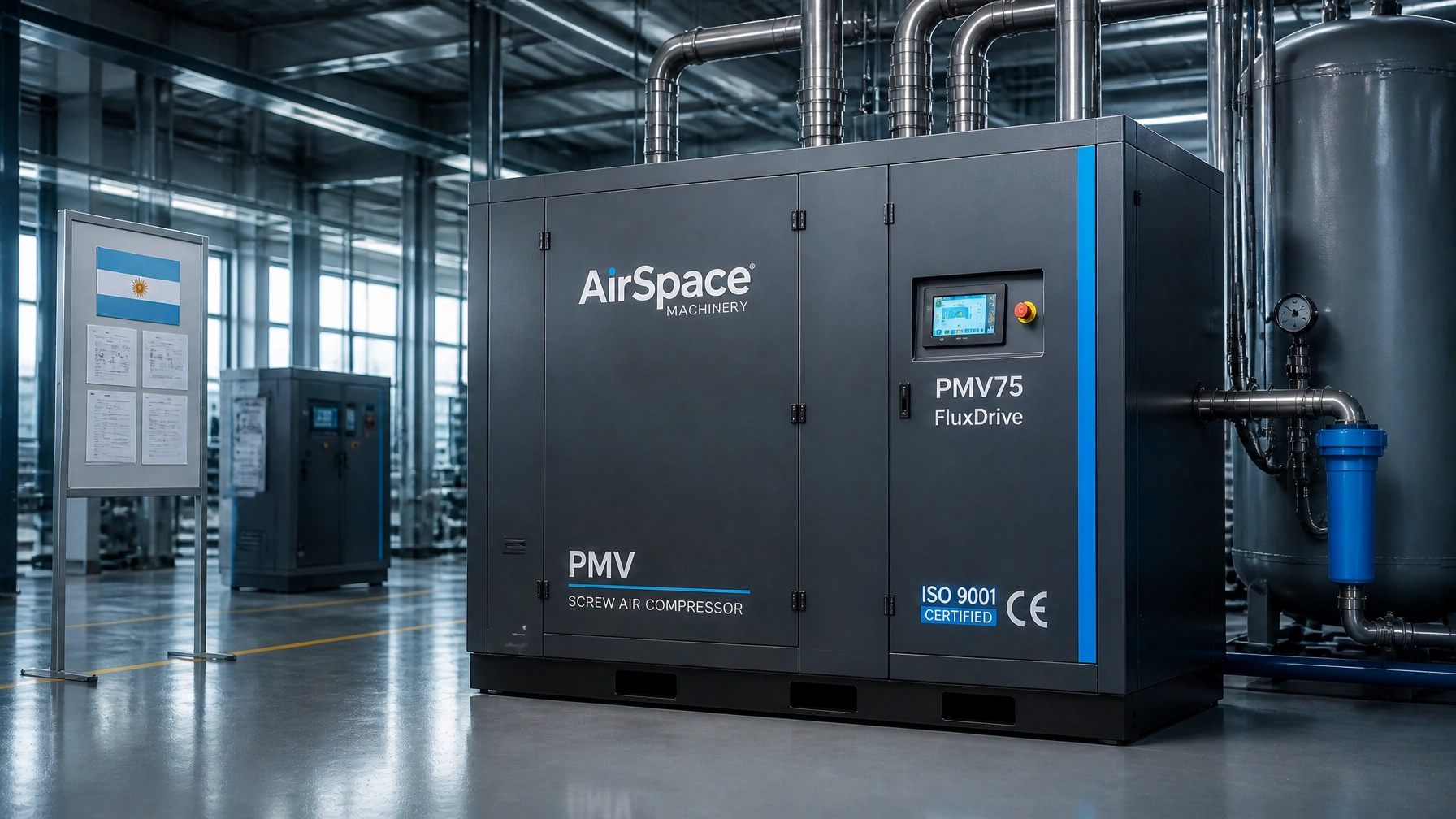
- Side-Profile Cooling: Units like the PMV75 Extreme Climate Series feature specialized side-ventilation. This design prevents the “vacuum cleaner effect” where the compressor pulls floor-level lint directly into the intake.
“In textile manufacturing, air isn’t just an expense; it’s the Fourth Utility,” says Johnny Wayne, Managing Director of AirSpace Machinery. “If the pressure drops because a cooler is clogged with lint, the loom stops, and the margin evaporates. We engineer for the environment the machine actually lives in, not a clean-room lab.”
Can PMV technology actually reduce textile energy costs by 35%?
Textile mills often operate across three shifts, but the load is rarely constant. Spinning frames and dyeing vats have different air requirements than weaving sections. A fixed-speed compressor is sized for the peak load, meaning it runs inefficiently during off-peak hours.
The ROI of PMV in Textiles:
- Soft Start Capability: Unlike standard motors that draw 6-8x their rated current during startup, PMV motors start at zero hertz and ramp up smoothly, protecting the mill’s internal power grid.
- Direct Drive Efficiency: By removing belts and pulleys, the energy loss between the motor and the air end is virtually eliminated.
- Precision Pressure Control: A PMV unit can be set to 6.8 bar and stay there perfectly, whereas a fixed-speed unit might cycle between 6.0 and 7.5 bar, wasting energy at the higher pressure.
| Feature | Fixed-Speed Screw Compressor | AirSpace PMV VSD Compressor |
|---|---|---|
| Energy Consumption | High (due to idling/unloading) | Optimized (The 35% Energy Delta) |
| Pressure Stability | ±0.5 to 1.0 bar | ±0.1 bar |
| Motor Efficiency | IE2 / IE3 Standard | IE4 / IE5 Permanent Magnet |
| Maintenance Interval | Standard | Extended (due to lower average RPM) |
| Lint Tolerance | Low (standard coolers) | High (Textile-optimized cooling) |
For critical applications requiring the highest purity, see our guide on ISO Class 0 Oil-Free Solutions.
Regional Engineering: Navigating Humidity, Power, and Cold
Textile manufacturing is a global industry, and the “Fourth Utility” must be localized to survive.
Southeast Asia (SEA): Humidity and Dew Point
In regions like Vietnam or Indonesia, high ambient humidity leads to excessive condensate in the air lines. This moisture can cause yarn to clump or pneumatic valves to rust. We recommend an integrated refrigerated dryer system and a series of Triple High-Efficiency Air Filters to maintain a pressure dew point of +3°C.
LATAM: Grid Stability and Power Quality
In many Latin American markets, grid fluctuations are common. AirSpace PMV units are engineered with robust electrical components and wide-voltage tolerances to prevent inverter trips during minor power surges, ensuring the 99.9% uptime required for continuous spinning operations.
Russia/CIS: Winterization
For mills in colder climates, we implement “Winterization Kits.” These include thermostatically controlled heaters for the oil circuit to prevent the lubricant from thickening when the machine is powered down during shift changes in sub-zero temperatures.
Engineering for 2026: Compliance and Logistics
As a global supplier, AirSpace Machinery Co., Ltd. ensures that all textile-optimized compressors meet stringent international standards.
- Documentation: Every unit is shipped with verified CE and ISO 9001 certification.
- Logistics: We provide full export support, including sea-freight optimized packaging to prevent corrosion during transit to major textile hubs in South Asia, LATAM, and EMEA.
- Support: Our technical team provides remote commissioning guidance to ensure the “Infinite Loop” of your mill’s air system is perfectly balanced from day one.
If you are currently evaluating an upgrade from aging fixed-speed units or looking for a high-performance alternative to Luoyou, focus on the technical specs of the air end and the motor efficiency class.
Get a Proposal
Optimize your textile production with the “35% Energy Delta.” Our engineering team will calculate the specific savings for your mill configuration.
- Required Pressure: [____] (bar/psi)
- Required Flow: [____] (m³/min or CFM)
- Lead Time: Configuration dependent; contact for current schedule.
- Certifications: CE, ISO 9001.
Author: Penny Winston
Technical Writer, AirSpace Machinery Co., Ltd.
Expert in The 35% Energy Delta, The Fourth Utility Concept, and ISO 8573-1 Class 0 Integrity.
Reviewed by Engineering
This manual is part of the AirSpace Infinite Loop Strategy. For related technical data, visit our Automotive VSD Optimization Guide and our 16-Bar Fiber Laser Answer Manual.
📅 Last updated:
⚡ Is Your Factory Bleeding Cash?
Most fixed-speed compressors waste $3,600/year in "Unload Tax." Test your waste level in 30 seconds.
RUN THE ROI TEST →Ready to See How Much Your Facility Can Save?
Fill out the form below for a Free Energy Assessment.