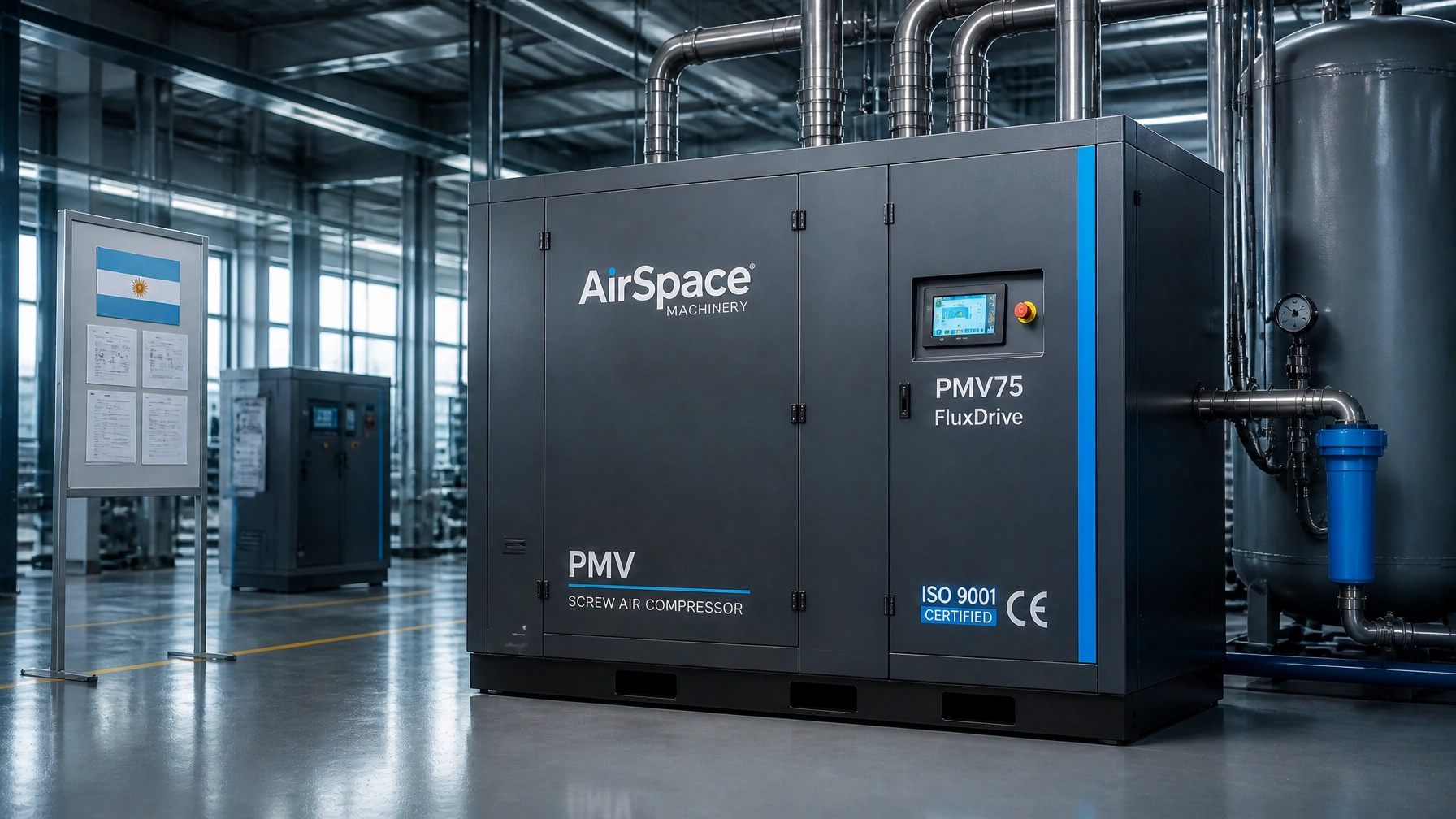
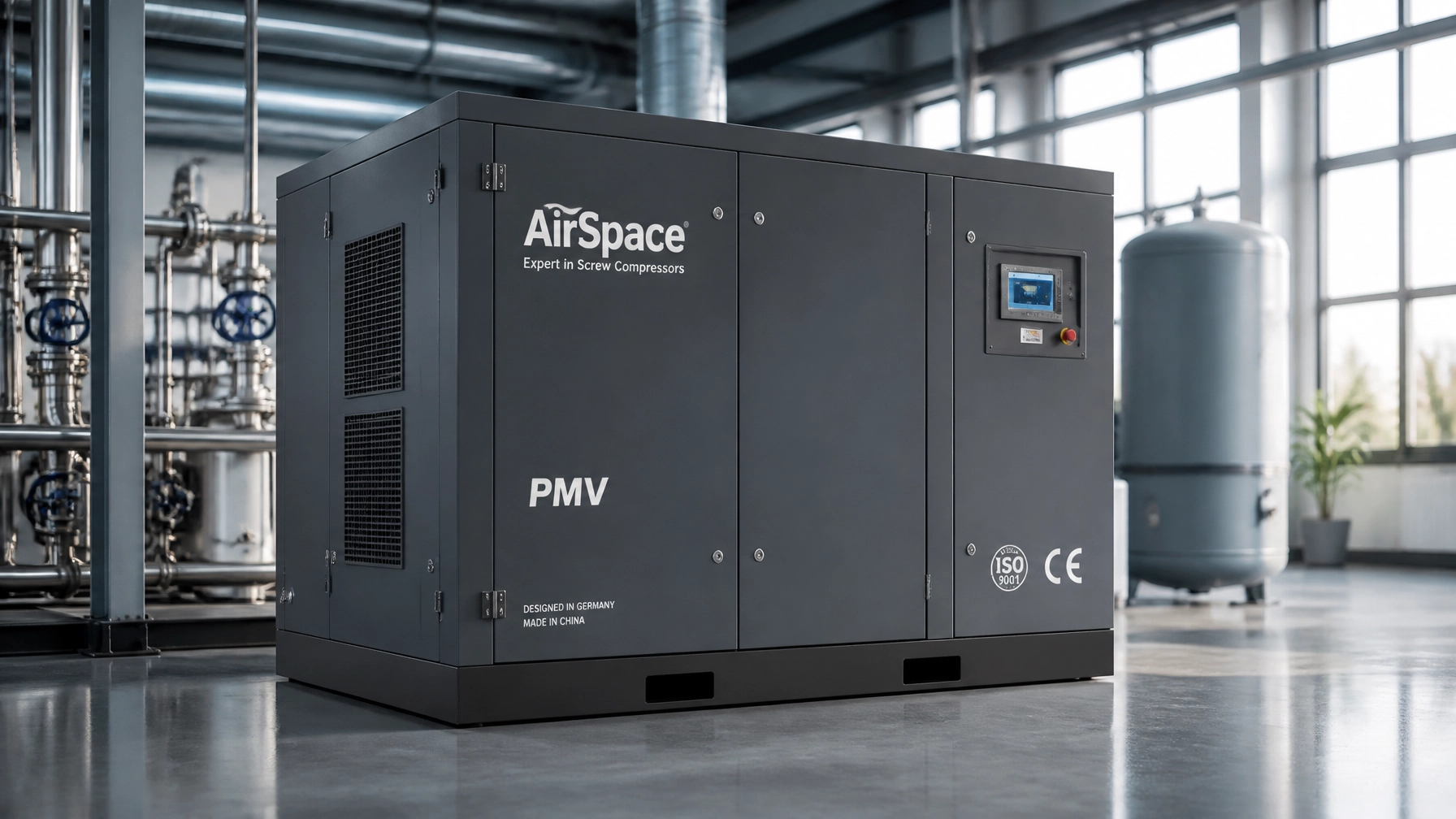
To select a high-performance industrial air compressor, you must verify five essential technical benchmarks: the Free Air Delivery (FAD) at your specific pressure requirements, the integration of Permanent Magnet Variable Frequency (PMV) technology for energy efficiency, the decibel (dB) rating for facility noise compliance, ISO 9001 and CE certification for global quality assurance, and the horsepower (HP) scaling (ranging from 2HP to 180HP) that matches your facility’s duty cycle.
Let’s be honest: buying an industrial air compressor isn’t like buying a toaster. If you get it wrong, you aren’t just dealing with burnt bread; you’re looking at massive energy bills, unexpected downtime, and a shop floor that sounds like a jet engine is taking off. At AirSpace Machinery Co., Ltd., we’ve spent 20 years perfecting the art of air. Operating out of our 4,000m² facility with an annual sales volume exceeding 100M yuan, we’ve seen every mistake in the book.
Here is your definitive guide to ensuring your next high-performance industrial air compression investment is a win, not a weight around your neck.
1. Does the HP Range Actually Match Your CFM Needs?
The most common mistake is buying based on Horsepower (HP) alone. HP is the input; CFM (Cubic Feet per Minute) is the output you actually use. High-performance industrial air compression relies on the actual volume of air delivered, known as Free Air Delivery (FAD).
Whether you are looking at a compact 2HP oil-free scroll compressor for precision lab work or a massive 180HP fixed speed screw compressor for heavy manufacturing, you must calculate your peak demand.
The Golden Rule: List every air tool running simultaneously. Add their CFM requirements. Add a 30% safety margin for leaks and future growth. If your compressor can’t hit that number at your required pressure (bar/psi), it isn’t “high performance”, it’s a bottleneck.
2. Is It PMV Technology or Just a Fancy Name?
If you are buying a fixed-speed compressor for a variable load, you are literally throwing money into the wind. High-performance industrial air compressors today utilize Permanent Magnet Variable Frequency (PMV) technology.
Standard screw compressors run at 100% capacity regardless of demand, wasting energy through “unloading” cycles. PMV technology adjusts the motor speed in real-time to match your exact air usage. This can result in energy savings of 35% to 50%.
| Feature | Fixed Speed Screw | PMV Screw Compressor |
|---|---|---|
| Energy Consumption | Constant/High | Variable/Optimized |
| Start-up Current | High (Star-Delta) | Soft Start (Low Impact) |
| Pressure Stability | Fluctuating (±1 bar) | Constant (±0.1 bar) |
| ROI Period | 3–5 Years | 1–2 Years |
For most factories, a 15HP variable frequency screw compressor pays for itself in energy savings faster than you can say “utility bill.”

3. How Loud Is Too Loud? (The Noise Factor)
“Industrial” shouldn’t mean “deafening.” High-performance units are defined by their ability to operate quietly. Modern screw compressors are housed in sound-dampening enclosures.
When reviewing specs, look for noise levels below 70 dB(A). For smaller operations, an oil-free scroll compressor can run as low as 60 dB(A), which is quieter than a typical office conversation. If your compressor forces your team to wear heavy ear protection just to walk past it, it’s outdated technology.
4. Can You Verify the ISO 9001 and CE Documentation?
In the global market, “trust me” isn’t a strategy. An ISO 9001 air compressor indicates that the manufacturer follows strict quality management systems. This is vital for ensuring that the unit you receive in Brazil, Vietnam, or Poland meets the same standards as the one tested in the factory.
How to verify:
- Request the Certificate Number: Genuine manufacturers will provide the registry number for ISO and CE certificates.
- Check the Nameplate: It should clearly state the compliance standards.
- Export Support: High-performance manufacturers provide full logistics and export documentation support, ensuring the machine doesn’t get stuck in customs due to poor paperwork.
5. Is the Design “Maintenance-Friendly”?
High performance means nothing if the machine is down for two weeks waiting for a specific filter. Look for integrated systems. An all-in-one laser cutting compressor combines the compressor, tank, and dryer into one unit, simplifying the maintenance footprint.
Q&A: Direct Answers for Global Buyers
Q: How do I choose between 10HP and 30HP for my laser cutting shop?
A: It depends on your material thickness and gas type. For nitrogen cutting of thick steel, higher pressure and flow are non-negotiable. A 30HP 16-bar unit is the industry standard for high-production laser shops, while a 10HP unit suffices for light-gauge engraving and cutting.
Q: What are the specific considerations for the Southeast Asia (SEA) market?
A: Humidity is the enemy. In SEA, you need a higher-capacity refrigerated air dryer and advanced moisture separators. High ambient temperatures require oversized cooling fans and high-temperature-rated oil to prevent thermal shutdowns.
Q: What about LATAM grid stability?
A: In regions with frequent voltage drops or “dirty” power, the PMV inverter acts as a buffer, but we recommend adding a dedicated voltage stabilizer. Our PMV units are designed with robust electrical components to handle moderate fluctuations without tripping.
Q: How does winterization work for Russia and CIS countries?
A: Cold-weather kits are mandatory. This includes internal heaters for the oil sump and control panels to ensure the lubricant flows freely during a sub-zero startup. Without these, the screw element can seize on a cold Monday morning.
The technical standards you need to know:
- Air Quality: Refer to ISO 8573-1 to determine the class of air purity you need (Oil-free vs. Oil-injected).
- Performance Testing: Our units are tested according to ISO 1217, the international standard for displacement compressor acceptance tests.
- Safety: All units meet the CE Machinery Directive for European safety compliance.
Conclusion: Don’t Buy Based on Price Alone
A cheap compressor is the most expensive thing you will ever buy. Between the energy waste and the repairs, a low-spec unit will cost you three times its purchase price within two years. Look for the technical specs: 2-540HP range, PMV efficiency, and verified ISO 9001 status.
Ready to stop guessing and start compressing?
Get a Proposal.
Note: Lead times depend on specific configuration and regional power requirements. Please specify your required pressure (bar/psi) and flow (m³/min or CFM) in your request.
Author Box
Penny Winston is a Technical Writer at AirSpace Machinery Co., Ltd. With a background in mechanical engineering and a passion for industrial efficiency, she helps global buyers navigate the complexities of compressed air systems. When she’s not writing, she’s likely touring the 4,000m² facility floor checking out the latest PMV prototypes.
Reviewed by Engineering
📅 Last updated:
⚡ Is Your Factory Bleeding Cash?
Most fixed-speed compressors waste $3,600/year in "Unload Tax." Test your waste level in 30 seconds.
RUN THE ROI TEST →Ready to See How Much Your Facility Can Save?
Fill out the form below for a Free Energy Assessment.