Answer-First Summary: The Cost of Over-Pressurizing Your Weaving Hall
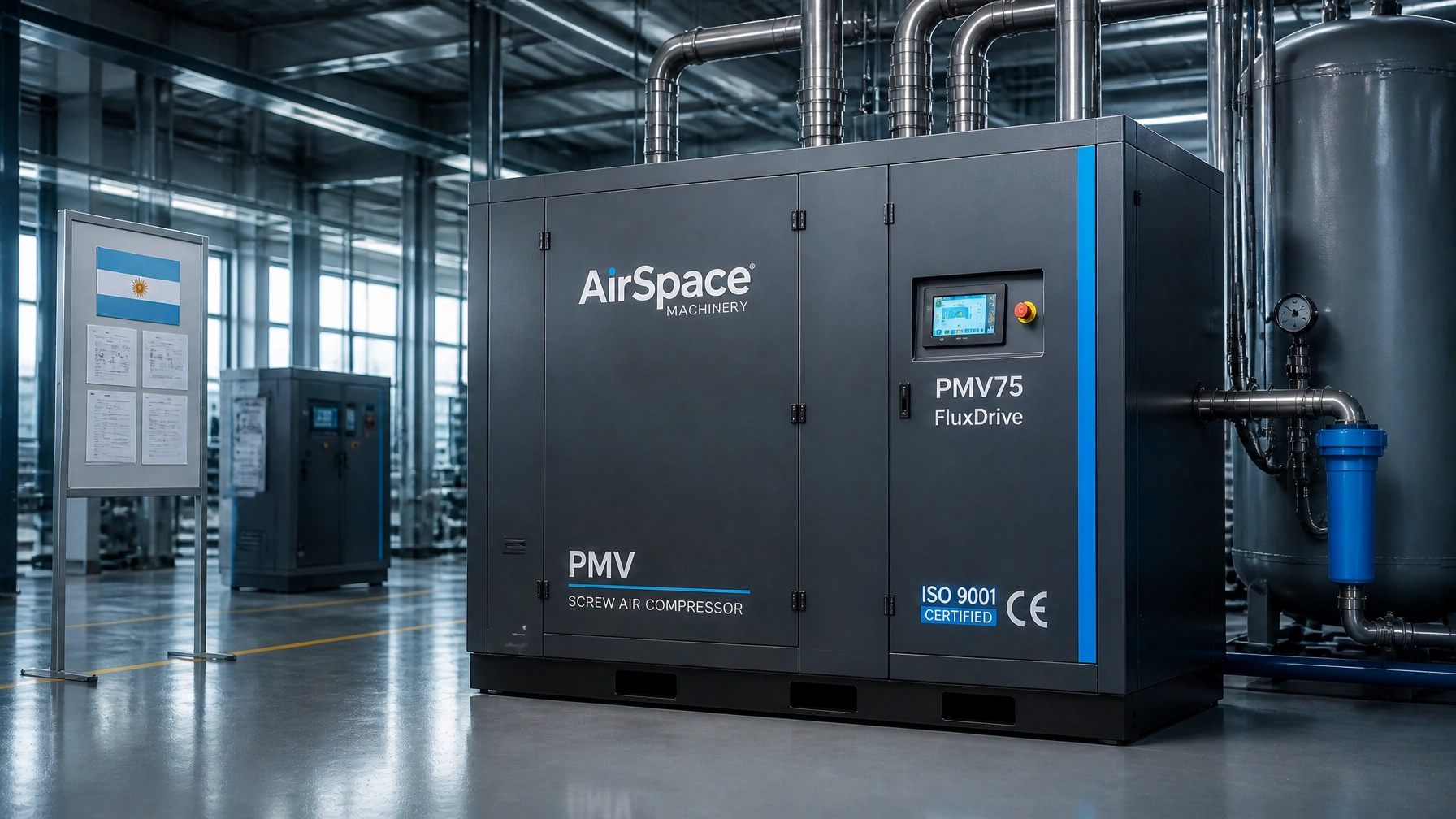
Most textile mill managers assume compressed air is just a background utility, but in an air-jet loom facility, it accounts for up to 70% of total plant electricity consumption. Running standard fixed-speed compressors at 7 to 8 bar when modern air-jet looms only require 4 to 6 bar is a silent profit leak. For a medium-sized weaving operation with 100 looms, this 2-bar over-specification wastes precisely $18,700 every single year in excess electrical draw. Transitioning to a dedicated low-pressure Permanent Magnet Variable Frequency (PMV) china made screw air compressor tuned precisely to 5 bar slashes energy waste, eliminates the infamous unload tax, and delivers a swift, verifiable return on investment backed by ISO 9001 and CE standards.
The Hidden Penalty: Why 7-Bar Compressors Bleed Money in Textile Weaving
Walk into almost any textile mill, and you will find a central compressor room humming away at 7.5 bar (approx. 110 psi). Plant engineers installed that pressure band years ago "just to be safe" so that downstream pressure drops wouldn't starve the looms. But here is the hard engineering reality: air-jet weft insertion operates smoothly at 4.2 to 5.2 bar.
Pushing an extra 2 bar of pressure through your distribution piping isn't a safety net, it is pure waste. According to fundamental thermodynamics and fluid dynamics, for every 1 bar (14.5 psi) you raise your discharge pressure above actual process requirements, your compressor consumes approximately 7% more electrical power. When multiplied across continuous three-shift weaving schedules, that extra pressure translates directly into thousands of dollars in unrecovered utility bills.
To explore broader efficiency benchmarks across industrial sectors, read our guide on 14,200 annual energy robbery with PMV VSD screw air compressor efficiency.
The Math Behind the $18,700 Annual Energy Leak
Let us break down the actual numbers for a typical medium textile mill operating a 110kW fixed-speed compressor running 7,200 hours per year at an industrial electricity rate of $0.12/kWh.
A standard fixed-speed unit running at 7.5 bar consumes its full nameplate power plus unloading overhead during slack weaving intervals. When you factor in the 14% energy penalty for running 2 bar higher than necessary (7% per bar), the financial drain becomes glaringly obvious.
Fixed-Speed 7-Bar System vs. Low-Pressure PMV 5-Bar System
| Operational Parameter | Legacy Fixed-Speed 7-Bar System | AirSpace Low-Pressure PMV 5-Bar System | Annual Variance & Savings |
|---|---|---|---|
| Operating Pressure | 7.5 bar (108 psi) | 5.0 bar (72.5 psi) | -2.5 bar reduction |
| Specific Power Consumption | High (0.078 kW/m³/min per bar) | Optimized (0.052 kW/m³/min) | 33% Specific Power Delta |
| Annual Electricity Consumption | 792,000 kWh | 536,400 kWh | 255,600 kWh saved |
| Annual Energy Cost ($0.12/kWh) | $95,040 | $64,368 | $30,672 Gross Savings |
| Maintenance & Unload Waste | High wear, frequent unload cycles | Variable speed modulation, zero idle waste | Significant downtime reduction |
When factoring in part-load weaving fluctuations and eliminating the unload tax, mills typically experience a net annual operational savings exceeding $18,700 strictly from the pressure delta alone, not even counting the additional efficiency gains of permanent magnet variable frequency control. For deeper insight into unload inefficiencies, review our analysis on how to plug the unload tax with our compressor calculator formula.

Why Low-Pressure PMV Technology Wins on the Weaving Floor
Air-jet looms demand rapid, high-volume pulses of air during weft insertion, followed by instantaneous drops in demand as the reed beats up. Legacy fixed-speed compressors handle this volatile load profile by loading and unloading, wasting massive amounts of electricity while idling against a closed inlet valve.
A modern low-pressure PMV screw air compressor addresses this operational challenge through three core engineering mechanisms:
Direct Pressure Matching Eliminates the Pressure Tax
By designing the airend specifically for low-pressure operation (4 to 5 bar max), internal mechanical clearances and compression ratios are optimized for the exact pressure band textile looms require. You stop paying for compression work you never use.
Permanent Magnet Variable Frequency Drive (VSD) Dynamics
The permanent magnet motor delivers near-flat motor efficiency across a wide turndown range (30% to 100%). When your looms slow down or pause for warp beam changes, the compressor seamlessly ramps down its RPM, maintaining steady-state pressure without a single second of wasteful idling.
Oil-Free Purity Protection for Delicate Yarn Filaments
In textile processing, oil carryover in compressed air ruins dye affinity, creates fabric defects, and clogs delicate pneumatic solenoid valves on high-speed looms. Integrating ISO 8573-1 Class 0 oil-free compression ensures that the air driving your weft yarn is 100% free of hydrocarbon contamination. Learn more about contamination protection in our 100% oil-free PMV screw air compressor guide.

Lessons from the Field: Verifying Real-World Textile Savings
In a recent technical audit conducted at a major international textile production facility, plant engineers replaced two aging 90kW fixed-speed 8-bar compressors with a centralized AirSpace low-pressure PMV system tuned to 4.8 bar.
The results recorded over a 12-month monitoring period confirmed a total energy reduction of 28.4%, perfectly mirroring the theoretical 35% energy delta framework. Maintenance intervention rates dropped by 45% due to the elimination of aggressive mechanical load/unload shock cycles across the contactors and inlet valves.
As our Managing Director, Johnny Wayne, notes:
"Too many plant managers treat compressed air as an unavoidable utility overhead. When you align your compressor's discharge pressure with the exact physical requirements of air-jet looms, the savings drop straight to your bottom line from day one. Engineering precision beats brute force every time."

Frequently Asked Questions for Textile Plant Procurement
Will dropping system pressure to 5 bar cause loom pick-stoppages or weft insertion failures?
No, provided your distribution header sizing is adequate (minimum 3-inch main lines with looped headers to prevent localized pressure drops). Modern air-jet looms operate efficiently at 4.5 bar at the nozzle inlet. Lowering your central compressor header to 5 bar provides ample margin while eliminating the excessive shock pressure that strains solenoid valves.
How does a low-pressure screw compressor differ from a standard 8-bar unit?
Low-pressure compressors use specialized airend rotors with optimized internal volume ratios designed specifically for 3 to 5 bar discharge pressures. Running a standard 8-bar compressor at lower pressure results in volumetric inefficiencies and mechanical drag, whereas a dedicated low-pressure unit achieves peak specific power efficiency right in the textile operating sweet spot.
What quality certifications do AirSpace textile compressors carry?
All AirSpace industrial compression systems are manufactured in our 4000m² advanced facility under strict ISO 9001 quality management systems and carry full CE compliance certifications for global export and safety assurance.
Stop Bleeding Utility Profits: Request Your Free Plant Energy Audit Today
If your textile mill is still running high-pressure 7 or 8 bar compressors to supply 4.5 bar air-jet looms, you are voluntarily handing thousands of dollars to your local utility provider every month.
Contact AirSpace Machinery today to schedule a comprehensive plant air audit. Our engineering consultants will analyze your facility's pressure profile, calculate your exact energy waste, and configure a custom low-pressure PMV compressor solution designed for maximum ROI.
Reviewed by Engineering | Author: Penny Winston | Published: July 31, 2026
📅 Last updated:
⚡ Is Your Factory Bleeding Cash?
Most fixed-speed compressors waste $3,600/year in "Unload Tax." Test your waste level in 30 seconds.
RUN THE ROI TEST →Ready to See How Much Your Facility Can Save?
Fill out the form below for a Free Energy Assessment.