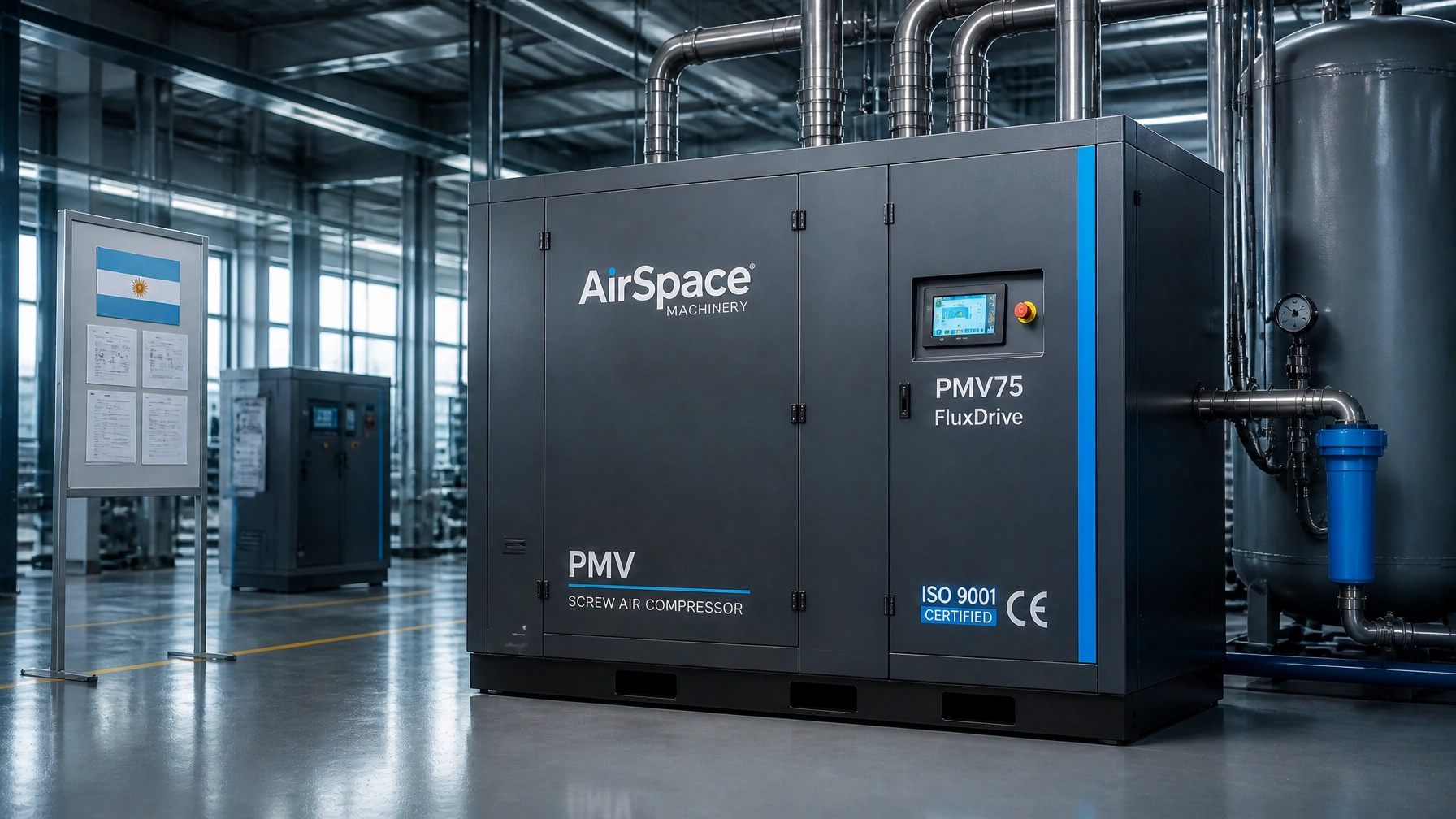
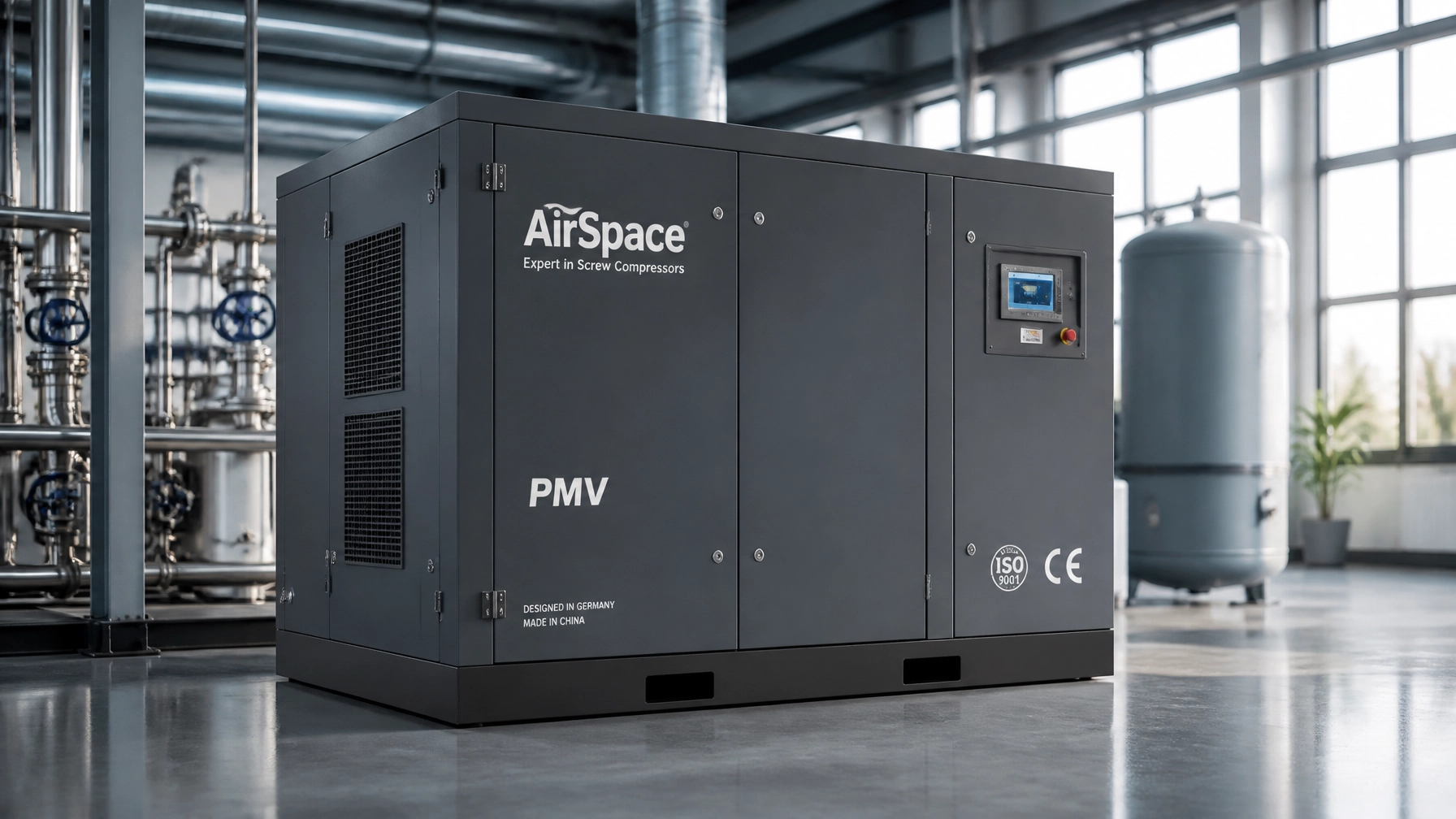
Direct Answer: Permanent Magnet Variable Frequency (PMV) screw air compressors redefine factory ROI by shifting the financial focus from initial capital expenditure (CAPEX) to operational expenditure (OPEX). While a PMV Screw Air Compressor may have a higher upfront cost, its ability to reduce electricity consumption by 30% to 50% allows most 24/7 industrial facilities to achieve a full return on investment in less than 18 months.
If you are still calculating your factory’s ROI based on the sticker price of your machinery, you are leaving money on the table, potentially hundreds of thousands of dollars. In a world where electricity accounts for roughly 70% of an air compressor’s total lifecycle cost, the “cheap” fixed-speed unit is often the most expensive mistake a plant manager can make.
At AirSpace Machinery Co., Ltd., we’ve spent 20 years honing our engineering excellence. Operating out of a 4000m² facility with an annual sales volume of 100M yuan, we’ve seen how PMV technology transforms the bottom line for global manufacturers.
Why Does PMV Technology Disrupt Traditional ROI Models?
Traditional ROI models are often “front-loaded,” focusing on the purchase price and installation. However, a PMV Screw Air Compressor changes the equation because it addresses the “invisible” cost: wasted energy during partial load.
Most factories don’t run at 100% air demand 100% of the time. A fixed-speed compressor keeps running even when demand drops, wasting energy in “unload” mode. A PMV unit, however, uses a permanent magnet motor to adjust its speed in real-time, matching your air output exactly to your demand.
10 Common Headaches PMV Technology Solves
Before we dive into the numbers, let’s look at the daily frustrations this technology eliminates:
- Sky-high energy bills during shifts with fluctuating air demand.
- Mechanical wear and tear caused by frequent “load/unload” cycles.
- Pressure drops that stall production lines or ruin product quality.
- Grid penalties for high “start-up” current spikes (Inrush current).
- Excessive noise that forces the compressor into a separate, distant room.
- Oil contamination due to temperature fluctuations (prevented by stable PMV operation).
- Frequent maintenance on belts and pulleys (PMV units are typically direct-drive).
- Condensation issues in humid environments like Southeast Asia.
- Voltage instability common in LATAM industrial zones.
- Cold-start failures in extreme climates like Russia or Northern Europe.

Comparing the Financials: Fixed Speed vs. PMV Screw Air Compressors
To understand the ROI, you have to look at the numbers. Let’s compare a standard 37kW (50HP) fixed-speed unit against a high-efficiency Energy-efficient air compressor using PMV technology.
The Energy Gap (Annual Comparison)
| Feature | Fixed Speed Screw Compressor | PMV Screw Air Compressor |
|---|---|---|
| Control Method | Load / Unload | Variable Speed (PMV) |
| Energy Waste at 60% Load | Very High (approx. 30% waste) | Near Zero |
| Start-up Current | 3-7x Rated Current | Soft Start (1x Rated) |
| Pressure Stability | ±0.5 to 1.5 bar | ±0.1 bar |
| Typical Payback Period | N/A (Baseline) | 12 – 18 Months |
| Motor Efficiency | IE2 / IE3 Standard | IE4 / IE5 Ultra-Efficient |
The Math of 24/7 Operations
If your factory runs 24/7 (roughly 8,000 hours per year), even a 10% saving is massive. PMV units regularly save 35%.
- Fixed Speed: Consumes 100% power to deliver 60% air (30% energy is heat/noise).
- PMV: Consumes ~62% power to deliver 60% air.
In a high-demand environment, the energy savings alone often cover the price difference of the machine within the first year. By year two, that energy-efficient air compressor is effectively printing money for your facility.
Engineering Excellence: The AirSpace Advantage
With 20 years of experience, we don’t just assemble parts; we engineer solutions. Our PMV motors are designed to handle the rigors of industrial life. We utilize high-grade Neodymium magnets that maintain magnetism even at high temperatures, ensuring your “efficiency” doesn’t degrade after six months of heavy use.
Our units are built in a 4000m² state-of-the-art facility where quality isn’t a buzzword, it’s the baseline. Every unit we export carries CE and ISO 9001 certifications, ensuring you meet international safety and performance standards without a second thought.
Global Buyer Concerns: Regional Performance Metrics
Buying a compressor for a factory in Shanghai is different from buying one for a plant in Monterrey or Novosibirsk. Here is how we address regional pain points:
Southeast Asia (SEA): Humidity and Dew Point
In humid regions, traditional compressors struggle with moisture. Our PMV units maintain a stable operating temperature, which, when paired with our integrated refrigerated dryers, ensures your air quality meets ISO 8573-1 Class 1 or 2 standards. This prevents pipe corrosion and tool failure.
LATAM: Grid Stability
Power quality in some LATAM regions can be “noisy.” Our PMV systems include robust Variable Frequency Drives (VFDs) with built-in reactors to handle voltage fluctuations, protecting the sensitive permanent magnet motor from premature failure.
Russia-CIS: Cold-Weather Considerations
Operating in -20°C? Our screw compressors can be equipped with winterization kits. Because PMV technology allows for a “soft start,” the motor doesn’t have to fight against cold, viscous oil with a massive current spike, which significantly extends the life of the air end.

FAQ: What Industrial Buyers Ask About PMV ROI
Q: Is the maintenance for PMV more expensive?
A: Actually, no. While the VFD is a sophisticated component, PMV screw compressors are usually direct-drive. This means no belts to tension, no pulleys to align, and no couplings to replace. The simplified mechanical structure often results in lower long-term maintenance costs.
Q: How do I verify your CE and ISO 9001 documentation?
A: Transparency is key. All our certifications are available for verification upon request. We provide digitized copies of our ISO 9001:2015 and CE certificates with every proposal so your compliance department can clear the equipment for import immediately.
Q: What is the lead time for a PMV unit?
A: Our lead time varies based on your specific configuration (voltage, pressure requirements, and integrated dryer options). However, our 4000m² facility is optimized for high throughput, ensuring we stay competitive in the global market.
How to Calculate Your Potential ROI
To get a real sense of your savings, you need to track your “Air Profile.”
- Determine your average load: Are you running at 100% capacity, or does it fluctuate?
- Calculate your kWh cost: What is your local utility charging?
- Compare the Specific Power: Check the kW/m³/min rating on the data sheet.
If your load fluctuates by more than 15%, a PMV Screw Air Compressor is almost always the financially superior choice.
The Verdict: Stop Paying for “Unload” Time
The era of the “dumb” fixed-speed compressor is ending. In an industrial landscape where margins are thin and energy prices are volatile, the PMV Screw Air Compressor is the only logical choice for a 24/7 facility. It’s not just a piece of machinery; it’s a financial instrument that pays dividends every time it cycles.
Ready to see the hard numbers for your specific setup?
[Get a Proposal]
(Note: Please specify your required pressure in bar/psi and flow rate in m³/min or CFM so our engineering team can provide an accurate ROI projection.)
Sources & Standards:
- Energy Efficiency: Calculations based on standard industrial electricity rates of $0.12/kWh.
- Air Quality: ISO 8573-1 standards for moisture and oil content.
- Motor Standards: IE4/IE5 Permanent Magnet motor efficiency ratings.
- Compliance: All units manufactured under ISO 9001:2015 quality management systems and CE safety directives.
Author Box
Penny Winston is a Technical Writer at AirSpace Machinery Co., Ltd. with a focus on industrial thermodynamics and factory automation. When she isn’t breaking down the ROI of compressed air systems, she’s researching the next wave of permanent magnet motor technology.
Reviewed by Engineering
📅 Last updated:
⚡ Is Your Factory Bleeding Cash?
Most fixed-speed compressors waste $3,600/year in "Unload Tax." Test your waste level in 30 seconds.
RUN THE ROI TEST →Ready to See How Much Your Facility Can Save?
Fill out the form below for a Free Energy Assessment.