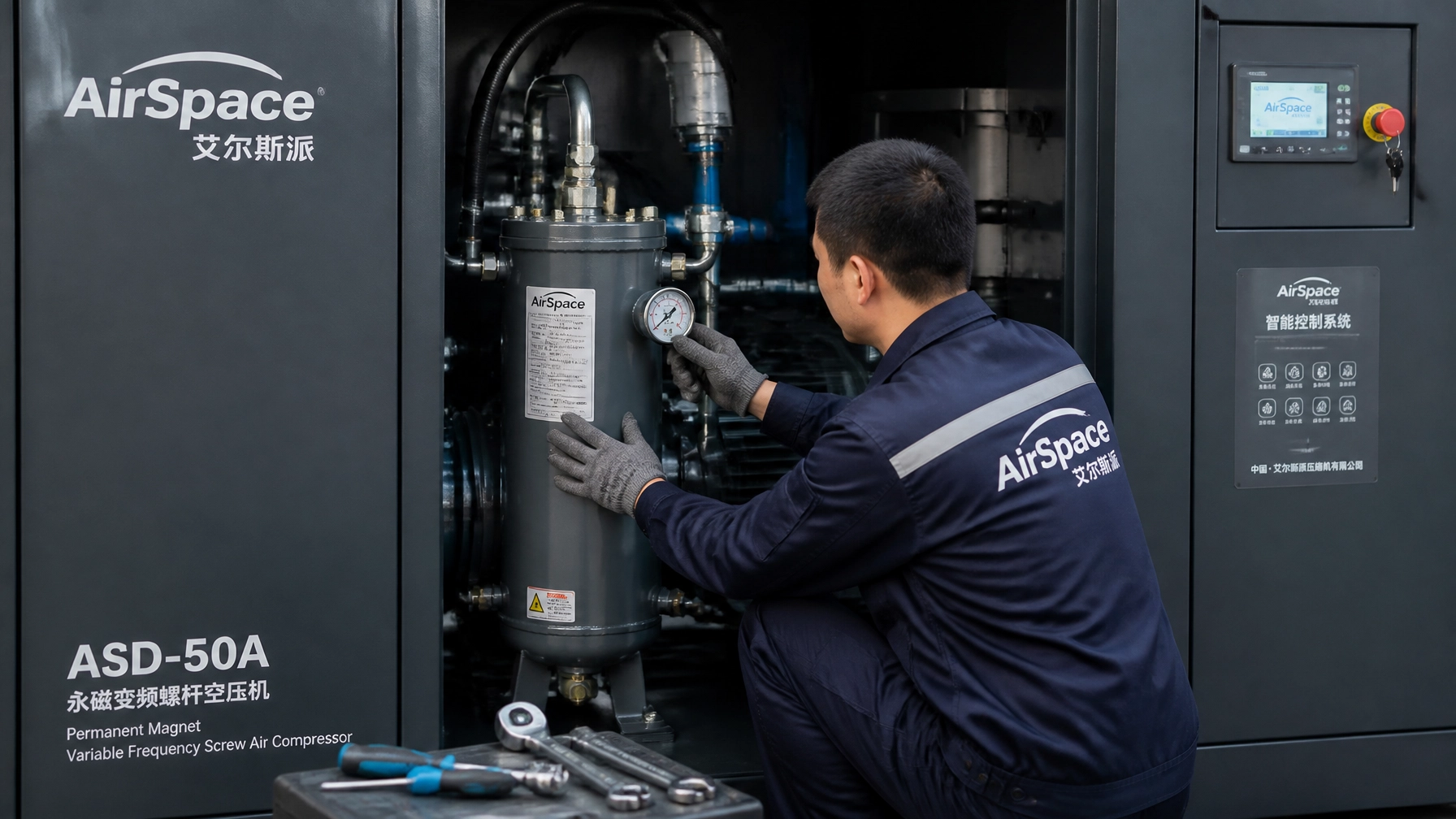
EXECUTIVE SUMMARY
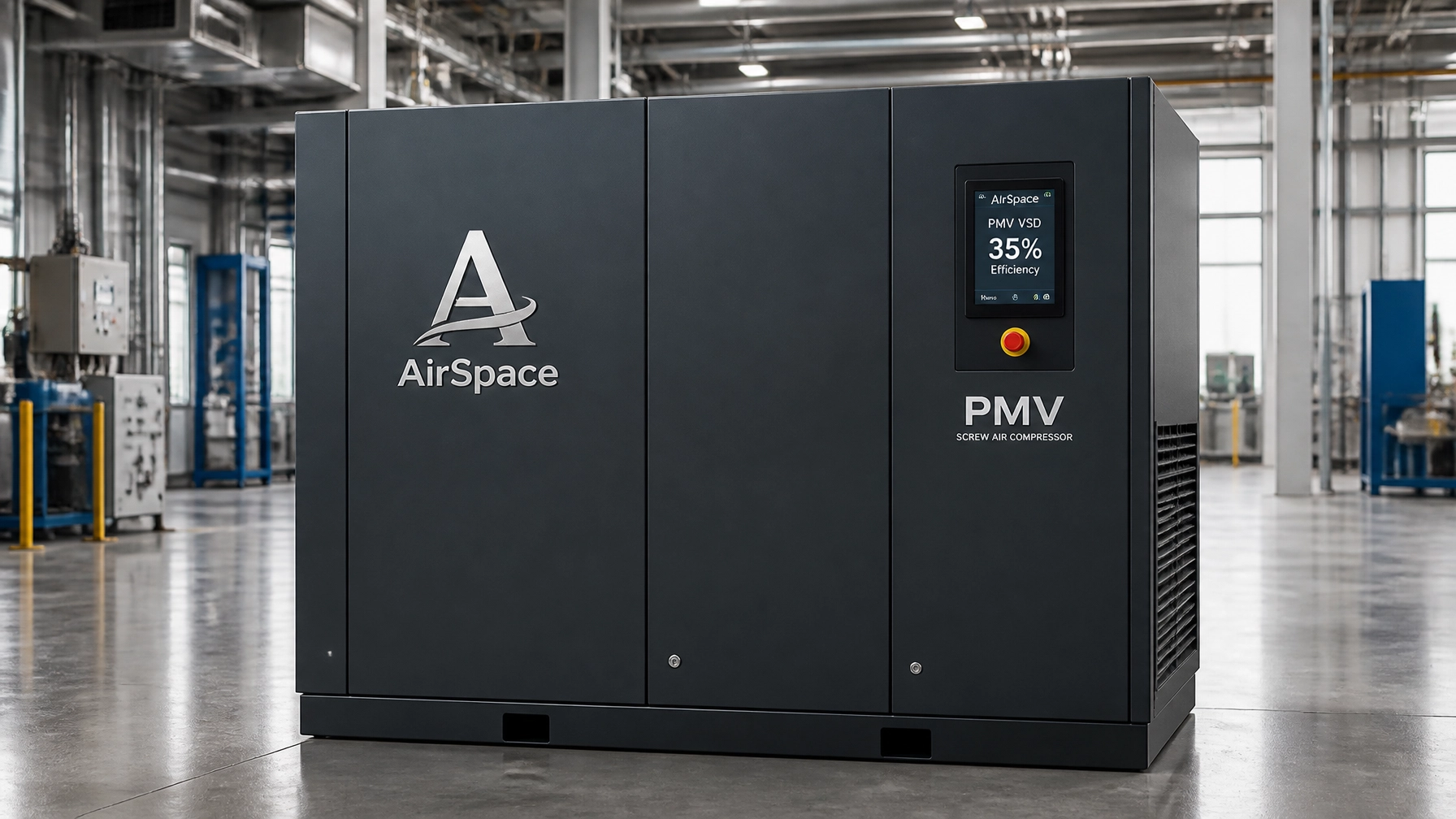
The industrial air compression landscape in 2026 is no longer defined by simple airflow delivery. It is defined by the 35 percent energy delta. For factory managers facing rising power costs and stringent carbon mandates, the transition from legacy fixed speed induction systems to Permanent Magnet Variable Frequency (PMV) technology represents the single largest operational cost reduction available in the fourth utility category. This guide serves as the definitive technical authority on why IE5 permanent magnet motors are replacing standard induction motors and how PMV systems eliminate the hidden unload tax that bleeds industrial profitability.
Jump to: How to Spot Fake PMV →
WHAT IS A PMV SCREW AIR COMPRESSOR?
A PMV screw air compressor is the integration of a Permanent Magnet (PM) motor with a Variable Frequency Drive (VSD) to create a system that modulates its output in perfect synchronization with real time air demand. In the AirSpace engineering framework, PMV is the intersection of two critical technologies:
- The IE5 Permanent Magnet Motor: Unlike traditional motors that use electromagnetic induction to create a magnetic field in the rotor, PM motors use rare earth permanent magnets. This eliminates rotor copper losses and allows the motor to maintain high efficiency even at low speeds.
- The Variable Frequency Drive (VSD): This is the intelligent inverter that controls the motor’s RPM. Instead of running at a constant 100 percent speed, the VSD instructs the PM motor to spin only as fast as necessary to maintain the target plant pressure.
For a facility operating between 10 HP and 180 HP (7.5 kW to 132 kW), the PMV system acts as a smart utility. While legacy brands often struggle with efficiency drops when demand falls below 80 percent, a China made screw air compressor utilizing true PMV architecture maintains its peak performance profile across a wide operating range of 25 percent to 100 percent load.
THE ENGINEERING DIFFERENCE: PM MOTOR VS INDUCTION MOTOR
The primary reason legacy induction motors are becoming obsolete in variable demand applications is the physics of induction itself. To move an induction motor, you must “induce” a current in the rotor, which generates heat and electrical resistance. This is why standard VSD systems, which pair an inverter with a standard induction motor, often fail to deliver the promised savings at lower speeds.

EFFICIENCY COMPARISON TABLE: PMV VS INDUCTION VS FIXED SPEED
- Efficiency at 100 Percent Load
- Fixed Speed (IE3 Induction): 92.4 percent
- Standard VSD (IE3 Induction): 91.8 percent (Inverter losses included)
- AirSpace PMV (IE5 PM): 96.5 percent
- Efficiency at 50 Percent Load
- Fixed Speed (IE3 Induction): N/A (Runs at 100 percent speed or unloads)
- Standard VSD (IE3 Induction): 84.5 percent
- AirSpace PMV (IE5 PM): 95.8 percent
- Speed Range (Turndown Ratio)
- Fixed Speed (IE3 Induction): 0 percent (Constant)
- Standard VSD (IE3 Induction): 40 to 100 percent
- AirSpace PMV (IE5 PM): 15 to 100 percent
- Heat Generation
- Fixed Speed (IE3 Induction): High (Rotor losses)
- Standard VSD (IE3 Induction): Moderate
- AirSpace PMV (IE5 PM): Very Low
- Torque at Low Speed
- Fixed Speed (IE3 Induction): Poor (Constant speed design)
- Standard VSD (IE3 Induction): Fair
- AirSpace PMV (IE5 PM): Excellent (Full torque at zero speed)
The data is clear. An IE5 permanent magnet motor maintains a 90 percent plus efficiency curve across its entire operating range. When you drop below 50 percent speed on a standard induction motor, the efficiency plummet is what we call the inefficiency trap. AirSpace PMV technology bypasses this trap entirely.
THE 35 PERCENT ENERGY DELTA: REAL MATH FOR FACTORY MANAGERS
We frequently discuss the 35 percent energy delta as the benchmark for ROI. To understand this, let us look at a standard 75 kW (100 HP) system running 6,000 hours per year with an average electricity cost of 0.12 USD per kWh.
- The Fixed Speed Scenario
A fixed speed 75 kW compressor running loaded 100 percent of the time consumes 450,000 kWh annually.
Cost: 54,000 USD per year.
However, in reality, most compressors run in a load/unload cycle. Including the waste of running “unloaded” (consuming 30 percent power for 0 percent air), the cost often jumps to 59,400 USD per year. - The Standard VSD Induction Scenario
An induction VSD system helps, but the motor losses at part load reduce the overall gain.
Annual Consumption: ~382,500 kWh.
Cost: 45,900 USD per year. - The AirSpace PMV Scenario (IE5 PM Motor)
By maintaining 96 percent efficiency even at partial loads and eliminating all unload waste, the system tracks the demand curve perfectly.
Annual Consumption: ~315,000 kWh.
Cost: 37,800 USD per year.
The 35 Percent Delta Results:
- Annual Savings vs Fixed Speed: 21,600 USD.
- Annual Savings vs Standard VSD Induction: 8,100 USD.
- 10 Year Savings: 216,000 USD.
The payback period for the incremental investment in a high quality China made screw air compressor with PMV technology is typically between 7 and 12 months. Beyond that, the machine is effectively a profit center.
WHY CHEAP PM IS NOT REAL PM: THE BUDGET TRAP
As the demand for PMV technology grows, many budget suppliers have entered the market with what we call “Label PM” machines. These units are often standard induction motors rebranded as PM, or they use low grade ferrite magnets instead of high coercivity rare earth magnets.
A true PMV system requires three non negotiable components:
- A Rare Earth Permanent Magnet Rotor: This ensures the magnetic field does not degrade over time, even under high thermal stress.
- A Matched VSD Inverter: The drive must be specifically tuned to the back EMF (Electromotive Force) of the PM motor. Using a generic drive on a PM motor leads to “cogging” and premature bearing failure.
- Proper Thermal Management: High grade PM motors are more compact and require specialized cooling to protect the magnets from demagnetization.
At AirSpace Machinery, we utilize the BAOSI air end with a 5:6 rotor profile paired with an IE5 PM motor. This ensures that the mechanical efficiency of the air end matches the electrical efficiency of the motor. If a supplier cannot provide the motor efficiency curve or the specific weight of the PM motor (which should be significantly lighter than an induction motor of the same power), you are likely looking at a budget compromise.
PMV APPLICATIONS BY INDUSTRY
The versatility of PMV technology makes it the default choice for modern industrial facilities.
- Automotive Manufacturing: Assembly lines and robotics have highly variable air demand. Painting booths require absolute pressure stability to prevent finish defects. Our PMV systems deliver ±0.1 bar stability, ensuring consistent quality.
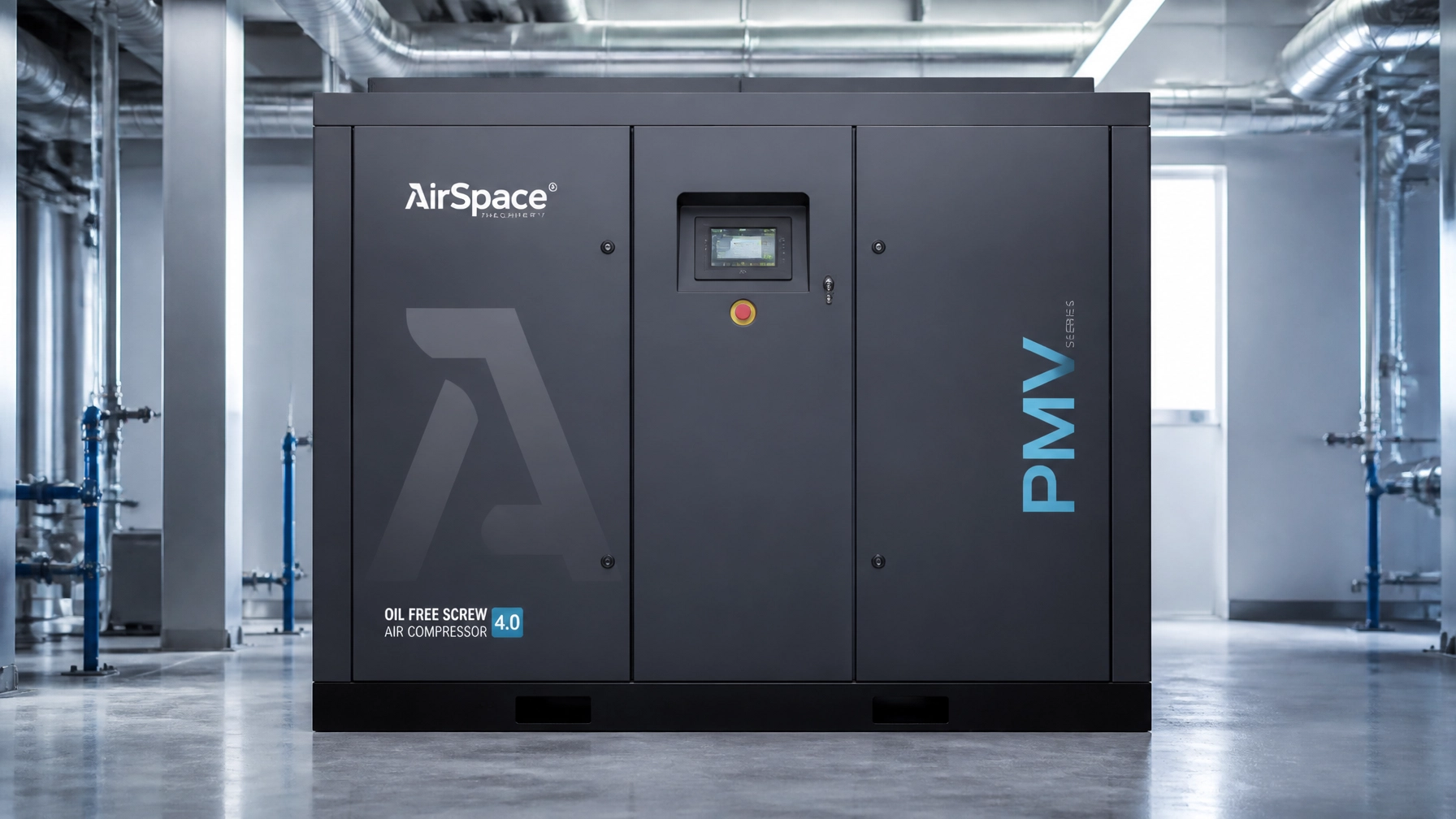
- Electronics and Semiconductors: These facilities require clean air and high reliability. The low heat generation of PM motors reduces the load on facility HVAC systems. For ultra sensitive applications, we recommend our Class 0 Oil Free PMV units. You can learn more about this in our specialized guide on Class 0 Oil-Free Compressor for Semiconductor Wafer Fab.
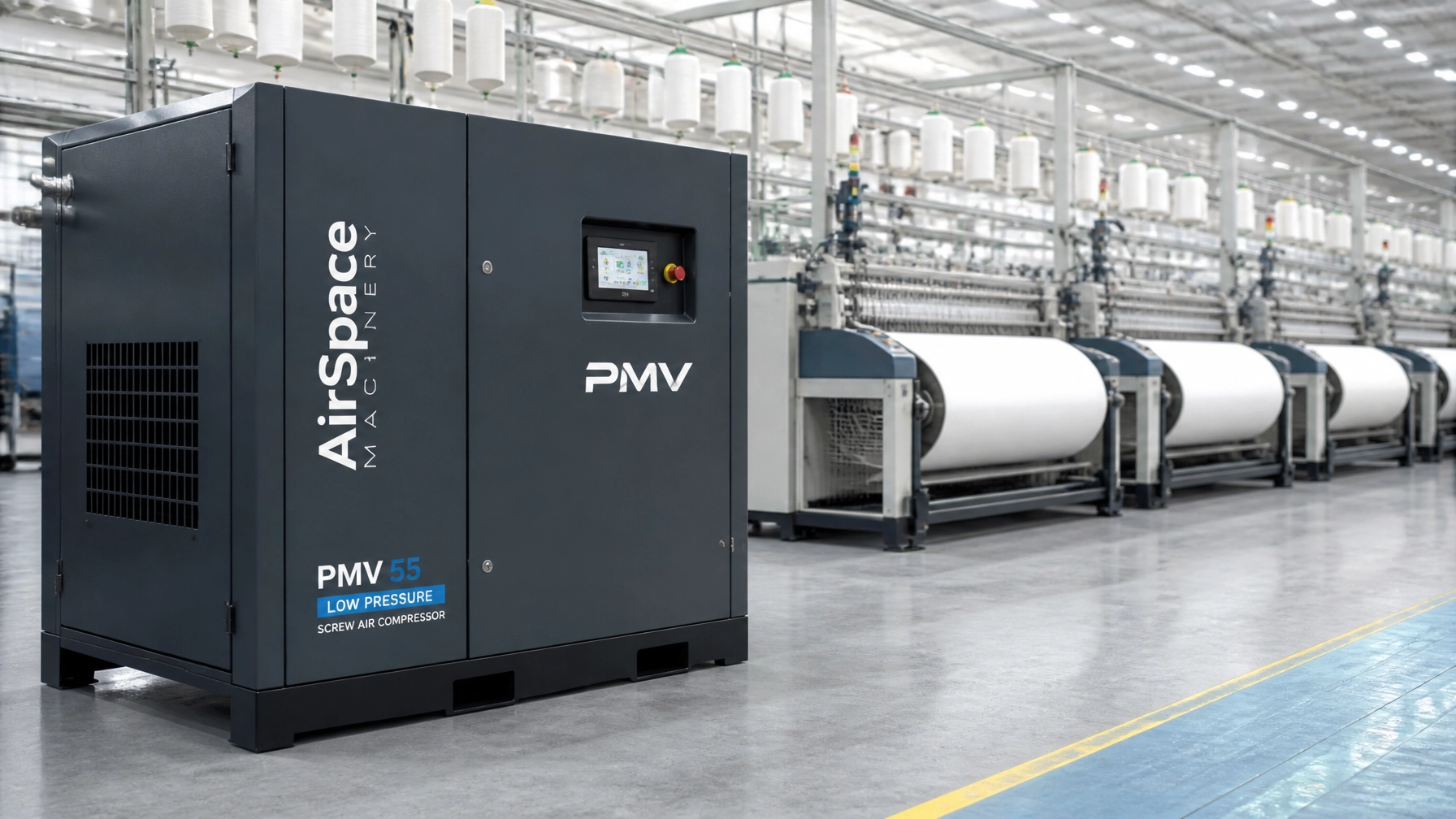
- Textile and Garment Industry: Shift changes and varying loom counts mean air demand is never constant. PMV technology matches these fluctuations, eliminating the “Unload Tax” during low production hours.
- Food and Beverage: 24/7 operations require a system that can handle 55°C ambient temperatures without tripping. Our PMV series is rated for these extreme environments, making it ideal for the Middle East and Southeast Asian markets.
- Metal Fabrication and Laser Cutting: Laser cutting requires high pressure and precise flow. A PMV system prevents the pressure drops that cause slag and poor cut quality. Our DEDICATED 16 BAR FIBER LASER COMPRESSORS often utilize PMV technology to maximize nitrogen or air cutting efficiency.
55 DEGREE CELSIUS AMBIENT RATING: THE HEAT TAX ADVANTAGE
In many parts of the world, industrial equipment is subject to what we call the “Heat Tax.” Standard compressors are often rated for 40°C. When the summer temperatures hit 45°C or 50°C in a factory setting, these units either trip on high temperature or lose significant efficiency as the air density changes and the motor struggles to cool itself.

Permanent magnet motors naturally run cooler than induction motors because they do not have rotor current losses. By combining this cooler motor technology with oversized oil coolers and high flow ventilation, AirSpace PMV systems are rated for stable operation at 55°C. This means no nuisance trips, no emergency shutdowns, and no loss of efficiency when the environment gets demanding.
PMV VS OTHER VARIABLE SPEED TECHNOLOGIES
While PMV is the gold standard, it is important to understand how it compares to legacy variable displacement technologies like spiral valves or poppet valves.
- PMV (IE5 PM): Best for wide range variability (15 to 100 percent). Offers the highest energy savings and best pressure stability.
- Standard VSD (Induction): Good for moderate variability (40 to 100 percent). Lower initial cost but higher long term TCO (Total Cost of Ownership).
- Variable Displacement: Effective for narrow ranges (70 to 100 percent). Mechanically complex and higher maintenance costs compared to the simplicity of a PM motor.
- Load/Unload: Only recommended for facilities with 95 percent plus constant load. In almost any other scenario, the energy waste is prohibitive.
To see how these technologies impact your specific bottom line, we recommend reviewing our ROI Guide for Industrial Air Compressors.
TECHNICAL SPECIFICATIONS: AIRSPACE LY-PMV SERIES
The LY-PMV series represents the pinnacle of China made screw air compressor engineering.
- Power Range: 7.5 kW to 132 kW (10 HP to 180 HP)
- Motor Efficiency: IE5 Permanent Magnet (96.5 percent peak)
- Air End: BAOSI High Precision Twin Screw
- Rotor Profile: 5:6 asymmetrical
- Pressure Range: 7 bar to 13 bar (Customizable)
- Control System: Intelligent Touchscreen PLC with IoT remote monitoring
- Cooling Method: Air Cooled (standard) or Water Cooled (optional)
- Ambient Rating: 55°C (131°F)
- Noise Level: 62 to 75 dB(A)
- Certification: CE, ISO 9001:2015
We maintain a strict quality control process in our 4,000 square meter facility, ensuring that every unit meets the global standards required for heavy industrial use.
FREQUENTLY ASKED QUESTIONS
What is the difference between PMV and standard VSD?
Standard VSD systems use an induction motor which loses significant efficiency when it slows down. PMV uses a permanent magnet motor that maintains nearly peak efficiency across its entire speed range. This difference alone accounts for an additional 5 to 10 percent energy savings over standard VSD units.
How much energy does a PMV compressor actually save?
On average, a PMV system saves 35 percent compared to a fixed speed compressor. In plants with highly fluctuating demand, these savings can reach as high as 50 percent.
What is the payback period for upgrading to PMV?
Most industrial facilities see a full return on investment through energy savings within 7 to 12 months.
Is PMV worth it for a factory running at 90 percent plus load continuously?
Yes. While the savings from speed modulation are lower, the IE5 PM motor itself is still 4 to 5 percent more efficient than an IE3 induction motor. Over the life of the machine, this still results in thousands of dollars in savings.
How does the 55 degree Celsius ambient rating help in real world conditions?
It prevents “nuisance trips” during peak summer months. Many compressors shut down when the internal temperature hits a certain threshold. Our systems are engineered with a higher thermal ceiling, ensuring your production line stays active.
What maintenance does a PMV compressor require?
The maintenance schedule is similar to standard screw compressors: regular oil, filter, and separator changes. However, because PM motors are often direct drive (no belts or gears), there are fewer mechanical wear parts to manage.
Can PMV be retrofitted to an existing fixed speed compressor?
It is technically possible but rarely cost effective. The cost of a new motor, drive, and control system often approaches the price of a new, factory integrated PMV unit.
What is the lifespan of a PMV compressor?
With proper maintenance, the AirSpace LY-PMV series is designed for a 10 to 15 year service life. The PM motors are built with high grade insulation and magnets designed to last the life of the machine.
CONCLUSION: THE FUTURE OF INDUSTRIAL AIR
As we move through 2026, the transition to PMV technology is no longer optional for businesses that wish to remain competitive. The combination of IE5 permanent magnet motors and advanced VSD control offers a level of efficiency, stability, and reliability that legacy induction systems simply cannot match. At AirSpace Machinery, we are committed to delivering this high performance technology with factory direct transparency and a 35 day delivery window.
Whether you are in the automotive, electronics, or textile industry, the 35 percent energy delta is waiting to be claimed. See our companion guide for semiconductor fab applications: Class 0 Oil-Free Compressor for Semiconductor Wafer Fab.
Ready to eliminate your facility’s energy waste?
[GET A PROPOSAL]
AUTHOR BOX
Penny Winston, Technical Writer
Penny Winston is a specialist in the “Fourth Utility” framework, focusing on high efficiency industrial air solutions. She is a leading advocate for the 35 Percent Energy Delta and ISO 8573-1 Class 0 Integrity. With a background in mechanical engineering and industrial cost analysis, Penny helps global buyers navigate the complexities of China made screw air compressor technology.
Connect with AirSpace Machinery on LinkedIn.
REVIEWED BY ENGINEERING