Last Updated: September 15, 2026
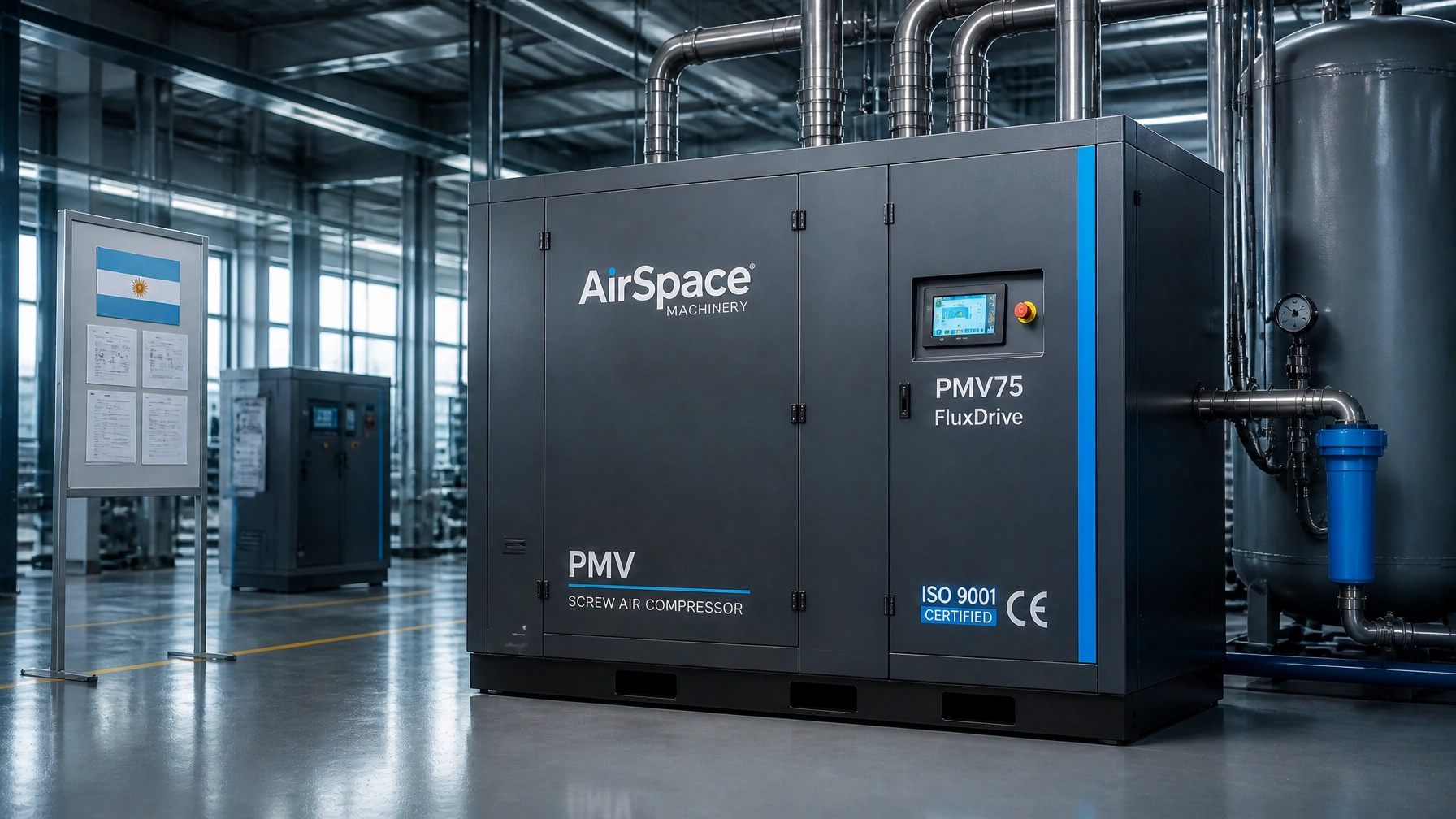
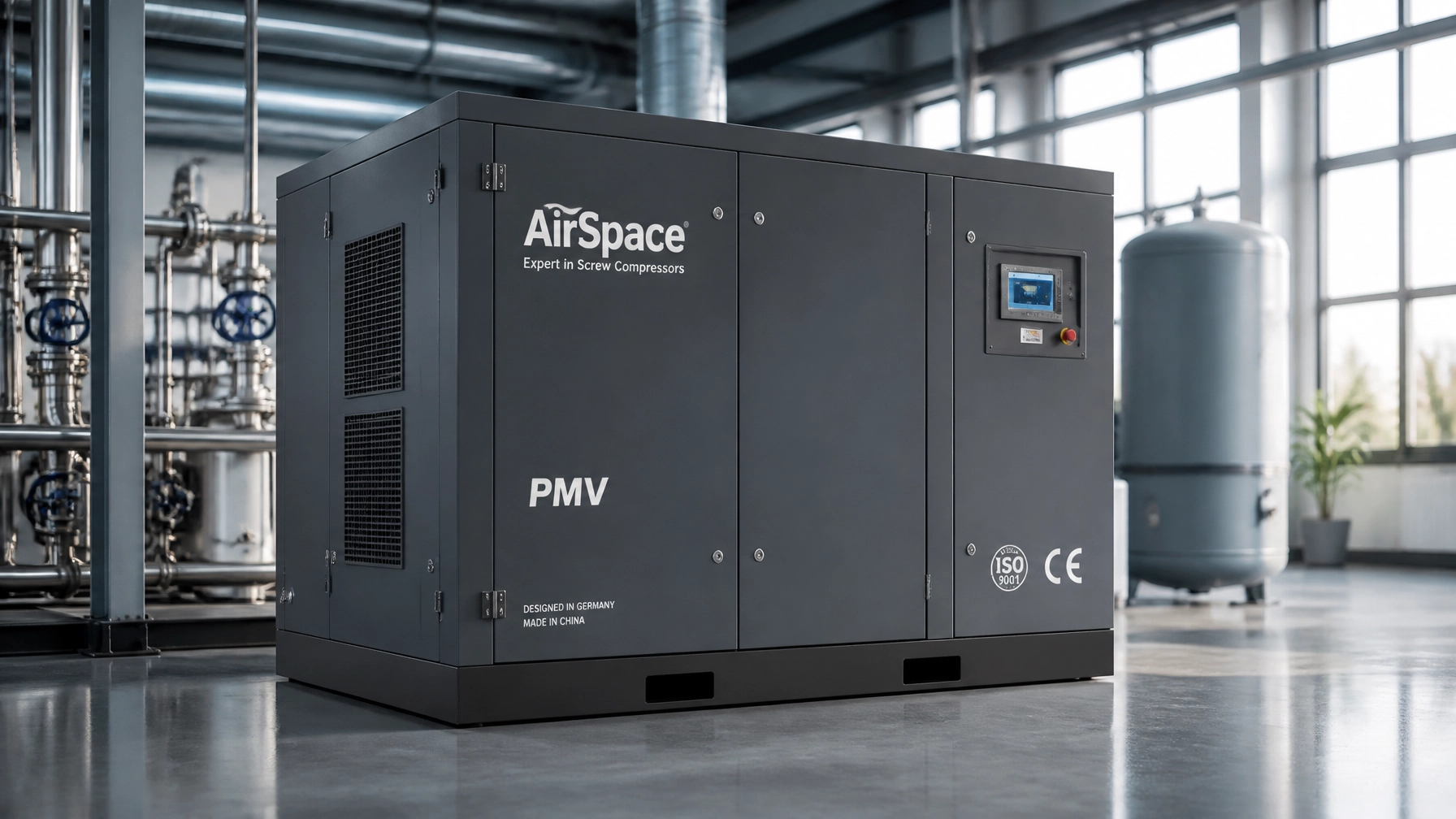
This comprehensive guide explains how Permanent Magnet Variable Frequency (PMV) screw air compressor technology delivers measurable energy savings of 30% or more for industrial facilities, covering the engineering principles behind IE5 motor efficiency, 5:6 asymmetrical rotor profiles, and intelligent pressure control systems. It is written for plant managers, procurement specialists, and operations directors evaluating compressed air system upgrades for cost reduction in 2026 and beyond.
A Permanent Magnet Variable Frequency (PMV) screw air compressor reduces industrial power bills by up to 30% by matching motor speed to real-time air demand and utilizing IE5 ultra-premium efficiency motors. Unlike traditional fixed-speed units that waste energy through “idling” and pressure overshooting, PMV technology maintains a constant pressure and eliminates the high-current surges of motor starts.
At AirSpace Machinery Co., Ltd., we leverage 20 years of engineering excellence and our 4000m² manufacturing facility to deliver high-performance solutions that have driven our annual sales to over 100M yuan. For managers looking to stabilize operational costs in 2026, understanding the ROI of an IE5-equipped PMV system is no longer optional, it is a competitive necessity.
How Does PMV Technology Eliminate the Costly “Idling Waste” Problem in Fixed-Speed Compressors?
PMV screw air compressors eliminate the wasteful “unload” cycle found in fixed-speed compressors by slowing the motor down to a near-halt instead of running it at full speed without producing air.
In a typical manufacturing environment, air demand fluctuates. A fixed-speed compressor runs at 100% RPM even when the demand is only 40%. To prevent over-pressurization, it goes into “unload” mode, the motor keeps spinning at high speed, consuming about 25-35% of its rated power while producing zero compressed air. This is pure waste. PMV technology uses a variable frequency drive to adjust the motor’s Hertz, ensuring you only pay for the air you actually use.
According to the U.S. Department of Energy, compressed air systems account for approximately 10% of all industrial electricity consumption, and optimizing these systems through variable frequency technology can yield energy savings of 15-35% depending on load profiles and operating conditions.
Why Is the IE5 Ultra-Premium Motor the New Gold Standard for Compressed Air System ROI?
The IE5 motor used in modern PMV screw air compressors offers the highest efficiency rating currently available, reducing internal energy losses by 20% compared to IE3 motors.
ROI on an energy-efficient air compressor is primarily driven by the motor’s ability to convert electricity into mechanical force without generating excess heat. Traditional induction motors suffer from “copper losses” in the rotor. Our PMV units utilize rare-earth permanent magnets that create their own magnetic field, eliminating rotor current losses entirely.
- Financial Impact: In a 24/7 operation, the price difference between a standard unit and an IE5 PMV unit is often recovered in energy savings within 10 to 14 months.
- Performance Stability: IE5 motors maintain high efficiency even at low speeds (partial loads), whereas standard motors see a sharp decline in efficiency when slowed down.
Does the 5:6 Asymmetrical Rotor Profile Actually Deliver Measurable Efficiency Gains?
The 5:6 asymmetrical rotor profile increases volumetric efficiency by 5-10% compared to older 4:6 profiles by reducing internal air leakage during the compression cycle.
Engineering precision at the “air end” is what separates a world-class PMV screw air compressor from a generic one. The 5:6 male-to-female lobe ratio provides a larger sealing area and a smaller “blow-hole” (the gap where air can escape back to the intake). This means the machine moves more cubic meters of air per kilowatt of energy consumed.

Addressing Global Buyer Concerns: Reliability, Compliance, and Regional Requirements
International buyers often ask how to verify the claims made by manufacturers. At AirSpace Machinery, we focus on verifiable standards and robust logistics support.
- Documentation: All our units carry CE and ISO 9001 certifications. We provide full technical data sheets that map flow (m³/min or CFM) against pressure (bar or psi) to ensure the machine meets your specific needs.
- Grid Stability (LATAM): For our partners in Latin America, our PMV drives are engineered to handle voltage fluctuations common in regional grids, protecting the IE5 motor from premature failure.
- Humidity & Dew Point (SEA): In Southeast Asia, we equip our all-in-one systems with oversized refrigerated dryers to maintain a stable pressure dew point despite high ambient humidity.
- Winterization (Russia-CIS): For cold climates, we utilize specialized lubricants and heater integrated systems to ensure the PMV drive doesn’t fail during sub-zero startups.
Why the Internal Control Panel Is the “Brain” Behind Your Energy Savings
The integrated variable frequency drive (VFD) and intelligent control panel allow for precise pressure control within ±0.1 bar, preventing the energy-intensive “pressure overshoot” common in manual systems.
Every 1 bar of excess pressure generated adds approximately 7% to your energy bill. By maintaining a razor-thin pressure margin, the 40hp variable frequency screw air compressor ensures you aren’t over-compressing air that your tools don’t need.
Complete Feature Comparison: Fixed-Speed vs. PMV Technology Performance
| Feature | Fixed-Speed Screw | PMV Screw (IE5) |
|---|---|---|
| Motor Efficiency | IE2 or IE3 (88-92%) | IE5 Ultra-Premium (95-97%) |
| Start-up Method | Star-Delta (6-8x surge) | Soft Start (No surge) |
| Partial Load Performance | Poor (Wasted energy in unload) | Excellent (Speeds matches demand) |
| Pressure Stability | Fluctuates ±1.0 bar | Stable within ±0.1 bar |
| Maintenance | Higher (Belts/Gears) | Lower (Direct Drive) |
| Total Cost of Ownership | High (70% is electricity) | Low (Reduced energy spend) |
The Second-Hand Trap: Why Used Japanese Machines Cost More Than New AirSpace PMV Systems
In Thailand and Vietnam, tightening policy on second-hand machinery imports makes a new PMV screw air compressor the only viable long-term strategy for many local factories. Used Japanese units may look cheap upfront. Regulatory risk, downtime, and energy waste change the math fast.
Second-hand imported machines have been common in both markets because they appear to offer a quick, low-capex solution. That logic weakens when import rules tighten and compliance scrutiny rises. If a factory builds its compressed air plan around aging imported equipment, it also takes on approval risk, uncertain service history, and unclear lifecycle cost.
What is changing in Southeast Asia for used machinery imports?
Thailand and Vietnam are moving toward tighter control of second-hand machinery imports, which raises the risk of relying on older used equipment as a long-term production asset.
For factory owners, the practical takeaway is simple: even where used equipment still circulates in the market, policy direction is moving toward stricter import compliance, age limits, technical documentation requirements, and higher scrutiny on older industrial assets. That makes a new compressor a more bankable decision than a used import with uncertain regulatory status.
In plain terms, if your plant needs stable compressed air for the next five to ten years, betting on old imported machinery is a shaky strategy. A new AirSpace PMV Screw Air Compressor aligns better with long-term production planning, service support, and documented compliance.
What are the hidden costs of used Japanese compressors?
The hidden costs are usually bigger than the initial discount.
- Unpredictable downtime: A 10+ year old machine may already have high running hours, worn air-end components, aging drives, and uncertain service history. That means more risk of sudden stoppages.
- Energy waste: Older fixed-control or legacy variable-speed systems typically consume more power than a current IE5 PMV design, especially under partial load.
- Zero warranty: Most used imports come with limited or no meaningful warranty coverage. If the controller, motor, or air end fails, the buyer absorbs the full repair cost.
- Hard-to-find spare parts: Legacy Japanese models can create long waits for specific filters, sensors, controller boards, and air-end parts, especially when local stocking is inconsistent.
- Unclear lifecycle cost: A used machine may need immediate maintenance, oil system work, separator replacement, bearing service, or electrical troubleshooting before it becomes stable.
Why does a new AirSpace PMV system offer higher ROI?
A new AirSpace PMV screw air compressor delivers clearer ROI because energy performance, reliability, and serviceability are known from the start.
Our PMV series uses IE5 motors, direct-drive architecture, and demand-based speed control to reduce wasted energy under partial load conditions. That matters in Thailand and Vietnam, where many factories run variable shifts, changing line loads, and humidity-sensitive compressed air systems.
Compared with a used unit, a new PMV system offers:
| Cost Factor | Used Japanese Unit | New AirSpace PMV Series |
|---|---|---|
| Regulatory Outlook | Rising import and compliance risk | Better fit for long-term factory planning |
| Warranty | Usually none or very limited | New equipment support based on configuration |
| Energy Efficiency | Often older 10+ year design | IE5 motor + variable speed control |
| Downtime Risk | Higher; unknown wear history | Lower; new components and factory testing |
| Performance Certainty | Actual condition varies by unit | Guaranteed factory-tested performance to spec |
| Spare Parts Access | Often difficult for older models | Direct support for current production models |
| ROI Visibility | Uncertain | Easier to model and verify |
Why is new equipment the safer long-term move for local factories?
Because long-term compressed air strategy depends on predictable compliance, predictable energy cost, and predictable uptime.
This is the key buyer takeaway: a used machine is not just a lower-price asset. It is often a bundle of unknowns. A new AirSpace PMV system gives factory owners a cleaner investment path with current efficiency technology, ISO 9001-certified production, and the backing of 20 years of engineering excellence.
For factories in Thailand and Vietnam, the decision is no longer just “used versus new.” It is regulatory uncertainty and hidden cost versus measurable ROI and guaranteed performance.
Frequently Asked Questions (Q&A)
Q: Can I upgrade my existing fixed-speed compressor to PMV?
A: While external VFDs can be added, they do not offer the same ROI as a dedicated PMV system. An external VFD cannot turn a standard induction motor into a Permanent Magnet motor. To achieve the 30% savings and IE5 efficiency, a full unit replacement is usually required.
Q: How do I verify CE and ISO 9001 documentation?
A: We provide the certificate numbers and the issuing body details with every proposal. You can verify these via the official accreditation portals.
Q: What is the typical lead time for a custom configuration?
A: Lead times vary depending on the specific pressure (bar/psi) and flow (m³/min) requirements. Generally, standard configurations ship faster, while custom-engineered units for extreme climates may require additional testing.

Sources and Technical Standards
- Efficiency Ratings: IEC 60034-30-1 (Defining IE1 to IE5 efficiency classes).
- Air Quality: ISO 8573-1:2010 (Contaminants and purity classes).
- Performance Testing: ISO 1217 (Displacement compressor acceptance tests).
Strategic Manufacturing Facility and Production Capabilities
Our production capability is backed by a state-of-the-art 4000m² facility. This scale allows us to maintain strict quality control over the 5:6 rotor assembly and IE5 motor integration, ensuring that the “energy-saving” label isn’t just marketing, but a measurable engineering fact.
Get a Custom Proposal for Your Industrial Facility
The path to a lower power bill starts with data. Whether you are running a laser cutting shop or a large-scale manufacturing plant, our technical team is ready to help you quantify your potential savings.
Email Johnny Wayne (Managing Director) at johnnywayne@chinacompressor.org to request a custom energy audit or receive our 2026 PMV Technology Handbook. Please specify your required pressure (bar/psi) and flow rate (m³/min or CFM) in your inquiry so we can provide an accurate technical proposal.
Author: Penny Winston
Position: Technical Writer, AirSpace Machinery Co., Ltd.
Reviewed by Engineering: May 2026
Certifications: CE, ISO 9001 Compliant Production
Additional Frequently Asked Questions About PMV Screw Air Compressors
What is the typical payback period for a PMV screw air compressor investment?
The typical payback period for a PMV screw air compressor ranges from 10 to 24 months depending on your facility’s operating hours, electricity rates, and current compressor efficiency. Facilities running 24/7 operations with high electricity costs often see payback in under 14 months due to the significant energy savings from IE5 motor technology and variable frequency control.
How does a PMV compressor perform in facilities with highly variable air demand?
PMV compressors excel in facilities with fluctuating air demand because the variable frequency drive continuously adjusts motor speed to match real-time requirements. This eliminates the energy waste associated with fixed-speed compressors cycling between loaded and unloaded states. Facilities with demand variations between 30-100% typically see the greatest energy savings compared to traditional systems.
What maintenance schedule is recommended for IE5 PMV screw air compressors?
IE5 PMV screw air compressors generally require less maintenance than fixed-speed units due to their direct-drive design eliminating belts and gears. Standard maintenance includes oil and filter changes every 2,000-4,000 operating hours, air-oil separator replacement every 4,000-8,000 hours, and periodic inspection of the VFD cooling system. The reduced mechanical complexity translates to lower long-term maintenance costs.
Can PMV technology work effectively in high-altitude or extreme temperature environments?
Yes, PMV compressors can be configured for high-altitude and extreme temperature operations with appropriate modifications. High-altitude installations may require derating calculations and enhanced cooling, while extreme cold environments benefit from specialized lubricants and integrated heating systems. AirSpace Machinery offers winterization packages for sub-zero climates and enhanced cooling options for tropical or high-altitude applications.
What is the difference between PMV technology and standard VFD compressors?
The key difference lies in the motor design: PMV compressors use permanent magnet synchronous motors (IE5 rated) that maintain high efficiency across all speed ranges, while standard VFD compressors typically use induction motors (IE2 or IE3) that lose efficiency significantly at reduced speeds. This means PMV systems deliver superior energy savings during partial load operation, which represents the majority of operating time for most industrial facilities.
How do I calculate the potential energy savings for my specific facility?
To calculate potential energy savings, you need to assess your current compressor’s power consumption, operating hours, load profile (percentage of time at full load vs. partial load), and local electricity rates. AirSpace Machinery offers complimentary energy audits that analyze your compressed air usage patterns and provide a detailed ROI projection comparing your existing system to a new PMV solution. Contact our technical team with your current system specifications for a customized analysis.
Are PMV screw air compressors suitable for oil-free compressed air applications?
While the PMV technology discussed in this article applies to oil-injected screw compressors, the same permanent magnet variable frequency principles can be applied to oil-free designs for applications requiring ISO 8573-1 Class 0 air quality. AirSpace Machinery offers both oil-injected PMV systems for general industrial use and oil-free configurations for food processing, pharmaceutical, electronics, and other contamination-sensitive industries.
📅 Last updated:
⚡ Is Your Factory Bleeding Cash?
Most fixed-speed compressors waste $3,600/year in "Unload Tax." Test your waste level in 30 seconds.
RUN THE ROI TEST →Ready to See How Much Your Facility Can Save?
Fill out the form below for a Free Energy Assessment.