Last Updated: September 6, 2026
This comprehensive guide is essential reading for factory managers, procurement specialists, and facility engineers who are evaluating industrial air compressor purchases from Chinese manufacturers. Whether you operate an automotive plant, textile facility, or any production environment requiring reliable compressed air, this analysis will reveal the true cost calculations behind the “cheapest option” and demonstrate why Total Cost of Ownership must guide your purchasing decision.
The “Cheapest Chinese Compressor” Trap: How Upfront Savings Vanish by Month 14
Buying an industrial air compressor based solely on the lowest sticker price is not a saving; it is an interest-bearing debt that your factory will pay every single day. The “Cheapest Chinese Compressor” trap is a common pitfall where a buyer saves $3,000 to $5,000 at the point of purchase, only to lose $8,700 in energy waste and maintenance by month 14. To avoid this, you must look beyond the invoice and evaluate the Total Cost of Ownership (TCO), where energy efficiency and reliability determine the true price of air.
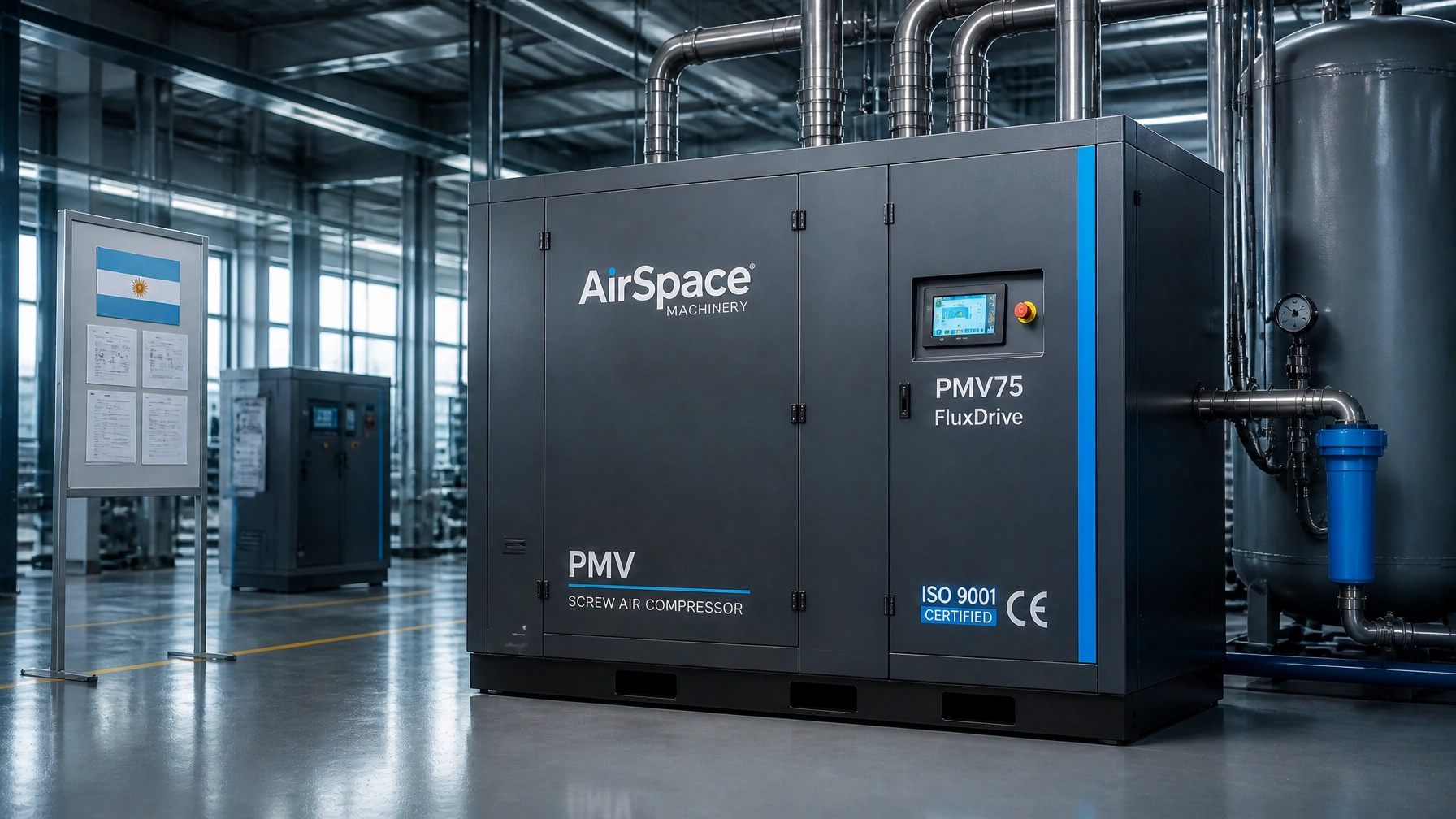
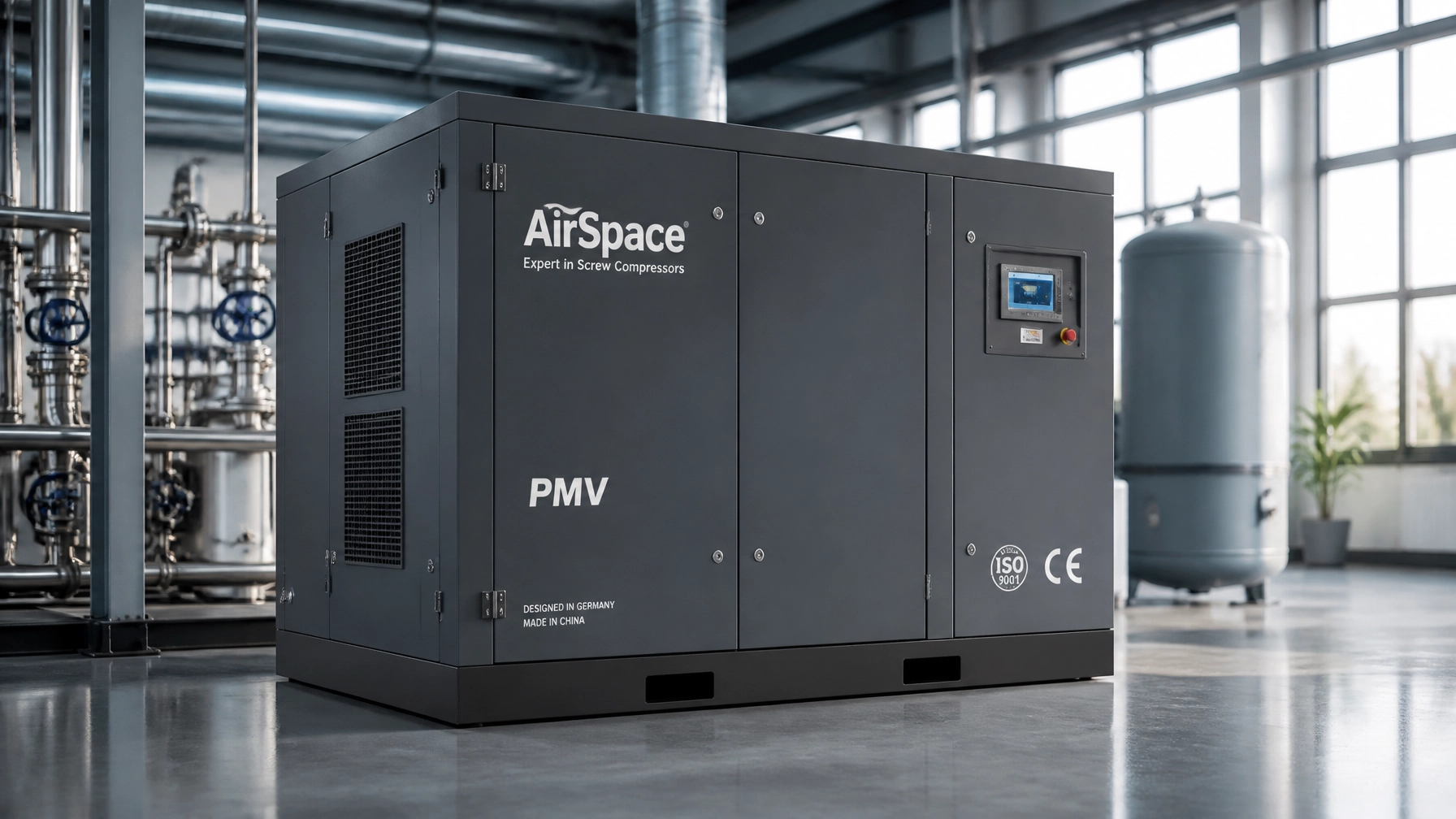
AirSpace Machinery specializes in breaking this cycle through Permanent Magnet Variable Frequency (PMV) technology that delivers a consistent 35% energy delta compared to standard fixed-speed systems.
The 14-Month Tipping Point: When Budget Compressor Costs Exceed Premium Alternatives
The math of industrial air is brutal. In a typical manufacturing environment, electricity accounts for roughly 75% of a compressor’s lifetime cost. The initial purchase price is usually less than 15%. When you buy the “budget” option from a typical OEM, you are essentially choosing a machine designed to be cheap to build, not cheap to run.
By the time you reach month 14, the cumulative “Unload Tax”, the energy wasted when a fixed-speed compressor runs but doesn’t produce air, and the “Maintenance Robbery”, the cost of replacing low-grade valves and filters, surpass the initial savings. At this stage, the “cheap” compressor becomes more expensive than a high-performance PMV unit from AirSpace.
According to the U.S. Department of Energy, compressed air systems account for approximately 10% of all industrial electricity consumption, and inefficient systems can waste up to 30% of that energy through poor load management and air leaks alone.
The Month-by-Month Cost Comparison: Budget vs. PMV Compressor Analysis
To illustrate the trap, let us look at the numbers. This table compares a standard 37kW (50HP) “budget” fixed-speed unit against an AirSpace PMV high-efficiency unit.
Month 1: Budget Unit Cost: $8,500 (Purchase). AirSpace PMV Cost: $12,000 (Purchase). The budget unit looks like a $3,500 win.
Month 6: Budget Unit Cumulative Energy: $9,600. AirSpace PMV Cumulative Energy: $6,240. The gap narrows by $3,360.
Month 12: Budget Unit Cumulative Energy: $19,200 + $800 Maintenance. AirSpace PMV Cumulative Energy: $12,480 + $400 Maintenance. The “saving” is now effectively gone.
Month 14: The Tipping Point. The budget unit has cost more in total electricity and repairs than the total purchase price of the superior unit.
Month 24: Budget Unit Total Cost: $48,900. AirSpace PMV Total Cost: $38,160. You have now lost over $10,000 by “saving” $3,500 upfront.

The Industrial Tax Series: Hidden Costs Draining Your Facility’s Profitability
At AirSpace, we categorize the hidden costs of low-end machinery into the “Industrial Tax” series. These are not just inconveniences; they are direct drains on your facility’s profitability.
- The Unload Tax
Standard fixed-speed compressors are designed to run at 100% capacity. When your plant needs only 50% air, the machine unloads, meaning the motor keeps spinning at full speed while producing zero air. This is the Unload Tax. In contrast, our PMV technology adjusts the motor speed to match your exact air demand. If you need 40% air, you pay for 40% energy. This creates the 35% energy delta that defines the AirSpace advantage.
- The Heat Tax
Many budget suppliers use undersized cooling systems that struggle when ambient temperatures rise. When a compressor runs hot, its efficiency drops and the oil degrades faster. We engineer our systems for the Heat Tax, ensuring stable 50°C operation even in demanding environments. This ruggedness is why our units maintain 99.9% uptime while cheaper alternatives are tripping out on high-temperature alarms.
- The Maintenance Robbery
Cheap compressors often use “proprietary” components that are actually just generic, low-grade parts with a high markup. These parts are designed to fail just after the warranty period. Frequent oil leaks, failing solenoid valves, and premature bearing wear are the hallmarks of the maintenance robbery. AirSpace follows ISO 9001 and CE standards, using high-tier universal components that ensure your “Fourth Utility”, your compressed air, is as reliable as your electricity or water.
The Fourth Utility Concept: Why Compressed Air Deserves Infrastructure-Level Reliability
We believe compressed air should be treated as the Fourth Utility. You do not expect your electricity to flicker or your water to be contaminated; why should you tolerate unreliable air? A “cheap” compressor treats air as a disposable commodity. An AirSpace system treats it as a critical infrastructure component.
By investing in ISO 8573-1 Class 0 integrity and PMV stability, you are not just buying a machine; you are securing your production line. Whether you are in automotive manufacturing or textile processing, a sudden loss of air pressure can ruin an entire batch of product. The cost of that single failure often exceeds the price of the compressor itself.

How to Evaluate a Global Supplier: Verification Criteria for Chinese Compressor Manufacturers
For buyers looking at Chinese manufacturers, it is vital to verify claims. Many legacy brands and industry giants rely on their name to justify high prices, while some budget suppliers hide their lack of engineering depth behind stock photos.
At AirSpace, we provide full transparency. We encourage buyers to verify our CE and ISO 9001 documentation. Our 4,000-square-meter facility in China produces high-performance systems with an annual sales volume of 100 million yuan. We do not hide behind marketing fluff; we lead with hard stats like our 35% energy delta and 99.9% uptime.
When comparing quotes, ask the following questions:
What is the specific power consumption (kW/m³/min) at 7, 8, and 10 bar?
Does the unit use a permanent magnet motor with a true Variable Speed Drive?
Is the cooling system rated for stable operation at 50°C?
What is the expected lifespan of the air end before a major overhaul is required?
If the supplier cannot answer these with data, you are looking at the “Cheapest Chinese Compressor” trap.
The Infinite Loop of Authority: Related Resources for Compressor Technology Decisions
Understanding the trap is just the first step. To truly optimize your facility, you must explore how different technologies impact your specific application. If you are debating between oil-free and oil-injected systems, read our analysis on Oil-Free vs Oil-Injected Screw Compressors: Which One Actually Saves Your Facility More? (https://www.chinacompressor.org/tag/air-compressor). For those still considering fixed-speed units, our deep dive into PMV vs Fixed Speed Air Compressor: The Real Cost Comparison (https://www.chinacompressor.org/tag/china-compressor) provides the granular data you need. Finally, for a benchmark against the market, see Legacy Brands vs AirSpace: The Honest PMV Efficiency Benchmark for 2026 (https://www.chinacompressor.org/tag/compressor-for-laser-cutting).
Conclusion: Escaping the Cheapest Compressor Trap Through TCO Analysis
The goal of any factory manager is to reduce costs and increase output. The “Cheap” compressor achieves the opposite. It inflates your energy bill, drains your maintenance budget, and puts your production at risk.
Escaping the trap means shifting your focus from the “Price per Unit” to the “Cost per Cubic Meter of Air.” When you make that shift, AirSpace Machinery becomes the clear choice. We provide the engineering excellence of a global leader with the value and export support of a specialized Chinese manufacturer.
Get a Proposal
Stop bleeding money on the Unload Tax and the Maintenance Robbery. Contact AirSpace Machinery today to receive a comprehensive proposal. We will help you calculate the TCO for your specific configuration, including pressure and flow requirements (please specify bar/psi and m³/min or CFM). Our lead times depend on your specific configuration, but our commitment to 35% energy savings is standard.
Author: Penny Winston
Penny is a Technical Writer at AirSpace Machinery, specializing in the “35% Energy Delta,” “The Fourth Utility Concept,” and “ISO 8573-1 Class 0 Integrity.” She translates complex engineering metrics into practical business logic for factory managers worldwide.
Reviewed by Engineering
Frequently Asked Questions About the Cheapest Chinese Compressor Trap
Why does the cheapest Chinese compressor become more expensive by month 14?
The 14-month tipping point occurs because electricity accounts for approximately 75% of a compressor’s lifetime cost, while the purchase price represents only about 15%. Budget fixed-speed compressors waste significant energy during unload cycles and require more frequent maintenance with low-grade replacement parts, causing cumulative costs to exceed the initial savings within 14 months of operation.
What is the Unload Tax and how does PMV technology eliminate it?
The Unload Tax refers to the energy wasted when a fixed-speed compressor’s motor continues running at full speed while producing zero air during low-demand periods. PMV (Permanent Magnet Variable Frequency) technology eliminates this waste by adjusting motor speed to match your exact air demand—if you need 40% air output, you only pay for 40% energy consumption, creating the 35% energy delta advantage.
How do I calculate the Total Cost of Ownership for an industrial air compressor?
To calculate TCO, you must factor in the initial purchase price (typically 15% of lifetime cost), energy consumption over the expected lifespan (approximately 75% of lifetime cost), maintenance and replacement parts, downtime costs from reliability issues, and any production losses from air quality problems. Shifting your focus from “Price per Unit” to “Cost per Cubic Meter of Air” provides an accurate TCO comparison.
What questions should I ask a Chinese compressor supplier to avoid the trap?
Request specific power consumption data (kW/m³/min) at 7, 8, and 10 bar operating pressures. Ask whether the unit uses a genuine permanent magnet motor with true Variable Speed Drive technology, whether the cooling system is rated for stable 50°C operation, and what the expected air end lifespan is before major overhaul. Suppliers who cannot provide data-backed answers to these questions are likely selling budget equipment that will cost more over time.
What certifications should a reliable Chinese compressor manufacturer have?
Reputable manufacturers should hold CE certification for European safety standards and ISO 9001 certification for quality management systems. For applications requiring oil-free air, look for ISO 8573-1 Class 0 certification which guarantees air purity standards. Always request documentation and verify these certifications directly rather than accepting claims at face value.
How much can PMV compressors actually save compared to fixed-speed units?
PMV technology typically delivers a 35% energy delta compared to standard fixed-speed systems operating under variable load conditions. In the 37kW comparison example, this translates to energy savings of approximately $6,720 in the first year alone. Over a 24-month period, the total cost difference can exceed $10,000 in favor of the higher-efficiency PMV unit despite its higher initial purchase price.
Why is compressed air called the Fourth Utility and why does it matter?
Compressed air is called the Fourth Utility because it should be treated with the same reliability expectations as electricity, water, and natural gas in industrial facilities. Unreliable compressed air can halt production lines, ruin product batches, and create losses that exceed the cost of the compressor itself. Investing in equipment that treats compressed air as critical infrastructure rather than a disposable commodity protects your entire operation from costly disruptions.
📅 Last updated:
⚡ Is Your Factory Bleeding Cash?
Most fixed-speed compressors waste $3,600/year in "Unload Tax." Test your waste level in 30 seconds.
RUN THE ROI TEST →Ready to See How Much Your Facility Can Save?
Fill out the form below for a Free Energy Assessment.