Last Updated: September 6, 2026
This comprehensive guide explains exactly how to calculate the energy costs of your compressed air system using industry-standard formulas, breaks down each variable affecting your electricity consumption, and reveals proven strategies for reducing annual operating expenses by thousands of dollars. Whether you are a plant manager evaluating equipment upgrades, a facilities engineer conducting energy audits, or a procurement specialist comparing compressor options for global sourcing, this article provides the technical calculations, cost benchmarks, and efficiency insights you need to make informed decisions about your compressed air infrastructure in 2026 and beyond.
The Quick Answer: Your Compressed Air Energy Cost Formula Explained
To calculate the annual energy cost of your compressed air system, use this formula:
Annual Energy Cost = (bhp) × (0.746) × (operating hours) × (electricity rate per kWh) × (load percentage) × (full-load bhp percentage) ÷ Motor Efficiency
For a 50-horsepower screw air compressor running 8,000 hours per year at USD 0.10 per kWh with 80 percent motor efficiency and 56 percent full-load capacity, the calculation looks like this:
(50) × (0.746) × (8,000) × (0.10) × (100%) × (56%) ÷ (80%) = USD 20,888 per year
That single number represents roughly 70 percent of your total compressed air operating costs. The remaining 30 percent typically breaks down into maintenance at 5 percent, system leaks at 20 percent, and other operational equipment at 5 percent. This is why energy-efficient air compressor technology has become the primary focus for cost-conscious plant managers worldwide.
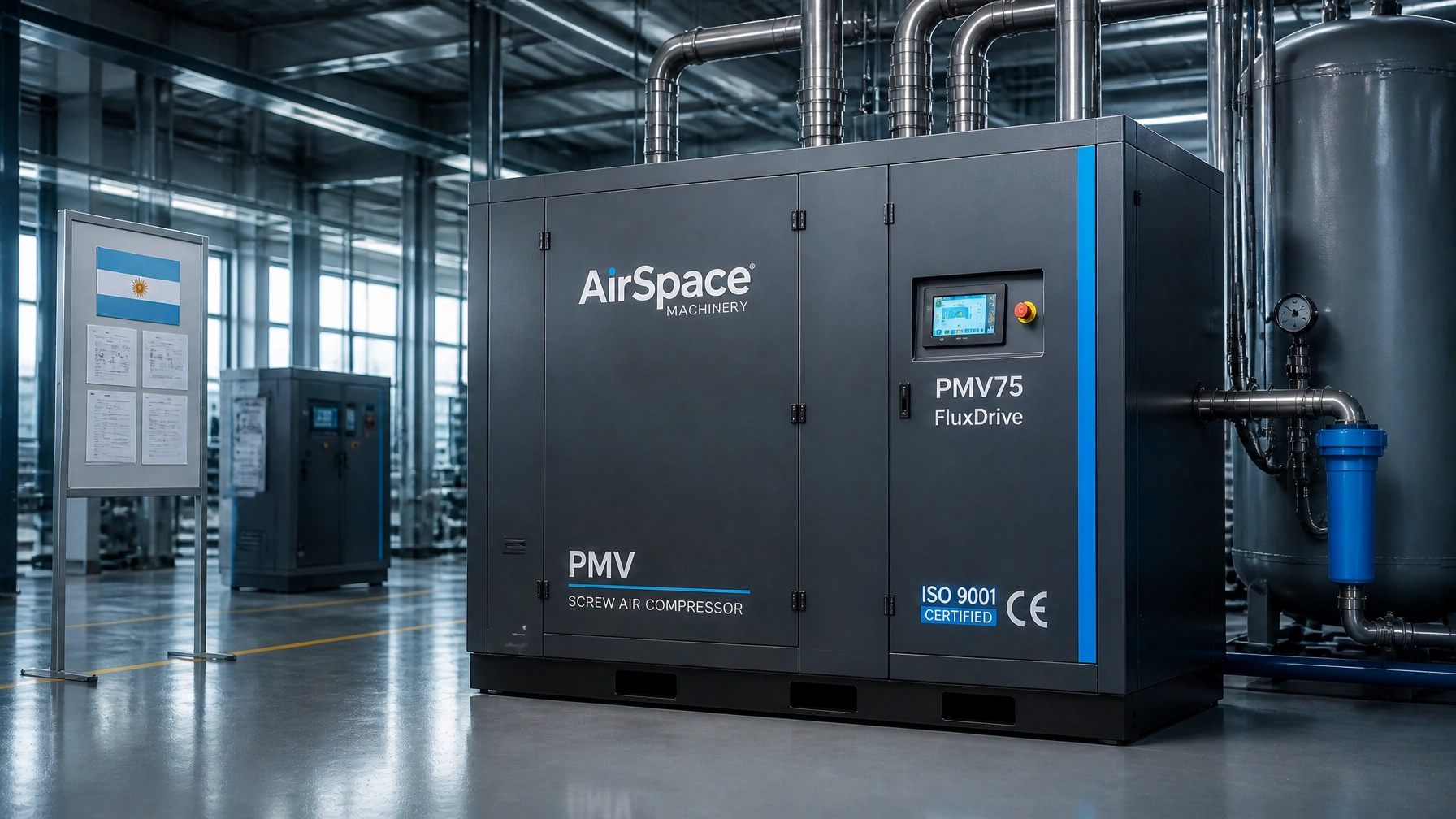
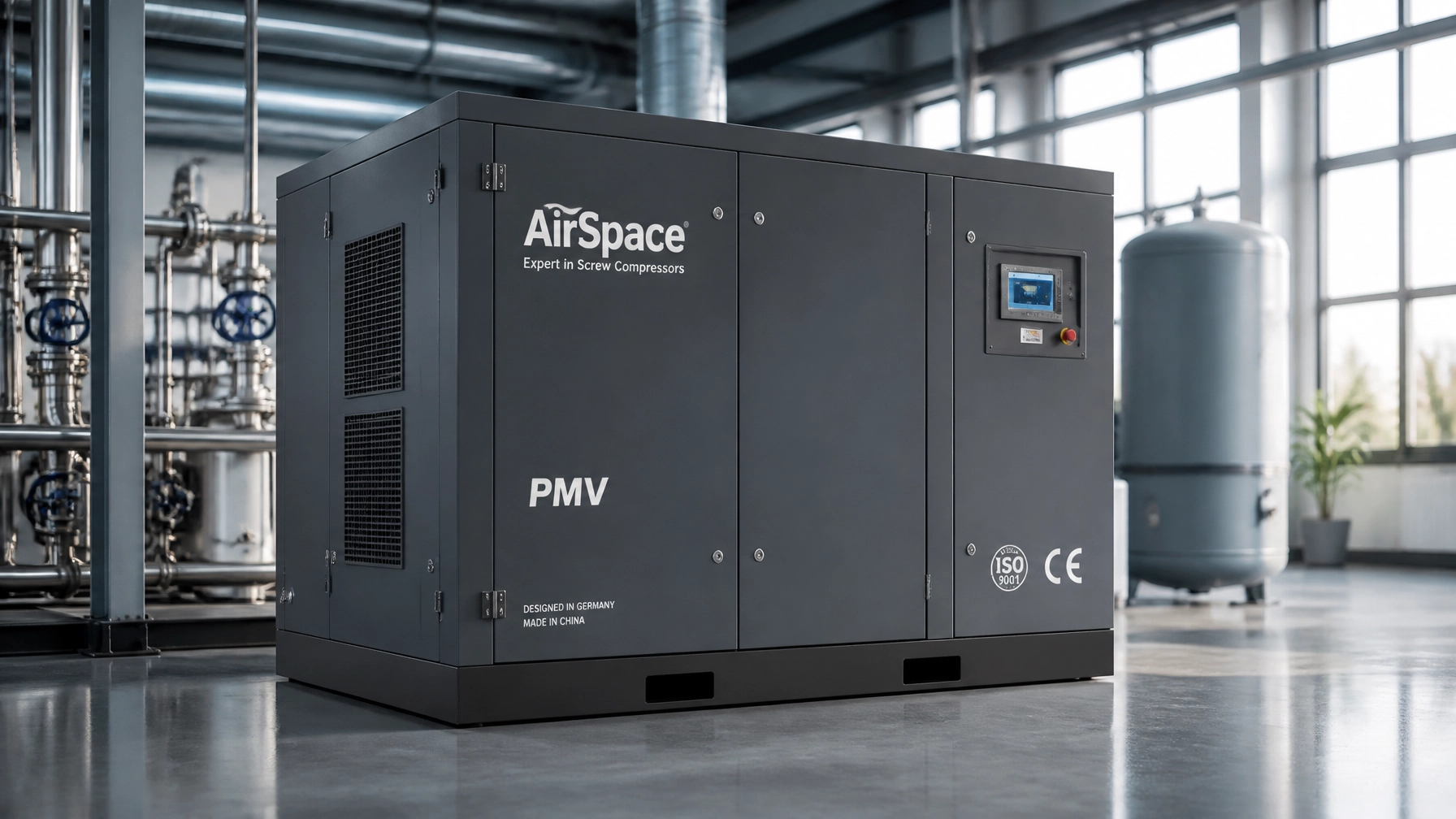
At AirSpace Machinery, our engineering team has spent 20 years helping global buyers understand these calculations and, more importantly, reduce them. Our 4000m² manufacturing facility produces Permanent Magnet Variable Frequency (PMV) screw air compressors specifically designed to cut those annual energy bills by 30 to 50 percent compared to fixed-speed alternatives.
According to the U.S. Department of Energy, compressed air systems account for approximately 10 percent of all industrial electricity consumption in the United States, representing an estimated USD 5 billion in annual energy costs across the manufacturing sector.
Why Electricity Dominates Your Compressed Air Operating Budget
Electricity accounts for approximately 70 percent of the total cost of ownership for industrial compressed air systems. This means that over a 10-year lifespan, a 75kW screw air compressor can consume energy costs exceeding 10 times its original purchase price.
The reason is straightforward: compressed air is one of the most energy-intensive utilities in any manufacturing facility. Generating compressed air requires significant electrical power, and traditional fixed-speed compressors run at full capacity regardless of actual demand. When your production line needs only 60 percent airflow, a fixed-speed machine still consumes nearly full power.
This inefficiency is precisely what Permanent Magnet Variable Frequency (PMV) technology addresses. PMV screw air compressors adjust motor speed to match real-time demand, delivering only the air volume your facility actually needs at any given moment.
Breaking Down the Variables in Your Energy Cost Calculation
Understanding each variable in the energy cost formula helps you identify where savings opportunities exist.
Brake Horsepower (bhp) refers to the rated power output of your compressor motor. This number appears on the equipment nameplate and in manufacturer specifications. Common industrial screw compressors range from 10 bhp to over 500 bhp depending on facility requirements.
The conversion factor of 0.746 translates horsepower into kilowatts, since electricity is billed in kilowatt-hours. This is a fixed constant used universally in power calculations.
Operating hours represent the total annual runtime of your compressed air system. A facility running two shifts, five days per week typically operates around 4,000 hours annually. Continuous 24/7 operations reach approximately 8,760 hours per year.
Electricity rate per kWh varies significantly by region and country. Industrial rates in China currently average between RMB 0.50 and RMB 0.80 per kWh. European facilities often pay EUR 0.15 to EUR 0.25 per kWh, while North American plants typically see USD 0.08 to USD 0.15 per kWh. Always use your actual utility rate for accurate calculations.
Load percentage indicates how much of the time your compressor runs versus sits idle. Most facilities see load percentages between 60 and 85 percent.
Full-load bhp percentage measures the actual demand placed on the compressor during operation. This is where variable frequency drive technology creates substantial savings. A PMV compressor operating at 60 percent demand consumes proportionally less energy, while a fixed-speed unit consumes nearly full power regardless.
Motor efficiency typically ranges from 75 to 95 percent for industrial electric motors. Premium efficiency motors meeting IE3 or IE4 standards deliver efficiencies above 90 percent.
How PMV Technology Cuts Compressed Air Energy Costs by 30 to 50 Percent
Permanent Magnet Variable Frequency (PMV) screw air compressors represent the current state of the art in energy-efficient air compressor design. These systems combine permanent magnet motors with variable frequency drives to achieve two critical advantages.
First, permanent magnet motors deliver higher efficiency than traditional induction motors across all operating speeds. Where a standard induction motor might achieve 88 percent efficiency at full load and drop to 75 percent at partial load, a permanent magnet motor maintains 95 percent or higher efficiency even at reduced speeds.
Second, variable frequency drives allow the motor to operate at precisely the speed required to meet current air demand. Instead of cycling on and off or running at full speed with unloaded intervals, a PMV compressor smoothly adjusts output. This eliminates the energy waste associated with starting surges, unloaded running, and blow-off losses.
AirSpace Machinery PMV screw air compressors typically achieve energy savings of 30 to 50 percent compared to equivalent fixed-speed models operating under variable load conditions. For a 75kW unit running 6,000 hours annually at USD 0.10 per kWh, this translates to annual savings between USD 13,000 and USD 22,000.
These savings assume load variation of at least 20 percent during normal operations. Facilities with highly consistent demand may see smaller percentage savings, while those with significant load swings often exceed 50 percent reduction.
The Hidden Cost: Air Leaks Waste Up to 30 Percent of Your Compressor Energy
Air leaks represent the largest controllable source of energy waste in most compressed air systems. Studies consistently show that leaks consume 20 to 30 percent of compressor output in facilities without active leak management programs.
A single quarter-inch leak in a 100 psi system wastes approximately 100 CFM of compressed air continuously. At typical energy costs, this single leak adds USD 12,000 or more to annual operating expenses.
Calculating leak losses requires measuring system pressure drop during non-production periods or using ultrasonic leak detection equipment. The formula for leak energy cost is:
Leak Cost = (leak volume in CFM) × (kW per CFM for your system) × (hours) × (electricity rate)
Most industrial screw compressors require between 0.18 and 0.25 kW to produce one CFM of compressed air at 100 psi. This ratio, known as specific power, varies by compressor efficiency and operating pressure.
Quick Estimation Method for Compressed Air Budget Planning
For rapid cost estimation without detailed measurements, use this simplified approach:
Compressed air costs approximately USD 0.25 per 1,000 cubic feet based on an electricity rate of USD 0.08 per kWh.
To apply this estimate, multiply your total daily air consumption in thousands of cubic feet by 0.25, then multiply by your annual operating days. Adjust proportionally if your electricity rate differs from USD 0.08 per kWh.
This method provides budget-level accuracy suitable for initial planning. For equipment selection and ROI calculations, use the detailed formula with measured variables specific to your facility.
Verifying Compressor Equipment Efficiency Before Purchase
Global buyers evaluating energy-efficient air compressor options should request specific documentation from manufacturers.
CE certification confirms the equipment meets European safety and electromagnetic compatibility standards. ISO 9001 certification indicates the manufacturer maintains documented quality management systems. Both certifications should be verifiable through the issuing bodies.
Technical specifications should include specific power ratings at multiple operating points, not just optimal conditions. Ask for performance data at 50 percent, 75 percent, and 100 percent load to understand real-world efficiency.
AirSpace Machinery provides complete technical documentation including CE and ISO 9001 certificates, detailed performance curves, and energy consumption data for all PMV screw air compressor models. Our 100 million yuan annual sales volume reflects the trust global buyers place in our engineering accuracy and product reliability.
Take Action: Calculate Your Potential Compressed Air Energy Savings
Every facility has unique operating conditions that affect compressed air energy costs. Variables including ambient temperature, altitude, humidity, pressure requirements, and demand patterns all influence actual consumption.
The engineering team at AirSpace Machinery offers detailed energy assessments for facilities considering upgrades to PMV technology. Provide your current compressor specifications, operating hours, and electricity rates, and we will calculate your projected annual savings with specific product recommendations.
For facilities requiring multiple compressors, system-level optimization often delivers additional savings beyond individual unit efficiency through intelligent load sharing and sequencing controls.
Get a Proposal by contacting our team at AirSpace Machinery Contact Page with your pressure requirements in bar or psi and flow requirements in cubic meters per minute or CFM. Lead times depend on configuration and destination.
Sources and Standards Referenced
Energy cost formulas based on Compressed Air and Gas Institute (CAGI) methodology. Motor efficiency standards reference IEC 60034-30-1 for IE efficiency classifications. Leak loss estimates derived from U.S. Department of Energy Compressed Air Challenge program data. Specific power ratios based on ISO 1217 testing standards for displacement compressors.
Author: Penny Winston | AirSpace Machinery Co., Ltd.
Penny writes about industrial compressed air systems, energy efficiency, and manufacturing technology for global B2B audiences.
Reviewed by Engineering | AirSpace Machinery Technical Team
Frequently Asked Questions About Compressed Air Energy Cost Calculations
What is the average cost per CFM to produce compressed air?
The average cost to produce one cubic foot per minute (CFM) of compressed air ranges from USD 0.18 to USD 0.30 per hour depending on your electricity rate, compressor efficiency, and operating pressure. For most industrial facilities using screw air compressors at 100 psi, the specific power requirement falls between 0.18 and 0.25 kW per CFM. Multiplying this by your local electricity rate gives you the hourly cost per CFM for your specific operation.
How much can a variable frequency drive compressor save compared to a fixed-speed unit?
Variable frequency drive (VFD) compressors, particularly Permanent Magnet Variable Frequency (PMV) models, typically save 30 to 50 percent on energy costs compared to equivalent fixed-speed compressors in facilities with variable demand patterns. The actual savings depend on your load profile, with facilities experiencing demand fluctuations of 30 percent or more seeing the highest returns. For a 75kW compressor running 6,000 hours annually, this can translate to USD 13,000 to USD 22,000 in annual savings.
What percentage of compressed air system costs goes to electricity?
Electricity accounts for approximately 70 percent of the total cost of ownership for industrial compressed air systems over their operational lifespan. The remaining costs typically break down into maintenance at approximately 5 percent, energy lost to system leaks at 20 percent, and other operational expenses at 5 percent. This distribution makes energy efficiency the most impactful factor when selecting new compressor equipment or optimizing existing systems.
How do I calculate the cost of air leaks in my compressed air system?
To calculate air leak costs, use the formula: Leak Cost = (leak volume in CFM) × (kW per CFM for your system) × (operating hours) × (electricity rate per kWh). A quarter-inch leak in a 100 psi system wastes approximately 100 CFM continuously, which can add USD 12,000 or more annually to your energy bill. Ultrasonic leak detection equipment can help identify and quantify leaks throughout your distribution system for accurate cost assessment.
What is specific power and why does it matter for compressor efficiency?
Specific power measures how many kilowatts (kW) a compressor requires to produce one cubic foot per minute (CFM) of compressed air at a given pressure, typically expressed as kW/100 CFM. Lower specific power values indicate higher efficiency, with modern PMV screw air compressors achieving specific power ratings 15 to 25 percent better than traditional fixed-speed units. When comparing compressor options, request specific power data at multiple load points (50%, 75%, and 100%) rather than just optimal conditions to understand real-world performance.
How many hours per year should I use when calculating compressed air energy costs?
Annual operating hours vary significantly by facility type: single-shift operations typically run 2,000 to 2,500 hours, two-shift facilities operate approximately 4,000 hours, and continuous 24/7 production reaches 8,000 to 8,760 hours annually. Use your actual runtime data from production logs or compressor hour meters for the most accurate calculations. If historical data is unavailable, estimate conservatively based on your shift schedule and include an allowance for overtime and weekend production periods.
What certifications should I look for when purchasing an energy-efficient air compressor internationally?
When sourcing compressors from international manufacturers, verify CE certification for European safety and electromagnetic compatibility standards, and ISO 9001 certification confirming documented quality management systems. Additionally, request performance data tested according to ISO 1217 standards and motor efficiency ratings per IEC 60034-30-1 classifications (IE3 or IE4 for premium efficiency). Reputable manufacturers like AirSpace Machinery provide complete technical documentation including these certificates and detailed performance curves for all operating conditions.
📅 Last updated:
⚡ Is Your Factory Bleeding Cash?
Most fixed-speed compressors waste $3,600/year in "Unload Tax." Test your waste level in 30 seconds.
RUN THE ROI TEST →Ready to See How Much Your Facility Can Save?
Fill out the form below for a Free Energy Assessment.