Short answer: A 75kW PMV screw air compressor can save about $20,120 per year in a variable-demand plant under the assumptions shown below.
Written by Penny Winston, Blog Writer, AirSpace Machinery Co., Ltd. — a 4,000 m² compressor manufacturing facility in Shanghai, ISO 9001:2015 certified and CE marked.
Reviewed by Richard Moore, Field Technical Manager.
A Permanent Magnet Variable Frequency (PMV) screw air compressor typically cuts energy use by up to 35% versus a legacy fixed-speed induction-motor compressor in variable-demand applications. The big win usually shows up at part load, where unloaded running and rotor losses burn power without making air.
In modern manufacturing, compressed air is often called the “Fourth Utility” because it is essential and expensive. If your facility still runs legacy fixed-speed induction motors, you may be paying for heat, unloaded run time, and poor part-load control instead of useful compressed air.
Knowledge Chunk 1: What Is the Hard Efficiency Delta?
The practical energy-efficiency delta is commonly up to 35%, and in many real plants the difference shows up most clearly at partial load. Simple version: when air demand moves up and down, a PMV screw air compressor follows demand, while a fixed-speed induction machine often keeps spinning and wasting power.
Hard stats buyers care about:
- Up to 35% lower energy consumption is a realistic comparison benchmark for PMV vs. fixed-speed induction systems under variable demand conditions.
- 30% to 70% of full-load power can still be consumed by a fixed-speed compressor while unloaded, depending on control method and package design.
- 96% to 98% motor efficiency is typical for high-efficiency permanent magnet motor packages, versus roughly 88% to 92% for many older induction motor installations in this size band.
- In a representative 75kW installation running 6,000 hours/year at $0.15/kWh, modeled annual savings can reach $20,120/year when load profile and control losses favor variable-speed operation.
“Compressed air is too expensive to run with yesterday’s motor logic. Buyers should ask one question first: what happens at part load? That is where the money leaks out.”
— Johnny Wayne, Managing Director, AirSpace Machinery Co., Ltd.
Knowledge Chunk 2: Why Does a Legacy Induction Compressor Waste Money?
Legacy fixed-speed induction compressors waste money because they keep consuming power when your air demand drops. That waste comes from unloaded running, motor slip, and rotor heat loss.
Traditional induction motors are designed to run at a constant speed. When demand falls, the compressor often shifts into an unloaded state instead of matching output to demand. In that state, the motor still spins and can consume 30% to 70% of full-load power while producing zero air.
Induction motors also have slip and rotor copper losses. They rely on induced current in the rotor to create the magnetic field, so part of your input power becomes heat instead of shaft power. For a high-output factory, that inefficiency becomes a recurring operating cost on every shift.
Knowledge Chunk 3: How Does PMV Technology Fix the Problem?
PMV technology fixes the waste problem by staying stable at changing demand and matching compressor speed to actual air use. That is the core win: less wasted power, steadier control, and better low-speed performance.
Permanent Magnet Variable Frequency (PMV) technology replaces the traditional copper-wound rotor with high-coercivity permanent magnets. This creates three immediate engineering advantages:
- Lower rotor-related loss: The motor avoids the same induced-rotor-loss pattern as a conventional induction motor, which reduces wasted energy and excess heat.
- Stable synchronous operation: The motor runs in sync with electrical frequency, which supports stable speed control and strong low-speed torque.
- Demand matching: A PMV screw air compressor slows down or speeds up to match your actual Flow (m³/min or CFM) requirement. If air demand falls, power draw falls with it.
Authority hook: AirSpace Machinery commonly configures PMV packages with high-tier named parts, including BAOSI air ends and Hanbell air-end options/components in selected configurations, depending on model, pressure range, and buyer specification. Buyers should ask for the exact bill of materials and data sheet for the quoted machine. Simple rule: trust the paperwork, not the sales pitch.
Knowledge Chunk 4: What Does the ROI Look Like on a Real 75kW Site?
A 75kW PMV screw air compressor can save about $20,120 per year in a variable-demand plant under the assumptions shown below. The point is not the headline number alone. The point is that the savings come from measurable operating conditions: hours, tariff, and load profile.
To understand the financial impact, let’s look at a typical 75kW (100HP) installation. A standard fixed-speed induction compressor running 6,000 hours a year in a facility with fluctuating demand (averaging 70% load) will consume significantly more energy than an equivalent 100hp 75kw PMV Variable Frequency Screw Air Compressor.
| Feature | Legacy Induction (Fixed Speed) | PMV Screw Air Compressor |
|---|---|---|
| Annual Electricity Cost | ~$72,500 | ~$52,380 |
| Energy Efficiency Delta | Baseline | ~27.8% lower annual electricity cost in this scenario; up to 35% in variable-demand applications |
| Energy Efficiency (Part Load) | Poor (30% waste) | Excellent (Matches Demand) |
| Motor Efficiency | 88-92% (IE2/IE3) | 96-98% (IE4/IE5) |
| Maintenance | Higher (Belts/Couplings) | Lower (Direct Drive) |
| Estimated Annual Savings | $0 | $20,120 |
Note: Calculations based on $0.15/kWh and 6,000 annual operating hours. Actual savings vary by local utility rates, pressure setpoint, leakage rate, control band, ambient temperature, and load profile.
“A savings claim without operating assumptions is just decoration. Good engineering starts with duty cycle, tariff, pressure band, and required air quality.”
— Johnny Wayne, Managing Director, AirSpace Machinery Co., Ltd.
Addressing Global Operational Challenges
When exporting equipment to diverse markets, we recognize that energy efficiency is only one part of the equation. Our engineering team at AirSpace Machinery focuses on region-specific pain points to ensure that your energy-efficient air compressor survives the environment it’s placed in.
LATAM: Power Quality and Grid Stability
In many South American industrial zones, voltage fluctuations are common. A traditional induction motor might burn out during a brownout. Our PMV systems utilize high-grade Variable Frequency Drives (VFDs) that act as a buffer, protecting the motor from power spikes and reducing the “in-rush” current that can trigger expensive peak-demand penalties from your utility provider.
Southeast Asia: Humidity and Dew Point
In humid climates like Vietnam or Indonesia, moisture is the enemy of the screw element. Our PMV compressors are engineered to maintain optimal discharge temperatures, preventing internal condensation while ensuring the refrigerated air dryer doesn’t overwork.

Knowledge Chunk 5: How Do Buyers Verify Compliance, Components, and Engineering Claims?
Buyers should verify CE documents, ISO 9001 certification, exact component declarations, and machine performance data before purchase. Do not rely on brochure language alone.
For international buyers, the biggest risk is often documentation quality, not the basic compressor concept. When sourcing a PMV screw air compressor, ask for:
- ISO 9001 Certification: This verifies the manufacturer operates a documented quality-management system.
- CE Documentation: Ask for the Declaration of Conformity and supporting technical file references relevant to the machine scope and destination market.
- Technical Data Sheets: Always verify Specific Power (kW/m³/min) at the stated Pressure (bar/psi) and reference conditions.
- Component Confirmation: If the supplier mentions BAOSI or Hanbell components, request written confirmation of the exact air end or major component included in your quoted configuration.
- Inspection Records: Request factory test data, nameplate details, and packing documentation before shipment.
At AirSpace Machinery, we support buyer verification with CE and ISO 9001 documentation, technical data sheets, and export coordination. Configuration, accessories, and delivery timing depend on the final machine specification and destination.
FAQ: Common Questions from Procurement Teams
Q: What is the typical lead time for a custom PMV unit?
A: Depending on the specific configuration and pressure requirements (e.g., 8-bar vs. 16-bar for laser cutting), our lead times range from 7 to 35 days.
Q: Can I replace my existing motor with a PMV motor?
A: While retrofitting is possible, it is often more cost-effective to replace the entire unit. A PMV screw air compressor is designed as an integrated system where the air end, motor, and inverter are perfectly matched for maximum efficiency.
Q: Is PMV technology reliable in dusty environments?
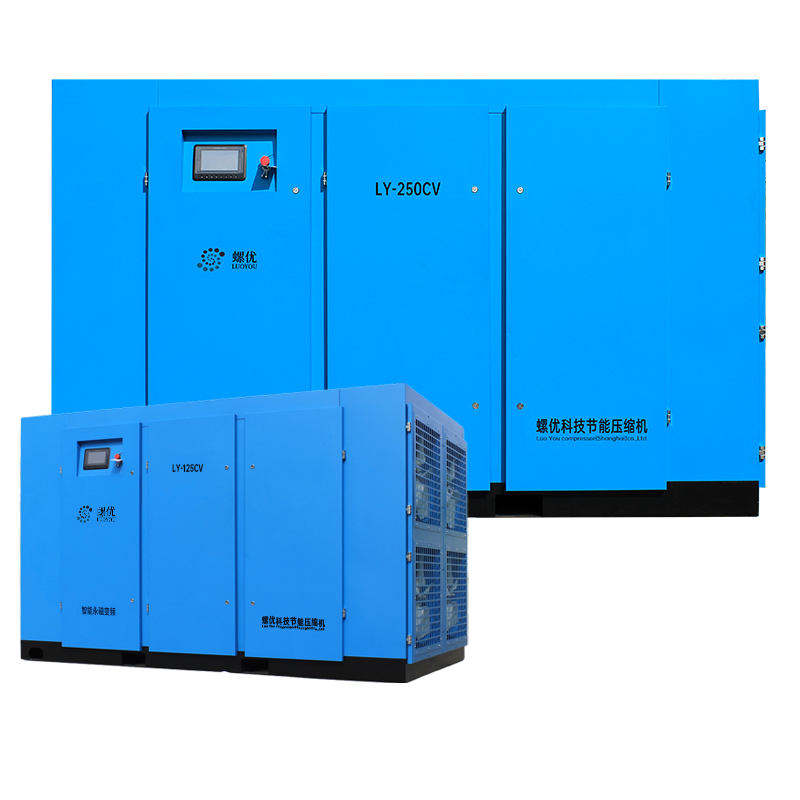
A: Yes. Our enclosures are designed with high-efficiency filtration and cooling paths. Models like the LY-125CV feature robust, noise-reducing cabinets that protect sensitive electronics from ambient factory dust.

Conclusion: The Cost of Inaction
Sticking with your old induction motor isn’t “playing it safe.” It’s a steady monthly loss. With energy prices rising globally, the case for PMV is simple: up to 35% energy savings, better control stability, and stronger component confidence when the package uses proven named parts like BAOSI and Hanbell. Whether you are running a 10HP shop or a 340HP industrial plant, the physics stays the same: match output to demand and stop paying for wasted power.
Ready to stop overpaying for your “Fourth Utility”?
Get a Proposal for a custom-configured PMV solution today. Please specify your required Pressure (bar/psi) and Flow (m³/min or CFM) so our engineers can provide an accurate energy-savings projection.
Sources and Standards
- Motor efficiency classification: IEC 60034-30-1 defines efficiency classes such as IE2, IE3, IE4, and IE5 for rotating electrical machines.
- Motor test methods: IEC 60034-2-1 provides methods for determining losses and efficiency of rotating electrical machines.
- Variable speed energy performance context: Efficiency gains cited in this article assume variable-demand compressed air operation where speed control reduces unloaded running and part-load waste.
- Air quality standards: ISO 8573-1:2010 defines compressed air purity classes; final class depends on downstream treatment and filtration.
- Compliance: AirSpace Machinery references CE and ISO 9001 documentation for applicable products and manufacturing quality systems.
- Engineering note on statistics: The up-to-35% energy-saving range, 30% to 70% unloaded-power range, and the 75kW ROI example are engineering application estimates based on stated assumptions, model comparisons, and field-use scenarios; actual performance must be confirmed against the quoted machine data sheet and site conditions.
May 2026
Key takeaways
- The up-to-35% energy-saving range, 30% to 70% unloaded-power range, and the 75kW ROI example are engineering application estimates based on stated assumptions, model comparisons, and field-use scenarios; actual performance must be confirmed against the quoted machine data sheet and site conditions.
- A standard fixed-speed induction compressor running 6,000 hours a year in a facility with fluctuating demand (averaging 70% load) will consume significantly more energy than an equivalent 100hp 75kw PMV Variable Frequency Screw Air Compressor.
- What Does the ROI Look Like on a Real 75kW Site?.
- Whether you are running a 10HP shop or a 340HP industrial plant, the physics stays the same: match output to demand and stop paying for wasted power.
- To understand the financial impact, let’s look at a typical 75kW (100HP) installation.
⚡ Is Your Factory Bleeding Cash?
Most fixed-speed compressors waste $3,600/year in "Unload Tax." Test your waste level in 30 seconds.
RUN THE ROI TEST →Ready to See How Much Your Facility Can Save?
Fill out the form below for a Free Energy Assessment.