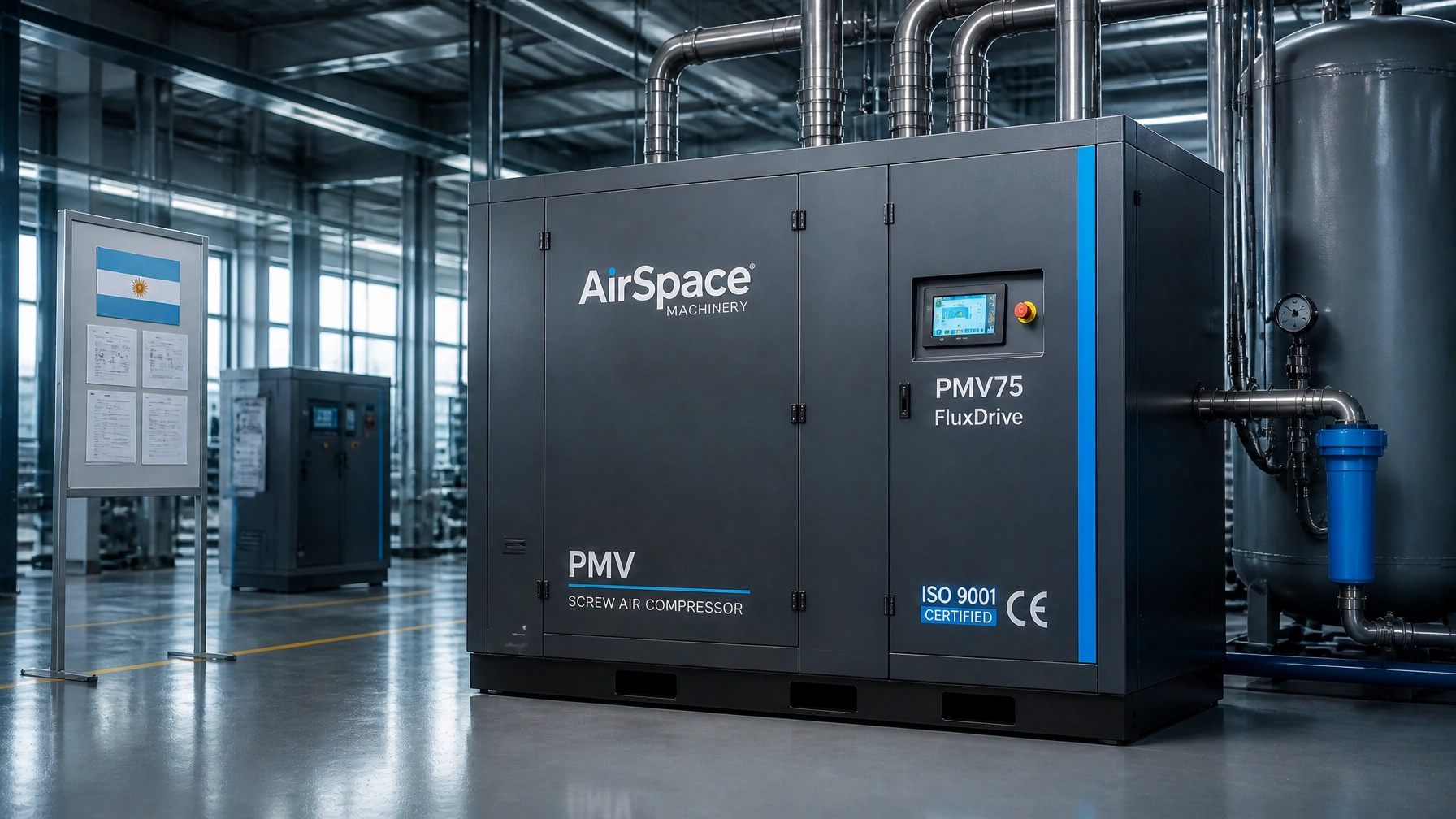
Short answer: A 75 kW oil-injected screw compressor running at 70% average load turns roughly 42 kW of its electrical input into recoverable heat — about 250,000 kWh of thermal energy across 6,000 operating hours. Valued against gas at 0.05 USD/kWh, that is roughly 12,600 USD a year of displaced fuel. Basis: 0.08 USD/kWh electricity · 0.05 USD/kWh gas equivalent · 6,000 h/yr · 70% duty · 75 kW machine, with the calculation method following ISO 11011:2013. Ducted warm air typically captures 60–80% of the available heat; an oil-to-water exchanger typically 50–70%.
By Johnny Wayne, General Manager, AirSpace Machinery Co., Ltd. — 20 years in industrial compressed air systems. Reviewed by our engineering team.
Here is the fact most energy conversations miss: an air compressor does not really make compressed air. It makes heat, and compressed air is the by-product. Typically 90–96% of the electrical power you feed into an oil-injected screw package leaves it as heat — through the oil cooler, the aftercooler and the motor.
If that heat leaves through a roof vent, you paid for it twice: once to generate it, and again to heat your workshop or process water from scratch. Heat recovery is how you stop paying twice.
What does “recoverable” actually mean?
The theoretical maximum is close to 100% of input power. What you can usefully capture depends on how you capture it:
| Recovery method | Typical usable share | What you get |
|---|---|---|
| Ducted warm air (space heating) | 60–80% | Warm air, easiest retrofit |
| Oil-to-water heat exchanger | 50–70% | Hot water at roughly 50–70°C |
| Combined air + water | up to ~80% | Both, if demand matches |
These are typical figures for oil-injected screw packages in the 30–200 HP (22–150 kW) class — not guarantees. The share you actually bank depends on duct distance to the point of use, duct losses, and whether your heat demand runs the same hours your compressor does.
How do you size heat recovery in three lines?
You do not need simulation software for a first estimate:
- Average input power = rated motor power × average load factor
- Recoverable heat = average input power × recovery efficiency (from the table above)
- Annual value = recoverable heat × operating hours × the price of the energy it displaces
The third line is where most people get stuck, because “the price of displaced energy” means knowing what you would otherwise burn: natural gas, diesel, electric heaters — or nothing at all. If the answer is nothing, heat recovery saves you very little, and that is a useful answer too, because it stops you spending on a retrofit that cannot pay back.
Worked example: a 75 kW PMV VSD machine
Assumptions first: 75 kW rated, 70% average load, 6,000 operating hours a year, electricity at 0.08 USD/kWh, displaced heat otherwise produced by a gas boiler at 0.05 USD/kWh equivalent. Every figure is stated so you can swap in your own.
- Average input power: 75 kW × 0.70 = 52.5 kW
- Recoverable heat at 80% capture: 42 kW thermal
- Annual thermal energy: 42 kW × 6,000 h = ~250,000 kWh
- Annual value against gas: 250,000 × 0.05 USD = ~12,600 USD a year
Two things worth noticing. First, the recovered value is not small change next to the electricity bill — 250,000 kWh of heat is a real boiler offset, which is why plants with year-round hot-water demand (food washing, chemical processes, staff facilities in cold climates) are the natural first candidates. Second, the arithmetic scales down honestly: a 22 kW (30 HP) machine at the same duty recovers about 12 kW of heat, and if your gas is cheap and your summer is long, the payback stretches. Run your own numbers before believing anyone’s — ours included.
Where does the heat leave a PMV VSD package?
On a permanent-magnet variable-speed package like our PMV series, heat leaves from three places:
- The oil cooler — the main stream, 50–70°C when run through a plate exchanger. This is your hot-water source.
- The aftercooler — heat picked up by the compressed air itself; recoverable, but a lower priority.
- The canopy airflow — warm air you can duct straight into an adjacent workshop for space heating in winter.
One caution that protects your machine: do not starve the package of cooling airflow to force more recovery. The compressor still needs its designed cooling circuit; recovery taps the heat after the machine has done its job, not instead of it. In hot climates this design line matters more, not less. We build these packages in Shanghai and ship them into tropical, high-humidity markets, so the cooling circuit is specified with a 50°C ambient margin as standard — and that same margin is what makes downstream recovery safe to tap, because you are taking heat the machine was going to reject anyway.
Does variable speed change the shape of the savings?
Yes, in two ways.
A fixed-speed machine cycling between load and unload gives you heat in pulses, which your hot-water system has to buffer. During the unload phase it typically draws 20–30% of full-load power while delivering no air at all — the “unload tax” your electricity meter still records.
A VSD machine at part load produces a steadier, proportional heat stream at the power it is actually drawing — easier to use, and it pairs naturally with the same logic that makes VSD economics work in the first place. The heat follows the kilowatts; you save electricity and therefore recover less heat, but from a smaller bill.
What did the numbers look like in real installations?
We publish our project data rather than only describing method, because a sizing formula nobody has run is just arithmetic.
Our 75 kW PMV VSD installation case study documents our customer, an iron processing and fabrication plant in Ho Chi Minh City — a 15,000 m² facility with more than 200 employees running 16 hours a day — where compressed air generation had been costing over 3,200 USD a month in electricity, with pressure swinging ±0.5 bar and maintenance averaging 850 USD a month on the old fixed-speed unit. In practice that pressure swing is the part buyers underestimate: it is what forces the ±0.5 bar safety margin nobody budgets for.
A second documented project, a 34% annual energy reduction with a 14-month payback, replaced a 75 kW fixed-speed machine marketed as European technology — and stabilised plant pressure to ±0.1 bar.
Neither project was sold on a heat-recovery claim. Both are exactly the data set you need before you trust one: measured input power, hours, and a pressure band that held. That is the same evidence standard your heat-recovery business case has to meet, and the reason the worked example above states its assumptions instead of asserting a single “typical saving”.
How do you verify the saving before you commit?
A duct and a heat exchanger are cheap; being wrong about your heat demand is not. Two steps keep the project honest:
- Log actual input power and load profile for a representative week — not a nameplate figure, a measured one. This is what ISO 11011:2013 calls the assessment baseline.
- Match the recoverable profile against what you currently pay to heat — boiler fuel, electric heaters, process water.
We ask for both numbers before we will quote a heat-recovery scope, because in the field the second one is where most projects die: the plant has plenty of waste heat and nowhere to send it.
If you want a second pair of eyes, our free compressed air kWh forecast and system review does exactly this as an indicative estimate from your operating data — power, pressure, hours, tariff — with all assumptions stated. It is not a substitute for a measured ISO 11011 audit, but it tells you whether heat recovery deserves a project number.
Key takeaways
- 80% capture on a 75 kW machine at 70% load returns about 42 kW of heat — roughly 250,000 kWh a year, worth about 12,600 USD against gas at 0.05 USD/kWh.
- Ducted air typically captures 60–80%, oil-to-water 50–70%. Confirm which one your site can actually use before sizing anything.
- A 30 HP (22 kW) machine at the same duty returns about 12 kW. Heat recovery scales with input power, not with the size of your ambition.
- Recovery only pays where heat demand runs the same hours as the compressor. Night-shift compressors in an empty building usually cannot justify a retrofit.
- Measure first. Supply the power, hours and displaced-fuel price from your own meter, or the number you get is somebody else’s site.
Frequently asked questions
How much heat does a 75 kW air compressor produce?
At full load, roughly 70 kW — almost all of its electrical input, per the 90–96% heat-recovery ratio typical of oil-injected screw packages. At a realistic 70% average load that is around 50–55 kW, of which 60–80% is typically capturable with ducting and a heat exchanger.
Can compressor waste heat make hot water, and how hot?
Yes — through an oil-to-water plate heat exchanger, typically 50–70°C, which covers washing, process pre-heat and staff facilities. Higher temperatures usually need dedicated high-temperature recovery designs.
Does heat recovery harm the compressor?
Not if the machine keeps its designed cooling margin. Recovery taps heat after the oil and air have cooled the package; problems come from retrofitting ducts that restrict airflow, not from recovery itself. Check this at commissioning, while the canopy is still open.
Is a VSD or fixed-speed compressor better for heat recovery?
VSD gives a steadier, load-following heat stream that is easier to use without large buffers. Fixed speed works too, but you will need buffer volume to smooth the load/unload pulses, and you will keep paying the unload tax while it cycles.
What payback should I expect?
Commonly 1–3 years where there is steady year-round heat demand, but it is genuinely site-specific — it moves with your tariff, your boiler fuel and your operating hours. State your assumptions before trusting anyone’s payback figure, including ours.
Sources and standards
- ISO 11011:2013 — Compressed air — Energy efficiency — Assessment. The method behind the baseline-measurement step above.
- ISO 1217:2009 — Displacement compressors — Acceptance tests. Defines how delivered flow is verified, including the acceptance tolerance that turns a nameplate figure into a real one.
- ISO 8573-1:2010 — Compressed air — Contaminants and purity classes. Relevant if recovered heat is used in rooms where air quality is regulated.
- ISO 50001 — Energy management systems. Most plants buying heat recovery are already reporting under it.
- EU Machinery Directive 2006/42/EC — the directive under which CE marking is applied to machinery placed on the EU market.
- Our published case studies — 75 kW PMV VSD installation, Vietnam and 34% savings against a European-tech brand.
About the author
Johnny Wayne (Wei Zhuang) is Managing Director of AirSpace Machinery Co., Ltd., the Shanghai manufacturer behind ChinaCompressor.org. The company builds oil-injected and Class 0 oil-free screw compressors from 2 to 540 HP (1.5–400 kW) on a 4,000 m² production facility with 20 years of engineering history behind it, using BAOSI 5:6 asymmetric rotor technology. Products carry CE marking and ISO 9001:2015 quality certification, and we sell through distributors rather than around them.
Have a duty point you want checked? Send pressure, flow, hours and your electricity tariff to sales@chinacompressor.org, or start with the free kWh forecast and system review.
📅 Last updated:
⚡ Is Your Factory Bleeding Cash?
Most fixed-speed compressors waste $3,600/year in "Unload Tax." Test your waste level in 30 seconds.
RUN THE ROI TEST →Ready to See How Much Your Facility Can Save?
Fill out the form below for a Free Energy Assessment.