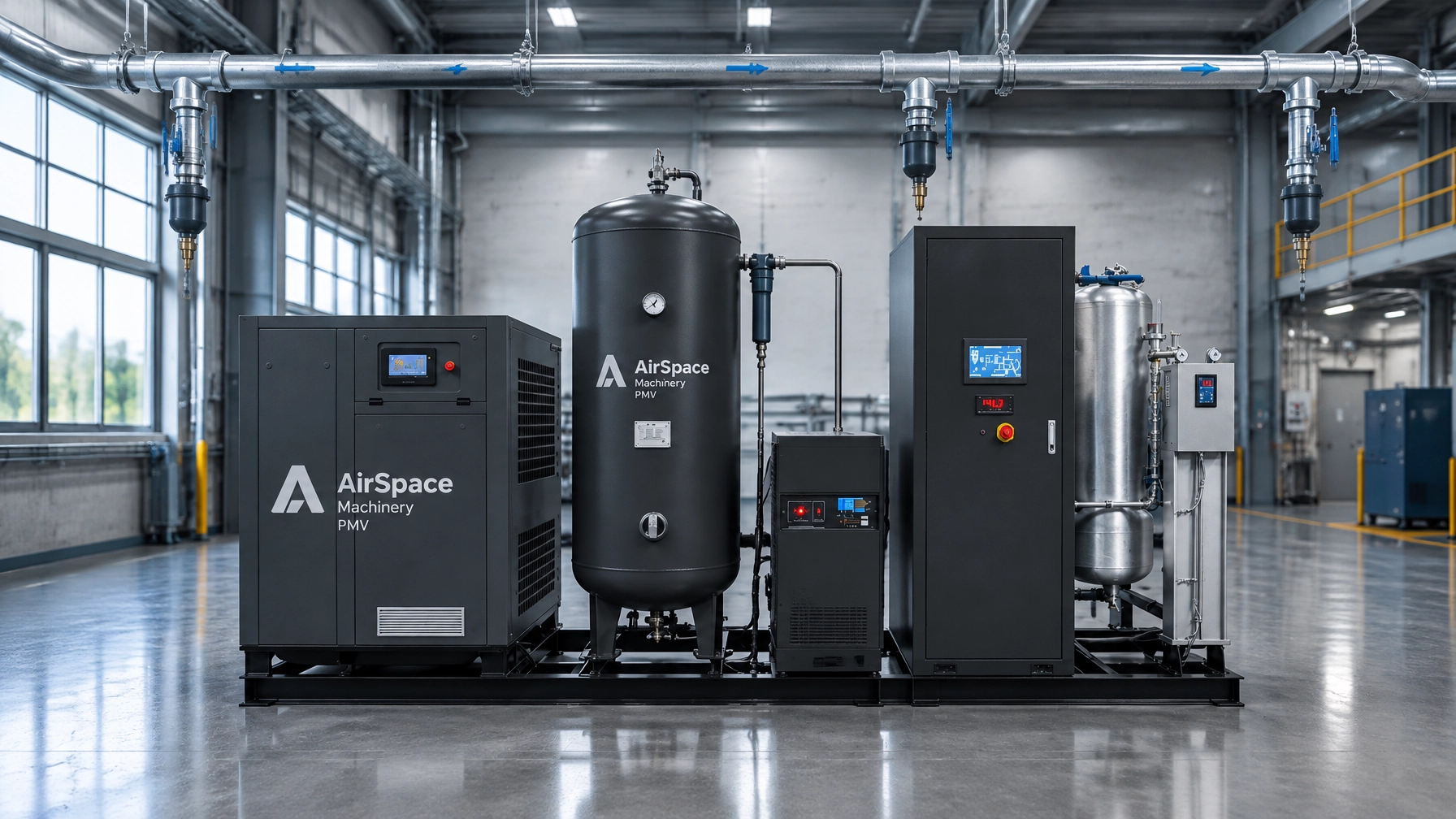
Short answer: A PET blow moulding line does not run on one air supply. It typically needs stretch-blow air at 25–40 bar, machine and actuation air at 7–8 bar, and pressure dew point of −40 °C or better (ISO 8573-1 Class 2) throughout. A 0.5-litre bottle blown at 36 bar absolute consumes roughly 24 litres of free air per bottle (per 0.5 L · 36 bar abs · 35% pre-blow allowance), so flow and purity must be sized service by service, not by one catalogue number.
By Johnny Wayne, General Manager, AirSpace Machinery Co., Ltd. — 20 years in industrial compressed air systems. Reviewed by our engineering team.
Blow moulding is the one process on a bottling site where compressed air is the product’s forming force, not just a utility. When the pressure sags, the bottles are thin; when the dew point rises, they come out hazy or the moulds sweat. We audited enough PET installations to know the failures are almost never exotic — they are a line fed by one compressor that was asked to do three jobs.
What air services does a PET blow moulding line actually run on?
Three, and they have different pressure classes. The stretch-blow circuit takes high-pressure air and does the forming; the pre-blow circuit uses the same air at lower pressure and flow; and the machine circuit runs valves, actuators, conveying and sorting at normal factory pressure. Treating these as one demand is the most common specification error we see in PET inquiries.
| Service | Typical pressure class | What it does | What goes wrong if it is wrong |
|---|---|---|---|
| Stretch-blow air | typically 25–40 bar | final forming of the preform against the mould walls | thin spots, poor material distribution, rejects |
| Pre-blow air | typically 8–12 bar | initial stretch before high-pressure blow | wall thickness variation, pearl effect |
| Machine air | typically 7–8 bar | valves, actuators, grippers, bottle conveying | stopped machine, sorting faults |
Those are process-typical ranges, not ratings — confirm them against your machine builder’s datasheet before ordering anything.
What pressure does the stretch-blow circuit really need?
Typically 25–40 bar at the mould, which is why a standard 8 bar plant compressor can never feed it, no matter how large. Pressure is lost across the path — piping, valves, quick couplings and the mould manifold — so the compressor must be rated for the mould pressure plus the line losses, and the line losses grow with every fitting added after installation.
This is also why PET plants buy a dedicated medium-pressure machine for this service. Our PET blowing medium-pressure screw air compressor series is rated for 25–40 bar duty precisely so the stretch circuit does not depend on the general plant header.
Why does dew point matter more on a PET line than in the next workshop?
Because the air expands inside the mould and chills. High-pressure air holds little moisture to begin with, and when it expands through the blow valve it drops in temperature, so any residual water vapour condenses directly on the bottle interior. PET lines therefore typically specify −40 °C pressure dew point, which corresponds to ISO 8573-1 Class 2 for moisture — and some food-grade lines tighten that further.
Yes, this means a desiccant dryer is part of the stretch-air path on most lines. A refrigerated dryer alone, at typically +3 °C pressure dew point, cannot hold −40 °C, and the condensation it leaves behind shows up as haze, mould sweating and label problems downstream.
How do you size the flow for each service?
Free air demand, not mould volume, is what the compressor must deliver. The calculation is short enough to do on paper:
- Bottle volume: 0.5 litre finished bottle.
- Absolute blow pressure: 35 bar gauge + 1.013 bar atmosphere ≈ 36 bar absolute.
- Free air per final blow: 0.5 L × 36 ≈ 18 litres of free air per bottle.
- Pre-blow allowance: typically 35% on top → 18 × 1.35 ≈ 24 litres per bottle (per 0.5 L · 36 bar abs · 35% allowance).
- Machine output: 2 cavities at typically 3,000 bottles/hour each = 6,000 bottles/hour.
- Stretch-air demand: 6,000 × 24 L = 144,000 L/h = 2.4 m³/min of free air for the stretch circuit.
To that you add machine air, typically 2–3 m³/min for a two-cavity machine, and any conveying or purge air. Size each compressor for its own service at ISO 1217 conditions, then add the receiver volume the cycle needs — a blowing machine is an intensely batch load, and the high-pressure receiver between compressor and moulds is what carries the peak.
What should the pre-order checklist actually check?
Five items, all verifiable before you sign:
- Rated discharge pressure of the medium-pressure machine against your mould pressure plus measured line losses, not the machine builder’s nominal figure.
- FAD stated per ISO 1217 at your working pressure — FAD at 40 bar is not FAD at 25 bar, and the difference is real.
- Pressure dew point specification in ISO 8573-1 class terms (Class 2 or better for the stretch circuit), with the dryer included in the scope.
- Receiver volume between compressor and moulds, sized for the blow cycle so the compressor does not chase each bottle.
- Condensate handling on the high-pressure side — a desiccant tower that dumps brine into an un-drained line will find the moulds.
We keep this list on one page in our inquiries because a buyer who asks these five questions rarely ends up with a mismatched package.
What did the numbers look like in a real installation?
Our documented 75 kW PMV VSD case study in Vietnam is an iron processing plant in Ho Chi Minh City — 15,000 m² of floor area, more than 200 employees, running 16 hours a day, with compressed air electricity above 3,200 USD a month and maintenance at 850 USD a month on the old fixed-speed unit, and header pressure swinging ±0.5 bar before the change.
We audited that site’s air bill before proposing anything, and the lesson travels to PET plants directly: when air is the forming force, every bar of instability is scrap you can weigh. A plant already paying over 3,200 USD a month for air cannot afford to size its circuits by guesswork, and a PET line multiplies the cost of being wrong because the air is in the product.
Where does low-pressure air fit on the same site?
Not every service around a bottling plant wants high pressure, and this is where buyers overspend. A low-pressure air compressor rated 15–300 HP at 3–5 bar is the right tool for high-volume, low-pressure duties — and the same logic applies across the low-pressure air compressor for the textile / ceramic / glass / cement industry, where running an 8 bar machine at half load to feed a 3–5 bar process wastes energy by design.
| Industry | Low-pressure duty | Typical pressure band | Series rating |
|---|---|---|---|
| Textile | air-jet loom weft insertion | 3–5 bar | 15–300 HP |
| Ceramic | spray drying, press blow-off | 3–5 bar | 15–300 HP |
| Glass | mould cooling, blow-off | 3–5 bar | 15–300 HP |
| Cement | pneumatic conveying, baghouse pulses | 3–5 bar | 15–300 HP |
If a site mixes PET blowing with such processes, the specification conversation should start with service separation: one medium-pressure machine for the stretch circuit, standard plant air for machine service, and a low-pressure series machine for the high-volume low-pressure loads.
How do you verify a supplier’s claims before the order?
Ask for test certificates, not adjectives. FAD measured per ISO 1217 acceptance test, dew point measured per ISO 8573-1 methods, pressure vessels with their local code certification, and the machine’s own CE marking and ISO 9001:2015 certificate — AirSpace Machinery Co., Ltd. publishes all of these on our downloads page. A supplier who will not state FAD at your working pressure is selling you a catalogue number, not a machine.
Key takeaways
- A PET line is three air services, not one: stretch air typically 25–40 bar, machine air typically 7–8 bar, and conveying or purge loads as separate items.
- Dew point is a forming-quality parameter: −40 °C pressure dew point (ISO 8573-1 Class 2) is the typical specification for the stretch circuit, because expanding air condenses residual moisture inside the mould.
- Flow arithmetic is short: a 0.5 L bottle at 36 bar absolute consumes about 24 litres of free air per bottle (per 0.5 L · 36 bar abs · 35% pre-blow allowance) — 6,000 bottles/hour is 2.4 m³/min of stretch air.
- Size FAD per ISO 1217 at your working pressure, and confirm receiver volume for the batch cycle.
- Separate the services before you buy: medium pressure for forming, standard pressure for machine service, and 15–300 HP low-pressure series machines for 3–5 bar high-volume loads.
Frequently asked questions
What pressure does a PET stretch-blow machine actually need?
Typically 25–40 bar at the mould for the stretch circuit, with machine and actuation air at 7–8 bar. Confirm the exact figure against your machine builder’s datasheet, because preform design and line losses change the requirement.
Can one compressor feed both the blow circuit and the machine circuit?
Not usually at the pressures involved — the stretch circuit needs a dedicated medium-pressure machine, while machine air comes from the general plant system. Sharing a supply means either starving the blow or over-pressurising the actuators.
What dew point do PET bottles require?
Typically −40 °C pressure dew point, which is ISO 8573-1 Class 2 for moisture, supplied through a desiccant dryer. Food-grade and label-sensitive lines sometimes specify tighter.
Why does my compressor show enough FAD but the bottles still come out thin?
FAD stated at the wrong reference pressure is the usual answer. Check that the rating is per ISO 1217 at your working pressure, then measure the actual pressure at the mould — line losses between compressor and mould frequently account for the gap.
How is low-pressure air used in a bottling plant?
For high-volume duties that need volume rather than pressure — conveying, rinsing, blow-off — a 15–300 HP low-pressure series machine at 3–5 bar does the job without running an 8 bar machine at half load, which is where the energy saving comes from.
Sources and standards
- ISO 8573-1:2010 — compressed air purity classes; the basis for Class 2 (−40 °C pressure dew point) moisture specification on the stretch circuit.
- ISO 1217:2009 — Displacement compressors — Acceptance tests. The method FAD must be stated at for working pressure.
- ISO 11011:2013 — Compressed air — Energy efficiency — Assessment, used when auditing site air costs.
- ISO 9001:2015 and CE marking under Machinery Directive 2006/42/EC — held by AirSpace Machinery Co., Ltd.; certificate scans are available on our downloads page.
- Our published references — the PET blowing medium-pressure screw air compressor series (25–40 bar) and the Vietnam 75 kW PMV VSD installation case study.
About the author
Johnny Wayne (Wei Zhuang) is General Manager of AirSpace Machinery Co., Ltd., the Shanghai manufacturer behind ChinaCompressor.org. The company builds oil-injected and Class 0 oil-free screw compressors from 2 to 540 HP (1.5–400 kW), including a PET blowing medium-pressure series for 25–40 bar duty and the low-pressure series at 15–300 HP for 3–5 bar duty, from a 4,000 m² production facility with 20 years of engineering history. Products carry CE marking and ISO 9001:2015 certification, and we sell through distributors rather than around them.
Send your bottle volume, cavities, cycle rate and mould pressure to sales@chinacompressor.org, or start with the free compressed air kWh forecast and system review.
⚡ Is Your Factory Bleeding Cash?
Most fixed-speed compressors waste $3,600/year in "Unload Tax." Test your waste level in 30 seconds.
RUN THE ROI TEST →Ready to See How Much Your Facility Can Save?
Fill out the form below for a Free Energy Assessment.