Short answer: AirSpace’s DewZero refrigerated dryer range is planned for pressure dew points of approximately 3–10°C in standard configurations.
Written by Penny Winston, Blog Writer, AirSpace Machinery Co., Ltd. — a 4,000 m² compressor manufacturing facility in Shanghai, ISO 9001:2015 certified and CE marked.
Reviewed by Richard Moore, Field Technical Manager.
Direct answer
Electronics and food producers choose an oil-free screw compressor because it removes lubricant from the compression process, reduces contamination risk, and supports ISO 8573-1 Class 0 air-quality planning. When the compressor also uses Permanent Magnet Variable Frequency technology, it can follow changing demand instead of running at full speed during low-load periods. AirSpace Machinery positions this combination around three practical outcomes: cleaner process air, a potential 35% Energy Delta under fluctuating demand, and quieter operation near production areas.
The final oil-content class, pressure, flow, dew point, noise level and configuration must be verified against the selected model and supporting test documentation. For a Benelux plant, the correct purchase is not simply “an oil-free compressor.” It is a complete compressed-air system matched to the production risk.
BUYER REALITY: 10 HEADACHES BENELUX FACTORY MANAGERS NEED TO AVOID
- Oil vapor reaching food-contact surfaces or sensitive electronics.
- A Class 0 claim without a clear test report or defined measurement conditions.
- Energy waste caused by a fixed-speed compressor running unloaded.
- Pressure instability affecting pneumatic actuators, pick-and-place equipment or packaging lines.
- Moisture carryover after the compressor room.
- Noise disturbing operators working near the utility area.
- A dryer selected without considering inlet temperature, ambient temperature and pressure.
- Filters creating avoidable pressure drop and higher compressor demand.
- Spare parts or technical support being unclear after export delivery.
- A supplier quoting a machine without asking for required air demand in m³/min or CFM and pressure in bar or psi.
WHAT DOES AN OIL-FREE SCREW COMPRESSOR PROVIDE?
An oil-free screw compressor generates compressed air without introducing lubricating oil into the compression chamber. That design is different from relying only on downstream filtration to remove oil from an oil-lubricated air stream.
For electronics manufacturing, this matters because oil residue can create films, interfere with precision assembly and increase cleaning requirements. For food processing and packaging, it reduces the risk of hydrocarbon contamination entering the process or contacting packaging surfaces.
ISO 8573-1 Class 0 is the strictest oil classification. It does not mean a mathematical absolute of zero oil. It means the user defines a limit more stringent than Class 1, and the equipment must be assessed against that limit. The correct procurement question is therefore:
“Can the supplier provide the relevant ISO 8573-1 Class 0 documentation for the proposed configuration and operating conditions?”
AirSpace’s oil-free catalog covers water-lubricated and dry-style screw configurations for high-purity applications. Review the oil-free compressor catalog and technical downloads before final selection.
WHY PMV TECHNOLOGY MATTERS TO TOTAL COST
PMV means Permanent Magnet Variable Frequency. The motor speed changes with the plant’s air demand, while the controller works to maintain the required pressure.
A standard fixed-speed compressor is like a car that keeps the engine revving while waiting at a traffic light. It may not be producing useful air, but it still consumes electricity. This is the Unload Tax: energy paid for output that the factory is not using.
Under a fluctuating demand profile, AirSpace uses a 35% Energy Delta benchmark when comparing PMV operation with standard fixed-speed systems. This is not a universal target. The actual result depends on operating hours, pressure, leakage, demand profile, electricity tariff, control settings and the condition of the existing compressor.
The practical way to test the assumption is to enter plant data into the AirSpace ROI Engine. Use actual annual hours, electricity cost, working pressure and average demand rather than relying on a brochure percentage.
Johnny Wayne, Managing Director of AirSpace Machinery, puts the decision plainly:
“Compressed air should be treated as the Fourth Utility. If the plant cannot measure its pressure, purity and energy cost, it is not managing the utility; it is guessing.”
PMV SELECTION DATA FOR INDUSTRIAL PLANTS
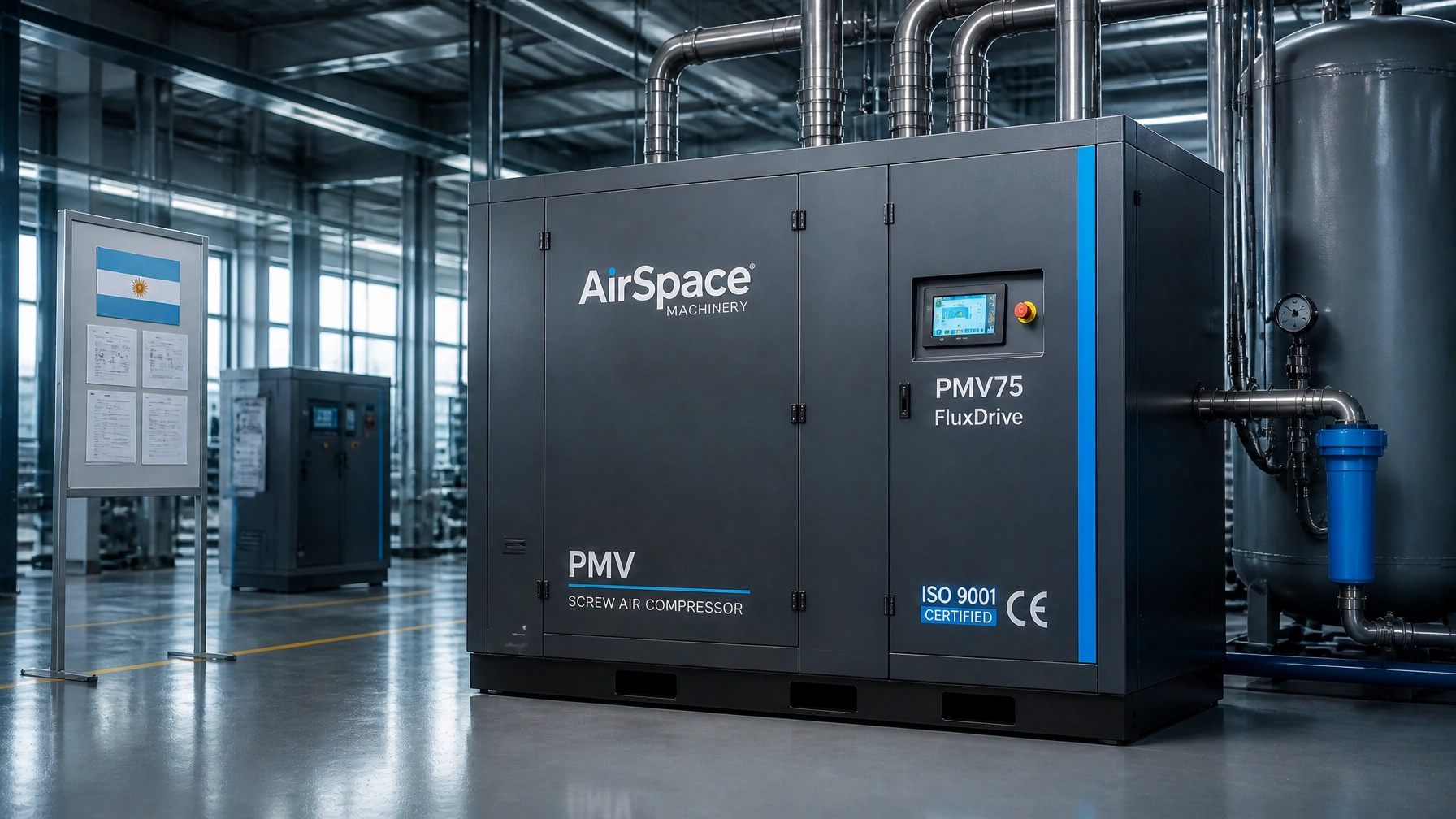
The AirSpace FluxDrive PMV series is planned across 10 HP to 180 HP, with typical working pressures from 7 to 13 bar. Indicative planning values include:
10 HP: approximately 1.2–1.5 m³/min
20 HP: approximately 2.2–2.8 m³/min
30 HP: approximately 3.2–4.0 m³/min
50 HP: approximately 5.2–6.5 m³/min
75 HP: approximately 7.8–9.5 m³/min
100 HP: approximately 10.5–13.0 m³/min
150–180 HP: approximately 16.0–22.0 m³/min
These are planning ranges, not a final quotation. Flow should be compared at a consistent pressure and test method, such as ISO 1217 acceptance testing. Ask the supplier to confirm free air delivery, motor power, voltage, frequency, pressure range, ambient rating and sound pressure measurement conditions.
For a project-specific configuration, use the AirSpace PMV compressor series and submit required air demand in m³/min or CFM and pressure in bar or psi.
COMPARISON: CLASS 0 OIL-FREE PMV VERSUS STANDARD FIXED-SPEED AIR
| Evaluation point | Standard fixed-speed system | Oil-free PMV system |
|---|---|---|
| Air purity strategy | Depends on compressor design and downstream treatment | Oil-free compression design with Class 0 documentation to be verified |
| Part-load operation | May continue running at high speed during unload periods | Motor speed adjusts to demand |
| Energy exposure | Higher Unload Tax when demand fluctuates | Potential 35% Energy Delta benchmark under suitable conditions |
| Pressure control | Often requires wider control band | Variable-speed control can respond more closely to demand |
| Food and electronics suitability | Requires careful contamination assessment | Designed for high-purity applications, subject to verified documentation |
| Noise planning | Depends on enclosure and operating state | Low-noise enclosure and variable-speed operation can reduce disturbance |
| Purchase decision | Lowest initial price may dominate | Lifecycle cost, purity and energy should be assessed together |
HOW TO CONTROL MOISTURE AND DEW POINT
Class 0 addresses oil content. It does not automatically define particles or water content.
A complete electronics or food compressed-air system may also require a refrigerated dryer, filters, drains and a defined pressure dew point. AirSpace’s DewZero refrigerated dryer range is planned for pressure dew points of approximately 3–10°C in standard configurations. The final dew point depends on the application and site conditions.
A refrigerated dryer is generally suitable for many indoor industrial systems. If the process requires a substantially lower dew point, the engineering review should consider another drying arrangement. The correct choice depends on inlet air temperature, ambient temperature, working pressure, flow and the required dew point at the point of use.
See the DewZero refrigerated air dryer range and connect the dryer selection to the AirSpace Solution Hub.
HOW TO VERIFY DOCUMENTATION BEFORE PURCHASE
A responsible Benelux procurement file should include:
- The proposed compressor model and configuration.
- ISO 8573-1 Class 0 test documentation applicable to the oil-free system.
- The defined oil limit and test conditions.
- FAD data at the selected pressure.
- Pressure dew point data for the dryer.
- Sound pressure level with distance and operating condition stated.
- CE documentation applicable to the supplied equipment.
- Evidence of the manufacturer’s ISO 9001 quality system.
- Electrical data, connection requirements and installation conditions.
- Export packing, logistics and service-support details.
Do not accept “Class 0” as a standalone marketing phrase. Match the certificate, test report and configuration to the equipment being quoted. AirSpace lists CE and ISO 9001 quality information in its engineering and catalog download center.
WHAT SUPPORT SHOULD A GLOBAL BUYER EXPECT?
The supplier should help confirm air demand, operating pressure, ambient temperature, electrical supply, dryer capacity, filtration and export documentation before production. Factory-direct planning is typically 7–35 days depending on configuration, testing, documentation and production scheduling.
For a quotation, provide:
Required air demand in m³/min or CFM
Working pressure in bar or psi
Operating hours per day
Average and peak demand
Current compressor power
Electricity tariff
Required dew point
Application and air-contact risk
Destination country
Use the AirSpace contact page to request a project review. The normal call to action is simple: Get a Proposal.
FAQ: OIL-FREE SCREW COMPRESSOR FOR BENELUX PLANTS
Is an oil-free screw compressor necessary for electronics production?
It is often the preferred starting point where compressed air may contact sensitive components, clean surfaces or precision equipment. The required air class should be confirmed with the process engineer and quality team.
Is ISO 8573-1 Class 0 the same as completely zero oil?
No. Class 0 is a user-defined limit more stringent than Class 1. The supplier must identify the limit, test method and operating conditions.
How much energy can PMV technology save?
AirSpace uses a 35% Energy Delta benchmark for suitable fluctuating-demand comparisons with standard fixed-speed systems. Actual savings require measured load data and an ROI calculation.
Does an oil-free compressor also remove moisture?
No. Oil-free compression addresses lubricant contamination. A correctly sized dryer and filtration system are still needed to control moisture and particles.
Is PMV technology noisy?
Noise depends on motor speed, enclosure, airflow, installation and distance from the equipment. Request the sound pressure level in dB(A) at a stated test point before purchase.
What information is required for a quotation?
Send required air demand in m³/min or CFM, pressure in bar or psi, operating hours, application, dew point, electrical supply and destination country. AirSpace engineers can then verify the compressor, dryer and documentation package.
STANDARDS AND ENGINEERING SOURCES
ISO 8573-1:2010, Compressed air , Contaminants and purity classes , Part 1: Contaminants and purity classes. See the ISO 8573-1 standard reference.
ISO 1217, Displacement compressors , Acceptance tests. Use a consistent test basis when comparing FAD and energy performance.
European Commission, CE marking guidance.
ISO, ISO 9001 quality management systems.
For related engineering guidance, read the ISO 8573-1 Class 0 pharmaceutical air assessment and the oil-free food and pharmaceutical solution guide. Her work helps industrial buyers compare compressor energy, purity, noise and lifecycle requirements using practical engineering criteria. If you need air consumption calculation, energy-saving scheme and factory quotation, please send us an inquiry.
⚡ Is Your Factory Bleeding Cash?
Most fixed-speed compressors waste $3,600/year in "Unload Tax." Test your waste level in 30 seconds.
RUN THE ROI TEST →Ready to See How Much Your Facility Can Save?
Fill out the form below for a Free Energy Assessment.