Last Updated: September 6, 2026
This comprehensive guide is designed for plant managers, procurement officers, facility engineers, and industrial decision-makers who are evaluating screw air compressor systems and want to avoid the hidden energy costs associated with outdated rotor technology. Whether you are purchasing a new system or auditing your current compressed air infrastructure, the following analysis will help you identify the five critical specifications that truly determine compressor efficiency and protect your operational budget from the $9,400 “Efficiency Robbery.”
If you are evaluating a new industrial air system, you have likely heard the marketing pitch: “Our rotors are the largest in the industry, and they run at the lowest speeds.” It sounds logical. In theory, a larger rotor running slowly should last longer and use less power. However, in the world of high-precision engineering, this is often a smoke screen used by budget suppliers to hide outdated rotor profiles.
The direct answer to the rotor size debate is this: Rotor diameter is only one of over a dozen variables that determine actual efficiency. A larger rotor with a generic, symmetric profile will actually lose more money through “blow-hole” leakage than a smaller, precision-engineered asymmetric rotor. At AirSpace Machinery, we have seen facilities lose upwards of $9,400 annually in hidden energy costs: what we call the “Unload Tax”: simply because they prioritized physical size over the specific power metrics of their china made screw air compressor.
The Rotor Diameter Myth: Why Bigger Rotor Size Doesn’t Guarantee Better Compressor Efficiency
In the air compression industry, physical weight and size are often used as proxies for quality. Marketing-focused manufacturers push “Large Rotor, Low Speed” because it is an easy concept to sell to procurement officers. But from an engineering standpoint, an oversized rotor is often a “Lazy Design” choice.
A larger rotor has a longer sealing line. If the manufacturing tolerances are not microscopic, that longer sealing line provides more area for air to leak back to the suction side. This is known as volumetric loss. To compensate for this leakage, the compressor has to work harder, driving up your kW per m³/min: the only number that truly impacts your factory’s bottom line.
According to the U.S. Department of Energy, compressed air systems account for approximately 10% of all industrial electricity consumption, and inefficient compressor design can waste 20-30% of input energy through internal leakage and poor load management alone.

5 Critical Specifications That Matter More Than Rotor Diameter for Screw Air Compressor Efficiency
To avoid the “Efficiency Robbery” of a poorly designed system, you must look past the physical dimensions and verify these five critical engineering specifications.
1. Asymmetric Rotor Profile Geometry: The Foundation of Internal Sealing
The shape of the rotor lobes is the single most important factor in efficiency. Older, symmetric profiles are easy to manufacture but leave a large “blow-hole”: a triangular gap between the rotors where compressed air escapes.
AirSpace Machinery utilizes advanced asymmetric profiles. By optimizing the wrap angle and lobe ratio (typically 5:6), we minimize the blow-hole area and shorten the sealing line. This ensures that more of the air you pay to compress actually reaches your production line, rather than leaking internally.
2. Specific Power (kW/m³/min): The Only Energy Efficiency Math That Matters
Specific Power is the amount of electricity (kW) required to produce a specific volume of air (m³/min). This is the “Fuel Economy” of your compressor.
If a “Large Rotor” compressor requires 7.2 kW to produce 1 m³/min, but a precision-engineered AirSpace PMV system requires only 6.4 kW for the same output, the rotor size is irrelevant. Over a standard 8,000-hour production year, that 0.8 kW difference per unit of air creates a massive energy delta.
3. Clearance Tolerances and Manufacturing Precision: Microns That Save Thousands
Precision is the enemy of waste. A “Large Rotor” with a clearance of 0.05mm will be significantly less efficient than a moderately sized rotor with a clearance of 0.02mm.
We manufacture our components in a 4,000m² facility following strict ISO 9001 and CE standards. By maintaining tighter clearances, we reduce internal recirculation, ensuring that our units maintain their “35% Energy Delta” compared to legacy fixed-speed units.
4. Coating Technology and Bearing Quality: Long-Term Efficiency Preservation
In oil-free and high-performance applications, the surface coating of the rotor determines its lifespan and efficiency over time. Low-tier suppliers often use basic coatings that flake off after 10,000 hours, increasing clearances and “bleeding” efficiency.
AirSpace uses high-tier, universal components and specialized PTFE or ceramic-based coatings that resist heat and corrosion. Combined with industrial-grade bearings, this ensures our systems maintain 99.9% uptime and consistent performance, even in extreme climates.
5. PMV Integration: Treating Compressed Air as The Fourth Utility
A rotor is only as good as the motor driving it. Many “Large Rotor” units are paired with standard induction motors that lose efficiency when the speed drops.
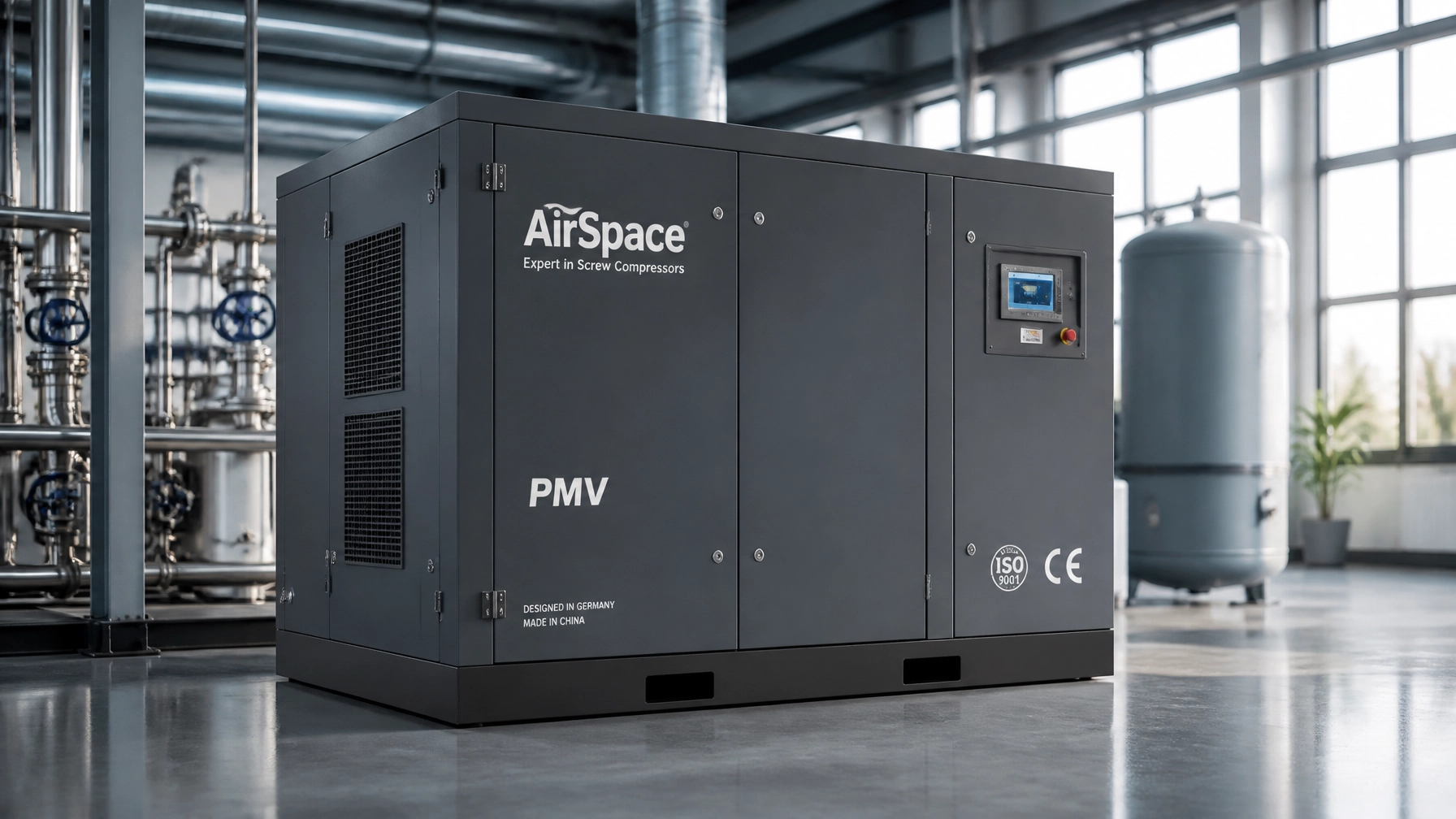
Our Permanent Magnet Variable Frequency (PMV) technology treats compressed air as the “Fourth Utility.” By integrating the motor directly with the male rotor shaft, we eliminate transmission losses (belts or gears). This allows the system to adjust its speed precisely to your plant’s demand, eliminating the “Unload Tax” entirely.

Verification Checklist: How to Spot a “Marketing-Focused” Compressor vs. Engineering Excellence
When a supplier emphasizes rotor size, challenge them with these three engineering requirements:
- Request the Published Efficiency Curve: Don’t settle for a “Full Load” rating. Ask for the specific power at 25%, 50%, and 75% load. Many large-rotor machines lose massive efficiency at part-load.
- Ask for ISO 1217 Annex C or E Verification: This is the international standard for displacement compressor acceptance tests. If they cannot provide a test report, the rotor size is likely a distraction from poor performance.
- Compare Weight to Technology: If a unit is significantly heavier than an AirSpace equivalent, it often indicates older casting technology or the use of heavy, inefficient materials rather than precision engineering.
Side-by-Side Comparison: Legacy Large Rotor Marketing Claims vs. PMV Engineering Reality
| Feature | Large Rotor (Legacy Focus) | Optimized PMV Rotor (AirSpace Focus) |
|---|---|---|
| Primary Goal | Slow speed at any cost | Minimum Specific Power (kW/m³/min) |
| Rotor Profile | Often symmetric or generic | Advanced Asymmetric (Low Leakage) |
| Drive Type | Often belt-driven or geared | Direct-drive PMV (No loss) |
| Energy Savings | Minimal vs. standard units | 35% Energy Delta vs. fixed speed |
| Weight | Heavy (Old casting methods) | Optimized (Modern high-strength alloy) |
| Maintenance | High (Belt/gear wear) | Low (Fewer moving parts) |
Summary: Protecting Your Bottom Line from the $9,400 Efficiency Robbery
Choosing a china made screw air compressor based solely on rotor size is like choosing a truck based only on the size of its fuel tank: it tells you nothing about how much work it can do or how much it will cost to run.
True “Engineering Freedom” comes from high-efficiency systems that prioritize rotor geometry, PMV stability, and verifiable specific power ratings. By focusing on the 35% Energy Delta, AirSpace Machinery Co., Ltd. ensures that your facility stops bleeding money into the grid and starts reinvesting it into production.
About the Author: Penny Winston
Penny Winston is a Technical Writer at AirSpace Machinery Co., Ltd., specializing in “The 35% Energy Delta” and “The Fourth Utility Concept.” With a focus on ISO 8573-1 Class 0 Integrity, she helps industrial facilities optimize their air systems for maximum ROI and engineering excellence.
Reviewed by Engineering
For a detailed analysis of how an optimized PMV system can eliminate your “Efficiency Robbery,” request a professional assessment today.
Frequently Asked Questions About Screw Air Compressor Rotor Size and Efficiency
Why do some manufacturers emphasize large rotor size as a key selling point?
Large rotor size is an easy-to-understand marketing concept that appeals to procurement officers who may not have deep engineering backgrounds. Manufacturers emphasize rotor dimensions because physical size creates a perception of quality and durability. However, without precision manufacturing tolerances and optimized rotor geometry, a larger rotor can actually decrease efficiency by increasing the sealing line length where air leakage occurs.
What is the “blow-hole” in screw compressor rotors and why does it matter for energy costs?
The blow-hole is a triangular gap that forms between the male and female rotors during the compression cycle where compressed air can escape back to the suction side. Older symmetric rotor profiles have larger blow-holes, which means more of the air you pay to compress is lost internally. Advanced asymmetric profiles, like those used by AirSpace Machinery, minimize this gap and significantly reduce volumetric losses that drive up your specific power consumption.
How do I calculate the real energy cost difference between two screw air compressors?
Compare the specific power ratings (kW per m³/min) at various load points—not just full load. Multiply the kW difference by your annual operating hours and your electricity rate to determine true cost impact. For example, a 0.8 kW/m³/min difference over 8,000 operating hours at $0.10/kWh can result in thousands of dollars in annual savings, regardless of which unit has a larger rotor diameter.
What is PMV technology and how does it eliminate the “Unload Tax” in compressed air systems?
PMV (Permanent Magnet Variable Frequency) technology integrates a high-efficiency permanent magnet motor directly with the compressor’s male rotor shaft, eliminating transmission losses from belts or gears. This direct-drive system allows the compressor to precisely match output to plant demand in real-time. By avoiding the frequent loading and unloading cycles of fixed-speed compressors, PMV systems eliminate the “Unload Tax”—the wasted energy consumed when a compressor runs but produces no useful air.
What certifications should I look for when evaluating a china made screw air compressor?
Request ISO 1217 Annex C or E test verification, which is the international standard for displacement compressor acceptance testing and proves actual performance metrics. Additionally, look for ISO 9001 quality management certification and CE compliance to ensure the manufacturer follows rigorous production standards. These certifications indicate that efficiency claims are backed by verifiable engineering data rather than marketing assertions.
How much money can an inefficient screw compressor actually cost my facility each year?
Facilities can lose $9,400 or more annually from a single inefficient compressor unit due to internal leakage, poor part-load performance, and transmission losses. The actual cost depends on your operating hours, electricity rates, and demand patterns. AirSpace Machinery has documented cases where switching to optimized PMV systems delivers a 35% Energy Delta compared to legacy fixed-speed units, translating to significant operational savings.
Can I retrofit my existing compressor with better rotor technology, or do I need a complete replacement?
In most cases, rotor profile geometry, clearance tolerances, and drive technology are integral to the compressor’s original design and cannot be effectively retrofitted. While some upgrades like VFD controllers can improve part-load efficiency on existing units, achieving the full 35% Energy Delta typically requires a purpose-built PMV system with optimized asymmetric rotors. Contact AirSpace Machinery for a professional assessment to determine the most cost-effective path for your specific situation.
📅 Last updated:
⚡ Is Your Factory Bleeding Cash?
Most fixed-speed compressors waste $3,600/year in "Unload Tax." Test your waste level in 30 seconds.
RUN THE ROI TEST →Ready to See How Much Your Facility Can Save?
Fill out the form below for a Free Energy Assessment.