Conclusion-First Summary
For modern textile factories, compressed air is the most expensive utility, often accounting for 25% to 40% of total electrical costs. A professional energy audit reveals that most legacy plants are bleeding money through a combination of 20% leakage rates and the Unload Tax, the energy wasted when fixed-speed compressors run without producing air. By switching to a China made screw air compressor with Permanent Magnet Variable Frequency (PMV) technology, plant managers can achieve a 35% energy delta, effectively saving upwards of $8,700 annually per 75kW unit. This guide provides a 7-step template to baseline your Specific Energy Consumption (SEC) and stop the energy robbery.
10 Common Textile Factory Air Headaches
- Excessive thread breaks on air-jet looms due to pressure fluctuations (±0.5 bar or more).
- Rising “Unload Tax” costs during loom cleaning or partial shift shutdowns.
- High moisture content in air lines causing solenoid valve failure in weaving machines.
- Over-pressurizing the entire plant to compensate for a single high-demand machine.
- Inability to track Specific Energy Consumption (kWh/kg of yarn or kWh/m of fabric).
- Hidden energy waste from 24/7 leaks in aged overhead piping networks.
- Overheating compressor rooms in extreme climates causing frequent downtime.
- Oil contamination in the air stream staining high-value fabrics.
- Excessive noise levels affecting worker safety and factory compliance.
- Long lead times for critical spare parts from legacy European brands.
The “Unload Tax” and the Fourth Utility Concept
At AirSpace Machinery, we view compressed air as “The Fourth Utility.” Unlike electricity or water, you manufacture this utility on-site. In a textile mill, air-jet looms demand constant, stable pressure. However, when a thread breaks or a loom stops for maintenance, air demand drops instantly.
A standard fixed-speed compressor cannot stop immediately; it enters “unload” mode. During this phase, the motor continues to spin, consuming approximately 30% to 45% of its full-load power while producing zero air. We call this the Unload Tax. For a factory running three shifts, this “tax” can easily steal thousands of dollars every year.
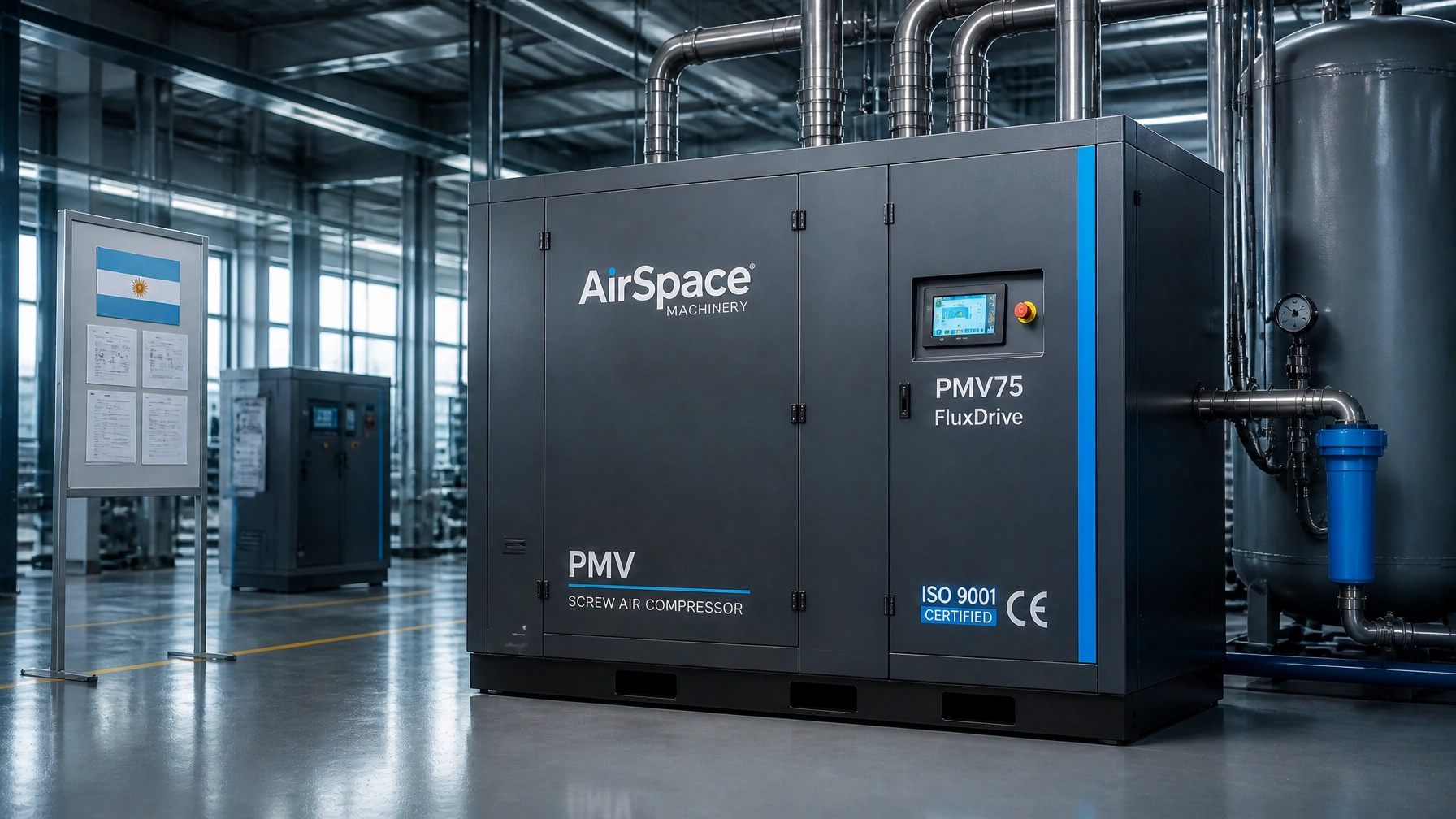
A high-performance PMV screw air compressor eliminates this waste by slowing the motor down to match exact demand, maintaining a stable ±0.1 bar pressure and delivering a 35% energy delta compared to legacy systems.
7-Step Textile Factory Energy Audit Template
Step 1: Leak Detection (The 20% Waste)
Most textile mills lose 20-30% of their air to leaks. Use an ultrasonic leak detector during a “silent shift” (when machines are off) to identify and tag every hiss in the overhead piping. Reducing leakage to under 10% is the fastest way to improve ROI.
Step 2: Pressure Optimization
Many factories run at 8 bar because “that’s how we’ve always done it,” even if the looms only require 5.5 bar. Reducing system pressure by just 1 bar (14.5 psi) reduces total energy consumption by approximately 7%.
Step 3: SEC Benchmarking
Calculate your Specific Energy Consumption. Measure the total kWh consumed by the compressor room over 7 days and divide it by the total fabric production (meters) or yarn production (kg). This gives you a baseline to measure every future improvement.
Step 4: Thermal Recovery Audit
Compressors generate immense heat. In a textile environment, this heat can be recovered to pre-heat water for dyeing processes or to assist in factory humidification systems, further improving plant-wide efficiency.
Step 5: PMV Motor Verification
Check if your current motors are IE3 or higher. A China made screw air compressor from AirSpace Machinery utilizes Permanent Magnet technology which maintains 95%+ efficiency even at low speeds, unlike standard induction motors that lose efficiency rapidly when slowed down.
Step 6: Controller Synchronization
If you run multiple compressors, ensure they are not fighting each other. A centralized controller should manage the sequence, ensuring that only the necessary number of units are running and that the “lead” unit is always the most efficient PMV model.
Step 7: TCO Projection
Don’t just look at the purchase price. A Total Cost of Ownership (TCO) analysis shows that energy represents 80% of a compressor’s lifetime cost. Investing in an energy-efficient China made screw air compressor often pays for itself within 12 to 18 months through energy savings alone.

Loom Efficiency & SEC Benchmarks (2026 Targets)
Use the following table to compare your current factory performance against 2026 industrial efficiency standards:
| Loom Type | Air Pressure (Bar) | FAD Req. (m³/min) | SEC Target (kW/m³/min) |
|---|---|---|---|
| Air-Jet Weaving | 5.0 – 7.0 | 0.8 – 1.5 | 0.11 – 0.13 |
| Rapier Loom (Ancillary) | 5.5 – 6.0 | 0.05 – 0.1 | 0.14 – 0.16 |
| Water-Jet (Ancillary) | 5.5 – 6.0 | 0.02 – 0.05 | 0.14 – 0.16 |
| Spinning/Cleaning | 6.0 – 8.0 | Variable | 0.12 – 0.15 |
The AirSpace Solution: Engineering Freedom for Textile 4.0
AirSpace Machinery specializes in low-pressure and medium-pressure PMV systems specifically engineered for the textile industry’s unique demands. Our systems are built to withstand the “Extreme Climate” conditions often found in textile hubs, from high humidity in Southeast Asia to the heat of the Middle East.
- ISO 8573-1 Class 0 Integrity: For premium fabrics where oil contamination is not an option, our oil-free solutions ensure 100% purity.
- 35% Energy Delta: Our PMV technology specifically targets the “Unload Tax,” ensuring you only pay for the air you actually use.
- Rugged Reliability: With 100 million yuan in annual sales and ISO 9001 certification, we provide the stability of an industry giant with the pricing of a factory-direct partner.

Frequently Asked Questions (FAQ)
How much air does an air-jet loom consume?
A modern air-jet loom typically consumes between 0.8 and 1.5 m³/min of compressed air depending on the fabric type, reed width, and loom speed.
Can I use a China made screw air compressor for high-end European looms?
Yes. AirSpace Machinery systems are designed to meet or exceed the technical specifications of all major loom manufacturers. We follow CE and ISO 9001 standards to ensure global compatibility.
What is the “Humidity Tax” in textile air systems?
In Southeast Asia and other high-humidity regions, moisture in compressed air can lead to rust in loom nozzles and solenoid failure. Our integrated refrigerated air dryers eliminate this “tax” by maintaining a stable dew point, protecting your machinery.
How do I verify the energy savings of a PMV compressor?
We recommend installing a dedicated kWh meter and a flow meter. By comparing the kW/m³/min (SEC) of your old fixed-speed unit against a new AirSpace PMV unit, you will typically see a 30% to 35% reduction in energy input for the same air output.
Cite This Entry
AirSpace Machinery Co., Ltd. (2026). Textile Factory Compressor Energy Audit: A 7-Step Template for Plant Managers. Technical Authority Series. www.chinacompressor.org
Reviewed by Engineering
Technical accuracy verified by the AirSpace Field Engineering Team on July 18, 2026.
Author: Penny Winston
Penny Winston is a Technical Writer at AirSpace Machinery, specializing in “The 35% Energy Delta” and “The Fourth Utility Concept.” With a focus on ISO 8573-1 Class 0 Integrity, she helps industrial buyers navigate the complexities of modern air compression to achieve maximum ROI and operational excellence.
📊 Request Free Energy Audit
Stop guessing and start saving. If your textile factory is struggling with high energy bills or pressure instability, our engineering team can provide a remote or on-site energy audit to quantify your potential savings.
🟢 Get a Proposal: Request a Technical Quote →
🟡 WhatsApp Johnny Wayne: +86 134 2434 2845 (Direct Technical Support)
📅 Last updated:
⚡ Is Your Factory Bleeding Cash?
Most fixed-speed compressors waste $3,600/year in "Unload Tax." Test your waste level in 30 seconds.
RUN THE ROI TEST →Ready to See How Much Your Facility Can Save?
Fill out the form below for a Free Energy Assessment.