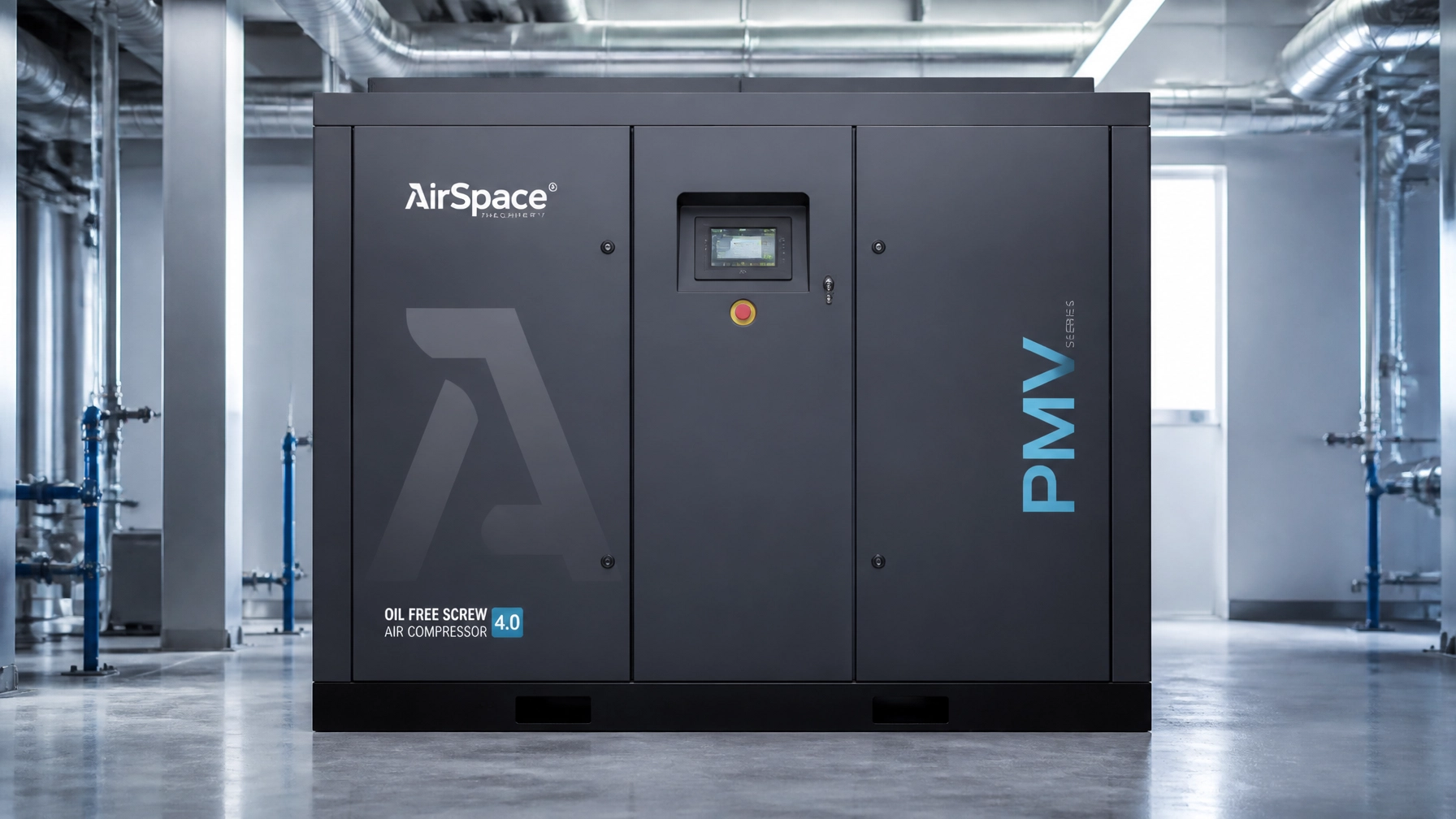
Textile mills typically waste 30% to 35% of their compressed air energy by over-pressurizing their systems. Most textile processes, such as air-jet weaving, spinning, and texturizing, require only 3 to 5 bar of pressure. However, many facilities continue to operate standard 8-bar or 10-bar screw compressors. This “Energy Crime” forces the compressor to work harder than necessary, leading to exponential increases in electricity costs and accelerated equipment wear. By switching to a dedicated Permanent Magnet Variable Frequency (PMV) low-pressure screw compressor, mills can achieve a 35% energy delta and significantly improve production stability.
The 10 Biggest Headaches for Textile Mill Managers
Before we dive into the technical solution, let’s look at why your current air system is likely a source of stress:
- Exorbitant Electricity Bills: Compressed air often accounts for over 50% of a mill’s total power consumption.
- Frequent Loom Downtime: Pressure fluctuations lead to mispicks and machine trips.
- Aggressive Air Leaks: High-pressure air escapes through tiny holes at a much faster rate than low-pressure air.
- Motor Overheating: Standard compressors running at high loads in hot mill environments often shut down.
- High Maintenance Costs: Over-pressurizing creates unnecessary heat and friction, killing bearings and seals.
- Complex Control Systems: Older units are difficult to sync with modern production lines.
- Moisture in the Lines: High-pressure discharge creates more condensate, risking fabric staining.
- Noise Pollution: Standard high-pressure units are loud, impacting the shop floor environment.
- Compliance Anxiety: Difficulty verifying CE or ISO 9001 documentation for export-heavy markets.
- Global Grid Instability: Power surges in developing markets can fry sensitive electronics on cheap compressors.
Why Is Using 8-Bar Air for 3-Bar Applications an “Energy Crime”?
In the world of thermodynamics, pressure is expensive. For every 1 bar (14.5 psi) you increase your system pressure, your power consumption rises by approximately 7% to 10%.
If your air-jet looms or spinning frames only need 3 bar to operate, but your compressor is pushing out 8 bar, you are effectively paying for 5 bar of “phantom pressure” that does nothing but create heat and leaks. This is what we call an “Energy Crime.” It’s like buying a heavy-duty freight truck to deliver a single envelope.
As Johnny Wayne, Managing Director of AirSpace Machinery Co., Ltd., puts it: “If you’re running a loom at 3 bar using an 8 bar compressor, you aren’t just making fabric; you’re burning cash. We see mills every day that could cut their power bill by a third just by matching the machine to the job.”
The Technical Solution: PMV Low-Pressure Screw Air Compressors
The solution isn’t just “turning down the pressure” on a standard machine. Standard 8-bar compressors are not designed to run efficiently at 3 bar; their air ends and motor speeds are optimized for higher resistance.
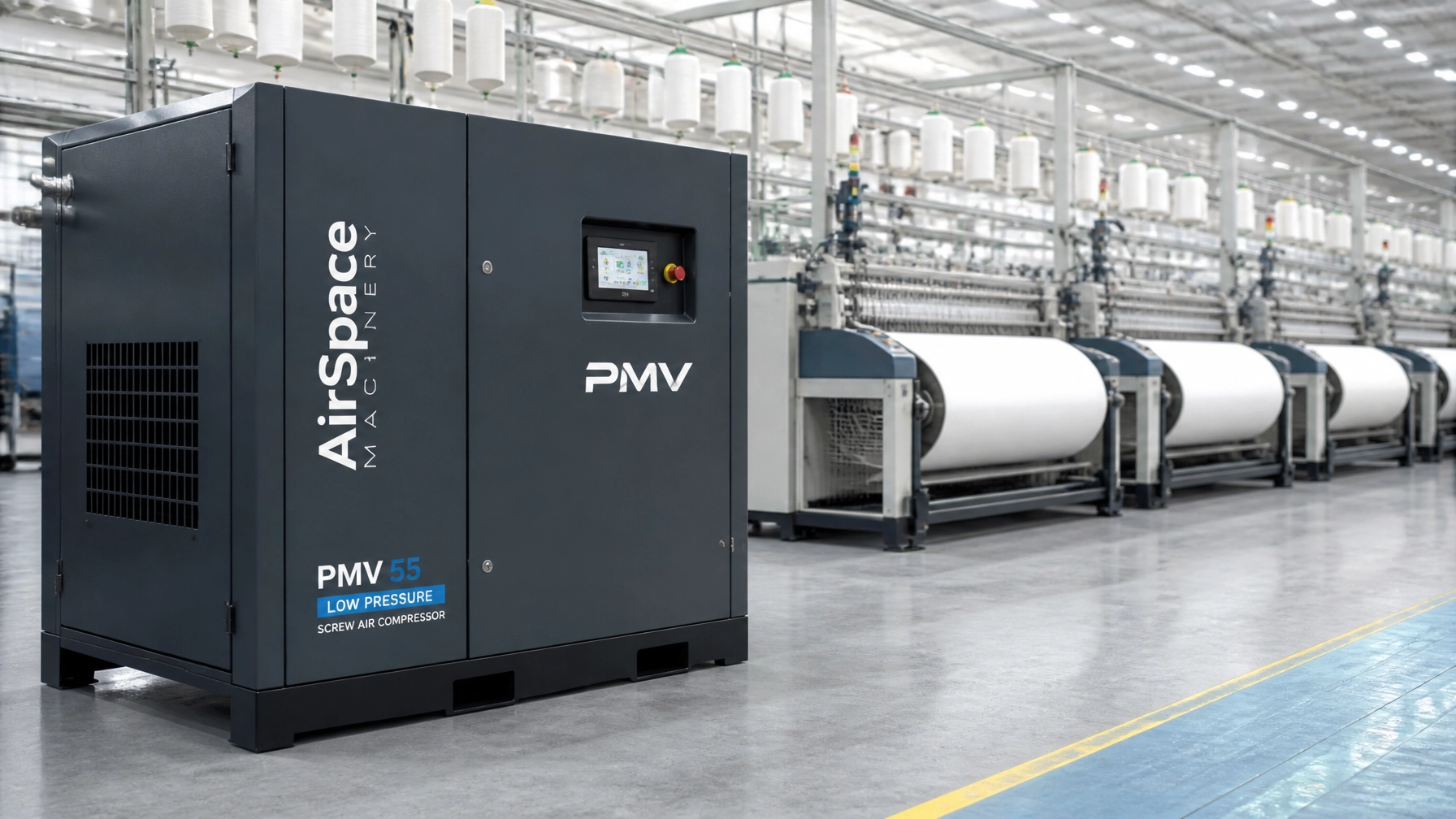
The AirSpace PMV Low-Pressure Screw Air Compressor is engineered specifically for the 3–5 bar range. It uses a specialized air end with a larger rotor profile (featuring BAOSI or Hanbell components) that moves a higher volume of air at a lower RPM.

Key Technical Advantages:
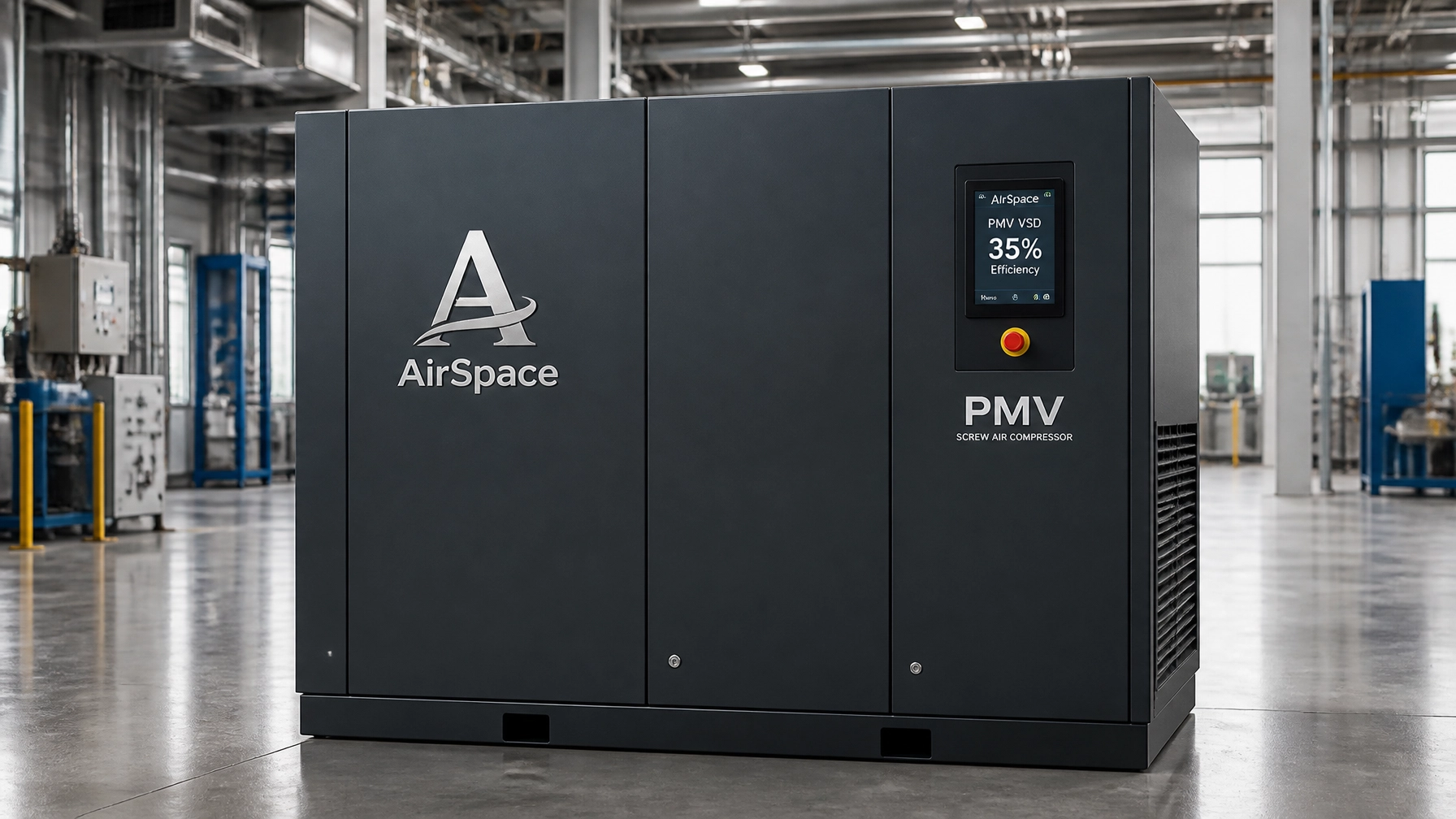
- 35% Energy Delta: Our PMV (Permanent Magnet Variable Frequency) technology allows the motor to adjust its speed in real-time. Unlike fixed-speed compressors that run at 100% even when demand is low, the PMV system scales to match your exact CFM requirements.
- Reduced Leakage Rates: Operating a system at 3 bar instead of 8 bar reduces the volume of air lost through existing leaks by nearly 50%.
- 99.9% Uptime: Designed for continuous 24/7 operation in harsh textile environments.
- Low Noise Operation: Engineered enclosures significantly reduce decibel levels compared to standard industrial units.
Comparison: Fixed-Speed 8-Bar vs. AirSpace PMV 3-Bar
| Feature | Standard 8-Bar Fixed-Speed | AirSpace PMV Low-Pressure (3-Bar) |
|---|---|---|
| Power Consumption | High (constant) | Low (variable/demand-based) |
| Energy Efficiency | Baseline | 35% Better |
| Air End Wear | High (due to pressure/heat) | Low (optimized RPM) |
| Leakage Cost | Severe | Minimal |
| Pressure Stability | +/- 0.5 bar | +/- 0.1 bar |
| Certification | Varies | CE & ISO 9001 |
Addressing Global Buyer Concerns: Quality and Logistics
When sourcing heavy machinery from China, we know you have questions about reliability and shipping. AirSpace Machinery operates out of a state-of-the-art 4000m² facility with an annual sales volume exceeding 100M yuan.
Verifying Documentation
All our low-pressure screw compressors come with verifiable CE and ISO 9001:2015 certifications. These documents ensure that the equipment meets international safety and quality standards. We provide full digital copies for your customs clearance and internal audits.
Logistics and Export Support
We have two decades of experience shipping to textile hubs in Southeast Asia, LATAM, and the CIS region. Our logistics team handles everything from sea-worthy wooden crate packaging to export documentation, ensuring your compressor arrives ready for installation.
Regional Considerations: Humidity and Grid Stability
For our clients in Southeast Asia, we equip our compressors with oversized cooling systems and high-efficiency moisture separators to handle extreme humidity. High ambient moisture can turn compressed air into a slurry of water and oil; our systems adhere to ISO 8573-1 Class 4 air quality standards as a baseline, ensuring your fabric remains spotless.
For our clients in LATAM and the CIS, where power quality can fluctuate, our PMV drives are built with ruggedized frequency converters that can withstand voltage variances without tripping, maintaining the 99.9% uptime your production schedule demands.
Q&A: Common Industrial Buyer Questions
Q: Can’t I just use a pressure regulator to drop my 8-bar air to 3-bar?
A: You can, but you won’t save energy. The compressor still uses the energy required to compress air to 8 bar. The “extra” energy is simply wasted as heat at the regulator. To save money, you must compress the air to the lower pressure at the source.
Q: Is PMV technology harder to maintain than fixed-speed?
A: Actually, it’s easier. Because the PMV motor has no bearings (the motor and air end are integrated) and uses soft-starts, there is less mechanical stress on the system. We use premium Hanbell or BAOSI air ends, which are the gold standard for longevity in the industry.
Q: How do I calculate my potential ROI?
A: We look at your current kWh rate, your annual operating hours, and your required CFM at 3 bar. Most textile mills see a full return on investment (ROI) within 12 to 18 months just from power savings alone.
Hard Stats for the Technical Mind
- 35%: The average energy savings when switching from fixed-speed 8-bar to PMV 3-bar.
- 20 Years: The engineering experience behind every AirSpace Machinery unit.
- 0.1 Bar: The precision of our pressure control, preventing loom trips.
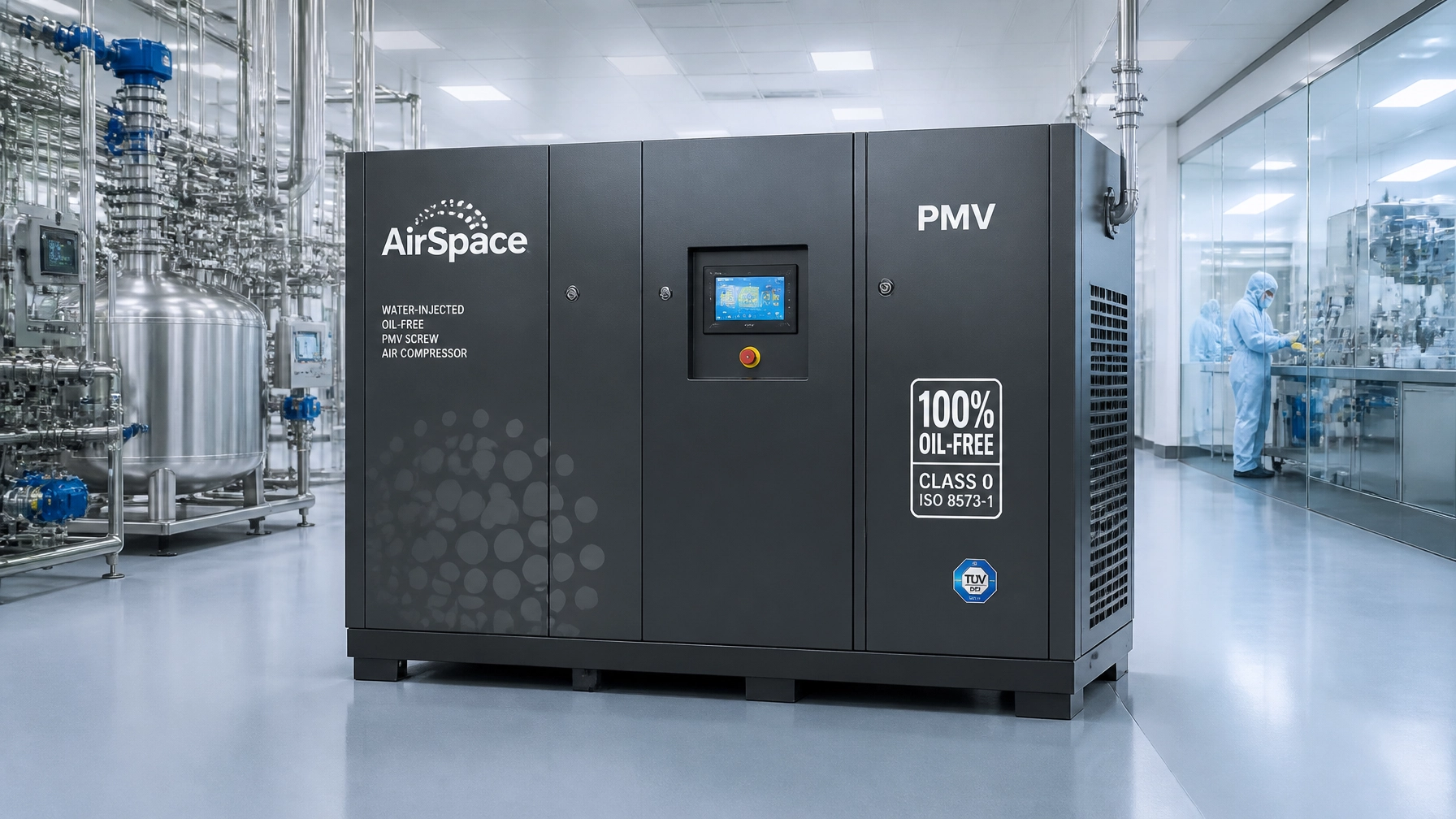
- 100%: Oil-free options are available for sensitive dyeing processes (though our standard screw units feature 3-stage filtration).
Get a Proposal
Ready to stop the energy crime in your facility? We provide custom solutions based on your specific needs. Please note that lead times vary depending on your specific configuration and regional electrical requirements.
To receive a tailored proposal, please provide your requirements:
- Required Working Pressure: [___] bar / psi (Mandatory)
- Required Air Flow: [___] m³/min or CFM (Mandatory)

Author: Penny Winston
Technical Writer, AirSpace Machinery Co., Ltd.
Specializing in industrial efficiency and sustainable manufacturing.
Reviewed by Engineering
Verified for compliance with ISO 1217:2009 displacement compressor standards.