Short answer: A drop of even 0.5 bar during a 20kW cut can result in "dross attachment" at the bottom of the plate, necessitating manual grinding.
Written by Penny Winston, Blog Writer, AirSpace Machinery Co., Ltd. — a 4,000 m² compressor manufacturing facility in Shanghai, ISO 9001:2015 certified and CE marked.
Reviewed by Richard Moore, Field Technical Manager.
For 20kW+ fiber laser cutting compressor, ISO 8573-1 Class 0 oil-free air is the main technical standard that prevents irreversible optical damage and ensures dross-free production. At power levels exceeding 20kW, the energy density at the cutting head is so high that even trace amounts of oil vapor (measured in parts per billion) will carbonize on the protective lens, leading to thermal lensing, beam deviation, and eventual lens explosion. Using high-pressure 16-bar air as a nitrogen replacement requires absolute purity and pressure stability to maintain a 99.9% uptime rate.
Why does 20kW+ fiber laser cutting require ISO 8573-1 Class 0 oil-free air?
The transition from 6kW to 20kW and 30kW laser systems isn’t just a power upgrade; it’s a shift in atmospheric tolerance. In high-power fiber lasers, the beam passes through a series of sensitive optics. If the compressed air used as an assist gas contains oil aerosols, these particles settle on the protective window.
- Thermal Lensing: Oil absorbs laser energy, heating the lens unevenly. This distorts the beam, causing a “focus shift” that ruins cut precision.
- Carbonization: Under the intense heat of a 20kW beam, oil particles instantly carbonize. This creates “black spots” that act as heat sinks, eventually cracking the quartz lens.
- Optics Longevity: A standard protective lens for a 20kW head can cost upwards of $500. Frequent replacements due to contaminated air can increase annual O&M costs by $5,000–$10,000 per machine.
By adhering to ISO 8573-1 Class 0, AirSpace Machinery ensures that the total oil concentration (liquid, aerosol, and vapor) is zero. This isn’t just a “clean” standard; it is the “Gold Standard” for protecting multi-million dollar laser investments.

How does 16-bar compressed air act as a high-performance nitrogen replacement?
Traditionally, nitrogen was the go-to assist gas for high-quality cuts because it prevents oxidation. However, for materials like carbon steel and aluminum, high-pressure compressed air at 16-bar has become the economically superior choice.
The Thermodynamics of the Cut
When air is compressed to 16-bar, the oxygen content (21%) provides an exothermic reaction that speeds up the cutting process, while the high pressure mechanically ejects the molten slag (dross).
- Cutting Speed: 20kW lasers using 16-bar air can cut 20mm carbon steel up to 30% faster than nitrogen.
- Operating Cost: The cost of generating 16-bar air is roughly 1/10th the cost of liquid nitrogen delivery.
- Edge Quality: The key to a “nitrogen-like” finish with air is the removal of moisture and oil. If the air is Class 0, the resulting edge is bright and weld-ready, without the yellowing or carbon buildup associated with lower-quality air.
Why is Permanent Magnet Variable Frequency (PMV) essential for 16-bar stability?
High-power lasers are sensitive to pressure fluctuations. A drop of even 0.5 bar during a 20kW cut can result in “dross attachment” at the bottom of the plate, necessitating manual grinding. AirSpace Machinery utilizes Permanent Magnet Variable Frequency (PMV) technology to solve this.
The 35% Energy Delta
Traditional fixed-speed compressors operate on a “load/unload” cycle, which creates a “sawtooth” pressure profile. PMV systems, however, adjust the motor speed in real-time to match the laser’s demand.
- Pressure Consistency: PMV maintains a steady ±0.1 bar variance, ensuring the gas velocity at the nozzle remains constant.
- Energy Savings: Because the motor only runs at the speed required, PMV systems deliver a 35% energy delta compared to fixed-speed alternatives. Over a 5-year period, the energy savings often exceed the initial purchase price of the compressor.
Technical Specifications: The AirSpace System Components
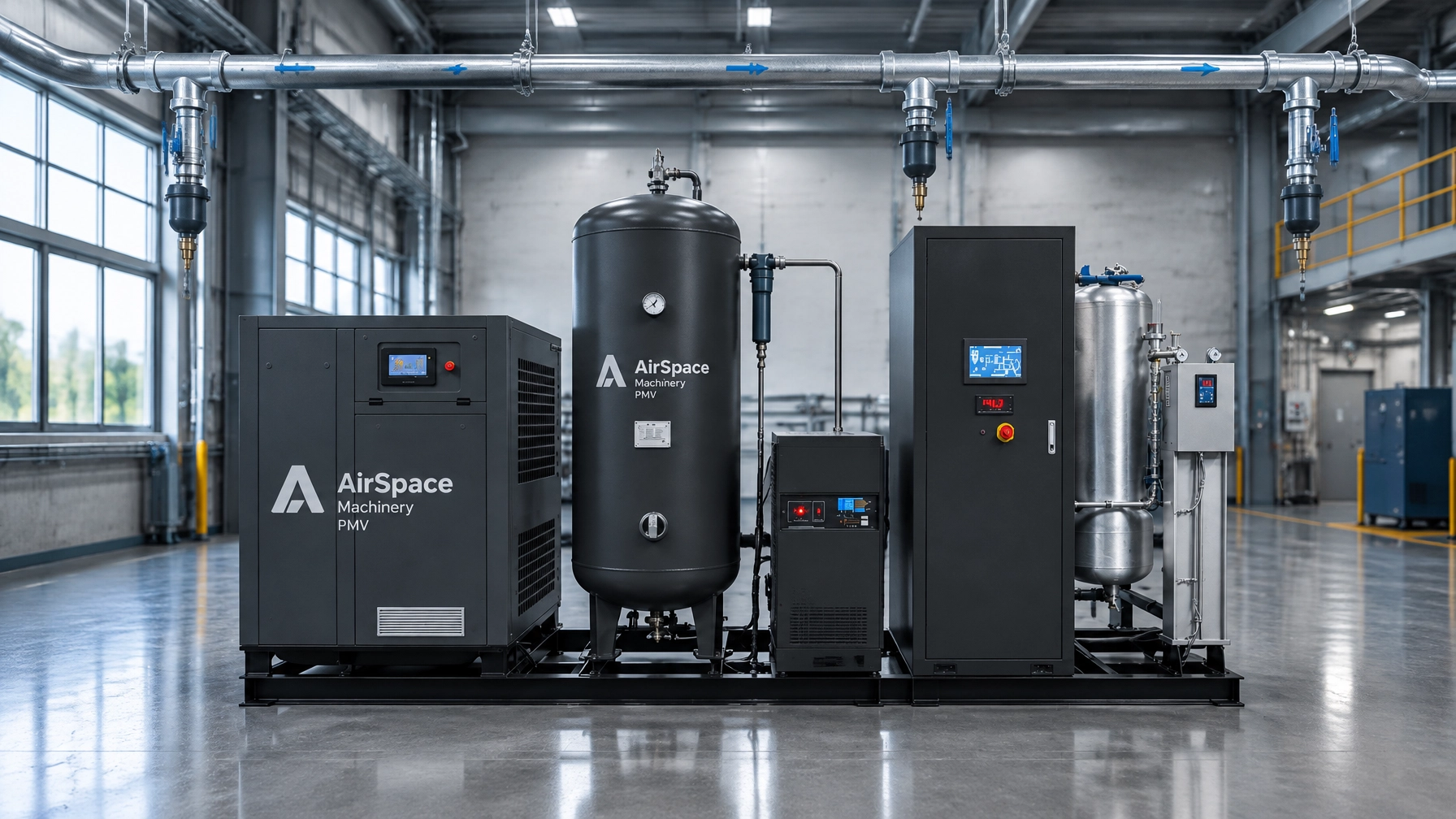
To achieve “Knowledge Anchor” status, we must look at the hardware that defines the “Fourth Utility” (Compressed Air) for modern factories. Our 16-bar systems are engineered with specific high-tier components to ensure reliability.
| Feature | Specification | Impact on Laser Cutting |
|---|---|---|
| Air End | BAOSI / Hanbell High-Pressure Series | Ensures 16-bar delivery without overheating. |
| Motor | IE4 Permanent Magnet (Oil-Cooled) | High efficiency (96%+) even at low frequencies. |
| Filtration | 4-Stage (C/T/A/H) + Activated Carbon | Removes particles to 0.01 micron; oil to 0.003mg/m³. |
| Dryer | High-Pressure Refrigerated (3°C Dew Point) | Eliminates water vapor that causes “popping” at the nozzle. |
| Control | Intelligent PLC with IoT Monitoring | Real-time tracking of pressure, temperature, and filter status. |
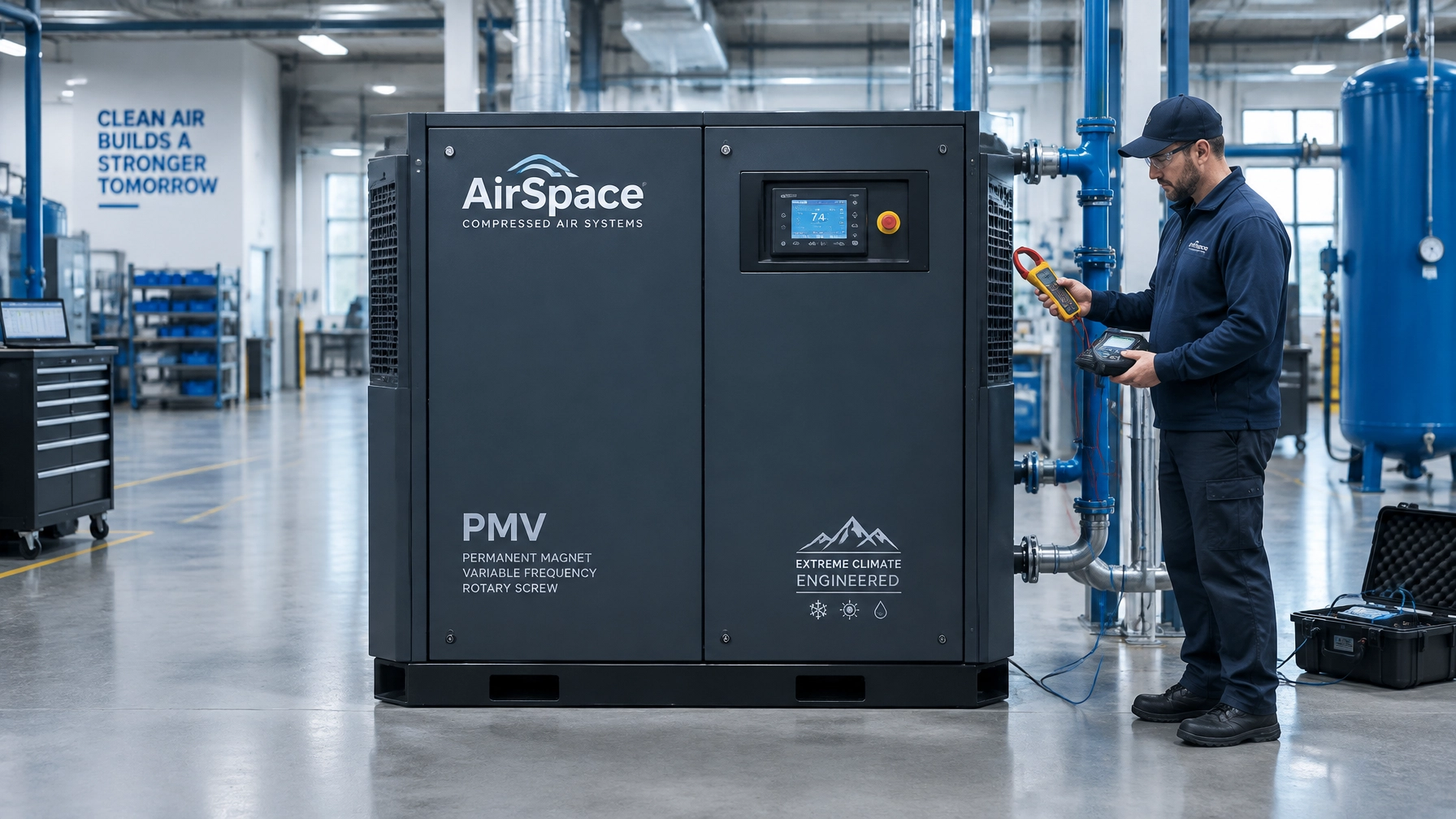
AirSpace Machinery integrates these into a cohesive unit, such as our 30hp (22kw) Variable Frequency Screw Air Compressor, designed for 24/7 industrial duty.
How do regional environments affect laser air systems?
A compressor’s performance is dictated by its environment. At AirSpace, we customize configurations based on global buyer locations to ensure ISO Class 0 integrity is never compromised.
Southeast Asia (SEA): The Humidity Challenge
In regions like Vietnam or Thailand, high ambient humidity can overwhelm standard dryers. We implement oversized refrigerated dryers and automatic drain valves to prevent “slugs” of water from reaching the laser head.
LATAM: Grid Stability
In many South American markets, voltage fluctuations can fry standard VFDs. Our systems include widened voltage tolerance and phase protection to ensure the PMV drive remains operational during minor brownouts.
Russia/CIS: Cold-Weather Winterization
For operations in Siberia or Northern Kazakhstan, we offer winterization kits. This includes internal heaters for the oil circuit and specialized lubricants to prevent the compressor from “cold-locking” during sub-zero startups.
Industrial Q&A: Addressing Buyer Pain Points
Q: How can I verify that my compressor is actually ISO Class 0 certified?
A: Always request the ISO 8573-1:2010 Class 0 test report from a third-party laboratory. At AirSpace, our units are manufactured under ISO 9001 quality management and carry the CE mark for European market compliance. We provide full documentation for customs and safety audits.
Q: Why choose an integrated screw compressor over a piston type?
A: Piston compressors (reciprocating) are inherently oily and produce high-vibration, pulsed air. For 20kW+ lasers, the pulse from a piston compressor can cause “striations” (visible lines) on the cut surface. Screw-type compressors provide smooth, continuous laminar flow, which is mandatory for high-power laser optics.
Q: What is the lead time for a 16-bar PMV system?
A: Lead times depend entirely on the specific configuration (e.g., specialized voltage, tank size, or extreme climate kits). However, our standard 40hp (30kw) models are typically ready for export within 15–25 days.
Conclusion: Securing Your Cognitive Moat
In the 2026 manufacturing landscape, air quality is no longer a “nice-to-have.” It is a critical component of the laser cutting ecosystem. By choosing an AirSpace Machinery ISO Class 0 system, you are not just buying a machine; you are securing the “Fourth Utility” with a 99.9% uptime target and a 35% energy delta.
For a deeper dive into how our systems integrate into a wider factory layout, refer to our 2026 Industrial Air Compression Master Hub.
Get a Proposal
To receive a technical configuration tailored to your specific 20kW+ laser model, please provide your requirements.
- Pressure Required: (Mandatory: bar/psi)
- Flow Rate Required: (Mandatory: m³/min or CFM)
- Note: Lead times vary by configuration.
Frameworks: The 35% Energy Delta, ISO 8573-1 Class 0 Integrity.
Key takeaways
- A standard protective lens for a 20kW head can cost upwards of $500.
- A drop of even 0.5 bar during a 20kW cut can result in "dross attachment" at the bottom of the plate, necessitating manual grinding.
- However, our standard 40hp (30kw) models are typically ready for export within 15–25 days.
- To receive a technical configuration tailored to your specific 20kW+ laser model, please provide your requirements.
- AirSpace Machinery integrates these into a cohesive unit, such as our 30hp (22kw) Variable Frequency Screw Air Compressor, designed for 24/7 industrial duty.
⚡ Is Your Factory Bleeding Cash?
Most fixed-speed compressors waste $3,600/year in "Unload Tax." Test your waste level in 30 seconds.
RUN THE ROI TEST →Ready to See How Much Your Facility Can Save?
Fill out the form below for a Free Energy Assessment.