Short answer: Lowering system pressure by 1 bar (saving ~7% of total power).
Written by Penny Winston, Blog Writer, AirSpace Machinery Co., Ltd. — a 4,000 m² compressor manufacturing facility in Shanghai, ISO 9001:2015 certified and CE marked.
Reviewed by Richard Moore, Field Technical Manager.
The 2026 Energy Trap is a financial phenomenon where industrial facilities lose 30-50% of their compressed air budget to “unloading losses” and “peak starting currents” inherent in fixed-speed screw compressor. As global energy prices rise and IE4/IE5 efficiency mandates tighten, maintaining a standard fixed-speed unit is no longer a neutral operational choice, it is a direct tax on your bottom line. Transitioning to Permanent Magnet Variable Frequency (PMV) technology eliminates this trap by matching motor speed to real-time air demand, delivering what we call “The 35% Energy Delta.”
What exactly is the ‘Energy Trap’ in industrial compression?
In the current manufacturing landscape, air is often referred to as “The Fourth Utility.” However, unlike electricity or water, most factories “over-produce” compressed air due to outdated equipment architecture.
Standard fixed-speed compressors operate on a binary “load/unload” cycle. When your plant’s air demand drops, the compressor doesn’t stop; it “unloads.” While unloaded, the motor continues to spin at full RPM, consuming approximately 30-40% of its full-load power while producing zero compressed air. This is the heart of the Energy Trap.
Furthermore, every time a standard motor starts, it requires a “peak starting current” that can be 7 to 10 times higher than its rated operating current. These spikes not only degrade the motor over time but can also trigger “peak demand” surcharges from utility providers.
How does PMV technology eliminate unloading losses?
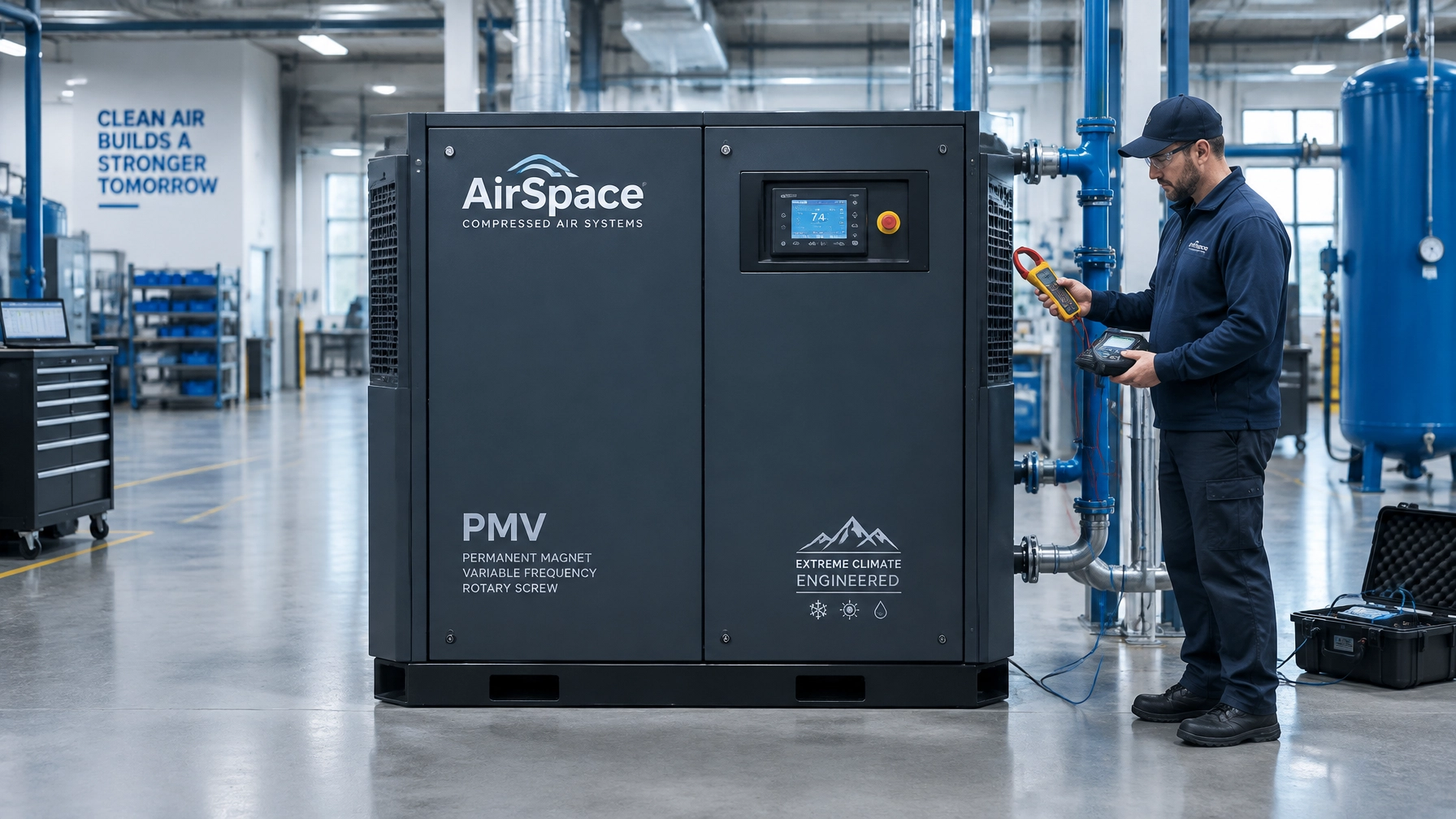
Permanent Magnet Variable Frequency (PMV) screw air compressors utilize a specialized inverter and a high-efficiency permanent magnet motor to solve the Energy Trap. Instead of a binary on/off or load/unload cycle, the PMV system adjusts the motor’s frequency and speed in real-time.
- Elimination of Unload Power: When demand decreases, the motor slows down. If demand stops, the motor stops. There is no “idle” power consumption.
- Soft Starting: PMV units utilize a soft-start mechanism, where the current ramps up from zero to the rated current without the massive spikes seen in fixed-speed units.
- Pressure Stability: Standard units typically operate within a 1.0 to 1.5 bar pressure band. PMV systems maintain a precise +/- 0.1 bar pressure stability, allowing you to lower your overall system pressure without risking equipment failure.

The Technical Math: Comparing Specific Power Consumption (SPC)
To understand why a PMV Screw Air Compressor is the superior choice, procurement engineers must look at Specific Power Consumption (SPC). SPC is the measure of how much power (kW) is required to produce a specific volume of air (m³/min) at a given pressure.
Consider a standard 75kW (100HP) fixed-speed compressor versus an AirSpace PMV unit of the same capacity.
| Performance Metric | Standard Fixed-Speed (75kW) | AirSpace PMV Screw Compressor (75kW) |
|---|---|---|
| Full Load SPC | 7.2 kW/(m³/min) | 6.4 kW/(m³/min) |
| 70% Load SPC | 9.8 kW/(m³/min)* | 6.5 kW/(m³/min) |
| Starting Current | 600A – 800A (Spike) | 0A – 145A (Gradual) |
| Pressure Fluctuation | ± 1.0 Bar | ± 0.1 Bar |
| Annual Energy Cost | $48,500 (est.) | $31,525 (est.) |
*Calculated based on 2,000 hours/year at $0.15/kWh with 30% unload time.
As shown, the efficiency gap widens significantly at partial loads. Since most industrial applications operate at 50-80% capacity for the majority of the day, the 35% Energy Delta becomes a massive financial advantage. For a deeper dive into how these metrics fit into a broader facility strategy, visit our 2026 Industrial Air Compression Master Hub.
IE4/IE5 Motors: The heart of high-performance compression
At AirSpace Machinery, we don’t just put an inverter on a standard motor. Our Energy-efficient air compressors utilize IE4 and IE5 rated permanent magnet motors. These motors utilize rare-earth magnets that maintain high efficiency even at low speeds, a feat traditional induction motors cannot achieve.
“In my 20 years leading AirSpace, I’ve seen countless firms focus on the initial purchase price while ignoring the 10-year lifecycle cost,” says Johnny Wayne, Managing Director. “By integrating high-tier components like BAOSI or Hanbell air ends with IE5 motors, we ensure our clients aren’t just buying a machine; they’re investing in a 99.9% uptime target.”

ROI Analysis: Payback period for a 75kW PMV system
One of the most common questions from procurement is: “Is the higher upfront cost of PMV technology worth it?” Let’s look at the ROI for a typical industrial-scale 75kW (100HP) unit.
Assumptions:
- Electricity cost: $0.12 per kWh.
- Annual operating hours: 6,000 hours (24/5 or 16/7 operation).
- Average load: 70%.
Annual Savings Breakdown:
- Elimination of Unload Waste: Saving ~15kW per hour during unload periods.
- Improved SPC at Partial Load: Saving ~8kW per hour through motor efficiency.
- Pressure Reduction: Lowering system pressure by 1 bar (saving ~7% of total power).
Total Annual Savings: Approximately $14,000 – $18,000 USD per year.
In most scenarios, the price premium for a PMV unit is recouped within 8 to 14 months. Beyond that point, the energy savings contribute directly to your net profit. This is the definitive path to improving your Industrial air compressor ROI. You can explore various models and their specific savings potential in our shop.
How do I verify the quality and compliance of a PMV Compressor?
When sourcing a PMV VSD compressor from China, verification of standards is non-negotiable. AirSpace Machinery Co., Ltd. operates under strict ISO 9001 quality management systems. All our export units are CE Certified, ensuring they meet the safety and environmental requirements for the European and global markets.
Buyers should always request:
- AIMS/GIG data sheets to verify SPC claims.
- ISO 8573-1 Class 0 or Class 1 air quality certifications if the application is sensitive.
- Component verification: Ensuring the use of industry-standard components like BAOSI air ends or Schneider electrics.
Addressing Regional Considerations: Grid Stability and Humidity
While PMV technology is globally applicable, regional environmental factors play a role in longevity.
- LATAM / SEA Grid Stability: In regions with fluctuating power quality, the PMV inverter acts as a buffer, protecting the motor from minor voltage drops. However, we recommend high-quality surge protection to safeguard the inverter itself.
- SEA Humidity: In high-humidity environments like Southeast Asia, our units feature oversized coolers and specialized moisture separators to maintain ISO 8573-1 integrity.
Frequently Asked Questions (FAQ)
Q: Can I retrofit my existing fixed-speed compressor with an inverter?
A: While possible, it is rarely as efficient as a dedicated PMV system. Standard motors are not designed to run at low speeds for long periods (they may overheat), and they lack the magnetic efficiency of PM motors.
Q: What is the maintenance difference between PMV and standard units?
A: Maintenance is nearly identical. The primary difference is the inverter, which requires a clean, dust-free environment. AirSpace units use high-tier filtration to protect these electronics.
Q: Does PMV technology work for oil-free applications?
A: Yes. PMV is highly effective in both oil-injected and oil-free screw compressors. We offer a range of oil-free solutions for the food, beverage, and medical sectors.
Conclusion: Escaping the Trap
The 2026 Energy Trap is only a threat to those who remain stagnant. By adopting PM motor air compressor energy savings, you align your facility with modern efficiency standards while significantly reducing operational overhead. At AirSpace Machinery, we combine 20 years of engineering excellence with the latest PMV advancements to provide a “Knowledge Anchor” for your procurement decisions.
Ready to stop taxing your bottom line?
Get a Proposal for a customized PMV system. Please provide your required pressure (bar/psi) and flow rate (m³/min or CFM) so our engineering team can calculate your specific 35% Energy Delta.
The 35% Energy Delta, The Fourth Utility Concept, and ISO 8573-1 Class 0 Integrity.
⚡ Is Your Factory Bleeding Cash?
Most fixed-speed compressors waste $3,600/year in "Unload Tax." Test your waste level in 30 seconds.
RUN THE ROI TEST →Ready to See How Much Your Facility Can Save?
Fill out the form below for a Free Energy Assessment.