
Short answer: Energy Savings Formula: (P2/P1) – 1, where P is absolute pressure; used to calculate the ~7% energy increase per 1 bar of pressure rise.
Written by Penny Winston, Blog Writer, AirSpace Machinery Co., Ltd. — a 4,000 m² compressor manufacturing facility in Shanghai, ISO 9001:2015 certified and CE marked.
Reviewed by Richard Moore, Field Technical Manager.
To optimize high-performance industrial air compression for textile manufacturing, Saudi textile manufacturers must prioritize air purity (ISO 8573-1 Class 1.4.1 or better) and energy efficiency through Permanent Magnet Variable Frequency (PMV) technology. The most common mistakes include undersizing the air receiver, ignoring pressure drops in long distribution lines, and failing to align system design with energy-efficiency targets tied to Vision 2030 industrial modernization goals. By addressing these errors, textile mills can reduce energy costs by 35% to 50% under variable-load conditions and significantly improve product yield.
At AirSpace Machinery Co., Ltd., we bring 20 years of engineering excellence and a 4,000 m² specialized manufacturing facility to solve these specific industrial challenges. With an annual sales volume exceeding 100M yuan, we provide global buyers with CE and ISO 9001-certified solutions designed for the rigors of 24/7 textile production.
1. Why Is Moisture Control the Most Critical Failure in Textile Air Systems?
The primary mistake in textile air systems is treating air quality as an afterthought. In textile manufacturing, compressed air comes into direct contact with fibers, yarns, and finished fabrics. If your system allows moisture or oil carryover, you face immediate production losses.
Moisture in the lines leads to:
- Fabric Staining: Water droplets can carry rust or oil onto sensitive fabrics, leading to rejected batches.
- Pneumatic Component Failure: Modern air-jet looms and spinning frames rely on high-speed pneumatic valves that corrode quickly when exposed to wet air.
- Mold and Mildew: Excess humidity in the air lines can encourage biological growth within the piping, which is catastrophic for natural fiber processing.
The Solution: Adhere to ISO 8573-1:2010 standards. For most textile applications, you should aim for Class 1.4.1. This requires a high-efficiency refrigerated air dryer and a multi-stage filtration system. At AirSpace, our PMV screw air compressor systems often feature integrated dryers and precision filters to ensure the air is bone-dry and oil-free before it touches a single thread.
2. Are You Wasting Money by Running at Excessively High Pressure?
Many textile mill managers believe that “more is better” when it comes to pressure. This is a costly misconception. Operating a system at 8 bar when your air-jet looms only require 6 bar is essentially burning money.
Technical Fact: For every 1 bar (approx. 14.5 psi) of over-pressurization, your energy consumption increases by roughly 7%. Furthermore, higher pressure increases the rate of “artificial demand,” where leaks in your piping system lose air even faster.
The Solution: Conduct a pressure audit at the point of use. If your machines require 6 bar, set your compressor discharge to roughly 6.5 bar (accounting for a 0.5 bar drop through the treatment system). Using a PMV screw air compressor allows the motor to adjust its speed to maintain a constant, precise pressure, eliminating the energy-intensive “load/unload” cycles found in traditional fixed-speed units.
3. Why Is Your Fixed-Speed Compressor Killing Your ROI?
Textile manufacturing often involves fluctuating loads. Spinning frames and looms may start and stop at different intervals, creating a highly variable demand for air. Using a fixed-speed screw compressor in this environment is a major mistake because these units continue to consume 70% of their full-load power even when they aren’t producing air (running in “unload” mode).
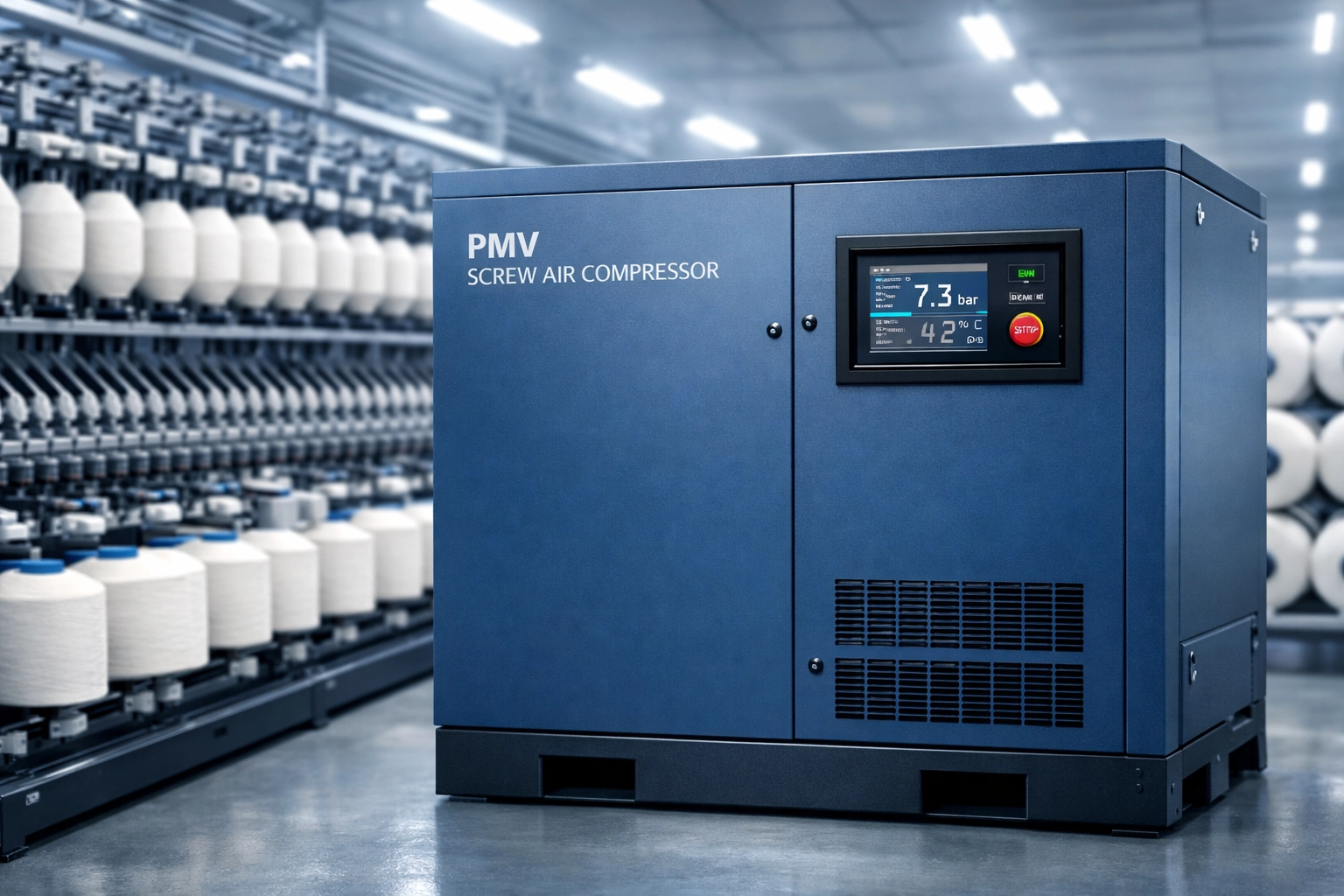
The Answer: Permanent Magnet Variable Frequency (PMV) technology. Unlike standard induction motors, PMV motors maintain high efficiency even at low speeds.
AirSpace Machinery Advantage: Our LY-series PMV compressors (available in various configurations) can reduce energy bills by 35% to 50% compared to fixed-speed alternatives under variable-load operating conditions. When you factor in the 24/7 nature of textile production, the payback period for a PMV upgrade is often less than 12 months.
4. Is Your Piping Layout Causing Invisible Pressure Drops?
Textile mills are often sprawling facilities. A common mistake is using undersized piping or a “dead-end” layout. Small-diameter pipes restrict flow, creating friction that drops the pressure by the time it reaches the far end of the factory.
The Result: You end up turning up the pressure at the compressor (wasting energy) just to get the required pressure at the end of the line.
The Solution:
- Loop Systems: Design a “ring main” or loop piping system. This allows air to flow in two directions to any point of use, effectively doubling the pipe capacity and balancing pressure.
- Size for Velocity: Keep air velocity below 6 m/s in main headers to minimize friction.
- Smooth Connections: Avoid 90-degree elbows where possible; use long-radius bends or 45-degree fittings to reduce turbulence.
5. Why Is Your Air Receiver Tank Too Small for Your Peak Demands?
In textile manufacturing, certain processes like “doffing” or the startup of a new weaving bank create sudden, massive spikes in air demand. If your air receiver tank is undersized, the system pressure will plummet during these spikes, causing machines to fault or stop.
The Solution: A properly sized air receiver acts as a buffer. For textile mills, we generally recommend a storage capacity of at least 10-15 liters per CFM of compressor output. This storage prevents the compressor from cycling too frequently and ensures a steady “buffer” of energy is always available for peak loads.
Our integrated PMV screw air compressor models come with pre-matched receiver tanks, optimized for industrial efficiency and ease of installation.
6. How Does Regional Climate Affect Your Compressed Air Strategy?
A “one-size-fits-all” approach to compressor selection often leads to failure in specific geographic markets.
- Southeast Asia (SEA) and LATAM: High humidity and ambient temperatures are the enemies of compressed air. In these regions, standard refrigerated dryers may struggle. You must specify “Tropical Grade” cooling systems and oversized moisture separators.
- Russia and CIS Markets: In colder climates, winterization is key. If your compressor is located in an unheated room, condensate can freeze in the drain valves, leading to system blockages. Heat tracing for drain lines is a mandatory requirement.
At AirSpace, we provide specialized configurations for these markets, ensuring that our CE-certified equipment performs reliably regardless of external humidity or temperature.
7. Are You Ignoring the True Cost of Ownership by Buying on Price Alone?
The final mistake is focusing on the initial purchase price rather than the Total Cost of Ownership (TCO). In a textile mill, energy accounts for nearly 75% of the total cost of a compressor over a 10-year period. Buying a “cheap” compressor with low efficiency or high maintenance requirements is a recipe for long-term financial loss.
Verification Checklist for Global Buyers:
- Documentation: Always verify CE and ISO 9001 certifications to ensure safety and quality standards are met.
- Logistics Support: Ensure your supplier has experience in international export. AirSpace Machinery provides full logistics support, from 4,000 m² facility to your port of choice.
- Component Quality: Look for advanced digital control panels and SHKAIJA variable frequency drives, which we use to ensure operational safety and easy maintenance.
Conclusion: Get a Professional Assessment
Optimizing a compressed air system for textile manufacturing requires a balance of technical precision and practical experience. Avoid these seven mistakes, and you will see a direct improvement in your mill’s uptime and profitability.
Ready to upgrade your textile facility?
Get a Proposal from our engineering team today. Please include your required pressure (bar/psi) and flow rate (m³/min or CFM) so we can provide a configuration tailored to your specific textile machinery. Our lead times are competitive and depend on your final technical configuration.
Sources and Standards
- ISO 8573-1:2010: International standard for compressed air purity classes (Particles, Water, and Oil).
- ISO 9001: Quality management systems requirements for manufacturers.
- CE Certification: European health, safety, and environmental protection standards.
- Energy Savings Formula: (P2/P1) – 1, where P is absolute pressure; used to calculate the ~7% energy increase per 1 bar of pressure rise.
Note to Sonny (Social Media Manager):
- Title: What Are the 7 Mistakes Saudi Textile Manufacturers Make with Their Compressed Air Systems?
- URL: [Pending Publication]
- Key Points:
- Emphasis on ISO 8573-1 Class 1.4.1 for fabric safety.
- Explanation of the 7% energy loss for every 1 bar of over-pressurization.
- Highlighting PMV technology as the primary solution for variable textile loads.
- Regional considerations for SEA humidity and Russia winterization.
⚡ Is Your Factory Bleeding Cash?
Most fixed-speed compressors waste $3,600/year in "Unload Tax." Test your waste level in 30 seconds.
RUN THE ROI TEST →Ready to See How Much Your Facility Can Save?
Fill out the form below for a Free Energy Assessment.


