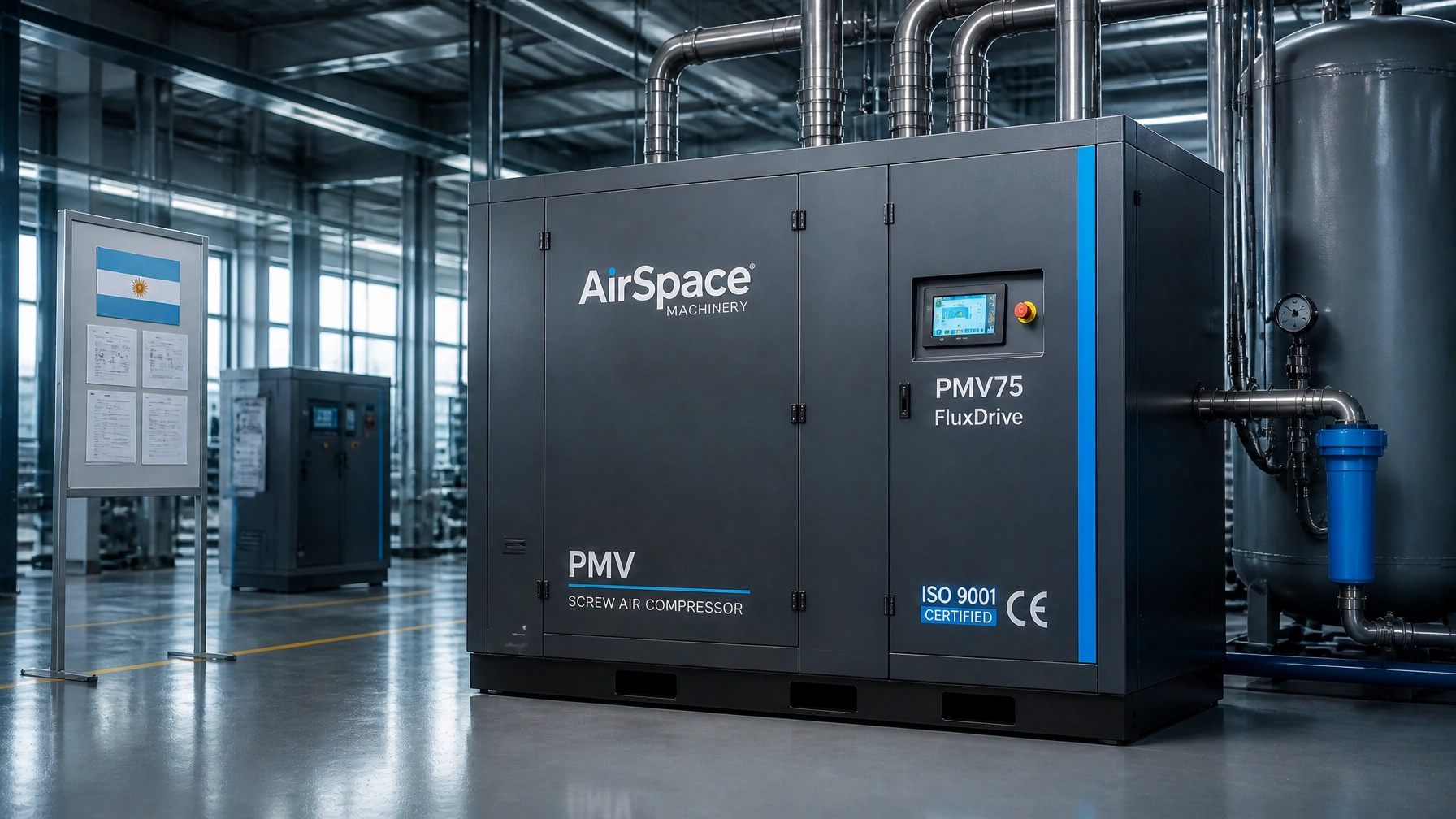
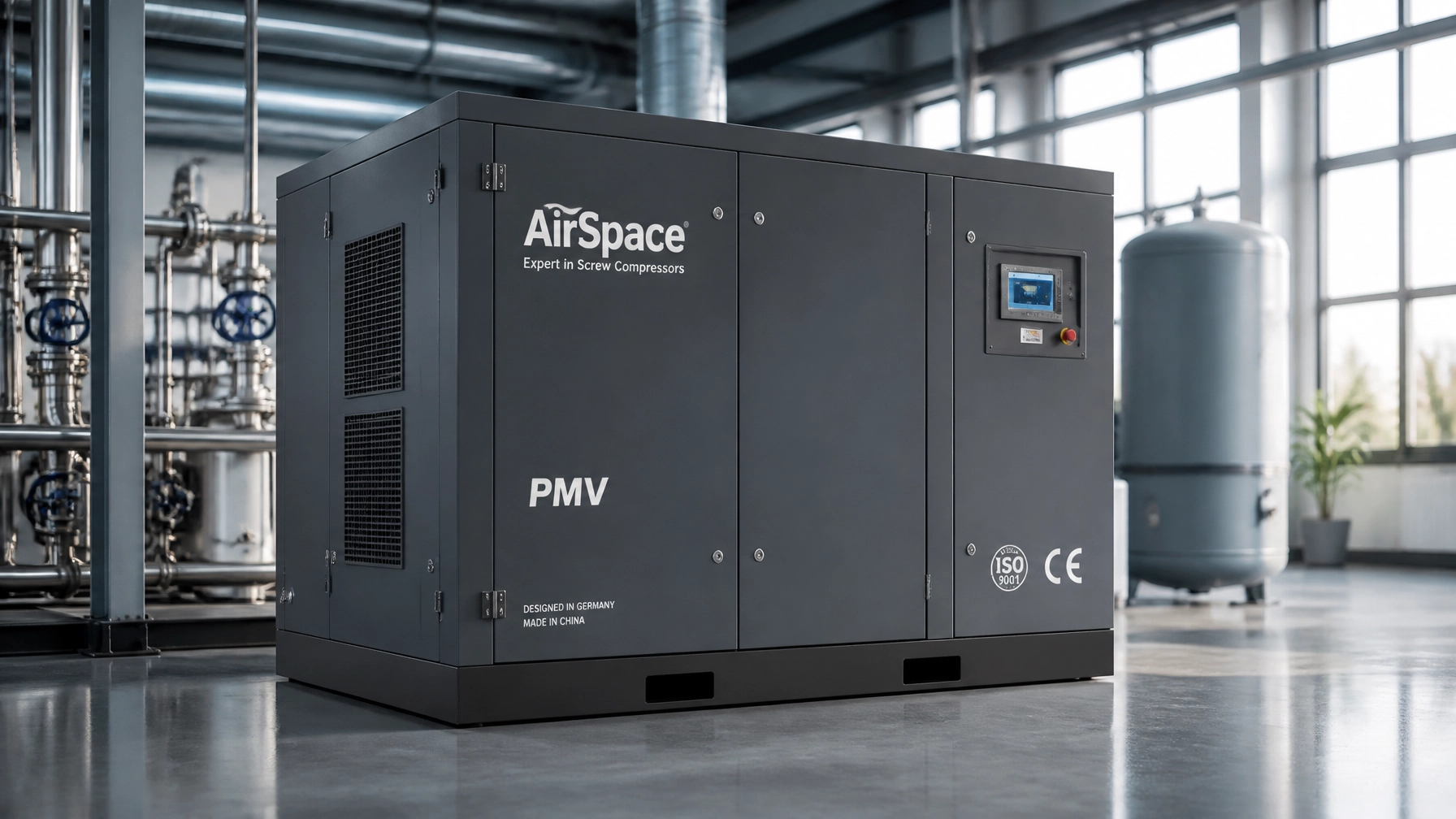
EXECUTIVE SUMMARY: THE SHIFT TO THE IE5 PMV MANDATE
In 2026, the industrial landscape has moved beyond the era of IE3 induction motors. For any facility running more than 4,000 hours per year, the IE3 fixed-speed unit is no longer a standard: it is a financial liability. This technical report establishes the PMV (Permanent Magnet Variable Frequency) system as the new baseline for industrial air compression. By integrating IE5 Ultra-Premium motors with advanced variable frequency control, AirSpace Machinery has closed the 35% energy delta that historically robbed factories of their operating margins.
The transition to this standard is driven by three pillars: the elimination of the Unload Tax, the optimization of volumetric efficiency through 5:6 rotor profiles, and the rigorous adherence to ISO 8573-1 Class 0 integrity. For a typical 75kW installation, the shift from legacy induction to PMV technology represents a recovery of approximately $26,400 in annual energy waste, paying for the equipment upgrade in less than 18 months.
SECTION 1: THE PHYSICS OF PMV ASYMMETRIC ROTORS
The heart of the 2026 China made screw air compressor standard lies in the air-end geometry. While budget suppliers continue to utilize symmetrical or outdated 4:6 rotor profiles, AirSpace engineering utilizes the 5:6 asymmetric rotor ratio. This configuration maximizes the sealing line length and minimizes the blow-hole area, resulting in a 5% to 7% increase in volumetric efficiency at the source.
When coupled with a Permanent Magnet (PM) motor, the drivetrain eliminates the mechanical slip common in induction motors. In a standard induction motor, the rotor lags behind the magnetic field, generating internal heat and wasting power. In our PMV systems, the rotor is synchronized perfectly with the magnetic field using high-coercivity neodymium magnets. This ensures that every kilowatt of electricity drawn from the grid is converted into mechanical work at the screw tips, maintaining high torque even at low RPMs where legacy units would stall or overheat.
SECTION 2: MOTOR TOPOLOGY PERFORMANCE DATA
To evaluate the technical superiority of PMV technology, one must compare the motor topology across the three primary tiers currently found in the market.
MOTOR TOPOLOGY COMPARISON MATRIX
Tier 1: IE2 Induction (Legacy)
- Operating Load Range: 80% to 100%
- Peak Efficiency: 91.2%
- Heat Generation: High (Internal friction)
- Maintenance Interval: 2,000 Hours (Bearing/Winding checks)
Tier 2: IE3 Induction (Current Minimum)
- Operating Load Range: 70% to 100%
- Peak Efficiency: 94.6%
- Heat Generation: Moderate
- Maintenance Interval: 4,000 Hours
Tier 3: IE5 PM Motor (AirSpace Standard)
- Operating Load Range: 25% to 100%
- Peak Efficiency: 97.8%
- Heat Generation: Low (Cold-running technology)
- Maintenance Interval: 8,000 Hours+ (No motor bearings in integrated designs)
The most critical data point is the part-load efficiency. While IE3 motors drop to sub-90% efficiency when running at 50% load, the AirSpace IE5 PM motor maintains >94% efficiency across its entire variable speed range.

SECTION 3: DECONSTRUCTING THE 35% ENERGY DELTA
The 35% energy delta is not a marketing claim; it is a measurable engineering reality. This delta is composed of three specific “Industrial Taxes” that legacy units force onto the plant owner.
1. The Unload Tax (25% Delta)
Fixed-speed compressors cannot stop immediately when air demand drops. Instead, they run “unloaded,” consuming roughly 30% of their full-load power while producing zero compressed air. AirSpace PMV systems eliminate this by varying the motor speed to match real-time demand, ensuring the motor only draws the power required for the air delivered.
2. The Inrush Current Robbery (5% Delta)
Starting a 75kW induction motor creates a massive power spike: often 7 to 10 times the rated current. This “Inrush Current” triggers peak-demand charges from utilities. Our PMV controllers provide a true soft-start, ramping up from 0 Hz to the required frequency without any current spikes, protecting your electrical infrastructure and lowering utility bills.
3. Mechanical Drivetrain Losses (5% Delta)
Traditional compressors use belts or gears to connect the motor to the air-end. Each belt or gear set introduces a 2% to 3% energy loss through friction and heat. AirSpace utilizes 1:1 direct-drive or integrated shaft designs, removing the transmission loss entirely.
SECTION 4: TROPICAL HARDENING AND IP55 STANDARDS
Industrial reliability is often compromised by the “Heat Tax” in regions like Southeast Asia or the Middle East. A China made screw air compressor must be “Tropical Hardened” to survive 24/7 operation in 55°C ambient temperatures.
AirSpace systems achieve this through:
- IP55 Rated Enclosures: Protecting the motor and sensitive electronics from heavy dust and moisture ingress.
- F-Class Insulation: Rated for higher thermal ceilings to prevent winding failure during peak summer loads.
- Oversized Cooling Arrays: 30% larger heat exchangers than the industry average, ensuring the discharge temperature remains within 10°C of the ambient air.

SECTION 5: OPEN-ARCHITECTURE CONTROLLERS AS FINANCIAL ASSETS
A major pain point for factory managers is “Vendor Lock-in,” where proprietary controllers prevent third-party servicing or integration. AirSpace Machinery adheres to the Open-Architecture principle. Our controllers utilize standard Modbus RS485 protocols, allowing the compressor to integrate seamlessly into any existing Factory 4.0 or SCADA system.
Key Controller Features:
- Real-time Specific Energy Consumption (SEC) tracking.
- Remote start/stop and pressure scheduling.
- Automated maintenance alerts based on actual run-hours, not just calendar days.
- Multi-unit master-slave sequencing to manage up to 16 compressors for maximum efficiency.

SECTION 6: ROI MATH AND 10-YEAR TCO ANALYSIS
When evaluating a China made screw air compressor, the purchase price represents only 10% of the Total Cost of Ownership (TCO). Energy accounts for 80%.
TEN-YEAR SAVINGS PROJECTION (BASED ON $0.12/KWH, 6,000 HRS/YEAR)
22kW System (30HP)
- Legacy Induction Cost: $189,200
- PMV IE5 Cost: $122,980
- 10-Year Profit Recovery: $66,220
75kW System (100HP)
- Legacy Induction Cost: $648,000
- PMV IE5 Cost: $421,200
- 10-Year Profit Recovery: $226,800
132kW System (175HP)
- Legacy Induction Cost: $1,140,480
- PMV IE5 Cost: $741,312
- 10-Year Profit Recovery: $399,168
Johnny Wayne, Managing Director of AirSpace Machinery, often says: “Praying for lower utility rates is a failed strategy. Plugging the leak at the source with PMV technology is a guaranteed engineering win.”
SECTION 7: ISO 8573-1 CLASS 0 INTEGRITY
For the electronics, pharmaceutical, and food industries, efficiency is secondary to purity. Our oil-free PMV series applies the same 35% energy delta logic to dry-screw or water-lubricated systems. By maintaining ISO 8573-1 Class 0 standards, we ensure that no oil aerosols enter the air stream, protecting multi-million dollar production lines from contamination.
CITE THIS REPORT
Penny Winston, “The PMV Standard: 2026 Technical Authority Report on Industrial Air Compression Efficiency,” AirSpace Machinery Co., Ltd. Technical Series, July 2026.
Internal Authority Links:
- The Fourth Utility Concept: Stop the $14,200 Annual Energy Robbery
- Air ROI: The Technical Specs and Selection Guide for China Made Screw Air Compressors
- Purity Standards: The 2026 Guide to ISO 8573-1 Class 0 Integrity
AUTHOR BOX
Penny Winston is a Technical Writer at AirSpace Machinery, specializing in the ‘35% Energy Delta,’ ‘The Fourth Utility Concept,’ and ‘ISO 8573-1 Class 0 Integrity.’ With a focus on engineering-led efficiency, she helps global manufacturers optimize their compressed air infrastructure through data-driven analysis and PMV technology adoption.
Reviewed by Engineering
REQUEST FREE ENERGY AUDIT
Stop guessing. Start saving. Our engineering team provides a comprehensive analysis of your current air system to identify hidden energy leaks and provide a direct ROI path to IE5 PMV technology.
📅 Last updated:
⚡ Is Your Factory Bleeding Cash?
Most fixed-speed compressors waste $3,600/year in "Unload Tax." Test your waste level in 30 seconds.
RUN THE ROI TEST →Ready to See How Much Your Facility Can Save?
Fill out the form below for a Free Energy Assessment.