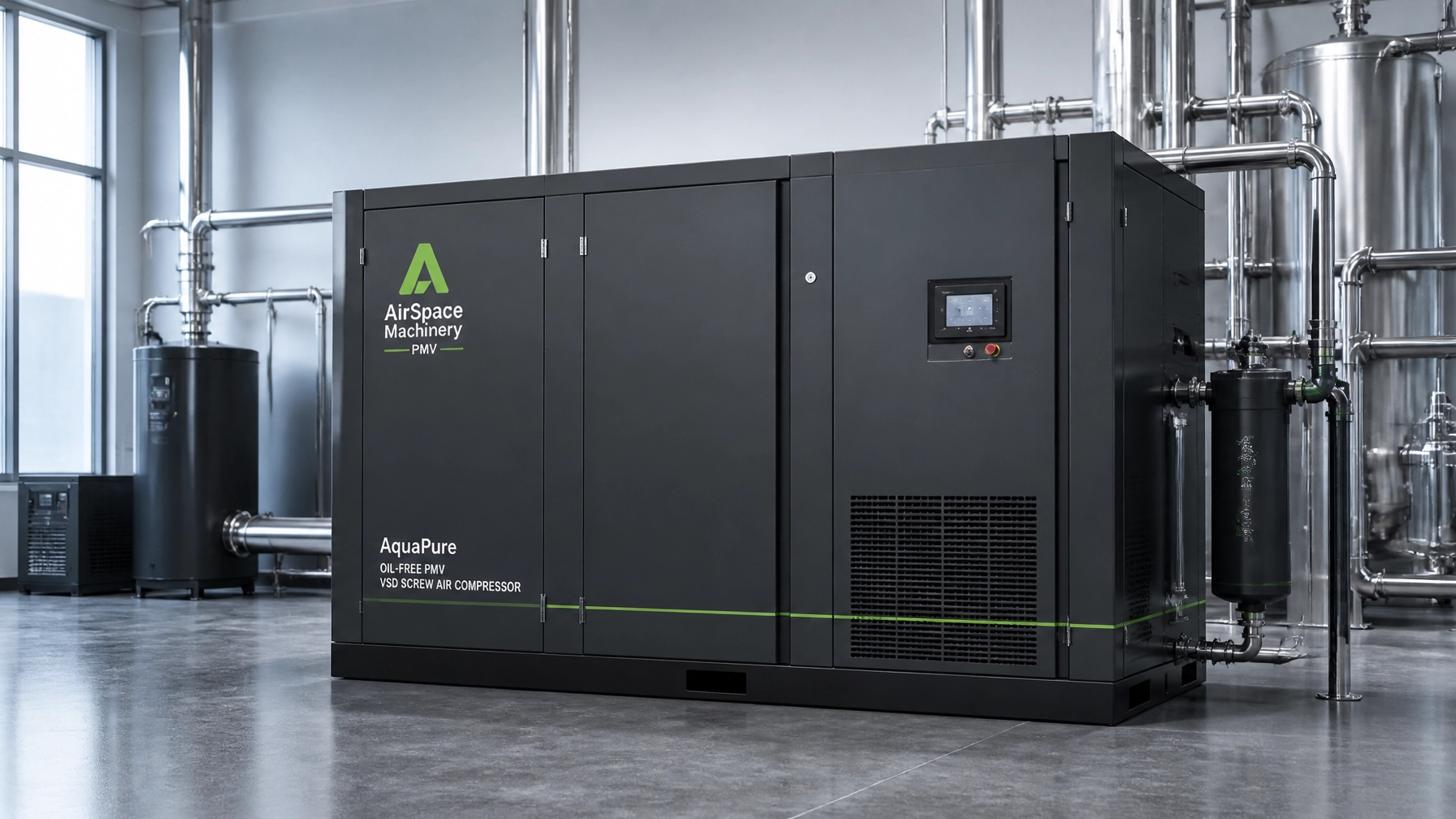
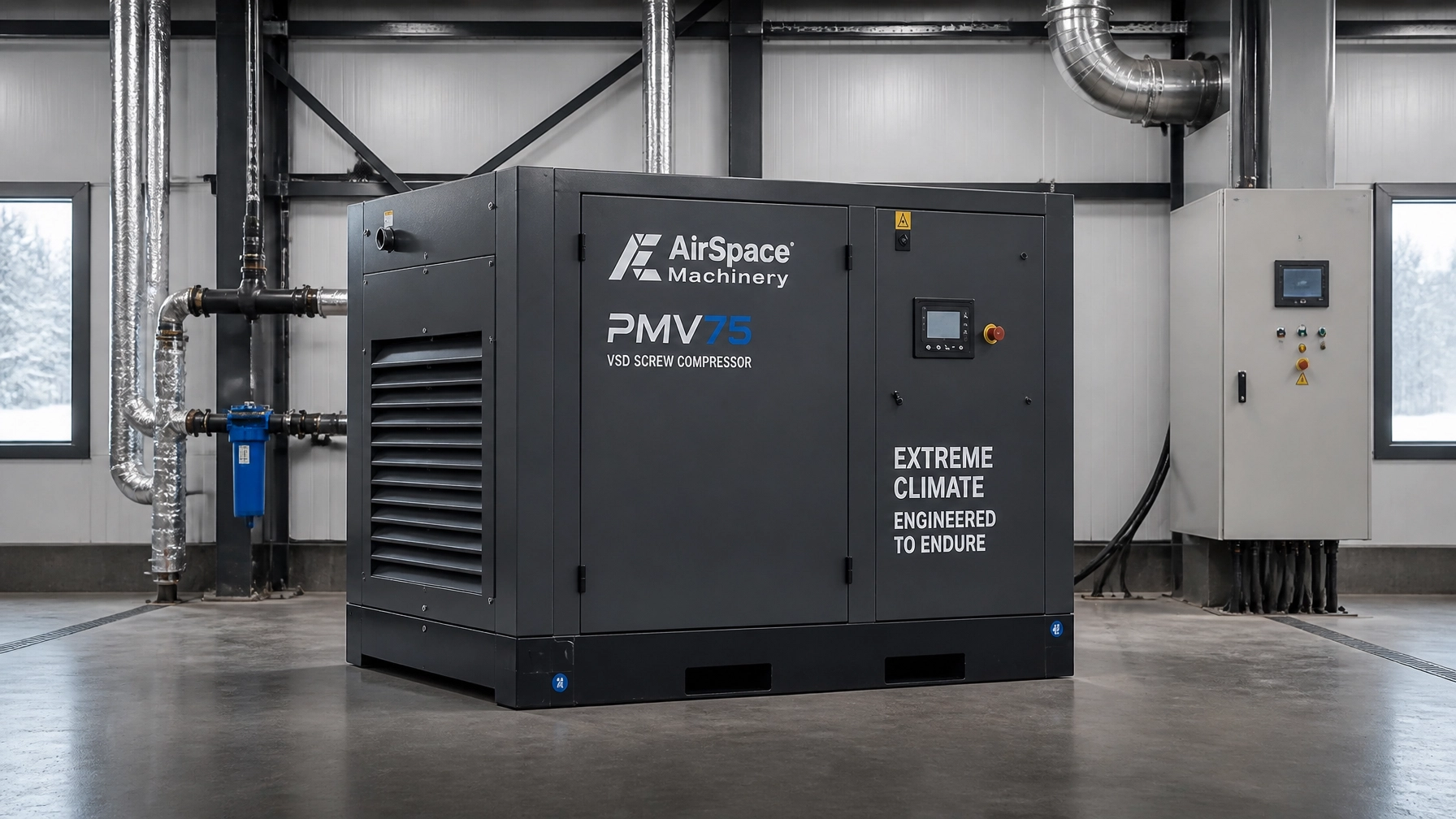
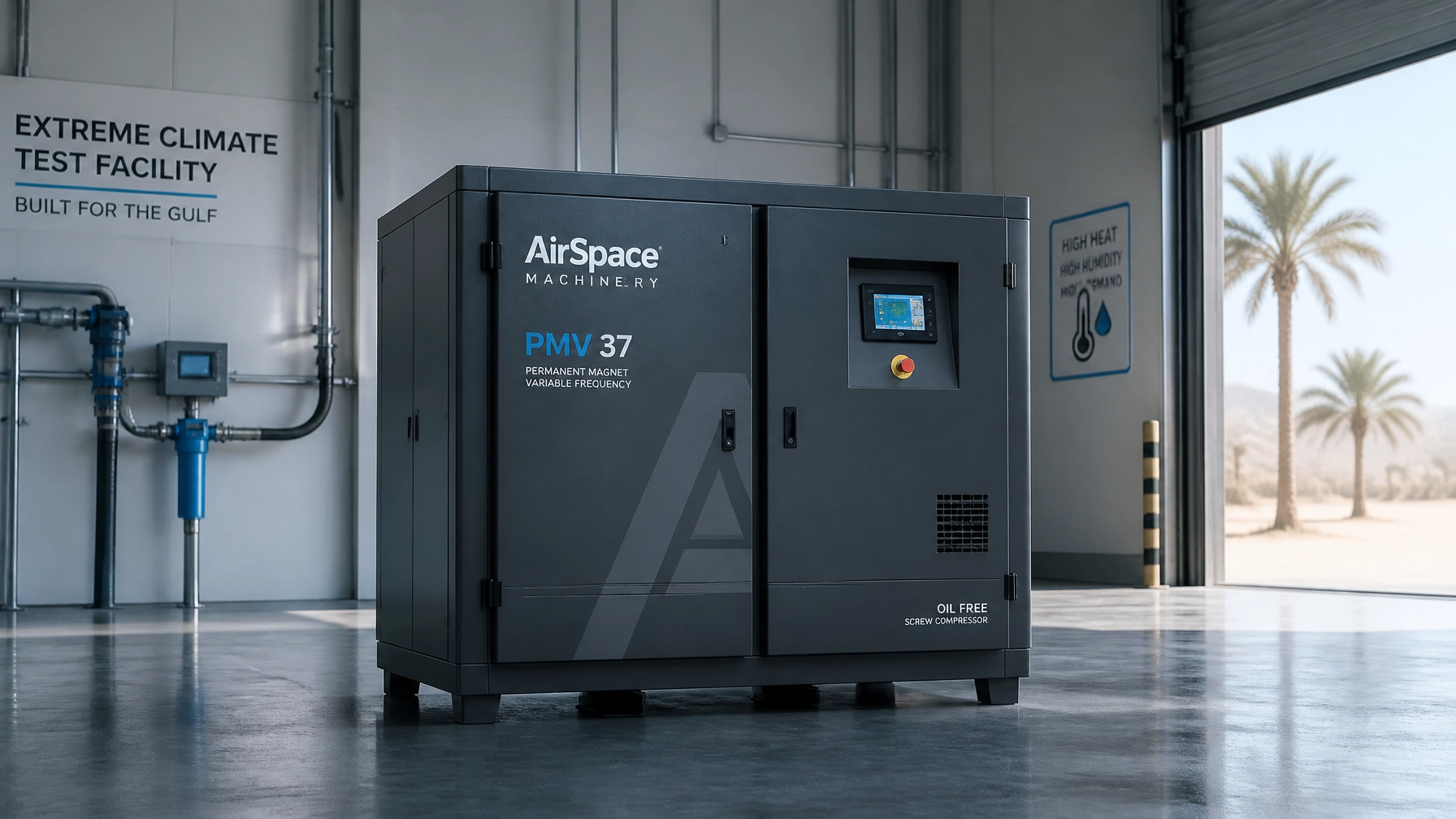
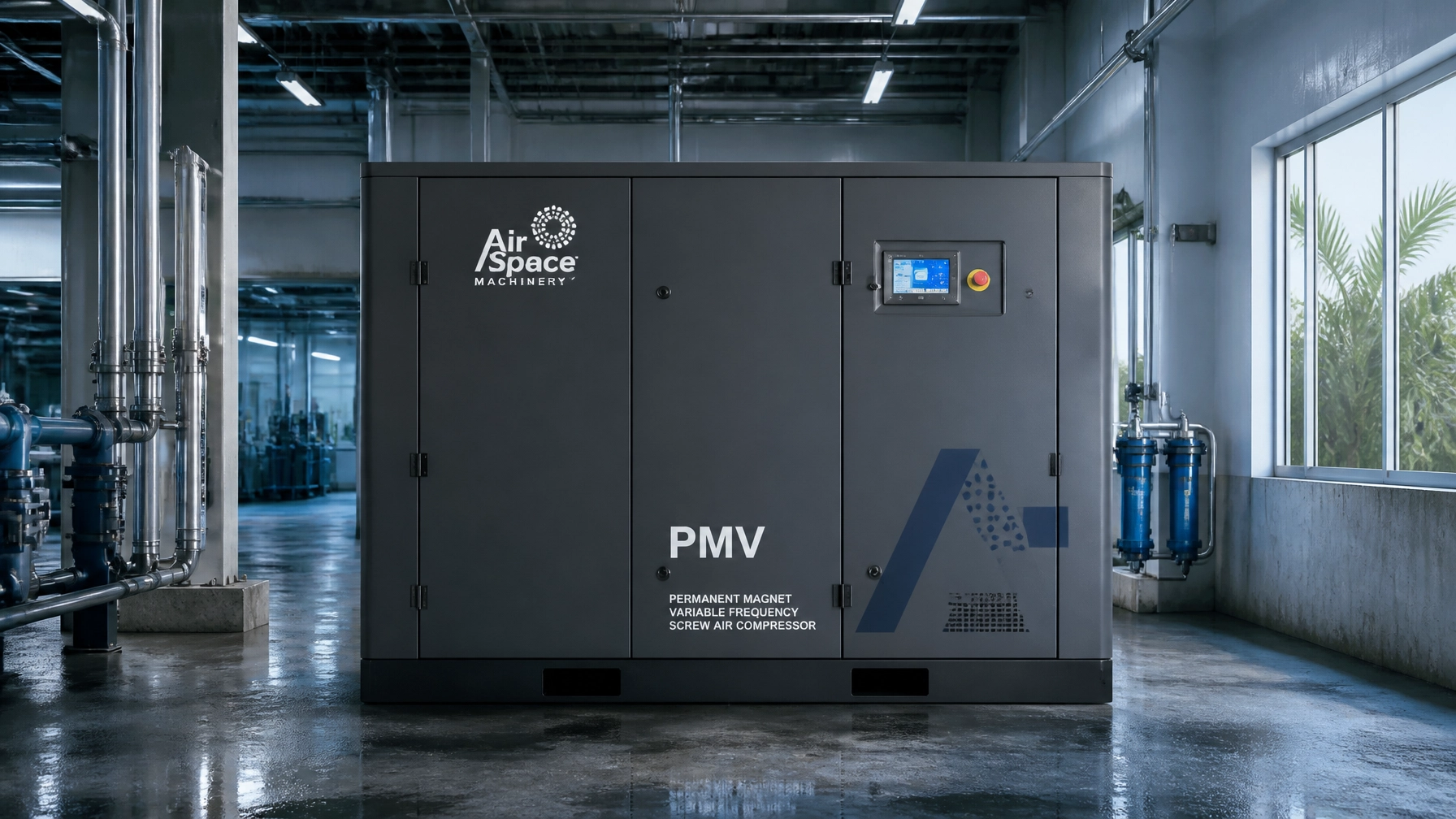
เครื่องอัดลมสกรูอินเวอร์เตอร์ PMV: ทางออกลดต้นทุนพลังงาน 35% สำหรับโรงงานในประเทศไทย
Language: English | Thai industrial market edition
ANSWER FIRST: WHY PMV INVERTER COMPRESSORS MATTER IN THAILAND
A correctly sized PMV inverter screw air compressor can reduce compressor electricity consumption by up to 35% compared with a standard fixed-speed system when factory demand changes during shifts. It also supports steadier pressure, softer motor starting, lower unloaded running, and more predictable operating costs.
The 35% figure is an engineering planning benchmark, not a guaranteed result for every plant. Actual savings depend on demand variation, operating hours, pressure, leakage, control settings, electricity tariff, and machine sizing. A site with fluctuating demand normally has stronger savings potential than a plant operating continuously at full load.
For Thai buyers searching for เครื่องอัดลมสกรูอินเวอร์เตอร์, the practical buying decision is simple: measure the air profile first, match the PMV capacity to average demand, then specify the required pressure, flow, air quality, dryer, and export documentation.
THE 10 COST HEADACHES THAI FACTORY MANAGERS ARE TRYING TO FIX
- Electricity consumption remains high even when production demand falls.
- The compressor spends too many hours running unloaded.
- Pressure drops affect pneumatic tools, automated lines, or air-jet equipment.
- The system is oversized for normal production but undersized for peak demand.
- Thailand’s heat and humidity increase cooling and moisture-control problems.
- Filter pressure drop forces the compressor to operate at a higher setpoint.
- Air leaks create a permanent hidden demand.
- Starting current causes electrical stress or production interruptions.
- Maintenance planning is difficult because equipment data is incomplete.
- Procurement teams cannot easily verify CE, ISO 9001, specifications, or export support.
A PMV system addresses the first four directly. The remaining issues require correct air treatment, pipework design, maintenance, and commissioning.

HOW DOES A PMV INVERTER SCREW AIR COMPRESSOR SAVE ENERGY?
A PMV compressor changes motor speed to follow real-time air demand. When demand falls, the motor slows down instead of continuing to operate at full speed and cycling through loaded and unloaded periods.
This is the core of the Unload Tax. A fixed-speed system may continue drawing power while delivering little or no useful air during low-demand periods. PMV control reduces this waste by matching production to consumption.
The 35% Energy Delta should be evaluated using measured operating data:
- Annual operating hours
- Average and peak air demand
- Working pressure in bar or psi
- Compressor power in kW
- Specific power in kW per m³/min
- Electricity tariff in THB per kWh
- Load profile by shift
Specific power is one of the most useful comparison metrics:
Specific power = input power divided by delivered free air
A lower specific-power value means the system uses less electricity to produce the same amount of compressed air. Ask suppliers for specific power at your actual pressure and flow rather than comparing motor horsepower alone.
A Thai industrial energy study reported meaningful savings from compressed-air improvements, while Joint Crediting Mechanism documentation uses specific power and operating conditions to evaluate efficiency projects. These sources support a measurement-based approach rather than relying on a headline percentage alone.
See the AirSpace ROI Engine to model operating hours, power, pressure, demand, and electricity cost.
PMV VSD VERSUS STANDARD FIXED-SPEED: WHAT CHANGES?
| Evaluation point | Standard fixed-speed system | PMV inverter screw compressor |
|---|---|---|
| Response to changing demand | Uses load and unload control | Adjusts motor speed to demand |
| Part-load efficiency | Can decline during unloaded operation | Designed to reduce low-demand waste |
| Pressure control | May fluctuate during cycles | Stable control when correctly configured |
| Starting method | Higher starting stress may occur | Inverter-assisted soft starting |
| Best operating profile | Stable, near-full-load demand | Variable demand across shifts |
| Energy comparison | Baseline for the 35% Energy Delta | Potentially lower annual kWh |
| Selection method | Often based on peak capacity | Based on measured average and peak demand |
| Buyer verification | Requires datasheet and test review | Requires specific power, control, and pressure data |
This comparison does not mean PMV is automatically the best choice for every plant. A compressor running continuously at a stable full load may have a smaller variable-speed advantage. The correct answer comes from the load profile.
HOW MUCH CAN A THAI FACTORY SAVE?
Use this example as a planning calculation.
Assume:
- Existing compressed-air consumption: 300,000 kWh per year
- Electricity tariff: 3.6 THB per kWh
- PMV planning benchmark: 35% energy reduction
Current annual electricity cost:
300,000 × 3.6 = 1,080,000 THB
Estimated energy reduction:
300,000 × 35% = 105,000 kWh per year
Estimated electricity saving:
105,000 × 3.6 = 378,000 THB per year
This estimate excludes maintenance, leakage reduction, production improvements, and possible demand-charge effects. It also assumes that the PMV compressor is correctly sized and that the plant does not create new losses through excessive pressure, poor filtration, or undersized pipework.
For a plant operating 6,000 hours per year, even a small improvement in specific power can compound quickly. The AirSpace ROI Engine can be used as a first estimate before a site-specific engineering proposal.
HOW SHOULD THAI PLANTS SPECIFY PRESSURE, FLOW, AND AIR QUALITY?
Start with the process requirement, not the compressor catalogue.
Specify these four items:
- Required working pressure: bar or psi
- Required air flow: m³/min or CFM
- Operating hours: hours per day and days per year
- Air quality: standard industrial air or ISO 8573-1 Class 0 oil-free air
For electronics, pharmaceutical, food-processing, medical-equipment, and contamination-sensitive applications, select an oil-free configuration and define the required ISO 8573-1 class for particles, water, and oil.
For general metal processing, textile production, construction materials, and plant air, an oil-injected PMV system may be appropriate when the process specification allows it. The air treatment system still matters. Refrigerated dryers, filters, receivers, drains, and pipework should be sized as one system.
The pressure penalty is often overlooked. Every unnecessary increase in discharge pressure raises energy use. A filter that is too small, a blocked element, or a poorly designed dryer can make the compressor work harder. Select low-pressure-drop treatment equipment and set pressure only as high as the process requires.
For Thailand’s humidity, specify the required pressure dew point and install the dryer in a location with suitable ventilation. The AirSpace refrigerated air dryer range can be combined with PMV compression for general industrial air treatment.

HOW DOES PMV STABILITY HELP PRODUCTION?
Stable pressure is not only an energy issue. It affects the process.
A pressure swing can reduce tool performance, disturb air-jet weaving, affect automated actuators, and create inconsistent results in air-assisted manufacturing. AirSpace technical documentation identifies pressure stability of approximately ±0.1 bar for relevant configurations, subject to model, setpoint, installation, and operating conditions.
The right control strategy includes:
- Correct compressor sizing
- Adequate air receiver capacity
- Accurate pressure sensors
- Proper sequencing for multiple machines
- Clean filters with monitored pressure drop
- Leak testing and repair
- Regular drain and dryer checks
Think of the receiver as a buffer and the PMV controller as the driver. The receiver absorbs short peaks; the PMV system follows the underlying demand. Neither can compensate for a badly designed distribution network.
WHAT SHOULD GLOBAL BUYERS VERIFY BEFORE ORDERING?
Thai procurement teams and international buyers should request a complete technical file before approval.
Verify:
- CE documentation for the supplied configuration
- ISO 9001 quality-system documentation
- Motor power and operating voltage
- Free air delivery at the required pressure
- Specific power data
- Ambient temperature rating
- Pressure dew point for the selected dryer
- Filter grades and pressure-drop data
- Warranty and maintenance requirements
- Packing, export documents, and destination support
AirSpace Machinery manufactures PMV screw air compressors and industrial air-treatment equipment under CE and ISO 9001 quality systems. The equipment range covers compact systems through larger industrial configurations. Ambient selection should consider Thailand’s high-temperature conditions; suitable models are available with engineering for environments up to 55°C, depending on configuration.
Delivery planning depends on the selected model, pressure, air treatment, electrical specification, documentation, and destination. Confirm the configuration and logistics plan before issuing a purchase order.
Download the AirSpace technical catalog for PMV, oil-free, low-pressure, medium-pressure, laser, and air-treatment information.
HOW CAN A THAI PLANT REQUEST A PROPOSAL?
Send the following information to the engineering team:
- Current compressor capacity
- Required pressure in bar or psi
- Required flow in m³/min or CFM
- Operating hours and shift pattern
- Electricity tariff in THB per kWh
- Existing dryer and filtration details
- Application and required ISO 8573-1 class
- Ambient temperature and installation conditions
Use the AirSpace Solution Hub to review industry configurations, or contact the AirSpace engineering team for a configuration-based proposal.
FAQ: เครื่องอัดลมสกรูอินเวอร์เตอร์ FOR THAI INDUSTRIAL PLANTS
Q: Is a PMV inverter screw air compressor suitable for factories in Thailand?
A: Yes, especially where air demand changes between shifts, production lines, or operating periods. Specify cooling, ventilation, humidity control, pressure, and flow for the actual installation environment.
Q: Does every factory achieve a 35% energy reduction?
A: No. The 35% Energy Delta is a planning benchmark under suitable variable-demand conditions. Actual performance depends on load profile, machine sizing, pressure, leaks, operating hours, and maintenance.
Q: What information is needed for an accurate selection?
A: Provide pressure in bar or psi, air flow in m³/min or CFM, operating hours, application, air-quality class, ambient conditions, and existing system data.
Q: Can PMV equipment provide stable pressure?
A: Correctly configured PMV equipment can provide stable pressure control, with relevant AirSpace configurations documented at approximately ±0.1 bar. Final performance depends on the compressor model, receiver, pipework, sensors, and commissioning.
Q: Is oil-free air required for every Thai factory?
A: No. Oil-free compression is normally selected when the process is sensitive to oil contamination, including certain pharmaceutical, food, electronics, and medical applications. The required ISO 8573-1 class should be defined before selection.
Q: How can I verify CE and ISO 9001 documentation?
A: Request documentation for the exact supplied configuration and compare the model, electrical specification, pressure range, and manufacturer details with the quotation. Do not accept unrelated certificates for a different model.
Q: How long does factory-direct supply take?
A: Timing depends on configuration, pressure, air treatment, electrical requirements, documentation, and destination. Confirm the project schedule with the engineering and export teams.
SOURCES AND ENGINEERING STANDARDS
- ISO 8573-1: compressed-air quality classification for particles, water, and oil. Product documentation and technical catalog: AirSpace Downloads
- Thai industrial compressed-air efficiency research and case material: IGES technical document
- Joint Crediting Mechanism approved methodologies for industrial energy-efficiency projects: JCM Thailand methodologies
- Joint Crediting Mechanism air-compressor calculation information: JCM air-compressor technical information
- AirSpace system configurations and pressure ranges: Solution Hub
AUTHOR BOX
Penny Winston, Technical Writer
Focus areas: The 35% Energy Delta, The Fourth Utility Concept, and ISO 8573-1 Class 0 Integrity.
Reviewed by Engineering: AirSpace Machinery Engineering Team
If you need air consumption calculation, energy-saving scheme and factory quotation, please send us an inquiry.
Meta description: Reduce Thai factory energy costs with a china made screw air compressor using PMV inverter control, stable pressure, ISO 8573-1 options, and ROI-based selection.
⚡ Is Your Factory Bleeding Cash?
Most fixed-speed compressors waste $3,600/year in "Unload Tax." Test your waste level in 30 seconds.
RUN THE ROI TEST →Ready to See How Much Your Facility Can Save?
Fill out the form below for a Free Energy Assessment.