Low Pressure Air Compressor Solution for Textile Factory
Executive Summary and Conclusion
Textile production lines, including spinning frames, air-jet looms, and yarn processing units, require continuous pneumatic power operating strictly at low pressure ranges, typically between 3.0 bar and 5.0 bar. Despite this low operational requirement, many legacy textile mills continue to deploy standard 8-bar or 10-bar industrial air compressors, bleeding off excess pressure through mechanical relief valves or pressure regulators. This practice creates a massive hidden energy tax known as the Unload Tax, driving up operating electricity costs by up to 35%.
AirSpace Machinery provides dedicated low-pressure screw air compressors engineered specifically to match real textile air demand. By eliminating unnecessary pressure amplification, our systems deliver immediate energy savings, 99.9% uptime, and stable airflow required for 24/7 spinning and weaving operations. Backed by CE and ISO 9001 certifications, AirSpace delivers high-efficiency compression solutions built for durability in demanding manufacturing environments.
Key Requirements for Textile Air Supply
Textile manufacturing environments place rigorous demands on compressed air systems. Meeting these requirements is essential for maintaining fabric quality, preventing thread breakage, and avoiding costly production halts.
Matched Low Pressure to Eliminate Relief Waste
Air-jet looms and spinning frames operate efficiently at lower pressures (3 to 5 bar). Deploying high-pressure compressors and reducing the pressure at the point of use wastes immense electrical energy. A dedicated low-pressure screw compressor produces precisely the bar rating required, saving substantial kilowatt-hours.Stable Air Flow for Air-Jet Looms and Spinning Frames
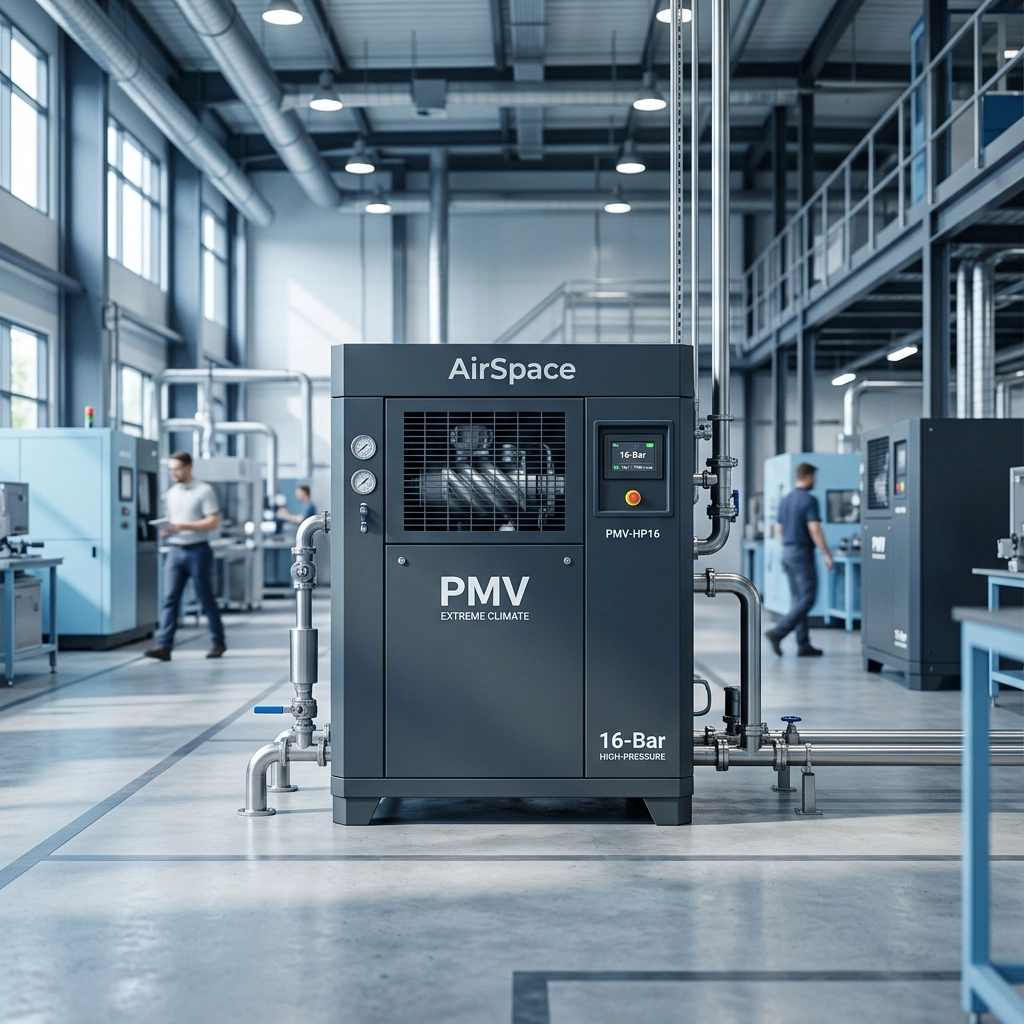
Pressure fluctuations directly impact weft insertion speed in air-jet looms, leading to loom stoppages and fabric defects. AirSpace permanent magnet variable frequency (PMV) low-pressure systems maintain ultra-stable pressure within ±0.1 bar, ensuring consistent production velocity.Oil-Free and Clean Air to Prevent Fiber Staining
Textile fibers are highly sensitive to lubricant contamination. For high-grade textile and yarn processing, clean, high-purity air prevents ruined batches and staining. AirSpace offers advanced filtration and oil-free configurations adhering to ISO 8573-1 Class standards.24-Hour Continuous Production Reliability
Textile mills operate around the clock. Equipment reliability is non-negotiable. AirSpace industrial compression systems feature robust components and advanced digital controls designed for continuous heavy-duty cycles with minimal thermal degradation.

Recommended Configuration and System Design
A reliable, energy-efficient compressed air station for a textile factory involves more than just the compressor unit. A complete, optimized air treatment setup ensures continuous dry and clean pneumatic power.
- Low-Pressure Screw Air Compressor: Custom-engineered to deliver high air volume at low discharge pressure (3 bar to 5 bar), perfectly matched to plant demand.
- Air Receiver Tank: Vertical storage receiver sized to buffer peak demand spikes during rapid loom actuation.
- Precision Filters: Primary, secondary, and activated carbon filters to remove particulate matter, moisture, and residual oil vapor, safeguarding sensitive pneumatic actuators.
- Refrigerated Compressed Air Dryer: Removes condensate to prevent internal corrosion and moisture damage in downstream textile machinery.
Comparison: Standard High-Pressure vs. Dedicated Low-Pressure Systems
To evaluate the financial and operational impact, let us examine the performance delta between legacy high-pressure setups and AirSpace dedicated low-pressure compressors.
| Metric | Standard High-Pressure Compressor + Regulator | AirSpace Dedicated Low-Pressure Compressor |
|---|---|---|
| Discharge Pressure | 8.0 bar to 10.0 bar (Throttled down) | 3.0 bar to 5.0 bar (Directly matched) |
| Specific Power Consumption | High kWh / m³ due to compression over-ratio | Low kWh / m³ optimized for low-bar output |
| Annual Energy Waste | Substantial "Unload Tax" and throttle losses | Zero pressure-relief waste; up to 35% energy savings |
| Pressure Stability | Moderate fluctuation during load/unload cycles | Ultra-stable ±0.1 bar via advanced PMV control |
| Maintenance Intervals | Frequent valve and seal wear due to high compression ratio | Extended service life with heavy-duty industrial bearings |

Our Core Advantages for Textile Manufacturers
Operating in competitive global markets requires minimizing overhead without compromising quality. AirSpace machinery delivers tangible engineering advantages:
- Dedicated Low-Pressure Design: Eliminates the pressure-relief penalty, directly lowering operating electricity costs by up to 35%.
- Energy-Saving PMV Technology: Automatic variable frequency speed adjustment matches motor output precisely to fluctuating factory air consumption.
- Stable Pressure Delivery: Protects air-jet looms from pressure drops, reducing thread breakage and reject rates.
- Certified Quality Standards: Fully CE certified and manufactured under strict ISO 9001 quality management systems, making them ideal for export and overseas factory deployment.
- Comprehensive Engineering Support: Free air flow calculation, plant layout suggestion, and custom engineering support tailored to your mill size.
Related Products and Equipment
Explore our primary compressor lineups engineered for industrial applications:
- Permanent Magnet VSD Screw Air Compressor Series
- 20HP Fixed Speed Screw Air Compressor: Explore reliable constant-speed options at https://www.chinacompressor.org/product/20hp-15kw-fixed-speed-efficient-low-noise-screw-air-compressor/
- All-in-One Skid Units — Turnkey compressor + dryer + tank stations
Product Series & Catalog Downloads
- Low-Pressure Screw Compressor Series — Dedicated 3 bar generation for textile air-jet looms and pneumatic conveying.
- PMV VSD Screw Compressor Series — Energy-saving permanent magnet variable frequency systems across multiple power ranges.
- Refrigerated Air Dryers — ISO Class 4-5 dew point moisture control for clean, dry compressed air.
- Water-Lubricated Oil-Free Series — Zero-contamination pure air compression for sensitive textile processes.
- Download Full Low-Pressure Compressor Specifications — Request comprehensive engineering data sheets and textile industry case studies via email inquiry.

Frequently Asked Questions
What exact working pressure do textile factories typically require?
Most textile operations, particularly spinning mills and air-jet weaving facilities, require low working pressures between 3.0 bar and 5.0 bar. Operating above this range is unnecessary and wastes electrical power.
Why is pressure-relief waste so expensive in textile plants?
Every 1 bar of over-compression increases energy consumption by approximately 7%. When a high-pressure compressor running at 8 bar is throttled down to 4 bar, nearly 28% to 35% of electrical energy is wasted as heat and pressure drop.
How does a low-pressure screw compressor compare to a standard VSD compressor?
While a standard VSD compressor can adjust its speed, its internal airend compression ratio is still mechanically fixed for higher pressures. A dedicated low-pressure compressor features an optimized airend designed specifically to maximize volume output per kilowatt at lower bar ratings.
Can an existing high-pressure compressor be converted to low pressure?
In most cases, simply adjusting internal valves on a high-pressure compressor reduces efficiency because the internal rotors and motor pairings are not optimized for low-pressure volume flows. Replacing it with a dedicated low-pressure compressor yields significantly better electrical efficiency and reliability.
What is the typical manufacturing and export lead time?
Lead times depend on the specific power configuration, voltage requirements, and unit capacity. Standard models are built and ready for dispatch from our advanced manufacturing facility with efficient global logistics support.
Get Technical Quotation and Custom Engineering Support
Tell us your production lines (spinning, weaving, yarn processing), required working pressure, and daily working hours. We will provide an optimized air station layout and a competitive quotation within 24 hours. WhatsApp and email channels are fully open for technical communication with our engineering team.
If you need air consumption calculation, energy-saving scheme and factory quotation, please send us an inquiry.
Reviewed by Engineering
Author: Penny Winston
Title: Technical Writer & Industrial Systems Analyst
Specializations: The 35% Energy Delta, The Fourth Utility Concept, ISO 8573-1 Class 0 Integrity
⚡ Is Your Factory Bleeding Cash?
Most fixed-speed compressors waste $3,600/year in "Unload Tax." Test your waste level in 30 seconds.
RUN THE ROI TEST →Ready to See How Much Your Facility Can Save?
Fill out the form below for a Free Energy Assessment.