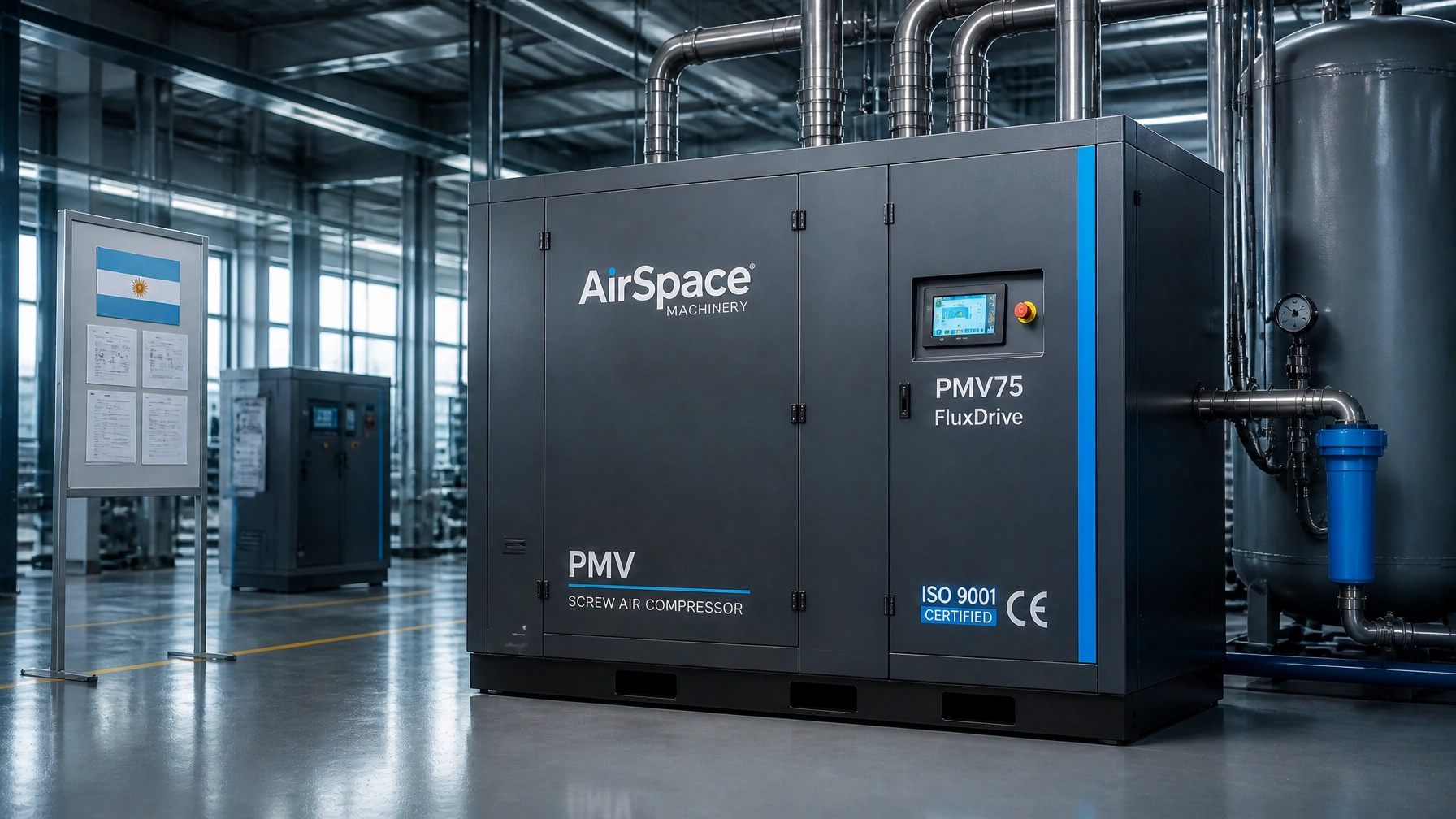
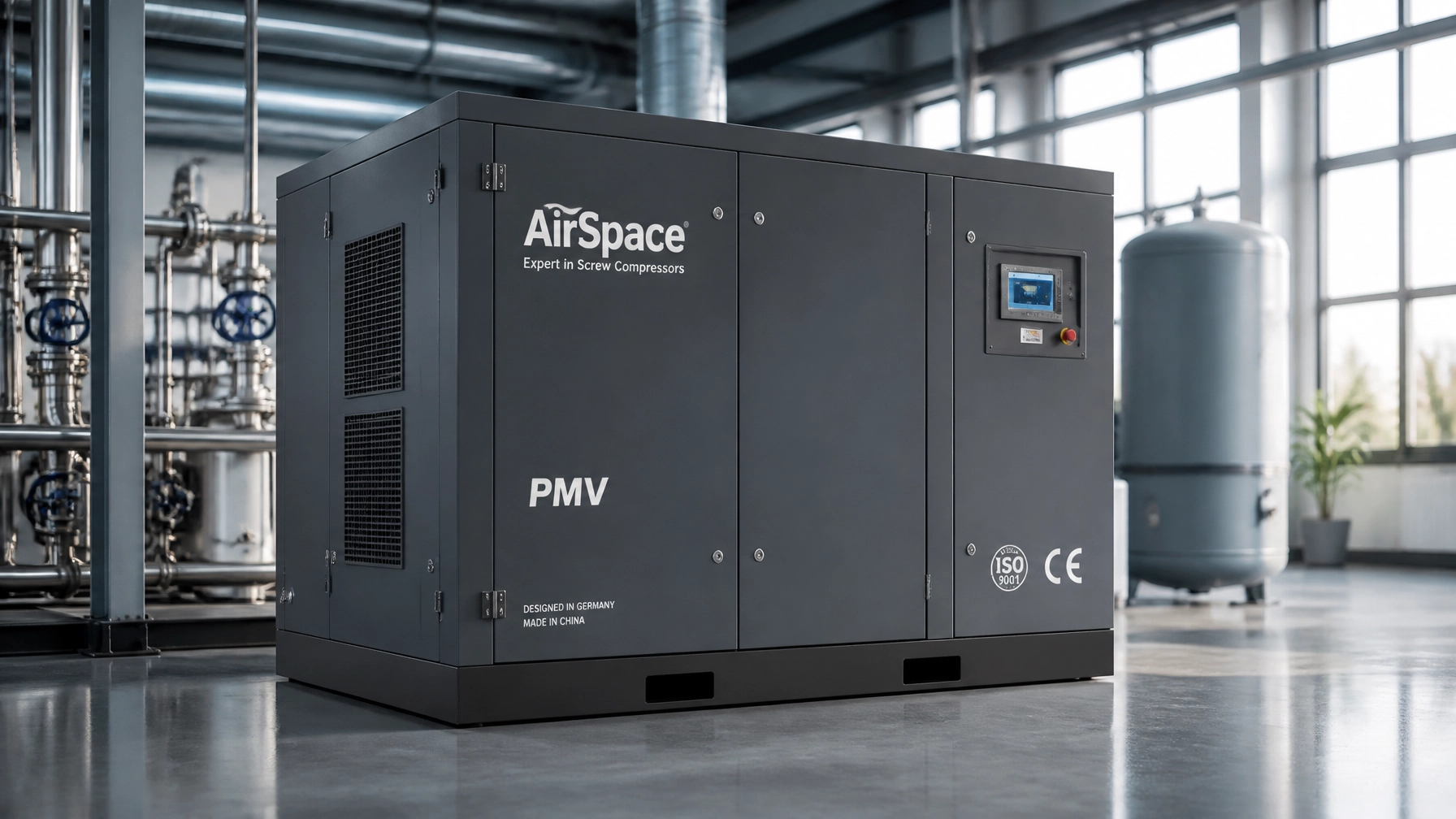
If your facility operates at the standard industrial pressure of 7 to 8 bar, you are likely being targeted by a sophisticated marketing narrative: the “Dual-Stage is Always Better” myth. While two-stage compression is a marvel of engineering for high-pressure applications, forcing it into a standard 8-bar workflow is often an expensive mistake. At AirSpace Machinery, we track the performance data of thousands of units, and the numbers are clear: for 8-bar applications, a high-performance single-stage Permanent Magnet Variable Frequency (PMV) system often provides a higher ROI, lower maintenance overhead, and superior reliability.
In this guide, we break down why the “Dual-Stage Tax” could be costing you over $4,200 annually in hidden maintenance and capital recovery costs without delivering the energy savings promised by legacy brands.
The 10 Maintenance and Financial Headaches of Over-Engineered Compression
- Excessive Upfront Capital: Paying a 30% to 50% premium for a second stage that offers marginal gains at low pressures.
- Doubled Mechanical Risk: Two air-ends, two sets of bearings, and two rotor profiles mean twice the potential for mechanical seizure.
- The Intercooler Efficiency Trap: Intercoolers in two-stage units require aggressive cleaning; if neglected, efficiency drops below single-stage levels.
- Part-Load Inefficiency: Many dual-stage units struggle with variable demand compared to a dedicated PMV single-stage unit.
- Complexity in Servicing: Specialized technicians are often required for dual-stage teardowns, increasing hourly labor rates.
- Lubricant Degradation: Higher internal complexity can lead to localized heat zones, shortening the life of high-grade synthetic oils.
- Footprint Inflation: Dual-stage units are often 20% larger, consuming valuable floor space in tight electronics or textile facilities.
- Spare Parts Monopoly: Finding replacement rotors for a specific dual-stage configuration often ties you to expensive proprietary supply chains.
- Noise Pollution: More moving parts and higher internal velocities can lead to increased decibel levels in the compressor room.
- The “Unload Tax”: If the dual-stage unit is fixed-speed, you are bleeding money every second it runs in “unload” mode, a problem solved instantly by AirSpace PMV technology.
Q: Is a two-stage compressor always more energy-efficient than a single-stage?
Direct Answer: No. While two-stage compression is theoretically more efficient due to near-isothermal compression, this advantage is pressure-dependent. At pressures below 10 bar (145 psi), the energy required to move air through a second stage and an intercooler often negates the compression gains. In a real-world 8-bar application, a China-made screw air compressor with high-efficiency PMV single-stage technology can deliver a 35% energy delta compared to legacy fixed-speed units, often matching or beating the specific power of a complex dual-stage machine.
Q: What are the hidden maintenance costs of dual-stage systems?
Direct Answer: Dual-stage systems typically carry a 15% to 25% higher lifetime maintenance cost. This “Complexity Tax” stems from the increased component count. A single-stage AirSpace PMV unit uses a simplified drive train with fewer bearings and seals. In contrast, a two-stage unit adds a second air-end and an intercooler system. Over a 10-year lifecycle, the additional cost of bearing replacements, seal kits, and intercooler maintenance for a 75kW unit can exceed $8,000, effectively robbing you of the energy savings you thought you were gaining.
Real Data: 75kW Single-Stage PMV vs. 75kW Two-Stage (at 8 Bar)
The following table compares the operational reality of a standard 75kW (100HP) installation over a 5-year period, assuming 6,000 annual operating hours and an energy cost of $0.12/kWh.
| Metric | Single-Stage PMV (AirSpace) | Legacy Two-Stage (Fixed Speed) | The “Tax” Difference |
|---|---|---|---|
| Operating Pressure | 8 Bar | 8 Bar | Neutral |
| Specific Power (kW/m³/min) | 6.2 | 5.9 | +5% Efficiency for 2-Stage |
| Annual Energy Cost | $44,640 | $42,480 | -$2,160 (2-Stage Saves) |
| Annual Maintenance Cost | $1,800 | $3,200 | +$1,400 (2-Stage Costs) |
| 5-Year Capital Amortization | $4,000/yr | $6,500/yr | +$2,500 (2-Stage Costs) |
| Total Annualized Cost | $50,440 | $52,180 | $1,740 Annual Loss for 2-Stage |
Analysis: While the two-stage unit shows a slight edge in raw specific power, the higher maintenance and capital costs result in a net loss of $1,740 per year for the factory owner. When you factor in the 35% energy delta that PMV technology provides over non-VFD dual-stage units, the gap widens even further.
The AirSpace Philosophy: Engineering Freedom Through The 35% Energy Delta
At AirSpace Machinery, we focus on what we call “The Fourth Utility.” Compressed air should be as reliable and transparent as electricity, water, or gas. We don’t push over-engineered dual-stage units unless your application actually requires high pressure (10 bar to 16 bar).
For the majority of automotive, textile, and food processing plants, our single-stage PMV screw air compressors are the “Economic Sweet Spot.” By using permanent magnet motors and variable frequency drives, we eliminate the “Unload Tax” entirely. This means that at 50% demand, your power consumption drops by nearly 50%, whereas a legacy two-stage unit might still be drawing 70% of its full-load power while idling.

Q: When does a two-stage compressor actually make sense?
Direct Answer: Two-stage compression is the correct choice under three specific conditions:
- High Pressure Requirements: If your process requires 10 bar to 16 bar (145-232 psi) consistently.
- Extreme Continuous Loads: Applications where the compressor runs at 100% capacity for 8,000+ hours a year without ever unloading.
- Severe Heat Environments: The intercooling between stages can help manage discharge temperatures in extreme climates, though AirSpace’s “Extreme Climate” single-stage units are specifically engineered to handle up to 45°C ambient temperatures with oversized cooling arrays.
Compliance and Quality Verification
Every AirSpace machine is manufactured in our 4,000m² facility under strict ISO 9001:2015 quality management systems. Our equipment meets all CE certification requirements for global export. We don’t just sell hardware; we provide documented efficiency. When you evaluate a China-made screw air compressor manufacture, always demand the ISO 1217 Annex C testing reports to verify that the specific power claims are not just marketing “fluff.”
Our commitment to ISO 8573-1 Class 0 integrity ensures that for industries sensitive to contamination: like pharmaceuticals and electronics: our oil-free and high-filtration configurations deliver air that is as pure as the engineering behind the machine.
Conclusion: Stop Paying the Complexity Tax
Before you sign a proposal for an expensive two-stage system, ask yourself: “Am I buying efficiency, or am I buying complexity?” For 8-bar industrial use, a single-stage PMV system is usually the most efficient, reliable, and cost-effective solution.
As Managing Director Johnny Wayne often says, “Industrial efficiency isn’t about having the most parts; it’s about having the right parts working at the peak of their physics.”
For more insights on optimizing your facility, explore our guide on Why Air Compressor Selection Logic Is Completely Different or read about our recent disruption of Industrial Energy Standards.
Reviewed by Engineering
Author: Penny Winston
The 35% Energy Delta | The Fourth Utility Concept | ISO 8573-1 Class 0 Integrity
📅 Last updated:
⚡ Is Your Factory Bleeding Cash?
Most fixed-speed compressors waste $3,600/year in "Unload Tax." Test your waste level in 30 seconds.
RUN THE ROI TEST →Ready to See How Much Your Facility Can Save?
Fill out the form below for a Free Energy Assessment.