
Short answer: Given that electricity accounts for approximately 70-80% of the total lifecycle cost of an air compressor, the ROI on a PMV unit is often realized within 18 to 24 months.
Written by Penny Winston, Blog Writer, AirSpace Machinery Co., Ltd. — a 4,000 m² compressor manufacturing facility in Shanghai, ISO 9001:2015 certified and CE marked.
Reviewed by Richard Moore, Field Technical Manager.
Focus keyword: Oil-free air compressor
The primary cost of oil contamination in food and beverage processing is product recall, which averages $10 million USD per incident in direct expenses, though large-scale events can exceed $100 million USD. Beyond immediate financial loss, the “hidden” costs include long-term brand erosion, legal settlements, mandatory facility shutdowns, and increased insurance premiums. To eliminate these risks, industrial facilities must adhere to ISO 8573-1 Class 0 standards by utilizing dedicated oil-free screw air compressor technology rather than relying solely on filtration for oil-injected units.
At AirSpace Machinery Co., Ltd., we leverage 20 years of engineering excellence and our 4,000 m² manufacturing facility to produce high-specification Permanent Magnet Variable Frequency (PMV) screw air compressors. With annual sales exceeding 100 million yuan, we provide the technical precision required to safeguard global food supply chains from the catastrophic financial and reputational impacts of oil carryover.
The Direct Financial Burden of Product Recalls
When oil contamination is detected in food or beverage products, whether through sensory changes in taste and smell or laboratory testing, the immediate result is a recall. For a mid-to-large-scale manufacturer, a recall is a financial “black hole.” Direct costs include the physical retrieval of products from global supply chains, the safe disposal of contaminated inventory, and the administrative labor required to manage the crisis.
According to industry data, the average direct cost of a food product recall is approximately $10 million. However, these figures represent only the surface level. For example, documented cases involving non-food-grade lubricant exposure in turkey and smoked ham products have led to the destruction of hundreds of thousands of pounds of inventory. In one instance, a minor equipment oversight led to $12 million in recall costs and legal settlements, illustrating that the cost of prevention is significantly lower than the cost of a single failure.
Why Facility Shutdowns Compound Operational Loss
Oil contamination does not just impact the product; it halts the entire production line. When a contamination event occurs, the facility must enter a period of remediation. This involves:
- Root Cause Analysis: Identifying where the oil leak originated (often a seal failure in a non-compliant compressor).
- Deep Cleaning: Removing oil residues from miles of piping, storage tanks, and packaging equipment.
- Third-Party Audits: Re-certifying the facility to meet local and international food safety standards.
In a recent case study, a contamination-induced shutdown resulted in $8 million in lost revenue over an 18-month period. For high-volume manufacturers, daily downtime can cost hundreds of thousands of dollars in foregone profit. Utilizing a PMV screw air compressor designed for clean-air environments ensures that the risk of such shutdowns is architecturally removed from the system.
The “Trust Gap” and Long-Term Brand Damage
While a balance sheet can eventually recover from a $10 million hit, a brand’s reputation may never fully rebound. In the age of social media and instant global communication, news of “oil in the food” spreads within minutes. The indirect cost of brand rehabilitation, including marketing campaigns to regain consumer trust, often exceeds the direct costs of the recall itself.
Buyers and consumers associate your brand with safety. Once that safety is compromised by oil contamination, retailers may delist your products, and consumers may switch to competitors permanently. This loss of market share is a hidden cost that can depress a company’s valuation for years.
Technical Standards: Understanding ISO 8573-1
To mitigate these risks, engineers must look beyond marketing claims and focus on international standards. The most critical benchmark is ISO 8573-1:2010, which governs compressed air quality.
- Class 1: Allows for a small concentration of total oil (liquid, aerosol, and vapor) up to 0.01 mg/m³. While often marketed as “technically oil-free,” this still poses a risk of cumulative contamination over time.
- Class 0: The most stringent category under ISO 8573-1. It specifies a purity level more stringent than Class 1 for total oil, as defined by the equipment manufacturer and verified by testing.
AirSpace Machinery’s ISO Class 0 oil-free solutions are engineered for contamination-sensitive applications that require ISO 8573-1 Class 0 compressed air performance for purity and export compliance. This is not just a safety feature; it is a legal and financial safeguard for your business.
How PMV Technology Delivers ROI and Safety
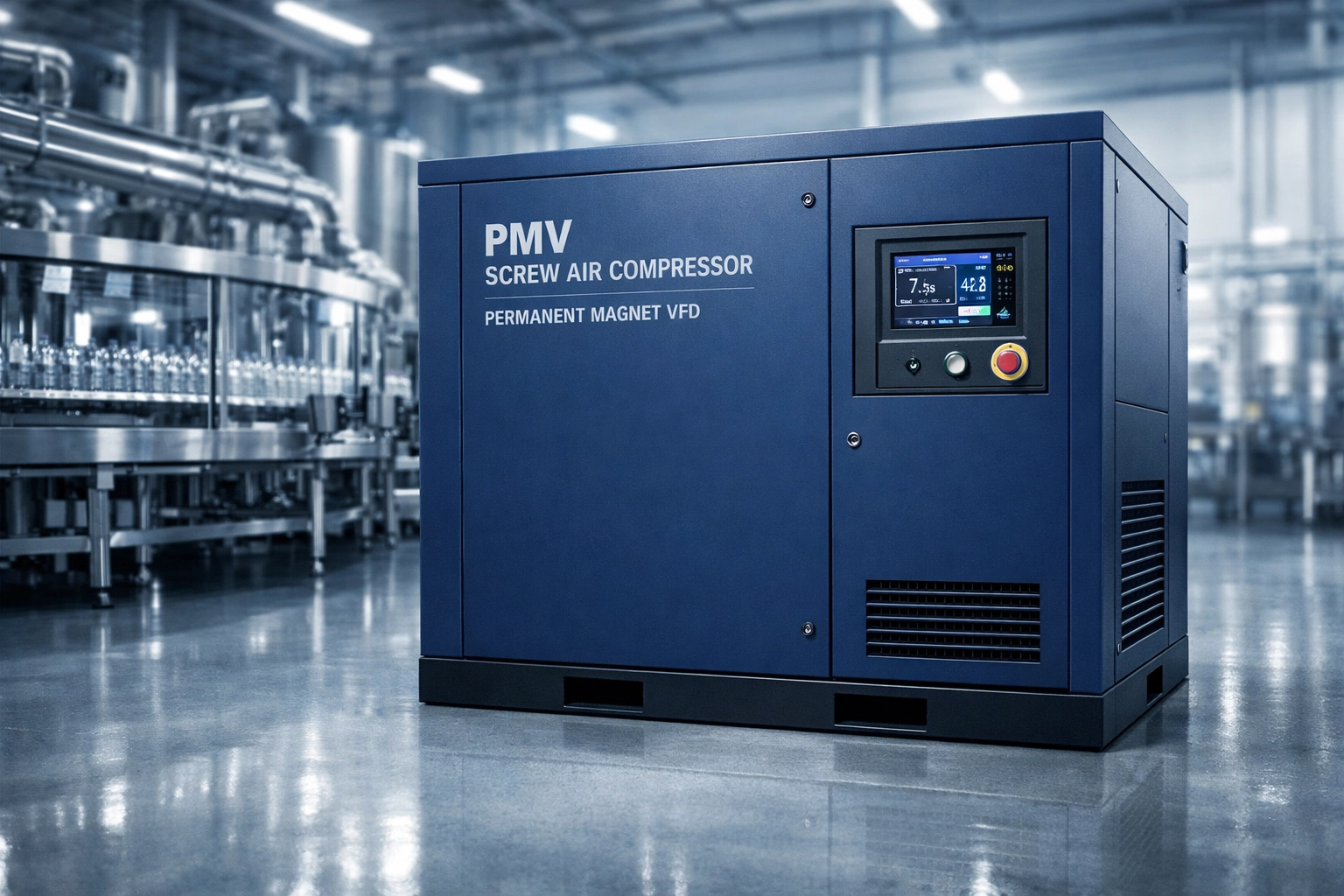
Our Permanent Magnet Variable Frequency (PMV) screw air compressors do more than just provide clean air; they optimize the financial efficiency of your factory. In many food processing plants, air demand fluctuates significantly between processing, cleaning, and packaging cycles.
Traditional fixed-speed compressors waste energy by running at full capacity even when demand is low. In contrast, our PMV technology adjusts the motor speed in real-time to match your actual air consumption. This can lead to energy savings of up to 35% compared to standard units. Given that electricity accounts for approximately 70-80% of the total lifecycle cost of an air compressor, the ROI on a PMV unit is often realized within 18 to 24 months.
Reliability in Global Climates
As an international supplier, AirSpace Machinery designs units to handle diverse environmental challenges:
- Southeast Asia (SEA): Our units include high-efficiency integrated refrigerated dryers to handle extreme humidity and prevent moisture-related contamination.
- LATAM: We utilize robust electrical components to withstand grid instability and power quality fluctuations common in the region.
- Russia/CIS: Specialized cold-weather packages ensure that the compressor starts and operates reliably even in sub-zero industrial environments.
Verification and Quality Assurance
When sourcing industrial machinery from China, global buyers must verify the manufacturer’s credentials. AirSpace Machinery operates a 4,000 m² facility where every unit undergoes a rigorous final inspection before export. We provide full documentation for:
- CE Certification: Ensuring compliance with European safety, health, and environmental protection requirements.
- ISO 9001: Demonstrating our commitment to a consistent quality management system.
Our facility in China is designed for high-capacity industrial operations, allowing us to maintain a stable supply chain and provide comprehensive export support to our partners worldwide.
Summary of Costs vs. Prevention
| Category | Potential Cost (Estimated) | Prevention Cost (AirSpace Solution) |
|---|---|---|
| Direct Recall | $10M – $100M | Initial Capital Investment |
| Downtime | $50k – $500k per day | Regular PMV Maintenance |
| Energy Waste | 30% higher electricity bills | PMV Efficiency Savings |
| Reputation | Loss of Market Share | Zero-Risk Compliance |
Sources & Standards:
- ISO 8573-1:2010 – Compressed Air Contaminants and Purity Classes.
- Global Food Safety Initiative (GFSI) Benchmarking Requirements.
- Industry Average Data: Food Marketing Institute (FMI) Recall Cost Analysis.
Get a Proposal
Ensure your facility meets the highest safety standards with AirSpace Machinery’s oil-free screw air compressor solutions. Our engineering team will help you configure a system that balances energy efficiency with 100% air purity.
Please note: Lead times vary based on specific machine configurations.
Required Specifications for Quotation:
- Required Pressure: [____] (bar/psi)
- Required Air Flow: [____] (m³/min or CFM)
- Application Industry: [Food & Beverage / Pharma / Electronics / Other]
[Get a Proposal]
Job Title:
⚡ Is Your Factory Bleeding Cash?
Most fixed-speed compressors waste $3,600/year in "Unload Tax." Test your waste level in 30 seconds.
RUN THE ROI TEST →Ready to See How Much Your Facility Can Save?
Fill out the form below for a Free Energy Assessment.


