
Short answer: A process advertised as “3 bar” may need additional pressure at the compressor discharge to cover filters, dryers, piping and elevation.
Written by Penny Winston, Blog Writer, AirSpace Machinery Co., Ltd. — a 4,000 m² compressor manufacturing facility in Shanghai, ISO 9001:2015 certified and CE marked.
Reviewed by Richard Moore, Field Technical Manager.
LOW-PRESSURE COMPRESSION IS A BUYING DECISION, NOT A PRESSURE-REDUCTION SETTING
Short answer: low pressure screw compressors operating in the 2–5 bar range are purpose-built for textile air-jet looms, pneumatic conveying, food packaging and other high-volume, low-pressure processes. Running an 8-bar compressor and regulating it down to 3 or 4 bar creates a pressure tax because the motor still performs the harder work of compressing air to 8 bar.
The $14,500 annual saving figure in this article is an illustrative model output, not a target. It uses stated assumptions for motor power, operating hours, electricity price and demand. Your actual result depends on FAD, duty cycle, pressure losses, unloading behavior, ambient conditions and electricity tariffs.
A dedicated AirSpace Machinery AirStream or WindForce low-pressure PMV system can be evaluated through the low-pressure compressor series and the wider industrial solutions hub.
THE 10 BUYER HEADACHES BEHIND THE PRESSURE TAX
Low-pressure compressor buyers usually come to the table with one or more of these problems:
- An 8-bar compressor is regulated down to a 3–5 bar process.
- Electricity bills rise even though production volume has not changed.
- The compressor unloads frequently during variable-demand shifts.
- Textile looms experience pressure swings and inconsistent airflow.
- Pneumatic conveying needs volume, but the existing system supplies unnecessary pressure.
- Operators cannot compare FAD figures because test conditions are unclear.
- Supplier data shows motor power but not specific power at the required pressure.
- A dryer is selected by compressor nameplate rather than actual FAD.
- The plant has mixed pressure requirements and no clear system architecture.
- The proposed payback is based on a promise rather than measured assumptions.
The practical fix is to separate low-pressure demand from standard-pressure demand instead of forcing one compressor to do every job.
WHY 8 BAR REGULATED TO 3 BAR BLEEDS ENERGY
A compressor is a little like a delivery truck. If the factory needs 3 tonnes of material moved a short distance, sending a truck designed for a much heavier route wastes fuel. The same principle applies to compressed air.
Compression work rises with the pressure ratio. In simple terms, the machine must remove more heat and perform more work when it compresses atmospheric air to 8 bar than when it compresses it to 3.5 bar. A regulator can reduce the pressure after compression, but it cannot recover the electricity already used to create the higher pressure.
Dedicated low-pressure rotors are designed to move more air volume at lower specific power. Specific power is commonly expressed as kW per m³/min FAD. Lower specific power means less electrical input for each unit of useful air.
The relevant comparison is not motor size alone. It is:
FAD at the required working pressure ÷ total package input power
FAD should be stated and compared using a consistent method such as ISO 1217:2009. Ask whether the quoted figure includes the complete package, including the drive, cooling system and controls.
This is the engineering basis of the 35% Energy Delta framework. The 28–35% range is a planning benchmark for suitable variable-demand systems, not a universal result.

WHEN SHOULD YOU CHOOSE LOW PRESSURE INSTEAD OF STANDARD PRESSURE?
Use a low-pressure screw compressor when the process pressure is 5 bar or below and the air demand is high. The decision rules are straightforward:
- Process pressure at or below 5 bar with high flow: choose a dedicated low-pressure compressor.
- Mixed pressure demand: use a low-pressure compressor for the high-volume process and a booster or separate standard-pressure system for higher-pressure equipment.
- Process pressure from 6–16 bar: evaluate a standard or high-pressure screw compressor.
- A laser application requiring approximately 16 bar: specify the dedicated laser compression package rather than a low-pressure unit.
| Application | Typical working pressure | Recommended AirSpace series |
|---|---|---|
| Textile air-jet weaving | 2–4 bar | WindForce textile PMV or AirStream low-pressure series |
| Pneumatic conveying | 3–5 bar | AirStream low-pressure series |
| Food and beverage conveying | 3–5 bar | AirStream with an oil-free configuration where required test reports are available |
| General plant air | 6–8 bar | FluxDrive PMV screw compressor series |
| Fiber laser assist air | Approximately 16 bar | Laser Boy, Laser Station or Laser Grid series |
Always verify the pressure at the point of use. A process advertised as “3 bar” may need additional pressure at the compressor discharge to cover filters, dryers, piping and elevation.
THE LOW-PRESSURE BUYER’S SIZING PLAYBOOK
Do not size from the nameplate of the old compressor. Size from measured demand.
- Measure actual air demand
Record flow during normal production, peak production, shift changes and idle periods. Use a calibrated flowmeter where possible. If no measurement exists, collect machine consumption data and identify simultaneous operation.
- Define pressure at the point of use
Write down the minimum pressure required by the loom, conveying line, packaging machine or actuator. Then add only the pressure needed for verified distribution and treatment losses.
- Request FAD at working pressure
Ask for FAD in m³/min or CFM at the exact working pressure. “Maximum flow” without a pressure reference is not a procurement specification.
- Compare specific power
Ask the supplier for specific power at 2, 3, 4 and 5 bar where applicable. Compare kW per m³/min FAD using the same ISO 1217-based test conditions.
- Map the duty cycle
A PMV compressor is most useful when demand varies. Document average load, peak load, operating hours and expected idle periods. This reveals both the PMV benefit and the Unload Tax in a fixed-speed system.
- Size storage and treatment
A receiver helps absorb short demand spikes and reduces control cycling. Select the refrigerated dryer and filters according to actual FAD, inlet temperature, ambient temperature, working pressure and required pressure dew point. The DewZero refrigerated dryer range is designed for dry industrial air, subject to final configuration review.
- Check the complete package
Ask for total package power, noise data in dB(A), discharge temperature, service requirements and ambient derating. High ambient conditions can reduce available performance and increase the Heat Tax.
SUPPLIER QUESTIONS THAT EXPOSE WEAK SPECIFICATIONS
Before accepting a quotation, ask the supplier:
- What is the FAD at my required working pressure?
- Is FAD verified according to ISO 1217?
- What is the specific power at 2, 3, 4 and 5 bar?
- How does the PMV system perform at 30%, 50% and 80% demand?
- What happens during unload or low-demand periods?
- What is the rated ambient temperature and derating curve?
- What is the discharge temperature at the selected pressure?
- What are the package noise levels?
- Which filters and refrigerated dryer are included?
- Which CE and ISO 9001 documents are supplied?
- If oil-free air is required, is an ISO 8573-1 Class 0 test report available for the exact model and configuration?
AirSpace Machinery supplies technical documentation through the Downloads Center. Certification should be verified against the model, serial documentation and supplied configuration, not just a general brochure.
THE $14,500 SAVINGS MODEL
The following model compares a standard 8-bar system regulated to 3.5 bar with a dedicated 55 kW low-pressure PMV system.
| Assumption | 8-bar regulated system | Dedicated low-pressure PMV |
|---|---|---|
| Motor or package power used for planning | 75 kW | 55 kW |
| Useful process pressure | 3.5 bar after regulation | 3.5 bar directly |
| Operating hours | 6,000 hours/year | 6,000 hours/year |
| Electricity tariff | $0.12/kWh | $0.12/kWh |
| Basic annual electricity cost | $54,000 | $39,600 |
| Illustrative difference | Approximately $14,400 | |
| Rounded planning output | Approximately $14,500/year |
The calculation is simple:
75 kW − 55 kW = 20 kW difference
20 kW × 6,000 hours × $0.12/kWh = $14,400
The rounded $14,500 figure represents the planning headline. It should not be treated as a targeted quotation, measured saving or fixed payback promise. Unload Tax, auxiliary power, pressure losses and Heat Tax can move the result in either direction.
A 28–35% energy delta may be a reasonable planning range where the existing machine is oversized, demand varies and the dedicated low-pressure unit operates near its design point. Confirm the outcome with measured kW, FAD and operating hours.
8-BAR REGULATED VERSUS DEDICATED LOW-PRESSURE PMV
| Metric | 8-bar system regulated to 3.5 bar | Dedicated low-pressure PMV |
|---|---|---|
| Pressure generation | Compresses to 8 bar, then reduces pressure | Compresses directly for the low-pressure band |
| Planning power example | 75 kW | 55 kW |
| Specific power | Usually higher for the useful 3–5 bar output; verify by ISO 1217 data | Optimized for lower pressure; verify by ISO 1217 data |
| Unload behavior | Can continue consuming power during low demand | PMV speed adjusts more closely to demand |
| Discharge temperature | Higher compression work can increase thermal load | Lower compression ratio can reduce thermal load; verify model data |
| Noise | Confirm package dB(A), especially during unloading and cooling | Confirm package dB(A) at the selected operating point |
| Best fit | Mixed or standard-pressure plant air | High-volume processes requiring 2–5 bar |
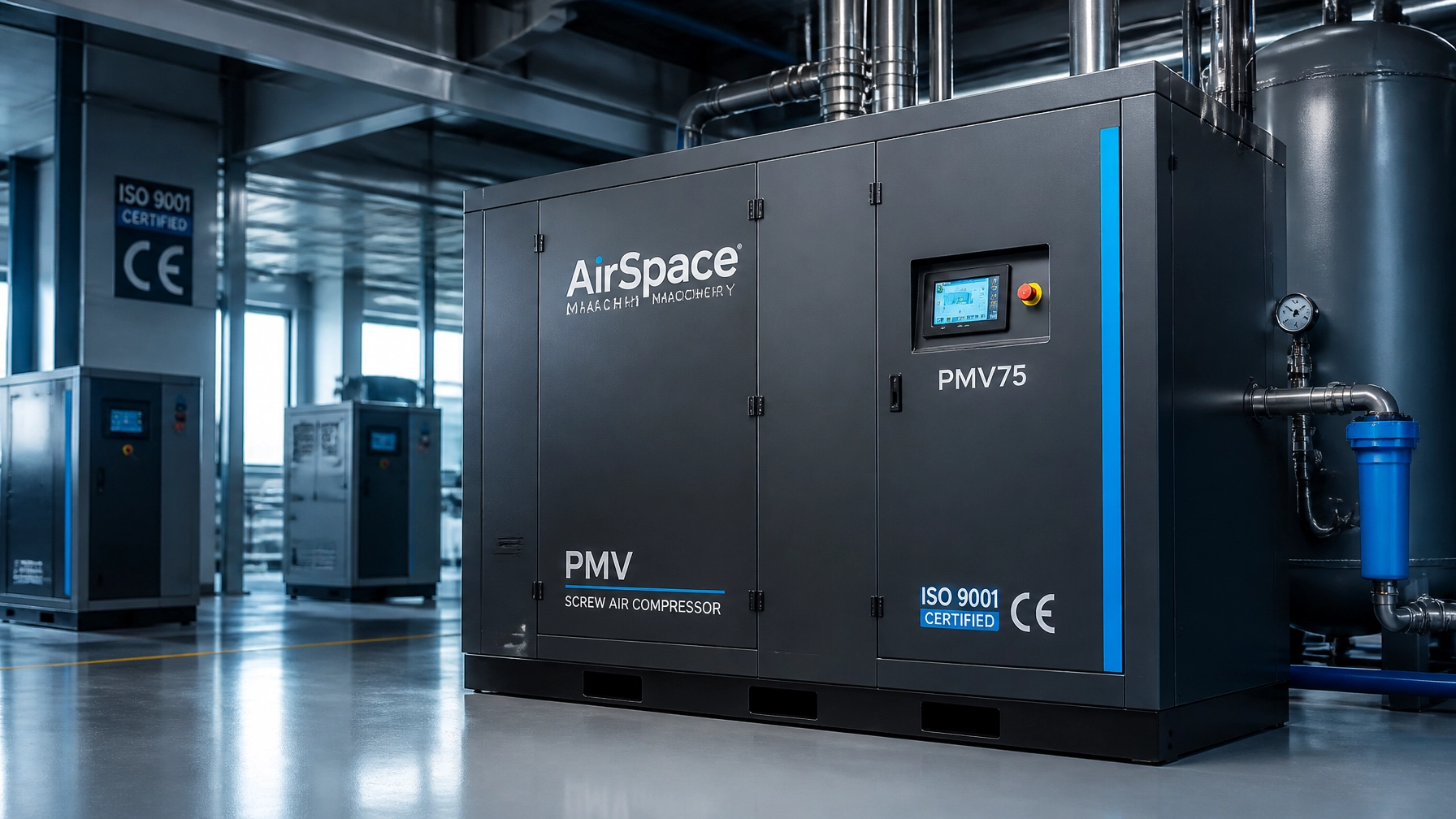
A REAL-PROJECT COMPANION FOR TEXTILE BUYERS
For a project-specific reference, review AirSpace Machinery’s Egypt textile low-pressure compressor case study. That page contains the published project information. This article does not add or alter its verified figures.
The Fourth Utility Concept is simple: compressed air should be managed like electricity, water and gas. Measure it, specify it at the point of use and stop paying for pressure the process never requested.
FREQUENT BUYER QUESTIONS
What pressure does a low pressure screw compressor deliver?
Dedicated low-pressure models are commonly configured from approximately 2.2 to 5.0 bar, depending on the series and application. The final pressure and FAD must be confirmed in the quotation.
When do I need low pressure instead of standard pressure?
Choose low pressure when the process needs 5 bar or below and requires substantial airflow. Choose standard or high pressure for applications requiring 6–16 bar.
Can I convert my 8-bar compressor to 3 bar?
A regulator can lower outlet pressure, but it does not remove the energy used to compress air to 8 bar. A dedicated low-pressure airend is usually the correct comparison when the process demand is consistently below 5 bar.
How much can I save at 3 bar?
The saving depends on power, FAD, operating hours, tariff, demand profile and pressure losses. In the stated 75 kW versus 55 kW model, the illustrative difference is approximately $14,500 per year. It is not a target.
What is the Unload Tax?
Unload Tax is the electricity consumed when a compressor remains powered while producing little or no useful air. Its effect depends on controls, motor type, operating profile and unload duration.
What FAD do I need?
Required FAD is the measured or calculated air volume needed at the point of use, plus verified distribution and treatment losses. Request FAD in m³/min or CFM at the working pressure and compare it using ISO 1217 conditions.
Do low-pressure compressors need dryers?
Usually, yes. Moisture can damage valves, piping and process equipment. A refrigerated dryer is suitable for many general industrial applications, but the correct dew point depends on the process, ambient conditions and downstream risk.
GET A PROPOSAL FOR THE RIGHT PRESSURE BAND
Send the required pressure in bar or psi, FAD in m³/min or CFM, current compressor power, daily operating hours, electricity price, site temperature, altitude, industry and equipment requirements. AirSpace engineers can compare a dedicated low-pressure PMV system with your existing arrangement and identify whether the pressure tax is material.
Use the AirSpace ROI Engine for an initial planning estimate, fill out the Free Compressed Air kWh Forecast & System Review form for product information and lead capture, then request a configuration-specific review through Contact AirSpace Machinery. Lead time depends on configuration, testing, documentation and production scheduling. Final technical claims, FAD values and purity classifications must be verified for the selected model and test documentation. If you need air consumption calculation, energy-saving scheme and factory quotation, please send us an inquiry. Sources and Standards
- ISO 1217: Displacement compressors : Acceptance tests
- U.S. Department of Energy compressor testing guidance
- AirSpace Machinery Low-Pressure Compressor Series
- AirSpace Machinery Downloads Center
- AirSpace Machinery Refrigerated Air Dryer Series
Key takeaways
- A laser application requiring approximately 16 bar: specify the dedicated laser compression package rather than a low-pressure unit.
- A dedicated low-pressure airend is usually the correct comparison when the process demand is consistently below 5 bar.
- A regulator can lower outlet pressure, but it does not remove the energy used to compress air to 8 bar.
- Dedicated low-pressure models are commonly configured from approximately 2.2 to 5.0 bar, depending on the series and application.
- The following model compares a standard 8-bar system regulated to 3.5 bar with a dedicated 55 kW low-pressure PMV system.
⚡ Is Your Factory Bleeding Cash?
Most fixed-speed compressors waste $3,600/year in "Unload Tax." Test your waste level in 30 seconds.
RUN THE ROI TEST →Ready to See How Much Your Facility Can Save?
Fill out the form below for a Free Energy Assessment.


