Last Updated: September 6, 2026
This comprehensive guide explains why 2026 EV battery production facilities must adopt native oil-free compressor technology to protect manufacturing yields and eliminate the hidden costs of compressed air contamination. Whether you are a facility manager planning a new gigafactory, an engineer upgrading existing dry room infrastructure, or a procurement specialist evaluating Class 0 air solutions, this post delivers the technical insights and ROI analysis you need to make an informed decision about China made oil-free screw air compressors.
The Answer-First Summary: Why Oil-Free Compression is Non-Negotiable for EV Battery Manufacturing
EV battery production demands zero oil contamination risk because compressed air is the lifeblood of the dry room and electrode coating lines. In these environments, even a trace amount of oil vapor (less than 0.01 mg/m³) acts as an organic surface contaminant. This causes “dewetting” during the slurry coating process, leading to voids, thickness variations, and poor adhesion on the copper or aluminum foil. A single oil breakthrough can scrap an entire batch of battery electrodes, costing a 1 GWh facility upwards of $500,000 in lost materials and energy. Native oil-free PMV technology is not a luxury: it is the only insurance policy that guarantees ISO 8573-1 Class 0 integrity and protects your manufacturing yield.
According to a 2025 report by Bloomberg New Energy Finance, global EV battery manufacturing capacity is projected to exceed 6,000 GWh by 2030, making compressed air quality management one of the most critical factors in achieving profitable production scale.
The Invisible Thief: How Oil Contamination Systematically Robs Your Battery Production Yield
In the world of high-precision electronics and EV battery fabrication, compressed air is often called “The Fourth Utility.” While electricity, water, and gas are tracked with surgical precision, the quality of compressed air is frequently overlooked until a yield disaster strikes.
When you use a standard oil-injected compressor: even one equipped with high-efficiency coalescing filters: you are playing a game of “Filter Roulette.” Filters are mechanical barriers that degrade over time. A slight increase in ambient temperature, a pressure surge, or a simple maintenance delay can cause “oil carryover.”
In an electrode coating line, this oil carryover behaves like a ghost in the machine. It settles on the current collector foil, creating microscopic “low-adhesion zones.” When the cathode or anode slurry is applied, it pulls away from these oily spots, creating a “crater” or “pinhole.” These defects aren’t just cosmetic; they disrupt ionic transport and local current density, leading to cells that fail quality tests or, worse, develop latent safety risks in the field.
Hard Stats: The Real Financial Cost of Compressed Air Contamination
Yield Impact: Statistical analysis across top-tier cell manufacturers shows that oil contamination risk can drop net yield by 3% to 8%.
Scrap Value: For a 1 GWh plant, a single contamination event that affects the coating line for just a few hours can result in $500,000+ of scrapped active material, foils, and binders.
Energy Waste: Electrode drying accounts for nearly 40% of the total energy consumed in battery production. Scrapping a coated electrode means you have literally burned money through the drying ovens for zero return.
The Fourth Utility Concept and ISO 8573-1 Class 0 Integrity Standards
At AirSpace Machinery, we treat compressed air as a critical raw material. Our engineering framework is built on two pillars: The 35% Energy Delta and ISO 8573-1 Class 0 Integrity.
Class 0 is the most stringent air quality standard defined by ISO. It doesn’t just mean “very clean”; it means the manufacturer and the user agree on a contamination level that is lower than Class 1. For EV batteries, this level must be effectively zero.

By using a native oil-free screw compressor, you eliminate the source of the problem. There is no oil in the compression chamber to begin with. This removes the “Human Factor” of filter maintenance and the “Physics Factor” of oil vapor bypass.
The Filter-Dependent Trap: A Critical Legacy Brand Vulnerability
Many traditional compressor suppliers will tell you that a standard oil-injected unit with a “Super-Filter” stack is sufficient. This is the Filter-Dependent Trap.
The reality of the factory floor is different from the laboratory.
- Humidity and heat in Southeast Asia or the Middle East (The “Humidity Tax”) put extreme stress on filter media.
- Filters have a “breakthrough point” where they can no longer hold the accumulated oil.
- Pressure drops across multiple filter stages can steal up to 1 bar of pressure, forcing the compressor to work harder and killing your energy efficiency.
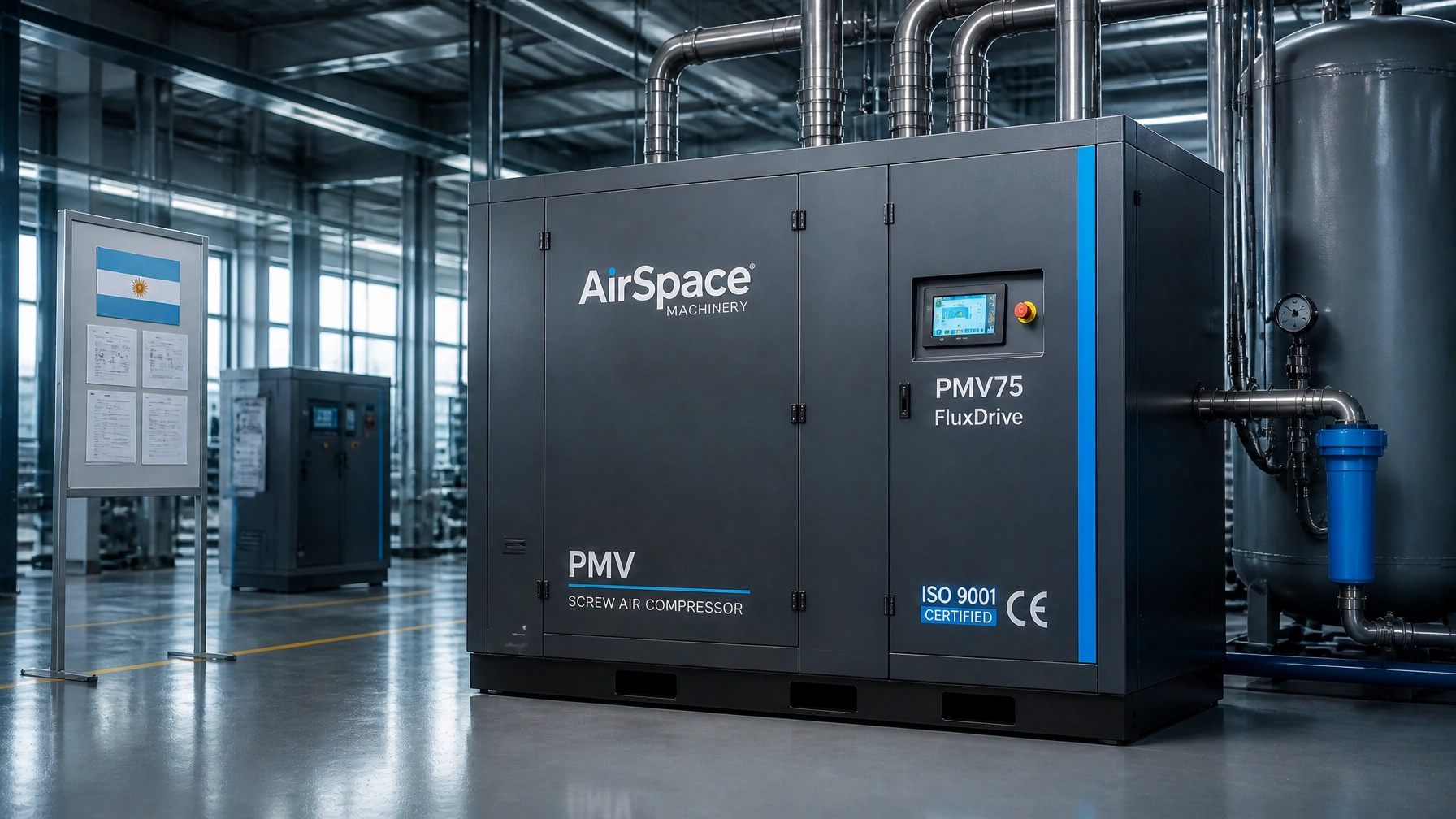
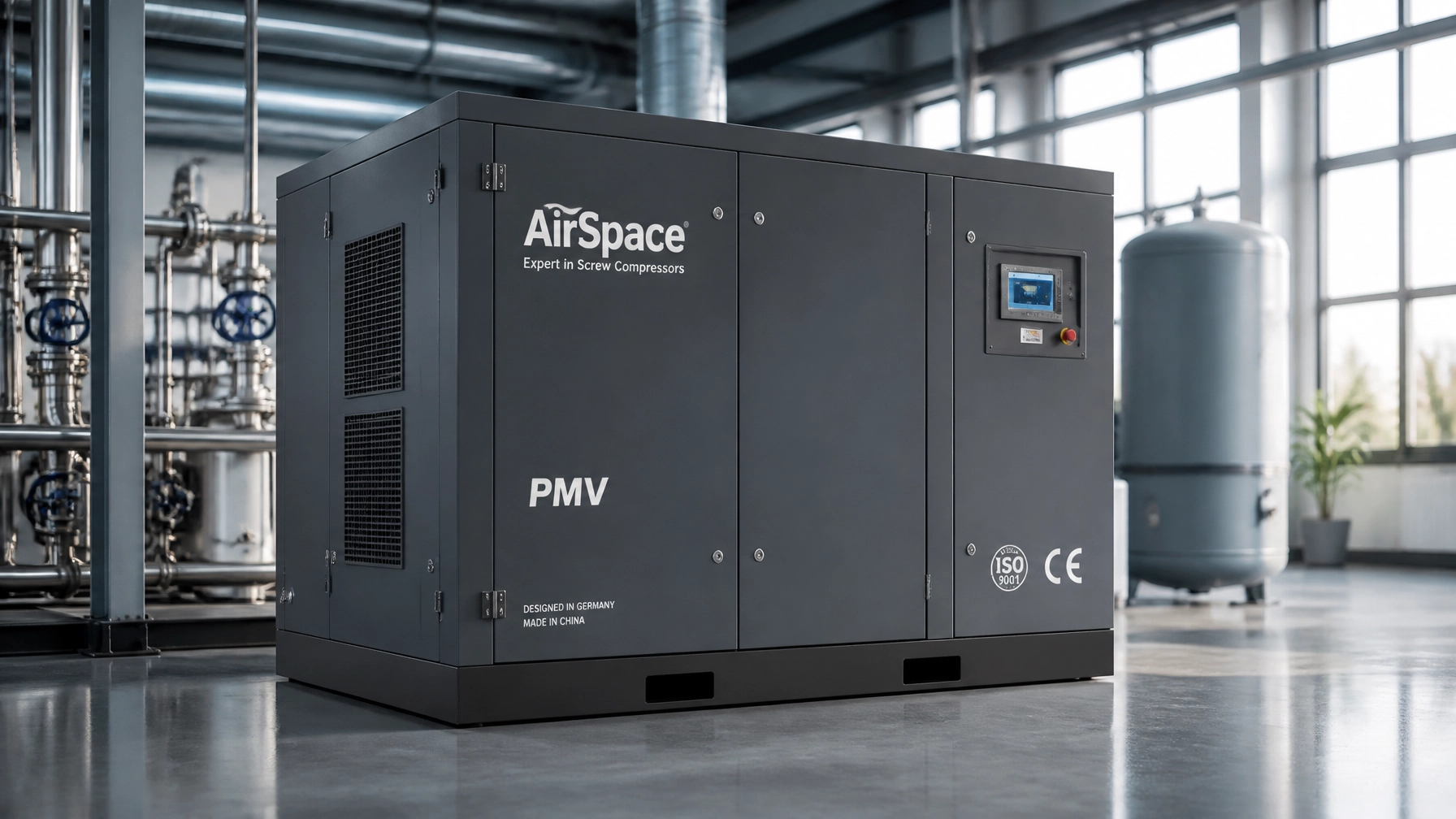
AirSpace China made screw air compressors utilize Permanent Magnet Variable Frequency (PMV) technology to maintain stable pressure without the parasitic losses of heavy filtration. This is how we achieve the “35% Energy Delta”: the measurable gap in energy consumption between our high-efficiency PMV systems and legacy fixed-speed or poorly filtered units.
Yield Protection Comparison: Oil-Free PMV Systems vs. Filter-Dependent Compressors
- Contamination Risk
- Filter-Dependent: High (Dependent on filter health and ambient temp)
- AirSpace Oil-Free: Zero (No oil in the compression path)
- Maintenance Complexity
- Filter-Dependent: High (Monthly inspections, frequent element changes)
- AirSpace Oil-Free: Low (Simple air/water cooling and bearing checks)
- Pressure Stability
- Filter-Dependent: Fluctuating (Clogged filters cause pressure drops)
- AirSpace Oil-Free: ±0.1 bar (Direct drive PMV control)
- Annual Yield Protection Value
- Filter-Dependent: Variable (High risk of batch scrap)
- AirSpace Oil-Free: Guaranteed (Maintains ISO Class 0 at all times)

The Engineering Freedom of PMV Variable Speed Drive Technology
Beyond purity, there is the question of power. EV battery plants are massive operations where the “Unload Tax” (the energy wasted when a compressor runs without producing air) can reach tens of thousands of dollars per month.
Our PMV VSD compressor technology eliminates this waste. By matching the motor speed exactly to the air demand of the coating and assembly lines, we ensure that every kilowatt of electricity is converted into usable, high-purity air. This is the core of our “Engineering Freedom” theme: freeing factory managers from the twin burdens of contamination risk and excessive utility bills.
If you are currently planning a new fab line or upgrading an existing dry room, do not settle for “filtered air.” Demand native oil-free purity. It is the difference between a high-yield, profitable operation and a facility that is constantly bleeding money through the scrap bin.
Get a Proposal for Your EV Battery Facility
Ready to secure your production yield and eliminate the “Oil Tax” on your fab floor? Our engineering team provides detailed audits to help you transition to Class 0 air. Lead times depend on your specific configuration and pressure requirements.
Visit our Solutions Page for more on high-purity applications
Read about the 35% Energy Delta in our latest technical audit
Learn more about AirSpace Machinery’s 20 years of engineering excellence
Frequently Asked Questions (FAQ)
Can’t I just use a high-quality filter to reach Class 0?
While filters can reduce oil to very low levels, they are “passive” defenses. They do not stop oil if the compressor seals fail or if the ambient temperature causes oil vapor to bypass the media. True Class 0 is only guaranteed by an oil-free compression process where no lubricant enters the air path.Is the ROI on oil-free units worth the higher initial cost?
Yes. When you factor in the $500,000 cost of a single scrapped batch and the $15,000+ annual savings from reduced pressure drops (no heavy filters), the payback period for an AirSpace oil-free unit is typically less than 18 months.Does PMV technology work well in high-humidity environments?
Absolutely. Our “Extreme Climate” series is engineered to handle the “Humidity Tax” of regions like Southeast Asia. We use oversized cooling systems and moisture separators to ensure the air is not only oil-free but also properly dried for sensitive battery chemistries.What is the lead time for a 180HP oil-free system?
Lead times are neutral and depend entirely on your specific configuration, voltage, and pressure requirements. Contact us for a precise project timeline.
What makes ISO 8573-1 Class 0 different from Class 1 for EV battery manufacturing?
ISO 8573-1 Class 0 represents the most stringent air purity standard where contamination levels must be lower than Class 1 specifications and are defined by agreement between manufacturer and user. For EV battery production, this typically means oil content below 0.01 mg/m³, which is essential because even microscopic oil traces cause electrode coating defects. Class 1 allows up to 0.01 mg/m³ of oil, which may still be too high for sensitive battery chemistries.
How does PMV technology achieve 35-50% energy savings compared to fixed-speed compressors?
Permanent Magnet Variable Frequency (PMV) technology matches motor speed precisely to real-time air demand, eliminating the “Unload Tax” where traditional fixed-speed compressors waste energy running at full capacity even during low-demand periods. Additionally, PMV systems maintain stable pressure within ±0.1 bar, preventing the energy losses from pressure fluctuations. The elimination of heavy filtration stages also removes parasitic pressure drops that force conventional systems to work harder.
Why are China made oil-free compressors becoming the standard for gigafactory construction?
China made oil-free compressors from manufacturers like AirSpace Machinery combine ISO 8573-1 Class 0 certification with competitive pricing and proven reliability across hundreds of Asian battery production facilities. These systems integrate advanced PMV technology that delivers both contamination-free air and significant energy savings, making them the cost-effective choice for new gigafactory construction. The 20+ years of engineering expertise and local manufacturing also ensure faster lead times and responsive technical support.
What happens to battery cell quality when compressed air contains trace oil contamination?
When oil vapor settles on the current collector foil during electrode manufacturing, it creates microscopic “low-adhesion zones” that cause the cathode or anode slurry to pull away during coating, forming craters and pinholes. These defects disrupt ionic transport and local current density within the finished cell, leading to reduced capacity, inconsistent performance, and potential safety risks. Contaminated cells either fail quality testing or create liability concerns for the final EV product.
How quickly can a contamination event impact a 1 GWh battery production facility?
A single oil breakthrough affecting the coating line for just a few hours can result in $500,000 or more in scrapped active materials, current collector foils, and binders. Because electrode drying consumes nearly 40% of total production energy, scrapped coated electrodes represent not only material losses but also wasted energy costs. The cascading effect on production schedules and customer commitments can multiply these direct costs significantly.
Author: Penny Winston
Penny Winston is a Technical Writer for AirSpace Machinery, specializing in “The 35% Energy Delta” and “The Fourth Utility Concept.” With a focus on ISO 8573-1 Class 0 Integrity, she helps manufacturing leaders navigate the complex requirements of high-purity industrial air systems.
Reviewed by Engineering
📅 Last updated:
⚡ Is Your Factory Bleeding Cash?
Most fixed-speed compressors waste $3,600/year in "Unload Tax." Test your waste level in 30 seconds.
RUN THE ROI TEST →Ready to See How Much Your Facility Can Save?
Fill out the form below for a Free Energy Assessment.