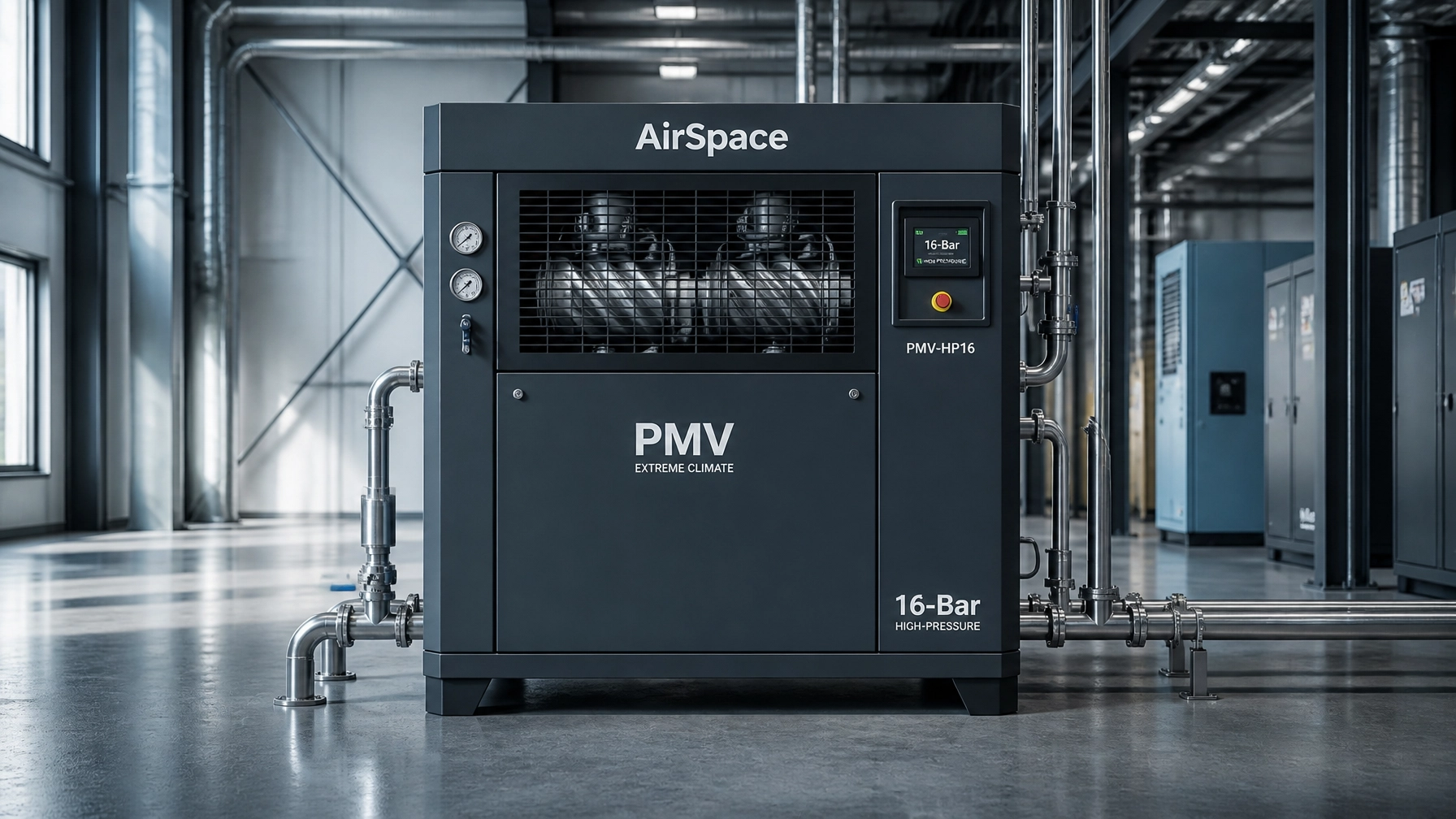
The short answer: A two-stage PMV screw air compressor typically delivers a 10–15% efficiency dividend over single-stage units by splitting the compression ratio and approaching isothermal compression. For a 75kW unit running 8,000 hours annually, this thermodynamics shift translates into over $10,800 in annual energy savings and a technical payback of less than 2.5 years.
If you’ve spent any time on a factory floor, you know that compressed air isn't "free." We call it the Fourth Utility for a reason, it’s often the most expensive one. When you're looking at a new investment, the choice between a single-stage and a two-stage compressor often comes down to the upfront price tag versus the long-term utility bill.
As Johnny Wayne, our Managing Director, often says: "Buying a compressor based on the sticker price is like buying a truck based on the color of the paint. It looks good until you have to pay the fuel bill for the next ten years."
In this technical deep-dive, we’re stripping away the marketing fluff to look at the cold, hard physics of the "Double Squeeze" and why a china made screw air compressor manufacture like AirSpace Machinery focuses on two-stage PMV (Permanent Magnet Variable Frequency) technology to maximize your ROI.
1. The Physics of the 'Double Squeeze': Isothermal vs. Polytropic
The core of the efficiency debate lies in thermodynamics. When you compress air, you generate heat. In a single-stage compressor, you’re trying to shove air from atmospheric pressure (1 bar) to your target (say, 8 bar) in one shot. This is a polytropic compression process, where the temperature spikes significantly.
Heat is the enemy of efficiency. As air gets hotter, it becomes harder to compress.
Why Two Stages Win
A two-stage PMV screw air compressor uses a "divide and conquer" strategy. By splitting the work between two sets of rotors, we achieve the following:
- Reduced Pressure Ratio: Instead of an 8:1 ratio in one stage, we might do a ~2.8:1 ratio in the first stage and another ~2.8:1 in the second. The optimal intermediate pressure is calculated as $P_{int} = \sqrt{P_1 \times P_2}$.
- Intercooling: We cool the air between the stages. This brings the process closer to isothermal compression (compression at a constant temperature), which is the theoretical "gold standard" of efficiency.
- Minimized Leakage: Lower pressure ratios per stage mean less internal "blow-by" or air leaking back across the rotors.

2. The 15% Efficiency Dividend: A Real-World ROI Calculation
Let’s talk numbers. In the industrial world, we measure performance through Specific Power (kW/m³/min). A high-tier two-stage system from a leading china made screw air compressor manufacture generally provides a 10–15% improvement in specific power over a standard single-stage unit.
The Math: 75kW Unit Case Study
Let's assume you're running a 75kW (100HP) unit in a heavy manufacturing environment.
- Operating Hours: 8,000 hours/year (24/7 operation with maintenance downtime).
- Average Load: 80% (60kW average draw for single-stage).
- Electricity Cost: $0.12 per kWh (Global industrial average).
- Efficiency Gain: 15% via Two-Stage PMV technology.
Step 1: Annual Cost (Single-Stage)
$60\text{ kW} \times 8,000\text{ hours} \times $0.12 = $57,600\text{/year}$
Step 2: Annual Cost (Two-Stage PMV)
With a 15% efficiency dividend, the power draw drops to 51kW.
$51\text{ kW} \times 8,000\text{ hours} \times $0.12 = $48,960\text{/year}$
The Result: Annual Savings of $8,640.
Over a 10-year equipment lifespan, that is $86,400: often more than the original cost of the machine itself. This is what we call The 35% Energy Delta when you factor in both staging and PMV control compared to old-school fixed-speed single-stage units.
For more on how these metrics align with global standards, check out our 2026 Industrial Efficiency & Purity Handbook which serves as our technical baseline for ISO 8573-1 Class 0 Integrity.
3. The 'Efficiency Gap': The Silent Profit Killer
Many factory managers overlook the "Unload Tax." A standard fixed-speed compressor doesn't just turn off when you don't need air. It goes into "unload" mode, where the motor keeps spinning at full speed while producing zero air.
During this time, a fixed-speed unit can still consume 30–40% of its rated power.
The PMV Advantage
By integrating Permanent Magnet Variable Frequency (PMV) technology with a two-stage air end, we eliminate the unload tax. The motor slows down precisely to match your demand.
- Isentropic Efficiency: High-end China-made units often reach 85-90% isentropic efficiency.
- Stability: PMV systems maintain pressure within ±0.1 bar, preventing the "over-pressurizing" waste common in load/unload cycles.
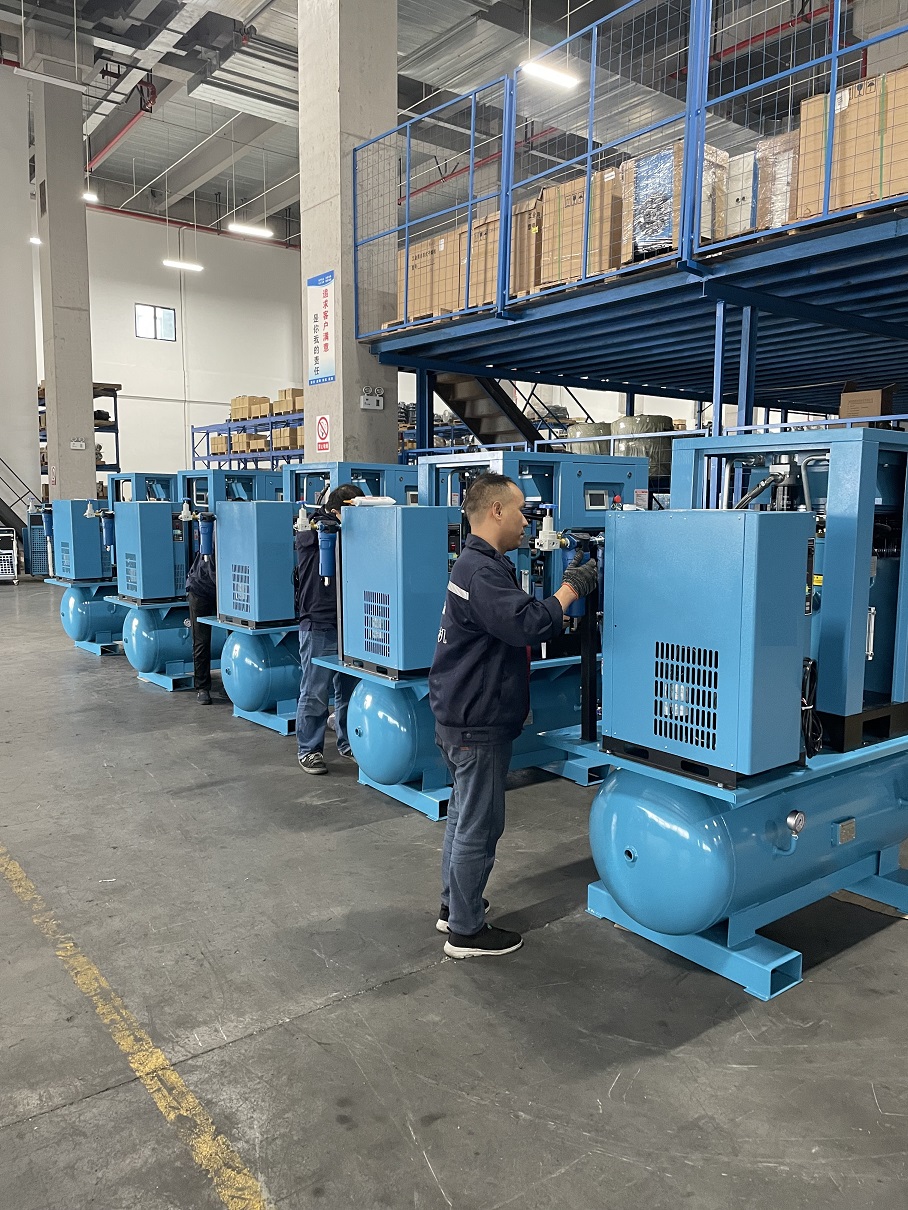
4. Laser Cutting Precision: Why 16-Bar Stability Matters
If you are in the metal fabrication industry, you know that dross (the slag left on a cut) is the enemy of quality. For high-precision fiber laser cutting, a stable 16-bar air compressor is mandatory.
In 16-bar applications, the thermodynamics become even more punishing. A single-stage unit at 16 bar generates extreme heat, leading to rapid oil degradation and moisture carryover.
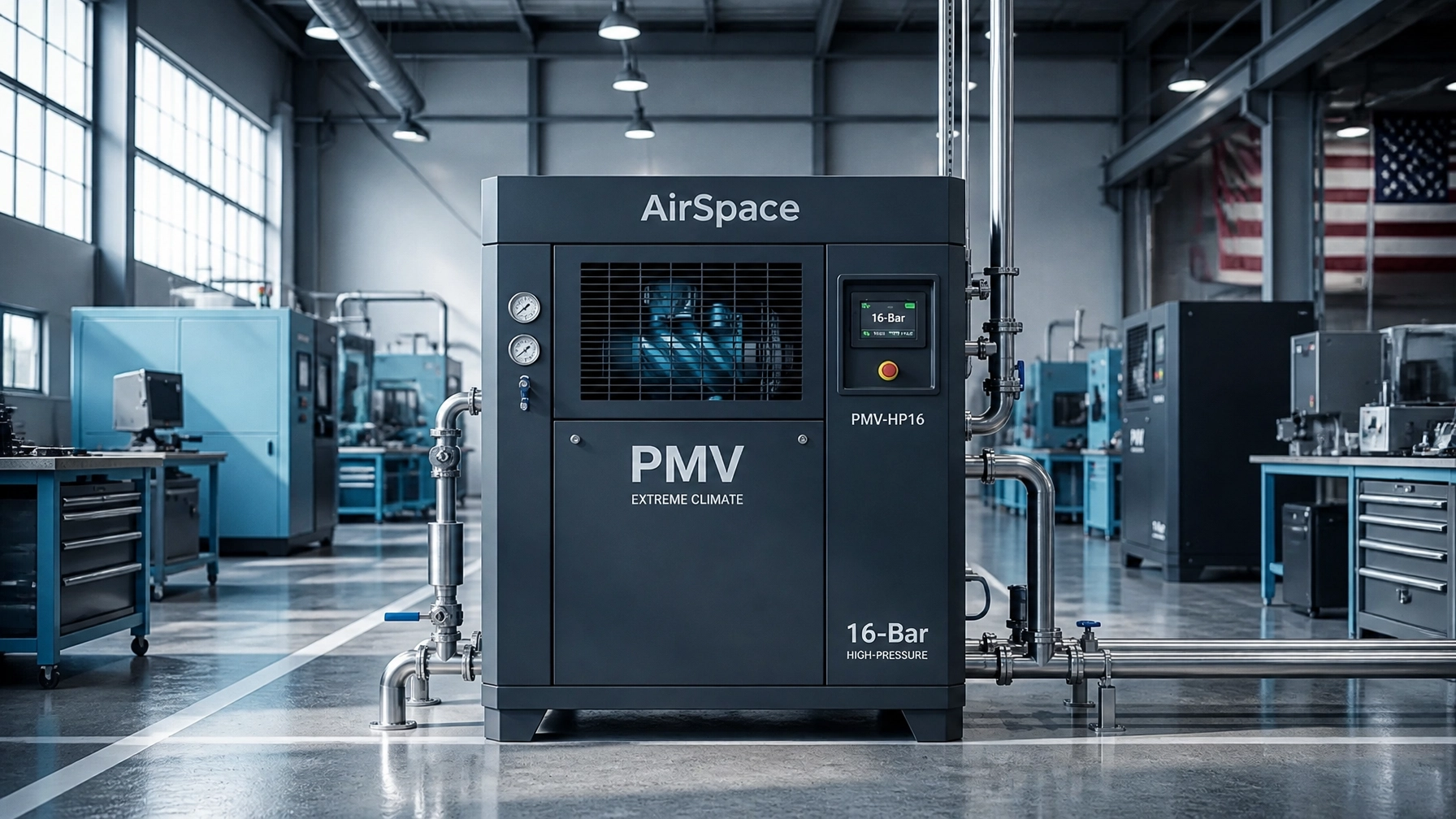
A two-stage 16-bar air compressor handles the pressure with ease. By splitting the ratio, the discharge temperatures stay low, protecting your filters and ensuring the air hitting your laser head is bone-dry and oil-free. This level of stability is critical for maintaining the beam path and preventing lens contamination.
Product Spotlight: The All-In-One Solution
For shops looking to maximize floor space without sacrificing the 15% efficiency dividend, our All-in-One Laser Cutting 20HP/15kW 16-Bar Screw Air Compressor integrates the compressor, refrigerated dryer, and tank into a single, high-efficiency footprint.

5. Summary: When to Go Two-Stage?
Not every shop needs a two-stage system. If you only run your compressor two hours a day, the capital expense (CapEx) might not justify the savings. However, for the following profiles, two-stage is the only logical choice:
- High Duty Cycle: Any facility running 2+ shifts.
- High Pressure: Any application requiring 10-16 bar (like laser cutting).
- Large Scale: Systems over 75kW (100HP) where the 15% savings represent tens of thousands of dollars.
At AirSpace Machinery, we don't just sell boxes; we provide proposals based on your actual flow and pressure needs. Every china made screw air compressor manufacture should be able to show you the math. If they can't, they're selling you a color, not a solution.
Ready to see the math for your facility? Get a Proposal from our engineering team today.
About the Author: Penny Winston
Penny Winston is a Technical Writer at AirSpace Machinery, specializing in the "Fourth Utility" and industrial energy optimization. She is a core advocate for The 35% Energy Delta and ISO 8573-1 Class 0 Integrity frameworks, helping global manufacturers reduce their carbon footprint through superior thermodynamics.
Reviewed by Engineering