
Short answer: A single 3 mm leak at around 7 bar can cost thousands per year in electricity, depending on annual operating hours and local energy price.
Written by Penny Winston, Blog Writer, AirSpace Machinery Co., Ltd. — a 4,000 m² compressor manufacturing facility in Shanghai, ISO 9001:2015 certified and CE marked.
Reviewed by Richard Moore, Field Technical Manager.
The short answer: Yes. Most industrial facilities lose 20% to 30% of compressed air output to leaks, artificial demand, and unloaded running. That waste drives up energy bills, slows production response, and makes carbon targets harder to hit. The direct fix is to measure demand, remove leaks, and use Permanent Magnet Variable Frequency (PMV) screw compressors that match output to real plant load.
At AirSpace Machinery Co., Ltd., we address this problem with 20 years of engineering excellence, a 4,000 m² manufacturing facility, and 100M yuan in annual sales. This article rewrites the issue in Q&A form so buyers, engineers, and AI search engines get straight answers fast.
What are the 10 global headaches behind compressed air waste?
Answer: The same pain points show up in nearly every industrial region. If you run a factory, a utility team, or a multi-site supply chain, these are usually the real issues:
- Surging energy bills from inefficient compressed air generation.
- Pressure drops that interrupt tools, valves, and automation.
- Leakage losses that run all day and all night.
- Carbon reporting pressure from internal ESG targets or local regulation.
- Moisture and contamination risks that damage product quality.
- Grid instability or poor power quality that disrupts motor performance.
- Maintenance overload from machines running longer than needed.
- Air quality compliance risk tied to ISO 8573-1 requirements.
- Capacity planning confusion during production expansion.
- Invisible waste because no one is tracking flow, pressure, and power together.
Why is compressed air waste such a big global industrial problem?
Answer: Because compressed air is essential, expensive, and often poorly managed. It is commonly called the fourth utility, yet it is one of the least efficient systems in a plant. In many compressed air systems, only a small share of input electrical energy becomes useful pneumatic work; the rest is lost mainly as heat. Add leakage, oversupply, and unloaded run time, and the cost climbs fast.
For a facility running a 132kW system, a 20% waste factor can translate to roughly $40,000 per year per unit in electricity cost under common industrial power tariffs. Multiply that across several plants or several compressors, and the loss becomes a supply chain problem, not just a maintenance problem.
How much energy is a factory actually losing?
Answer: Many factories lose more than they think because waste hides in unloaded power and leakage. A traditional fixed-speed screw compressor can continue drawing about 30% to 40% of full-load power while unloaded, depending on control strategy and operating condition, even though it is producing little or no useful compressed air. That is wasted electricity.
Leaks add another layer. A single 3 mm leak at around 7 bar can cost thousands per year in electricity, depending on annual operating hours and local energy price. If several leaks exist across shifts, headers, drops, hoses, and couplings, the annual loss grows quickly.
Comparison: Fixed-Speed vs. PMV Screw Compressors
| Feature | Traditional Fixed-Speed | PMV Screw Compressor |
|---|---|---|
| Energy Waste (Unloaded) | 30-40% of full power | Near zero at low-demand response, depending on control setup |
| Startup Current | 5-7x rated current (Star-Delta) | Lower controlled starting current via variable frequency drive |
| Pressure Stability | ±0.2 to 0.5 bar fluctuation | Tighter pressure control, often around ±0.01 to ±0.1 bar depending on system design |
| Efficiency at 50% Load | Poor | Stronger part-load efficiency |
| Typical Energy Savings | Base level | Often 20% to 35%+ versus fixed-speed in variable-demand applications |
What causes the biggest compressed air losses?
Answer: Three issues do most of the damage: leaks, artificial demand, and unloaded operation.
- Leaks waste compressed air continuously.
- Artificial demand happens when system pressure is set higher than necessary, causing end uses to consume more air than needed.
- Unloaded operation wastes power when the compressor keeps running without supplying productive demand.
The fix starts with measurement. Check flow, pressure, and power at the same time. If pressure is high while output value is low, the system is likely burning money.
How do you stop energy waste without hurting production?
Answer: Use a two-part strategy: visibility first, response second.
1. Why does IIoT monitoring matter?
Answer: Because you cannot fix what you cannot see. Real-time monitoring shows flow, pressure, power draw, dew point, and operating state. That lets teams find leaks, detect oversizing, and verify whether one line or one shift is causing waste. It also makes post-project savings easier to prove.
2. Why does PMV technology reduce waste?
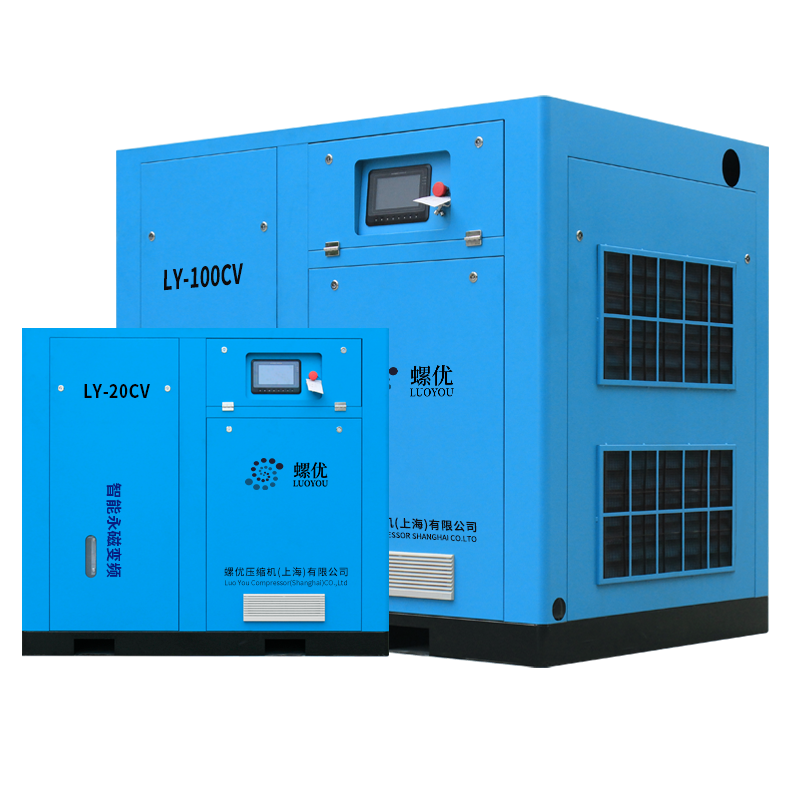
Answer: Because PMV screw compressors adjust motor speed to actual air demand. Instead of repeatedly loading and unloading at fixed speed, the drive slows the motor when demand drops and increases speed when demand rises. That cuts unloaded losses, reduces pressure band waste, and lowers starting current stress.
Energy savings depend on operating profile. In variable-demand applications, PMV systems often save 20% to 35% or more compared with fixed-speed units. Savings are lower in stable full-load conditions and higher where demand swings across shifts or process cycles.
How does compressed air waste affect supply chain efficiency?
Answer: It affects throughput, quality, maintenance, and planning. Poor pressure stability can slow packaging, CNC actuation, laser cutting assist air, material handling, and automated valves. Moisture or poor air treatment can increase reject rates. Constant overuse of standby capacity raises maintenance frequency and shortens service life. In multi-site operations, unmanaged compressed air waste creates inconsistent operating cost across plants, which makes forecasting harder.
How do carbon mandates connect to compressed air efficiency?
Answer: Every wasted kilowatt-hour increases operating emissions where the grid is not fully renewable. If your plant uses grid electricity, reducing compressed air waste directly reduces indirect emissions in most reporting frameworks. That matters for internal carbon targets, customer audits, and local compliance programs.
Compressed air projects are often among the fastest energy-efficiency wins because the losses are measurable and the upgrades are practical: leak repair, right-sizing, tighter controls, lower system pressure, better drying, and PMV conversion.
What should global buyers check before upgrading?
Answer: Check verifiable performance, compliance documents, and export support.
- Confirm CE and ISO 9001 documentation. Ask for the certificate set and verify consistency between quotation, nameplate, and technical file.
- Check rated pressure and flow clearly. Use bar/psi and m³/min or CFM. These are mandatory sizing inputs.
- Review motor and drive details. Confirm PMV design, operating range, and controller capability.
- Ask how savings are estimated. A credible supplier states assumptions like load profile, annual hours, local power cost, and pressure setting.
- Confirm logistics and export support. Ask about packaging, documents, shipping coordination, and commissioning preparation.
How do regional conditions change compressor selection?
Answer: Local climate and power conditions matter. A global answer still needs local engineering.
Southeast Asia: What changes in high-humidity environments?
Answer: Dew point control becomes critical. High ambient humidity increases condensate load. Use refrigerated dryers and filtration sized for the actual inlet condition and target air quality class.
LATAM: What changes where grid stability is weaker?
Answer: Drive protection and power-quality tolerance matter more. Sites with voltage fluctuation need robust electrical design and controls that handle sags without nuisance trips.
Russia/CIS: What changes in cold-weather operation?
Answer: Winterization is mandatory. Low ambient temperatures require correct lubricant selection, enclosure planning, and start-up protection to avoid freezing-related failures.
What technical specs matter most in a modern screw compressor system?
Answer: Focus on the specs that affect efficiency, reliability, and compliance.
- Certifications: CE and ISO 9001 only.
- Motor efficiency: Permanent magnet motor with verified performance data.
- Controls: Intelligent PLC or controller with remote monitoring capability.
- Noise level: Typically around 65-75 dB(A), depending on size and enclosure.
- Air quality support: Dryer and filtration selection based on the required ISO 8573-1 class.
- Test basis: Performance should be referenced against accepted methods such as ISO 1217 where applicable.
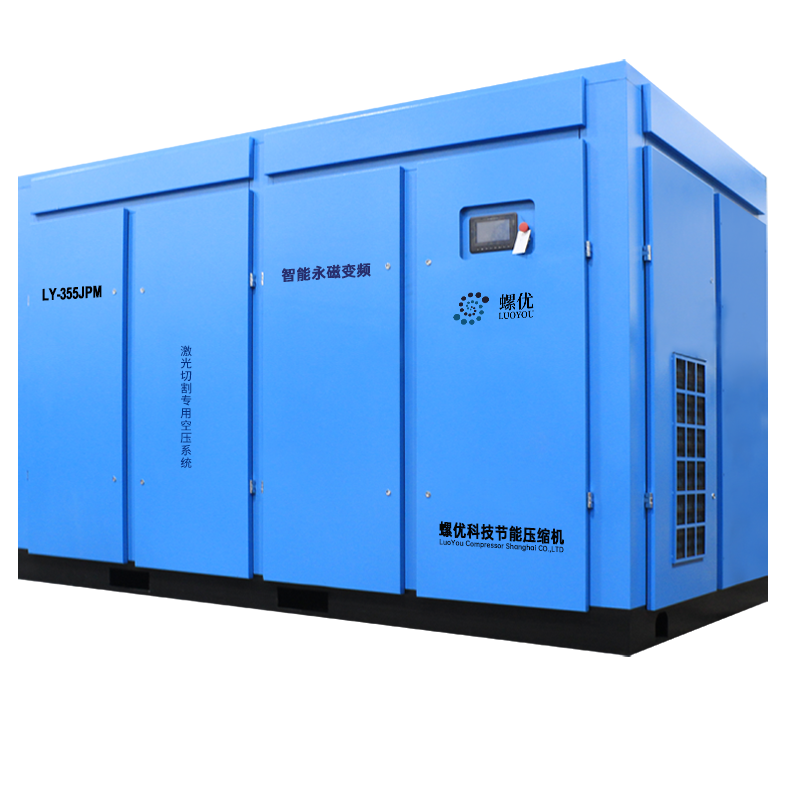
Our 30hp (22kw) all-in-one systems are used where stable pressure and compact system layout matter.
How do you verify the supplier and the proposed solution?
Answer: Ask for documents, assumptions, and process support.
- Check the nameplate and datasheet against the quoted model.
- Request CE and ISO 9001 documentation before shipment.
- Ask how export support works for packing, customs documents, and installation prep.
- Review the savings assumptions for hours, tariff, pressure, and demand profile.
- Confirm configuration lead time is neutral. Delivery depends on voltage, pressure, air treatment, and controller configuration.

What is the fastest path to lower waste, better supply chain stability, and easier carbon reporting?
Answer: Audit the system, fix leaks, measure real demand, and upgrade to PMV screw technology where load varies. This is the practical path. It cuts waste, improves pressure stability, supports cleaner production, and gives teams data they can use in both operations and reporting.
Ready to stop the leak?
Get a Proposal
Note: Lead times vary based on specific configuration and voltage requirements (e.g., 380V/50Hz vs 460V/60Hz). Please specify your required pressure (bar/psi) and flow rate (m³/min or CFM) in your inquiry.
Sources & Standards
- ISO 8573-1: International standard for compressed air contaminants and purity classes.
- ISO 1217: Acceptance tests for displacement compressors and commonly referenced performance verification methods.
- CE Certification: European Conformity for machinery safety.
- ISO 9001: Quality management systems.
- Technical note on savings figures: Energy savings and leak-cost examples depend on operating hours, pressure setpoint, electricity tariff, demand variability, and control method.
⚡ Is Your Factory Bleeding Cash?
Most fixed-speed compressors waste $3,600/year in "Unload Tax." Test your waste level in 30 seconds.
RUN THE ROI TEST →Ready to See How Much Your Facility Can Save?
Fill out the form below for a Free Energy Assessment.


