
Short answer: Every 15 psi of unnecessary pressure drop increases energy costs by up to 7%.
Written by Penny Winston, Blog Writer, AirSpace Machinery Co., Ltd. — a 4,000 m² compressor manufacturing facility in Shanghai, ISO 9001:2015 certified and CE marked.
Reviewed by Richard Moore, Field Technical Manager.
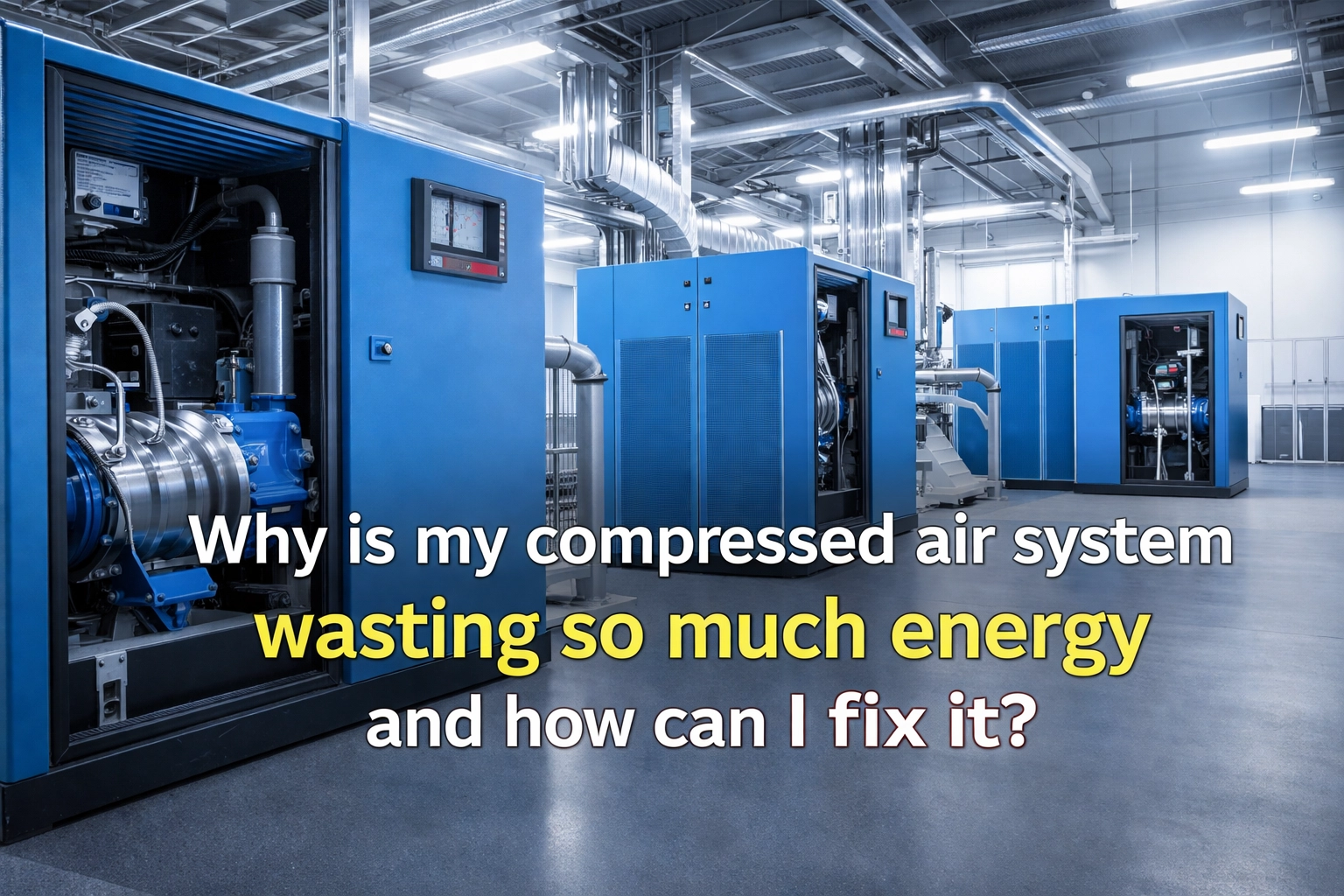
Direct Answer: Your compressor air system is wasting energy due to four primary issues: air leaks (20-30% of output), excessive operating pressure, pressure drop across distribution, and poor maintenance. Together, these problems waste 20-40% of your total compressed air energy. The fix involves systematic leak detection, pressure optimization, proper piping, scheduled maintenance, and, for significant long-term savings, upgrading to an energy-efficient air compressor with Permanent Magnet Variable Frequency (PMV) technology.
What causes compressed air systems to waste energy?
Answer: Four root causes account for most compressed air energy waste: leaks, overpressure, pressure drop, and maintenance neglect.
Compressed air is one of the most expensive utilities in any manufacturing facility. According to the U.S. Department of Energy, compressed air systems can account for 20-30% of a plant’s total electricity consumption. When systems are inefficient, that percentage climbs even higher, often without plant managers realizing it.
Here is a quick breakdown of the main culprits:
| Energy Waste Cause | Typical Energy Loss | Primary Source |
|---|---|---|
| Air leaks | 20-30% of compressor output | Worn fittings, damaged pipes, deteriorating seals |
| Excessive pressure | 7-10% per extra 1 bar (14.5 psi) | System set higher than application requires |
| Pressure drop | Up to 7% per 15 psi drop | Undersized piping, dirty filters, excessive fittings |
| Poor maintenance | 15-35% during unload cycles | Clogged filters, leaking unload valves |
At AirSpace Machinery Co., Ltd., our engineering team, backed by 20 years of compressed air system expertise, sees these issues repeatedly when auditing facilities worldwide.
How much energy are air leaks really costing you?
Answer: On a typical 100 HP screw compressor system, air leaks waste 15-22 kW continuously, costing $9,000-$13,500 per year in electricity alone.
Air leaks are the single largest source of compressed air energy waste. They are also the easiest to overlook because they often develop gradually at:
- Threaded pipe connections and fittings
- Quick-connect couplings
- Valve stems and pressure regulators
- Filter housings and drain traps
- Worn hoses and aging pneumatic tools
A 1/8-inch diameter leak at 100 psi wastes approximately 25 CFM of compressed air. At average industrial electricity rates, that single leak costs over $2,500 annually.
How to find leaks: Ultrasonic leak detectors are the industry standard for identifying leaks during production hours. For smaller facilities, listening during off-hours (when background noise is minimal) can reveal significant leaks.
Is your system running at the wrong pressure?
Answer: Yes, if your compressor discharge pressure exceeds your highest actual point-of-use requirement by more than 10-15 psi, you are wasting energy.
Many facilities operate compressed air systems at 110-125 psi when their actual equipment requires only 80-90 psi. This happens because:
- Operators raise pressure to compensate for leaks and pressure drop
- One piece of equipment needs higher pressure, so the whole system runs high
- “That’s how it’s always been set”
The math is simple: Every 1 bar (14.5 psi) increase in system pressure raises energy consumption by 7-10%. Running at 20% higher pressure than necessary wastes approximately 25% more energy.
The solution: Install point-of-use pressure regulators and, where needed, dedicated boosters for high-pressure applications. This allows your main system to run at optimal lower pressure while specific equipment gets the pressure it needs.
What role does pressure drop play in energy waste?
Answer: Pressure drop forces your compressor to work harder to maintain downstream pressure. Every 15 psi of unnecessary pressure drop increases energy costs by up to 7%.
Pressure drop occurs throughout your distribution system:
- Undersized piping: Creates excessive velocity and friction losses
- Dirty filters: A single neglected filter can cause 15 psi pressure drop
- Excessive fittings: Each 90° elbow equals 3-5 feet of additional pipe length
- Long distribution runs: Pressure decreases with distance from the compressor
Ideal system design: Maintain less than 10% total pressure drop from compressor discharge to point of use. This typically means:
| Component | Maximum Acceptable Pressure Drop |
|---|---|
| Aftercooler and separator | 3-5 psi |
| Air dryer | 3-5 psi |
| Main distribution line | 1-2 psi |
| Final filters at point of use | 2-3 psi |
| Hoses and connections | 2-3 psi |
How can proper maintenance reduce energy consumption?
Answer: A well-maintained compressed air system operates 10-15% more efficiently than a neglected one. Regular filter changes, leak repairs, and component inspections prevent the gradual efficiency losses that force operators to increase pressure.
Maintenance neglect creates a cascade effect:
- Filters clog, causing pressure drop
- Operators increase system pressure to compensate
- Higher pressure increases leak rates
- Compressor runs longer and harder
- Components wear faster, creating more leaks
- Energy costs climb while air quality drops
Essential maintenance schedule for screw compressors:
| Maintenance Task | Frequency | Impact on Efficiency |
|---|---|---|
| Air filter inspection/replacement | Weekly check, replace as needed | Prevents 2-5 psi pressure drop |
| Oil separator element | 4,000-8,000 hours | Prevents 3-8 psi pressure drop |
| Oil change (oil-injected units) | Per manufacturer spec | Maintains cooling and sealing |
| Leak survey | Quarterly minimum | Recovers 20-30% lost capacity |
| Drain trap inspection | Monthly | Prevents air loss through drains |
| Belt/coupling inspection | Monthly | Prevents efficiency and safety issues |
What is the fastest way to fix compressed air energy waste?
Answer: Start with a systematic leak detection and repair program. Leak repairs offer the fastest return on investment: often weeks or months: with minimal capital expense.
Here is a prioritized action plan:
Immediate actions (zero to minimal cost):
- Reduce system pressure to the minimum acceptable level
- Verify all regulators are actually regulating (outlet pressure should be lower than inlet)
- Check and replace clogged filters
- Repair obvious leaks with replacement fittings ($5-15 each)
Short-term actions (low to moderate cost):
- Conduct ultrasonic leak survey
- Replace leaking FRLs (filter-regulator-lubricators): $30-150 each
- Rebuild or replace leaking unload valves: $200-800 each
- Install point-of-use regulators throughout the system
Strategic actions (capital investment with strong ROI):
- Upsize undersized piping in high-flow areas
- Install a properly sized air receiver to reduce compressor cycling
- Upgrade to an energy-efficient air compressor with PMV technology
How can upgrading to PMV technology solve energy problems?
Answer: Permanent Magnet Variable Frequency (PMV) screw air compressors automatically adjust motor speed to match actual air demand, eliminating the wasted energy of fixed-speed units running in unload mode or cycling on/off.
Fixed-speed screw compressors are designed to run at full capacity. When demand drops, they either:
- Run unloaded (wasting 15-35% of full-load power while producing zero air)
- Cycle on and off (causing wear and inefficient operation)
PMV technology solves this by matching compressor output to real-time demand. Benefits include:
- Energy savings of 25-50% compared to fixed-speed units in variable-demand applications
- Soft-start capability that eliminates high inrush currents
- Stable pressure control within ±0.1 bar
- Reduced mechanical wear from fewer start/stop cycles
At AirSpace Machinery, we manufacture PMV screw air compressors in our 4,000 m² facility, achieving 100M yuan annual sales by delivering energy-efficient air compressor solutions to global markets. All units meet CE and ISO 9001 quality standards, and we provide full export documentation for international buyers.
Explore our Variable Frequency Air Compressor range
Ready to stop wasting energy?
If your compressed air system is driving up electricity costs, our engineering team can help you identify the problem and specify the right energy-efficient air compressor solution for your application.
Get a Proposal
Contact AirSpace Machinery for a consultation. Provide your pressure (bar/psi) and flow (m³/min or CFM) requirements, and we will recommend the optimal system configuration. Lead time depends on configuration and destination.
Request a quote at chinacompressor.org
Sources and Standards Referenced
- U.S. Department of Energy, Compressed Air Challenge Best Practices
- ISO 8573-1 for compressed air quality classification
- Industry-standard pressure drop calculations per Compressed Air and Gas Institute (CAGI)
Key takeaways
- A single neglected filter can cause 15 psi pressure drop.
- On a typical 100 HP screw compressor system, air leaks waste 15-22 kW continuously, costing $9,000-$13,500 per year in electricity alone.
- Many facilities operate compressed air systems at 110-125 psi when their actual equipment requires only 80-90 psi.
- Yes, if your compressor discharge pressure exceeds your highest actual point-of-use requirement by more than 10-15 psi, you are wasting energy.
- Every 1 bar (14.5 psi) increase in system pressure raises energy consumption by 7-10%.
⚡ Is Your Factory Bleeding Cash?
Most fixed-speed compressors waste $3,600/year in "Unload Tax." Test your waste level in 30 seconds.
RUN THE ROI TEST →Ready to See How Much Your Facility Can Save?
Fill out the form below for a Free Energy Assessment.


