TROPICAL VS. COLD CLIMATE: HOW DO YOU CHOOSE THE RIGHT DRYER FOR YOUR LASER AIR COMPRESSOR
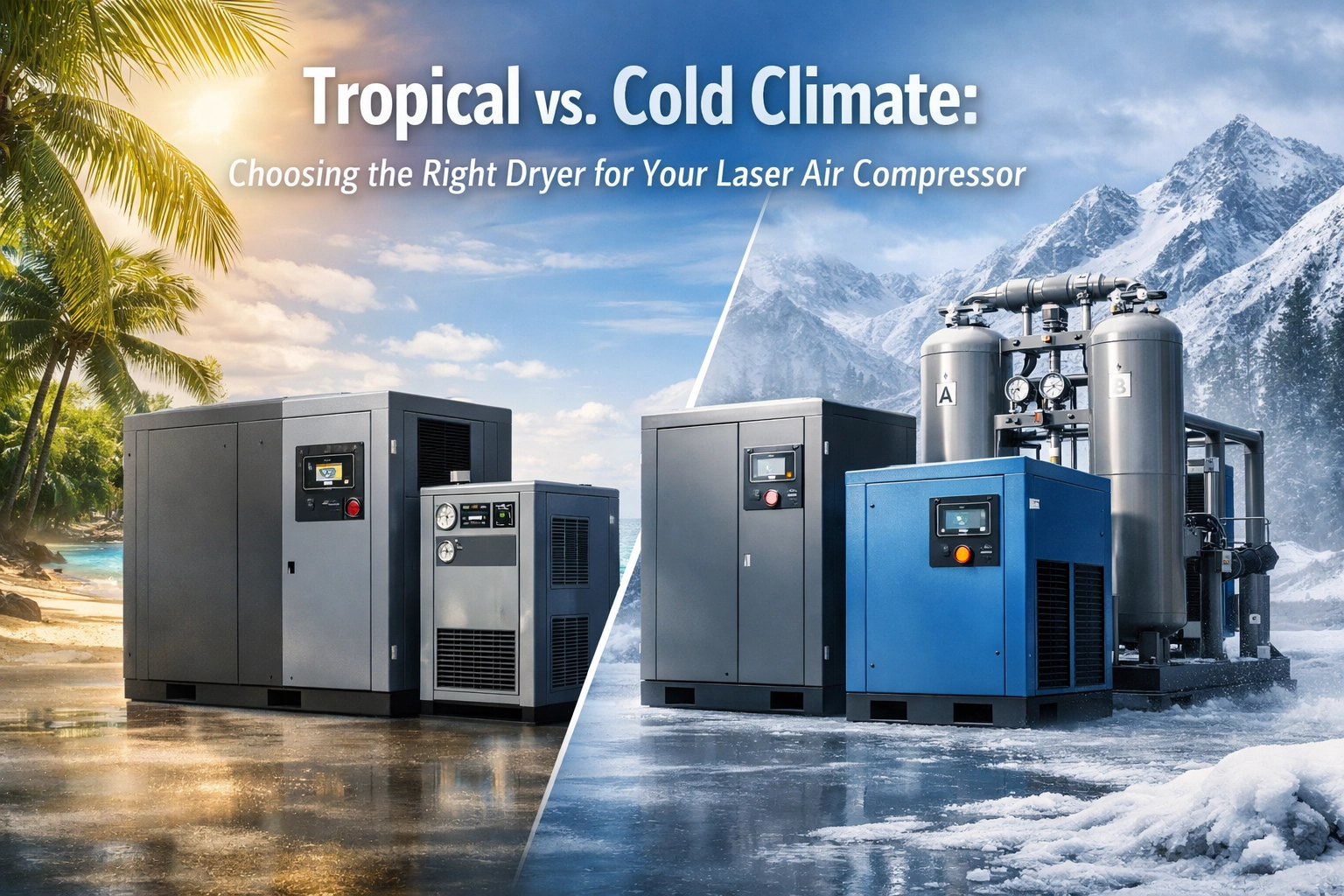
For laser cutting operations, the right dryer choice depends entirely on your climate. Tropical regions (Southeast Asia, Latin America) typically require oversized refrigerated dryers to handle extreme humidity, while cold climates (Russia, CIS countries, northern USA) demand desiccant dryers to prevent line freezing and ensure consistent laser performance. The core difference lies in dew point requirements: refrigerated dryers achieve +3°C dew points suitable for warm environments, while desiccant dryers reach -40°C to -73°C necessary for freezing conditions.
Understanding this climate-dryer relationship protects your fiber laser investment and maintains the ISO 8573-1 Class 1.4.1 air quality standard required for precision cutting.
WHY CLIMATE DICTATES AIR DRYER SELECTION FOR LASER CUTTING
Your laser cutting air compressor doesn't operate in a vacuum. Ambient temperature and humidity directly affect moisture load in compressed air systems. A 20°F increase in ambient temperature doubles the moisture-carrying capacity of compressed air, which means your dryer works twice as hard in tropical heat compared to temperate conditions.
Fiber laser machines operating at 1kW to 30kW demand ultra-clean compressed air at 16 bar to protect cutting heads, assist gas delivery systems, and prevent lens contamination. Moisture in the air line causes three immediate problems: lens fogging that reduces cut quality, corrosion in pneumatic components, and freezing in cold-climate installations that shuts down production entirely.
AirSpace Machinery Co., Ltd. has engineered air compressor for laser machine systems across 40 plus countries over 20 years, and climate-specific dryer selection remains the most frequently misunderstood component in compressed air system design.
TROPICAL CLIMATE CHALLENGES: SOUTHEAST ASIA AND LATIN AMERICA
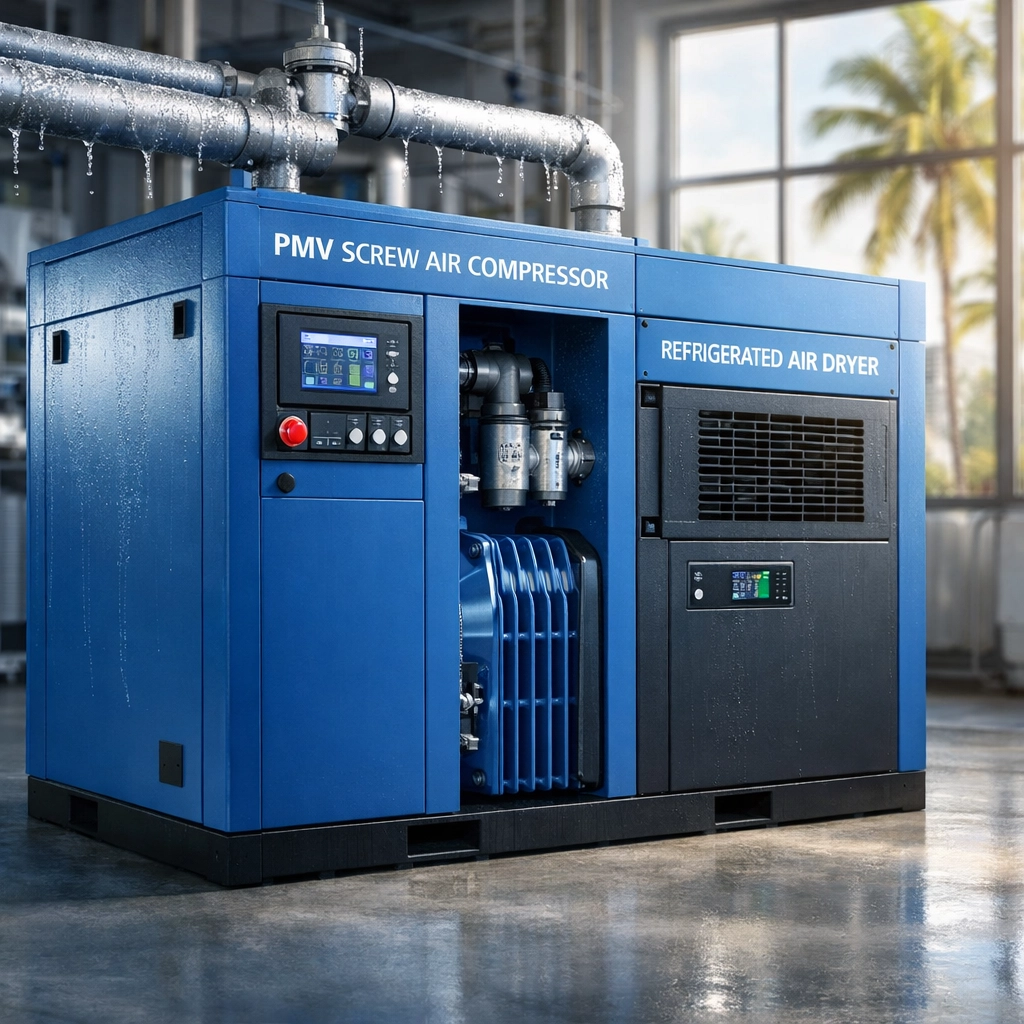
Tropical operating environments present the highest moisture challenge for laser cutting air compressor systems. Bangkok, Jakarta, São Paulo, and coastal manufacturing zones routinely see 80-95% relative humidity combined with 30-38°C ambient temperatures. This combination creates extreme moisture loads that standard refrigerated dryers cannot handle without significant capacity oversizing.
In tropical conditions, a rotary screw compressor operating at 100°F ambient temperature discharges compressed air at approximately 115°F. This elevated discharge temperature directly reduces refrigerated dryer cooling capacity by 25-40%, depending on the unit's design. The dryer must work harder to condense moisture from hotter, more saturated air.
Southeast Asian laser fabricators running continuous shifts face an additional challenge: afternoon humidity spikes that overwhelm undersized dryers. A refrigerated dryer rated for 100 CFM in standard conditions may effectively deliver only 60-70 CFM of dried air capacity when ambient temperature exceeds 35°C. This capacity reduction leads to moisture breakthrough, lens contamination, and inconsistent cutting performance during peak production hours.
Latin American installations compound this issue with variable grid voltage. Refrigerated dryer compressors and fans require stable electrical supply for consistent cooling performance. Voltage sags reduce cooling capacity further, creating a compounding effect with high ambient temperature.
The solution for tropical laser cutting installations requires refrigerated dryer oversizing by 30-50% above calculated CFM requirements. A 16 bar screw compressor delivering 50 m³/min should pair with a refrigerated dryer rated for 65-75 m³/min to maintain consistent +3°C pressure dew point during humid season peaks.
COLD CLIMATE CONSIDERATIONS: RUSSIA, CIS COUNTRIES, AND NORTHERN USA
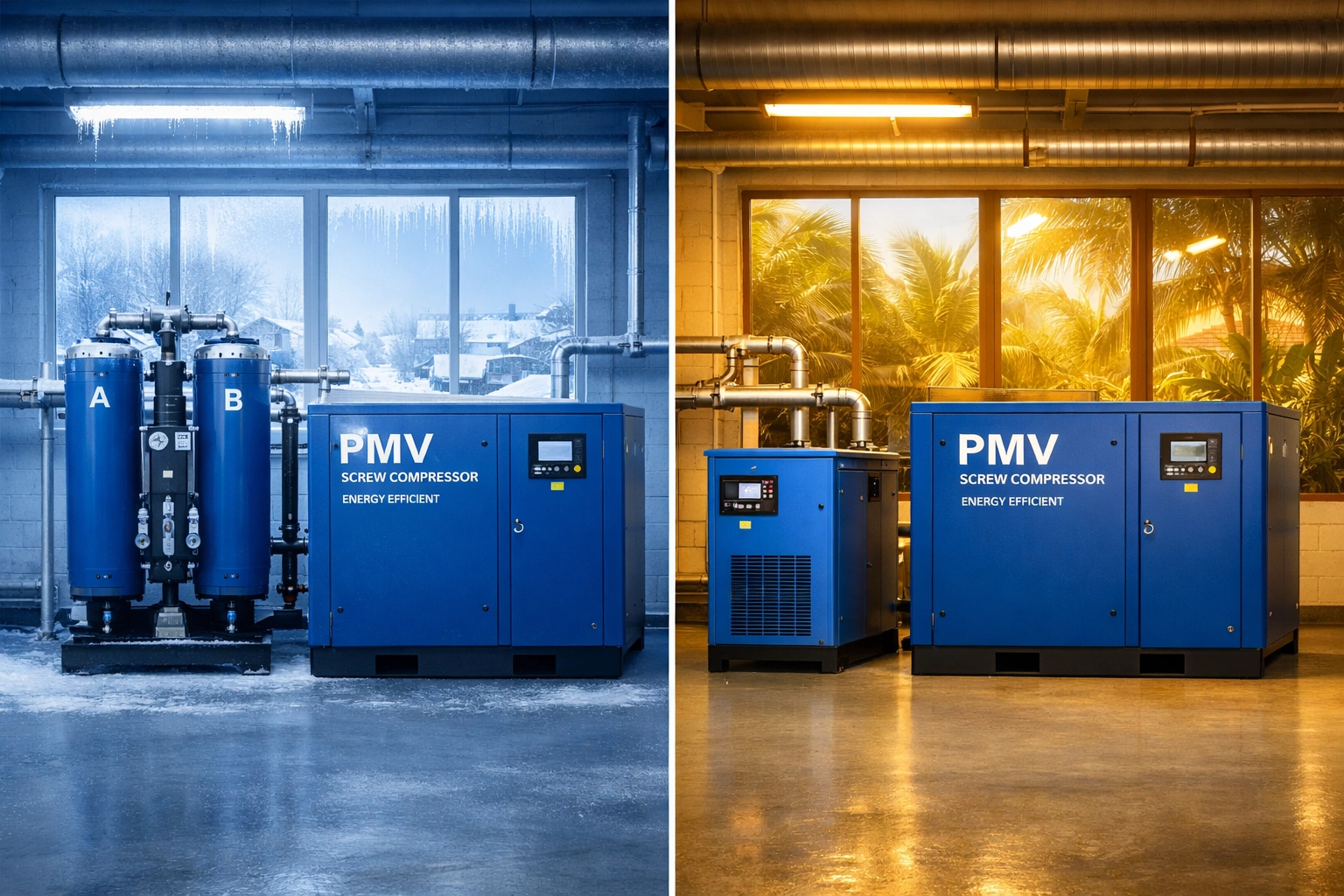
Refrigerated dryers become not just inadequate but dangerous in cold climate laser cutting installations. When ambient temperatures drop below freezing, the +3°C dew point achieved by refrigerated dryers allows condensation to form and freeze in compressed air lines, control valves, and laser assist gas delivery systems.
Russian and CIS country laser fabricators operating in unheated or partially heated facilities face line freeze risk from October through April. Northern USA installations in Michigan, Minnesota, and Wisconsin experience similar challenges. A single freeze event can rupture pneumatic lines, damage solenoid valves, and contaminate laser optics with ice particles during thaw cycles.
Desiccant dryers solve cold climate challenges by achieving pressure dew points between -40°C and -73°C. At these dew points, moisture remains in vapor phase even when compressed air lines run through unheated spaces or outdoor routing between buildings. This prevents ice formation under all realistic operating conditions.
For laser cutting operations requiring ISO 8573-1 Class 1.4.1 air quality in cold climates, desiccant dryers are mandatory, not optional. The investment cost difference between refrigerated and desiccant technology becomes irrelevant when a single freeze event can halt production for days and require costly pneumatic system repairs.
Cold climate installations also benefit from desiccant dryer technology during seasonal transitions. Spring and fall temperature swings create condensation risk in marginally heated facilities. A desiccant dryer maintains consistent ultra-dry air regardless of ambient temperature fluctuations.
ISO 8573-1 CLASS 1.4.1 AIR QUALITY STANDARD EXPLAINED
ISO 8573-1:2010 defines compressed air quality across three contamination categories: solid particles, water, and oil. For laser cutting air compressor systems, Class 1.4.1 represents the recommended purity specification.
The classification breaks down as follows. Class 1 for solid particles means maximum 0.1 mg/m³ total particulate with maximum particle size 0.1 microns. Class 4 for water content specifies a pressure dew point of +3°C, adequate for most laser cutting applications using refrigerated dryers in controlled temperature environments. Class 1 for oil aerosol and vapor requires total oil content below 0.01 mg/m³, achievable with proper filtration downstream from oil-injected screw compressors.
For cold climate installations or extremely sensitive laser optics, upgrading to Class 1.2.1 (pressure dew point -40°C) ensures zero condensation risk and requires desiccant dryer technology.
Meeting these standards requires more than just installing a dryer. The complete filtration train includes coalescing prefilter before the dryer to remove liquid oil and water, the refrigerated or desiccant dryer to control pressure dew point, and activated carbon filter plus final particulate filter to remove oil vapor and any desiccant dust carryover.
AirSpace Machinery Co., Ltd. designs complete laser cutting air compressor packages with integrated filtration trains that meet ISO 8573-1 Class 1.4.1 as standard configuration, certified by third-party testing and backed by our ISO 9001 quality management system.
REFRIGERATED VS DESICCANT DRYERS: TECHNICAL COMPARISON
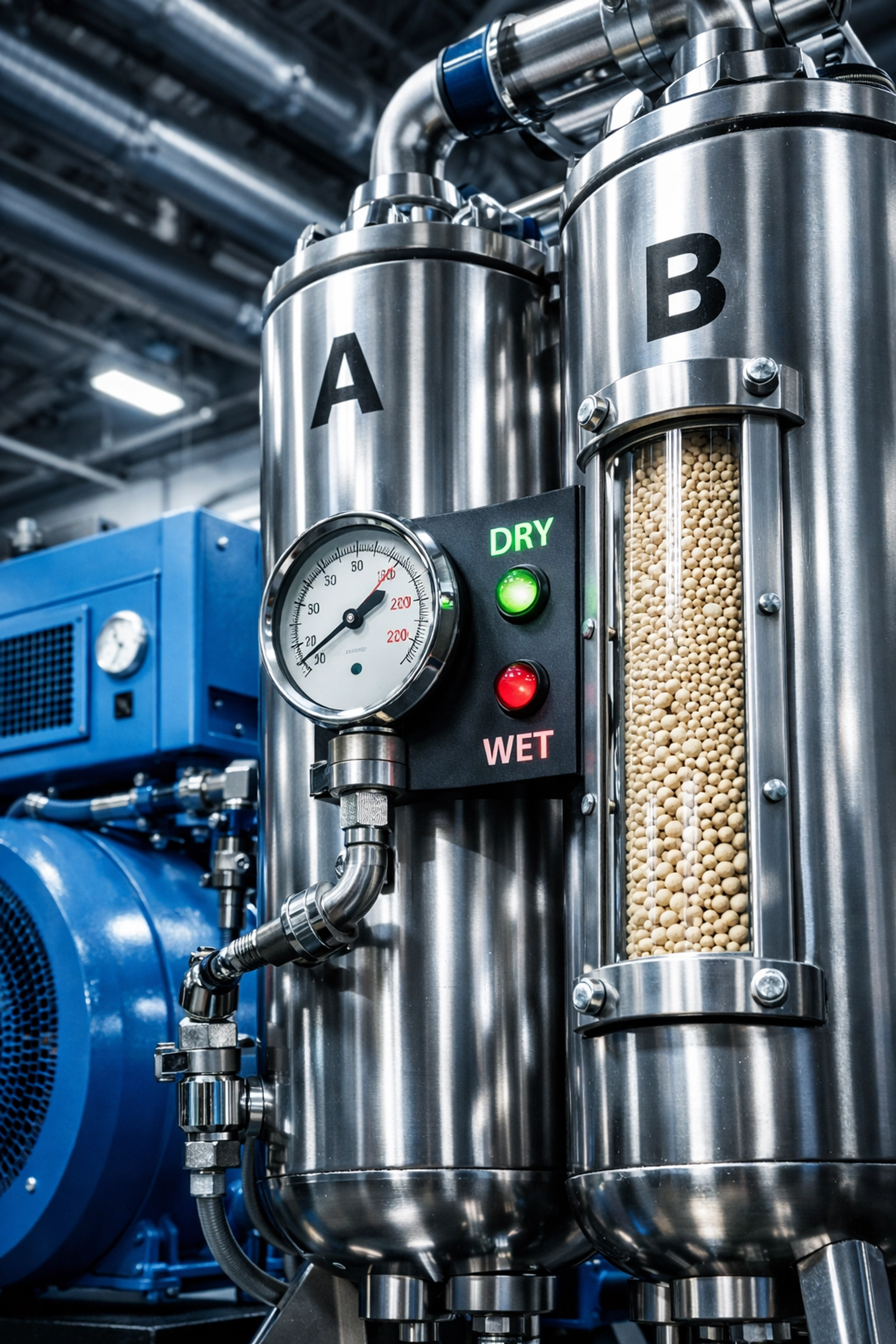
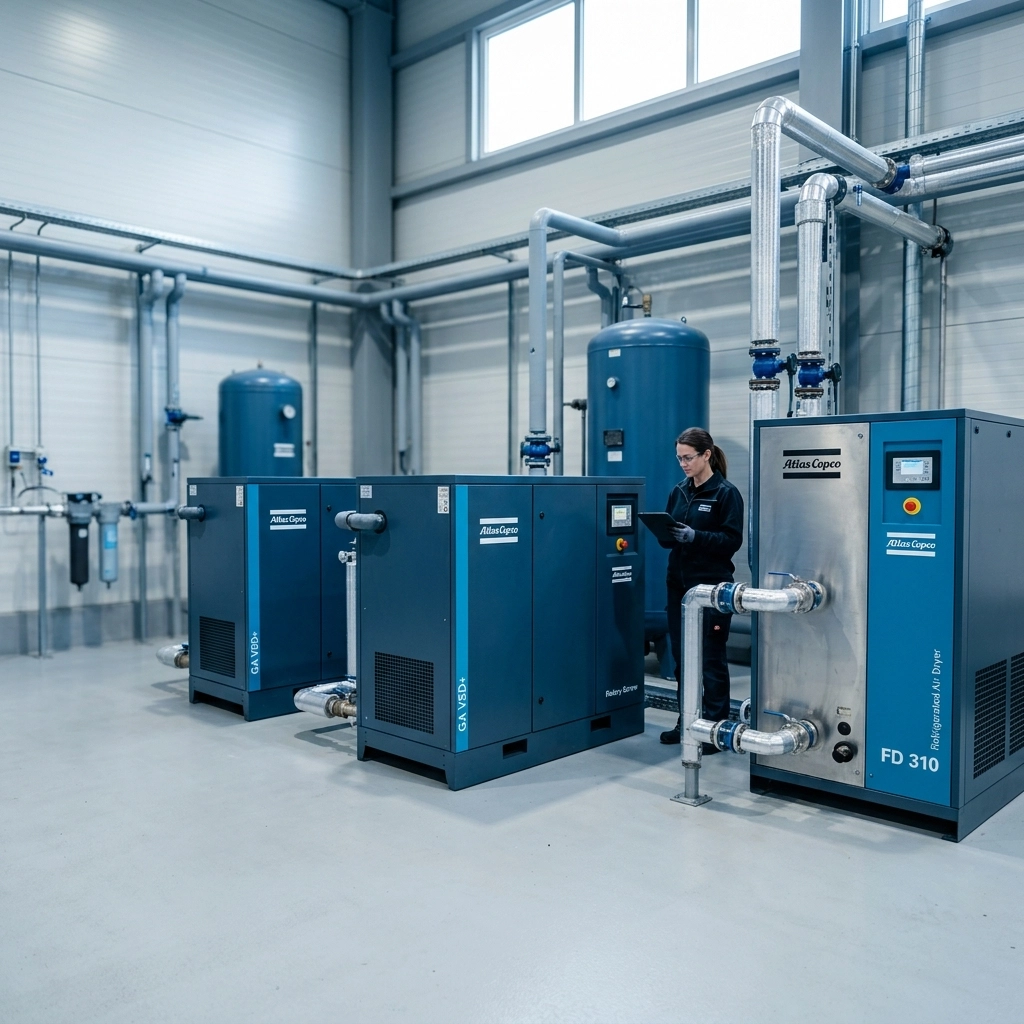
Refrigerated dryers operate on the same principle as household air conditioners. Compressed air passes through a heat exchanger cooled by refrigerant, lowering air temperature to approximately +3°C. Moisture condenses out as liquid water, which drains through an automatic moisture separator. The cooled, dried air then passes through an air-to-air heat exchanger that pre-cools incoming wet air while reheating outgoing dry air to prevent external condensation on piping.
The advantages of refrigerated dryer technology include lower initial investment cost, minimal pressure drop (typically 0.1-0.2 bar), no compressed air consumption for regeneration, and simple maintenance requirements. Refrigerated dryers suit tropical and temperate climate laser cutting installations where ambient temperature remains above 5°C and pressure dew point of +3°C meets application requirements.
Desiccant dryers use hygroscopic material (typically activated alumina or molecular sieve) to adsorb water vapor from compressed air. Twin tower designs alternate between adsorption and regeneration cycles. While one tower dries incoming air, the other regenerates by purging moisture using either heated air (heated purge design) or a portion of dried compressed air (heatless design).
Desiccant dryer advantages include pressure dew points to -73°C, operation in any ambient temperature including outdoor installations, and guaranteed freeze protection. The trade-offs include higher initial cost, greater pressure drop (0.2-0.4 bar typical), compressed air consumption for regeneration (10-15% of rated flow for heatless designs, 3-5% for heated purge designs), and more complex maintenance including periodic desiccant replacement.
For laser cutting air compressor installations, the climate and operating environment determine which technology delivers better total cost of ownership. Tropical regions benefit from refrigerated dryer simplicity and lower operating cost, while cold climates require desiccant dryer reliability and freeze protection regardless of higher investment.
SELECTING THE RIGHT DRYER CONFIGURATION FOR YOUR LASER AIR COMPRESSOR
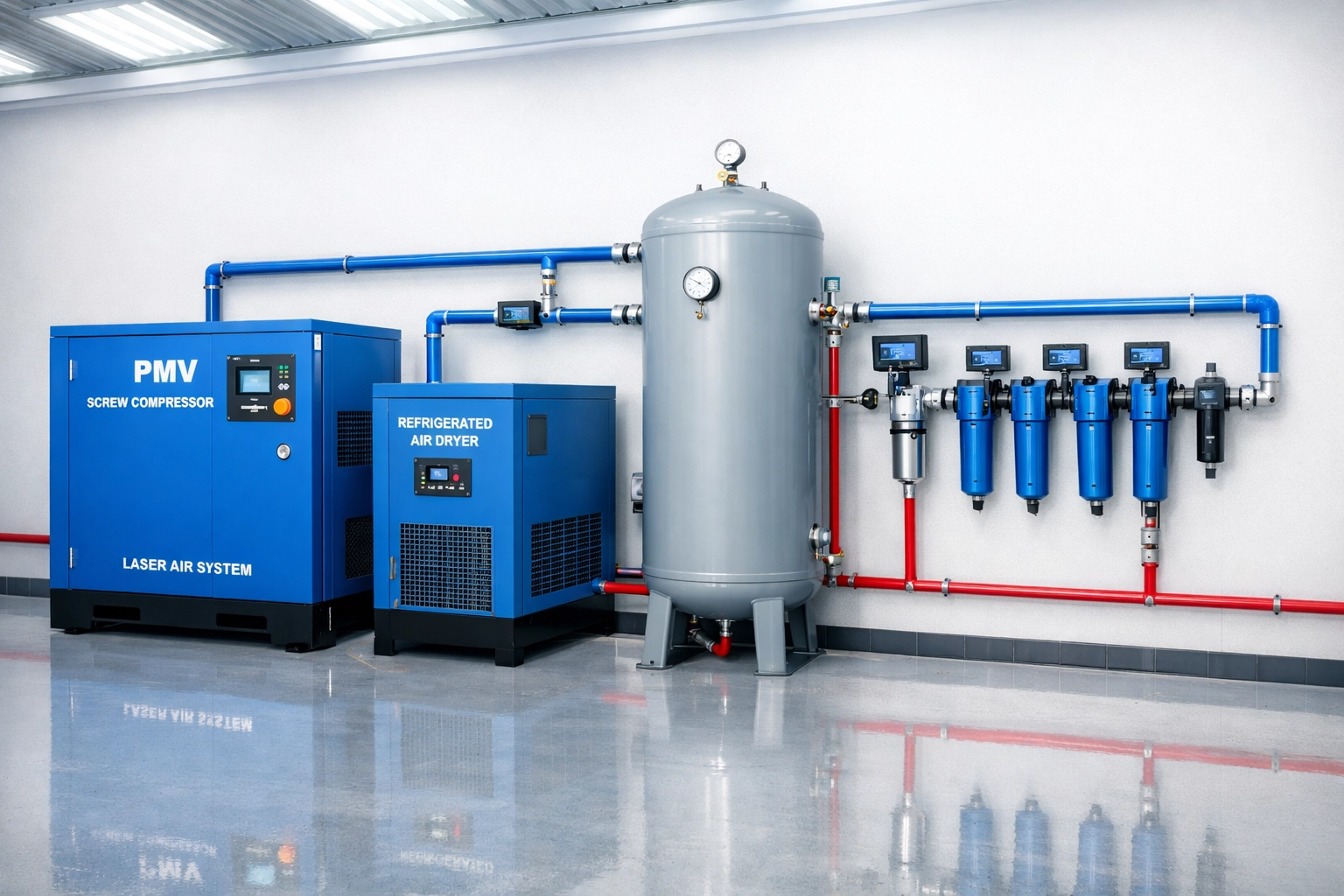
Proper dryer sizing starts with accurate CFM calculation at actual operating conditions. Your 16 bar screw compressor nameplate flow rating represents output at standard conditions (20°C, 1 bar absolute, 0% relative humidity). Actual delivered flow varies with ambient temperature, inlet filter restriction, and system pressure drop.
For a fiber laser machine running at 16 bar with auxiliary pneumatic tools and automation, calculate total CFM requirement including all demand points, then add 15-20% safety margin for future expansion and peak demand events. In tropical climates, oversize refrigerated dryers by an additional 30-50% to compensate for reduced capacity at high ambient temperature.
Dryer placement matters significantly. Install dryers in temperature-controlled spaces when possible, as performance degrades in both refrigerated and desiccant designs when operating beyond rated ambient temperature range. For refrigerated dryers, maintain ambient temperature between 5°C and 45°C. Desiccant dryers tolerate -20°C to +50°C ambient range but regeneration efficiency drops at temperature extremes.
Integration with the complete compressed air system requires proper pre-filtration and post-filtration. Install a coalescing filter rated for 0.01 micron before the dryer inlet to prevent oil and water carryover from damaging dryer internals. Install activated carbon and final particulate filters after the dryer to achieve ISO 8573-1 Class 1.4.1 specification.
For 24/7 laser cutting operations, consider redundant dryer installation. A dual refrigerated dryer system with automatic switchover provides continuous operation during maintenance or component failure. This configuration adds initial cost but eliminates production downtime risk.
PROTECT YOUR LASER INVESTMENT WITH CLIMATE-OPTIMIZED AIR TREATMENT
Your laser cutting air compressor system represents a significant capital investment. The dryer selection: refrigerated for tropical climates, desiccant for cold environments: determines whether that investment delivers consistent precision cutting or struggles with moisture-related failures.
AirSpace Machinery Co., Ltd. engineers complete compressed air solutions for laser cutting applications worldwide from our 4000m² manufacturing facility. With 20 years of compressed air expertise and 100M yuan annual production capacity, we design climate-specific air treatment systems that meet ISO 8573-1 Class 1.4.1 standards for fiber laser machines from 1kW to 30kW power ratings.
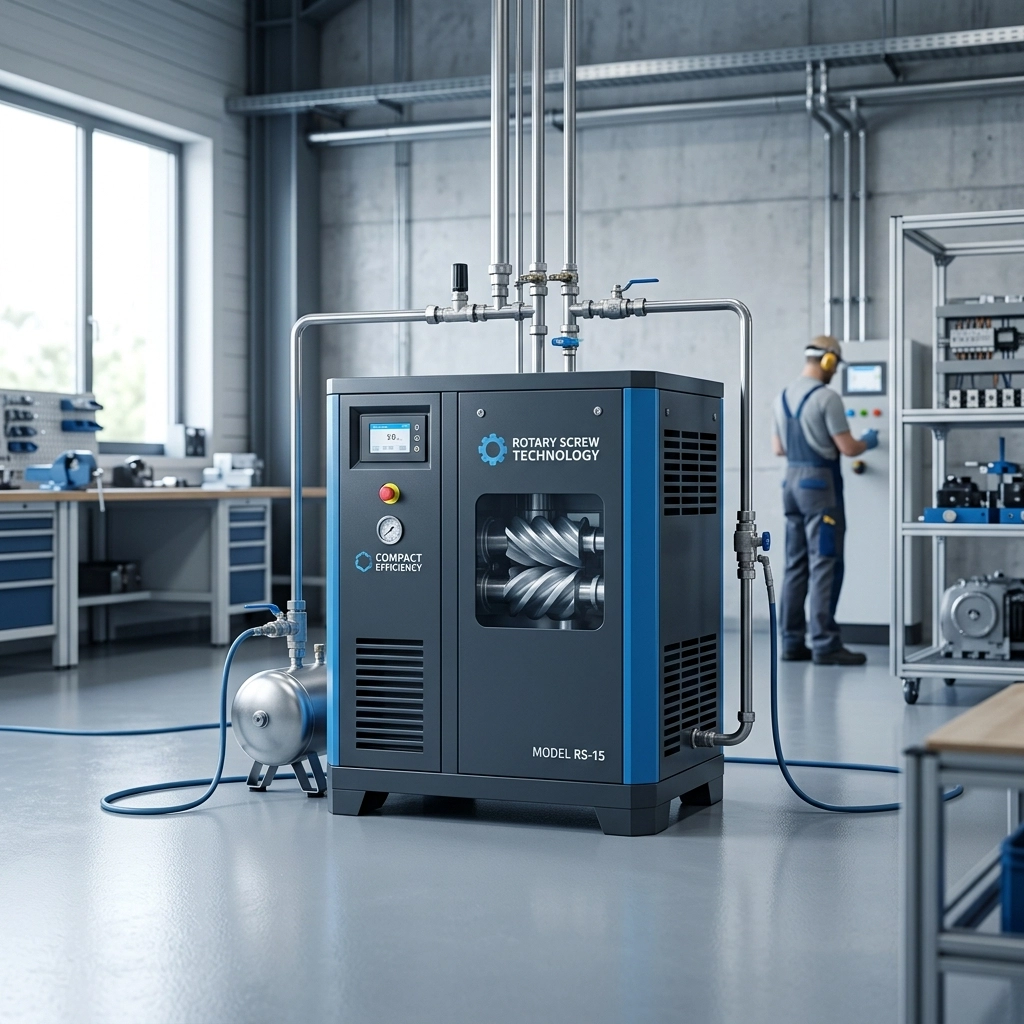
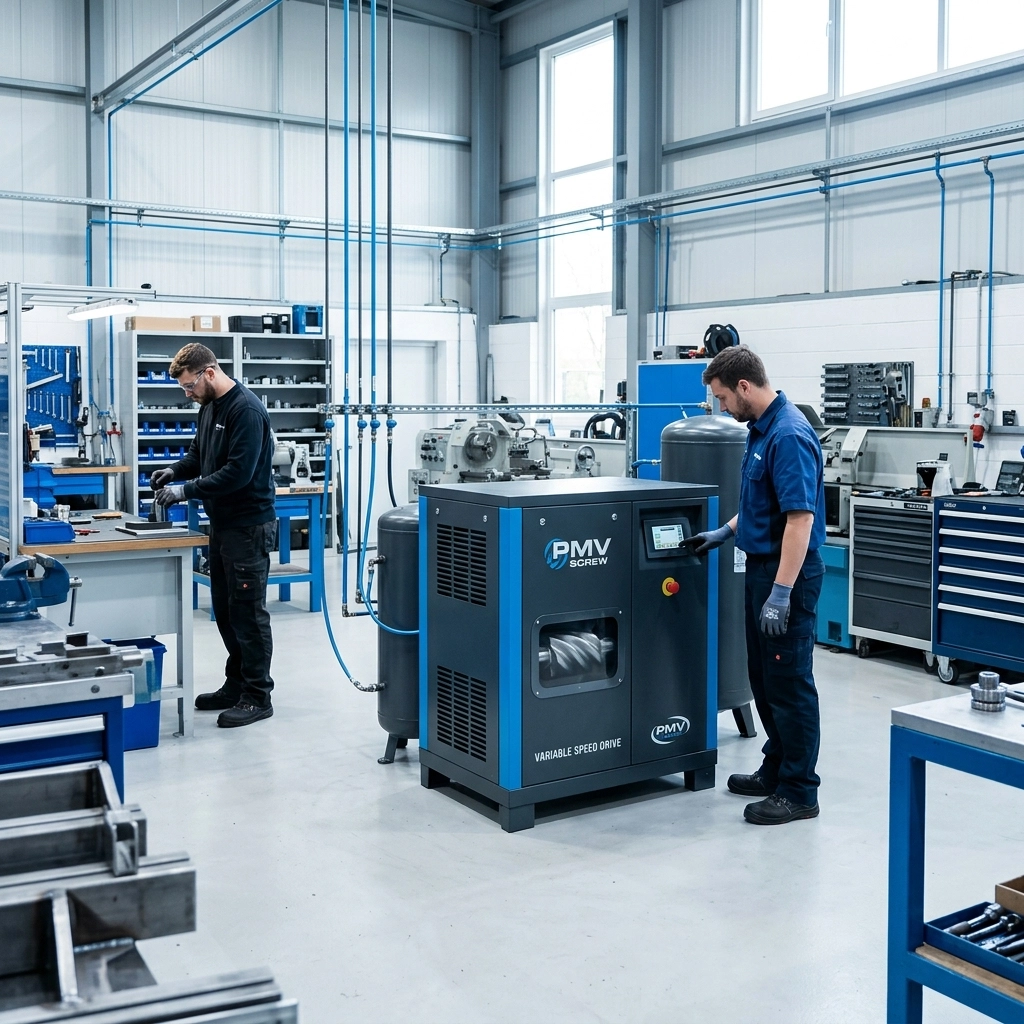
Our Permanent Magnet Variable Frequency (PMV) screw air compressor packages include integrated dryer and filtration systems sized for your specific climate, production schedule, and air quality requirements. Every system ships with CE and ISO 9001 certification documentation verifiable through third-party registries.
Explore our complete range of laser cutting air compressor systems at https://www.chinacompressor.org/shop/_category-air-compressor-for-laser-cutting/ or contact our engineering team to discuss your specific climate challenges and application requirements.
SOURCES AND STANDARDS
ISO 8573-1:2010 – Compressed air – Part 1: Contaminants and purity classes
ANSI/ISA-7.0.01-1996 – Quality Standard for Instrument Air
CAGI Performance Verification Program – Compressed Air and Gas Institute testing standards
ABOUT THE AUTHOR
Penny Winston is an AI Blog Writer at AirSpace Machinery Co., Ltd., specializing in compressed air technology and industrial applications. With expertise in translating complex engineering concepts into practical guidance, Penny helps global buyers understand compressed air system design, selection, and optimization.
REVIEWED BY ENGINEERING
This article has been reviewed and verified by AirSpace Machinery Co., Ltd. engineering team for technical accuracy and compliance with current industry standards.