Integrated PMV Compressor Stations: Do You Really Need the Tank + Dryer Package? (Honest Answer for Small Manufacturers)
Short answer: Most small manufacturers with steady production patterns do not need the full integrated tank and dryer package. A PMV compressor with its built-in dryer and filter can handle operations efficiently, saving you 3-5 square meters of floor space and reducing installation costs by 15-20 percent. However, if your air demand fluctuates heavily throughout the day, or you run multiple machines with staggered start times, the integrated tank package becomes essential for pressure stability.
Here is the detailed breakdown to help you decide what your workshop actually needs.
What Actually Comes Standard in a PMV Compressor Station
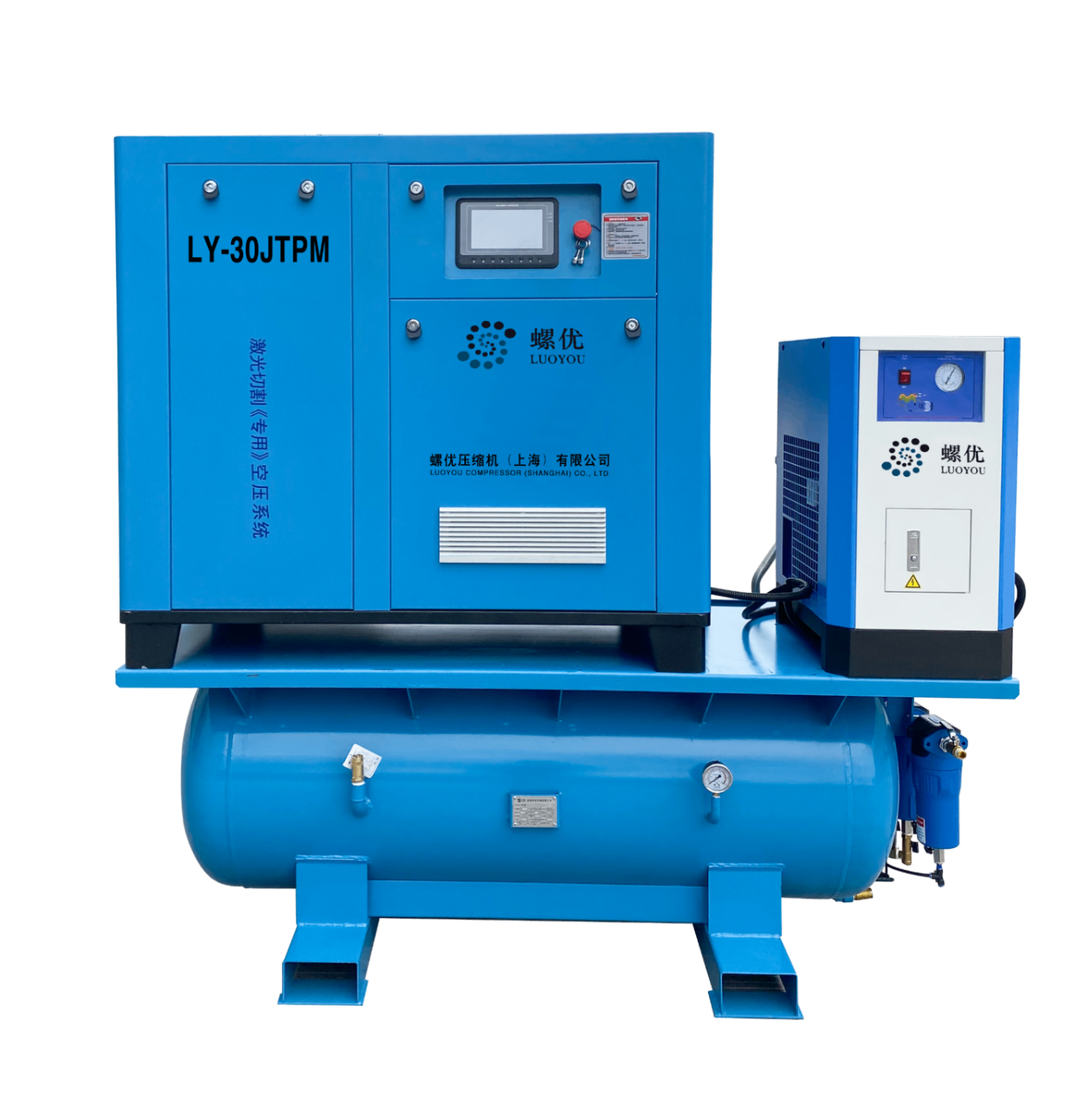
Every Permanent Magnet Variable Frequency screw air compressor from AirSpace Machinery includes integrated refrigerated dryer and air filtration as standard equipment. This is not an optional add-on. The system combines compressor, motor, cooling system, oil separator, dryer, and filter into one cabinet. You are already getting moisture removal and basic particulate filtration without purchasing additional equipment.
The variable frequency drive adjusts motor speed based on real-time air demand, which fundamentally changes how the system handles pressure management compared to fixed-speed compressors. When demand drops, the motor slows down instead of cycling on and off. This eliminates the pressure swing that makes storage tanks critical in traditional setups.
For small workshops running CNC machines, plasma cutters, or automated assembly tools with relatively consistent air consumption, the built-in components provide sufficient air treatment and pressure stability. The compressor responds to demand changes within 2-3 seconds, maintaining pressure within 0.2 bar of setpoint without requiring a large buffer tank.
When the Integrated Tank Package Makes Sense
The integrated receiver tank package becomes necessary in three specific scenarios. First, if your equipment has high instantaneous demand spikes. Pneumatic presses, tire changers, sandblasting cabinets, and similar tools that consume large volumes of air in short bursts will cause pressure drops even with PMV technology. The integrated 300-500 liter receiver tank acts as a buffer, maintaining system pressure during these demand surges.
Second, multiple machines with staggered operation patterns benefit from tank storage. If you run three or four pieces of equipment that start and stop independently throughout the day, the tank smooths out the cumulative demand variations. Without it, the compressor constantly ramps up and down, reducing efficiency and increasing wear on the variable frequency drive.
Third, applications requiring pressure consistency within plus or minus 0.1 bar need the dampening effect of a receiver tank. Precision spray painting, automated quality control systems, and certain pharmaceutical packaging operations fall into this category. The tank eliminates micro-fluctuations that PMV control systems cannot address alone.
The Real Space and Installation Benefits
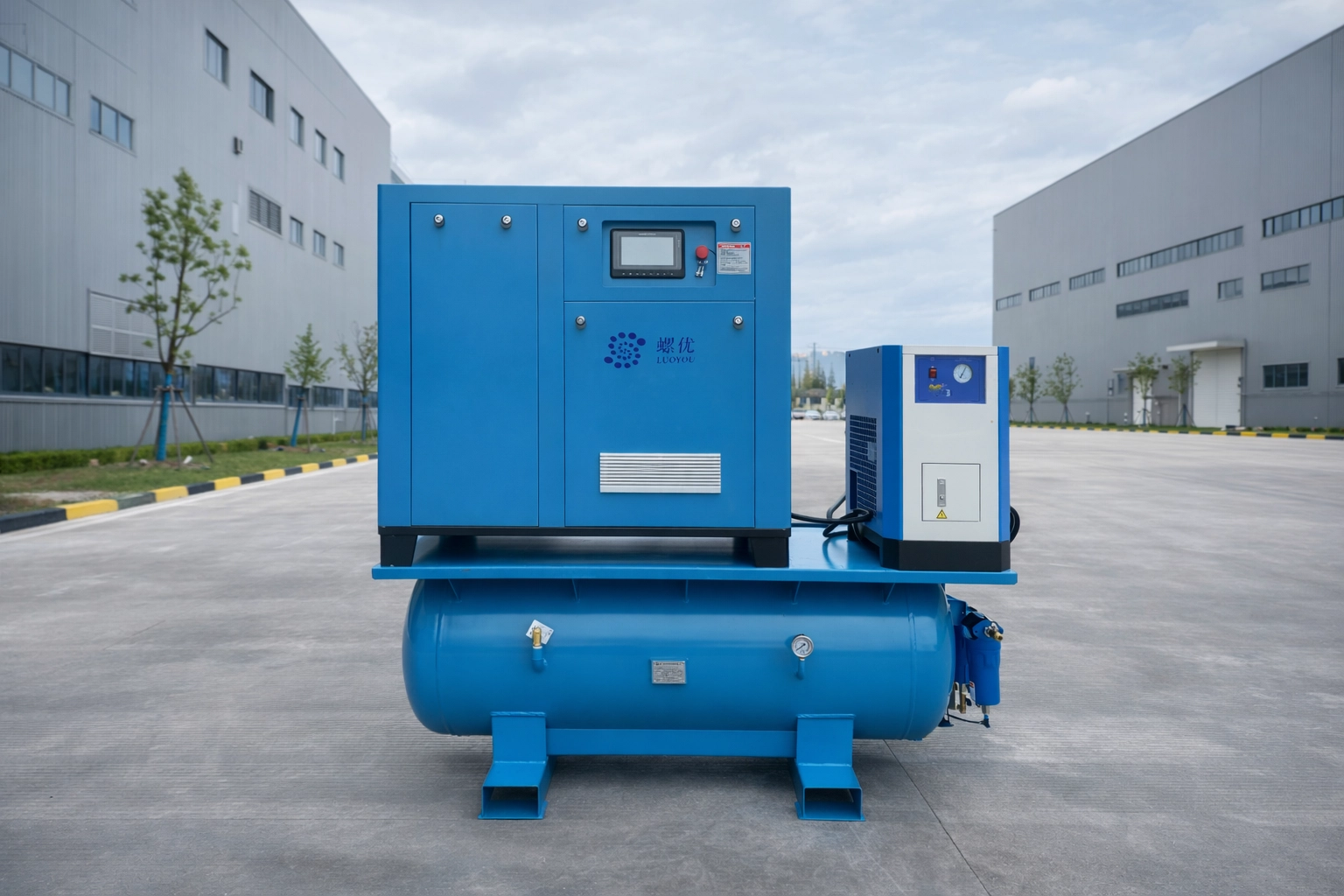
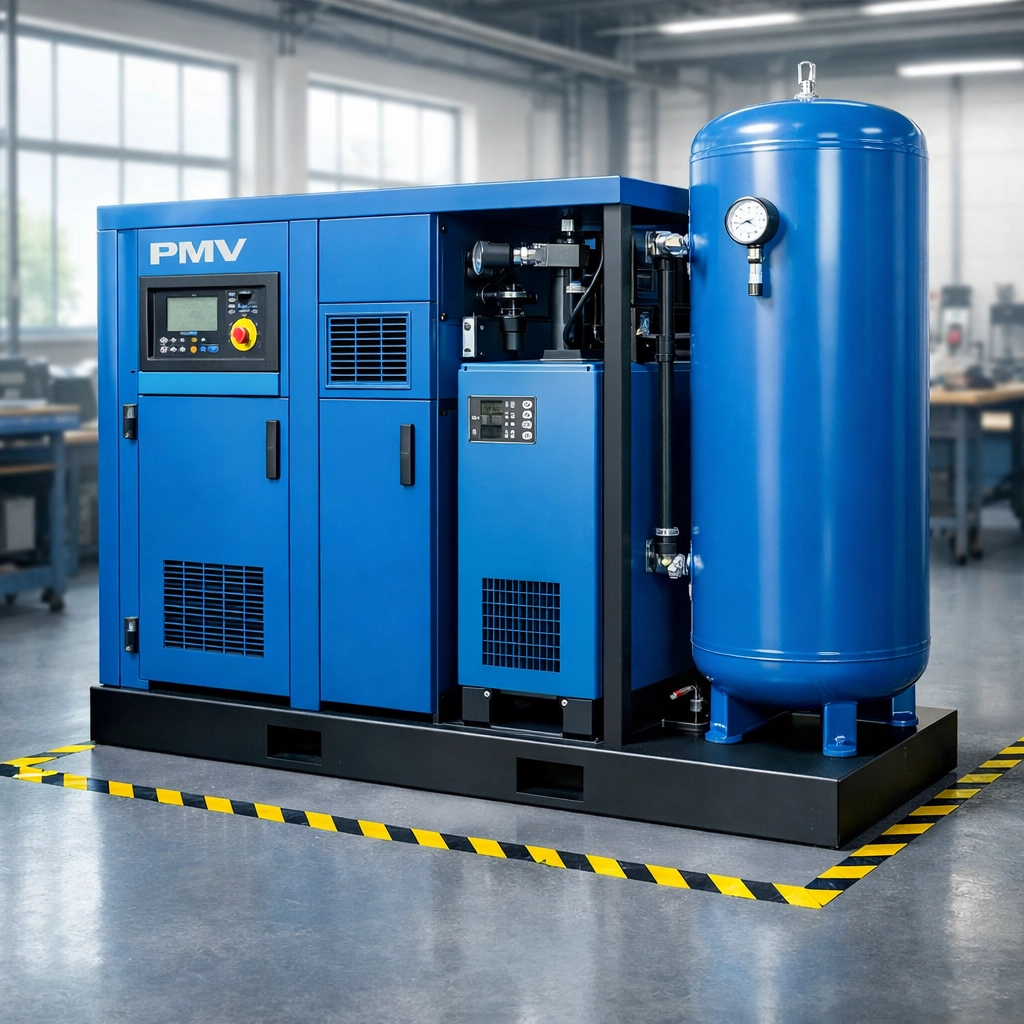
An integrated PMV compressor station with tank and dryer measures approximately 1.8 meters by 1.2 meters by 1.6 meters tall. This single footprint replaces what traditionally required three separate pieces of equipment. A standalone compressor, external dryer, and separate receiver tank would occupy 5-6 square meters when accounting for maintenance clearances and piping connections.
For workshops operating in rented facilities or urban industrial parks where floor space costs 8-15 dollars per square meter per month, the integrated package saves 240-540 dollars annually in rent alone. Installation complexity drops significantly as well. A single power connection, one compressed air outlet, and one condensate drain replaces multiple pipe runs, electrical circuits, and drain connections.
Rigging and positioning become simpler with integrated units. The complete station arrives on a single pallet, pre-tested and factory-assembled. Installation crews can position, level, and commission the unit in 4-6 hours compared to 10-12 hours for component-by-component installation. Electrical contractors appreciate the single power connection point instead of coordinating circuits for compressor, dryer, and controls separately.
The Honest Trade-Off: Maintenance Access
Here is the part most sales materials skip over. Integrated PMV stations pack components tightly to achieve their compact footprint. This creates maintenance access challenges that workshop owners need to understand before purchase.
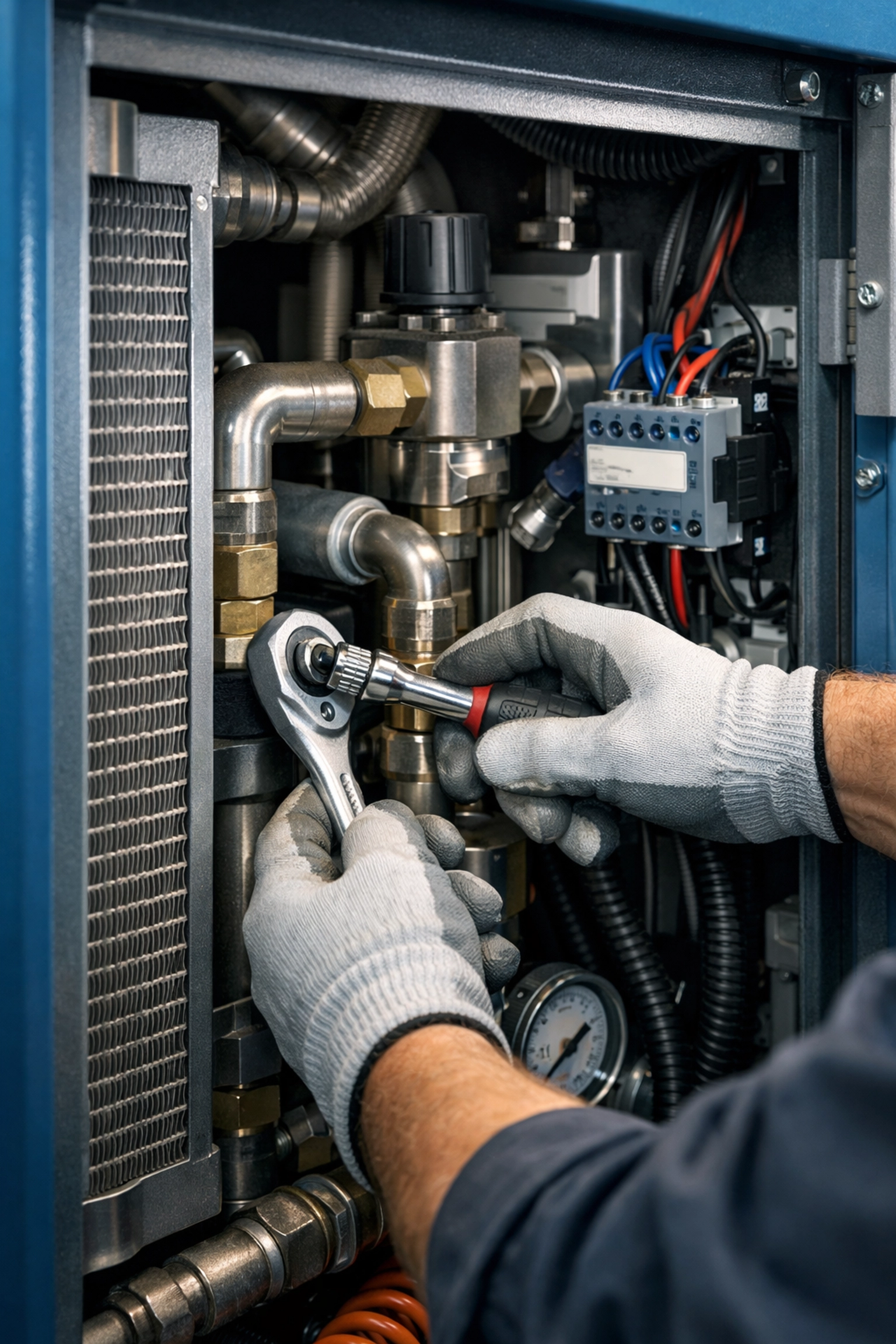
Refrigerated dryer heat exchangers sit behind removable panels, but accessing them requires removing the entire side panel and working in confined spaces. Annual cleaning takes 30-40 minutes longer compared to standalone dryers where you simply swing open an access door. Oil separator element changes require partial disassembly of internal piping in some integrated models. The 500-hour service interval remains the same, but the actual wrench time increases by 15-20 percent.
Air filter cartridge replacement is straightforward on integrated stations, as manufacturers position these components for quick access. However, checking refrigerant levels or servicing dryer components often means calling a technician instead of handling it in-house. Standalone dryer units allow workshop maintenance staff to perform routine service without specialized training. Integrated systems require factory-authorized service for anything beyond filter changes and oil top-ups.
Plan for this by ensuring your supplier provides local service support or training for your maintenance team. AirSpace Machinery offers technician training programs covering integrated PMV stations, enabling workshop staff to perform 80 percent of routine maintenance without external service calls.
Dryer Capacity: When the Integrated Unit Is Not Enough
The integrated refrigerated dryer matches the compressor air flow capacity under standard conditions. A 20 cubic meter per minute PMV station includes a dryer rated for 20 cubic meters per minute at 35 degrees Celsius ambient temperature and 35 degrees Celsius inlet air temperature. This works perfectly for most installations.
Problems arise in two situations. First, high ambient temperature environments above 40 degrees Celsius reduce dryer efficiency by 20-30 percent. Workshops in Southeast Asia, Middle East regions, or adjacent to heat-generating processes may need supplemental drying capacity. Second, applications requiring pressure dew points below 3 degrees Celsius need external desiccant dryers regardless of the integrated refrigerated unit performance.
If your compressed air feeds hygroscopic materials, operates pneumatic controls in freezing environments, or supplies air to processes sensitive to condensation, evaluate whether the standard integrated dryer meets your dew point requirements. ISO 8573-1 Class 4 air quality requires pressure dew point of 3 degrees Celsius or lower. The integrated refrigerated dryer typically achieves 3-5 degrees Celsius. For Class 3 or higher requirements, plan for external desiccant drying.
Russia and CIS Region Consideration: Moisture Control in Sub-Zero Workshops
Workshop operators in Russia, Kazakhstan, and other CIS countries face specific challenges with compressed air moisture in sub-zero ambient conditions. When workshop temperatures drop below minus 10 degrees Celsius during winter months, compressed air piping becomes a condensation risk zone even with properly functioning dryers.
The integrated refrigerated dryer in PMV stations removes moisture by cooling compressed air to 2-4 degrees Celsius, causing water vapor to condense and drain away. This works effectively when piping remains above freezing. However, air lines running through unheated areas or along external walls can drop below zero degrees, causing ice formation inside pipes. This blocks air flow, damages control valves, and creates pressure fluctuations.
Three solutions address this in cold climate installations. First, install all compressed air piping in heated zones with minimum 5 degrees Celsius ambient temperature. This requires careful routing during installation but eliminates freeze risk completely. Second, add electric trace heating to exposed pipe runs with insulation jacketing. This maintains pipe temperature above 10 degrees Celsius even when workshop areas reach minus 20 degrees.
Third, and most effective for harsh winter regions, upgrade to a desiccant dryer system that achieves minus 40 degrees Celsius pressure dew point. While this exceeds the capability of integrated refrigerated dryers, it prevents condensation formation even in extreme cold. Compressed air dried to minus 40 degrees dew point contains virtually zero moisture, making freeze-related blockages impossible regardless of piping temperature.
Workshop operators in Novosibirsk, Yekaterinburg, and similar regions should specify desiccant drying when purchasing PMV stations, or plan for external desiccant dryer installation if the integrated refrigerated unit proves insufficient during first winter operations.
Making the Decision for Your Workshop
Calculate your actual requirement using this framework. First, measure your peak instantaneous air demand. If any single tool or machine consumes more than 30 percent of compressor capacity in a single activation, you need tank storage. Second, count how many pieces of equipment operate simultaneously at maximum production. If total connected load exceeds 80 percent of compressor capacity even briefly during the day, the tank package prevents pressure drops.
Third, consider your air quality requirements. Standard integrated dryers meet ISO 8573-1 Class 4 moisture specifications. Applications needing Class 3 or better require additional treatment regardless of tank considerations. Fourth, evaluate your available floor space and monthly rent cost. If space is premium and your demand pattern is steady, the standalone PMV compressor without integrated tank saves money and simplifies installation.
Most small manufacturers operating laser cutters, CNC routers, automated assembly lines, or packaging equipment find the standalone PMV compressor sufficient. These applications feature consistent air demand without extreme spikes. The variable frequency drive maintains stable pressure, and the integrated dryer handles moisture removal adequately.
Workshops running metal fabrication with plasma cutting, automotive repair shops with tire equipment, and facilities operating sandblasting or powder coating benefit significantly from the integrated tank package. These operations create demand spikes that even variable speed control cannot fully accommodate without pressure storage.
Where to Get Specific Recommendations for Your Setup
AirSpace Machinery engineers provide application analysis free of charge for workshop operators evaluating PMV compressor configurations. Submit your equipment list, including air consumption specifications for each machine, peak simultaneous demand, and duty cycle information through our contact page at https://www.chinacompressor.org/contact-us.
Our technical team calculates actual compressed air requirements, recommends appropriate compressor sizing, and specifies whether integrated tank and dryer packages match your operational needs. This analysis includes pressure drop calculations for your planned piping layout, ambient temperature considerations for dryer sizing, and maintenance access planning.
For immediate specification review of our complete PMV screw air compressor range, including integrated station options, visit https://www.chinacompressor.org/shop. All models include CE and ISO 9001 certification documentation. Lead times depend on configuration, with standard integrated stations shipping within 15-20 business days and custom specifications requiring 25-35 business days for production.
Sources and Standards Referenced
This article references ISO 8573-1 standard for compressed air quality classifications, specifically pressure dew point requirements for moisture content classes. Dryer capacity calculations follow manufacturers engineering data for refrigerated dryer performance at various ambient and inlet air temperatures. Space savings estimates derive from standard equipment dimensions for 15-30 kilowatt PMV compressor configurations with integrated versus separate component installations.
Reviewed by Engineering Team, AirSpace Machinery Co., Ltd.
About the Author
Penny Winston is an AI Blog Writer at AirSpace Machinery Co., Ltd., specializing in industrial compressed air systems and energy efficiency solutions for manufacturing operations. With expertise in PMV technology and application engineering, Penny creates practical content helping workshop owners make informed equipment decisions. Connect with our engineering team for specific technical questions at https://www.chinacompressor.org/contact-us.