PMV or Traditional Screw Compressors?
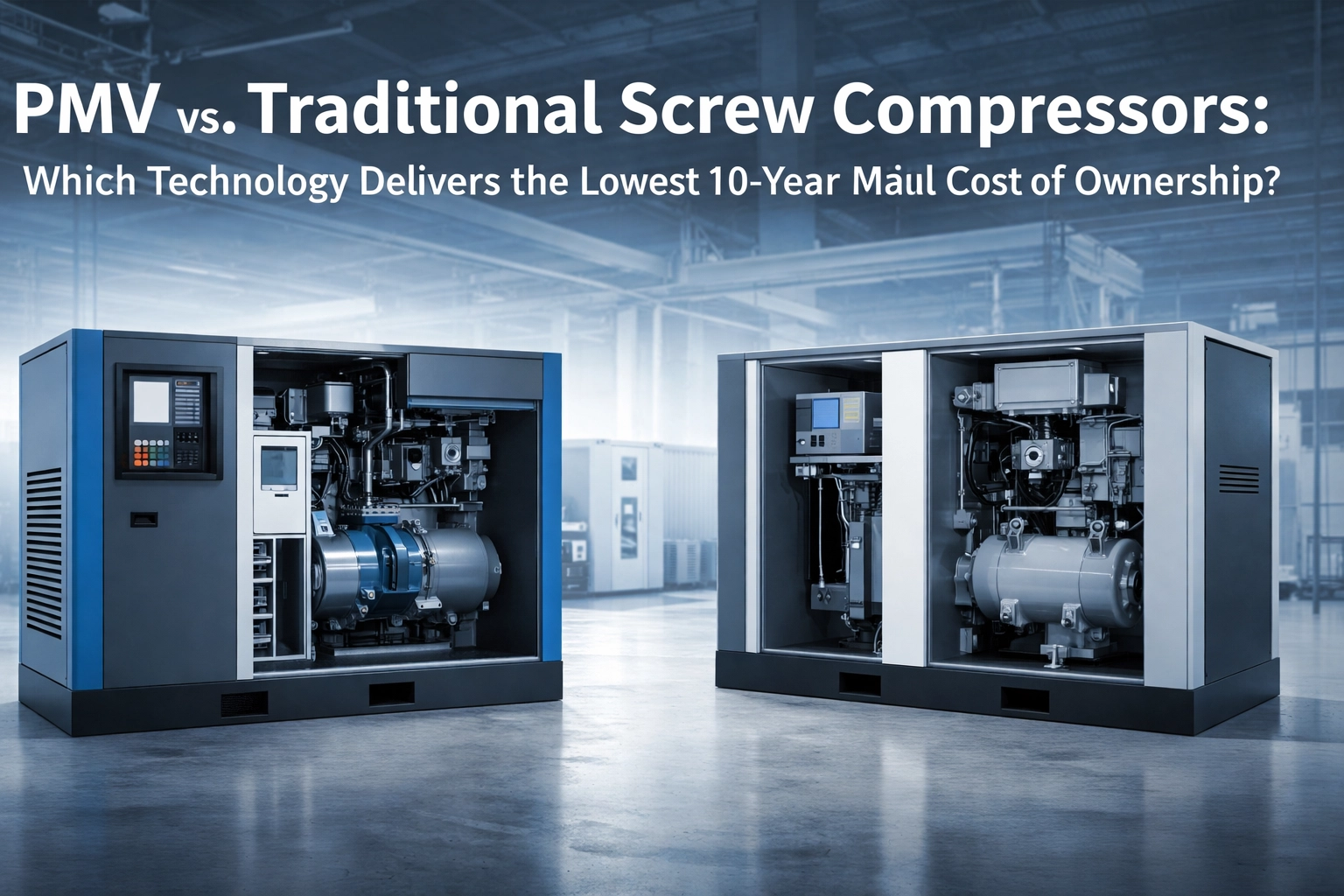
The Direct Answer: PMV Technology Delivers Lower 10-Year TCO in Most Industrial Applications
Permanent Magnet Variable Frequency (PMV) screw air compressors deliver 25 to 40 percent lower total cost of ownership over a 10-year period compared to traditional fixed-speed screw compressors. This conclusion applies to facilities with variable air demand patterns, which represents approximately 70 percent of industrial compressed air applications. The primary driver of these savings is energy consumption, which accounts for up to 80 percent of a compressor’s lifetime cost. While traditional fixed-speed units carry a lower purchase price, the energy waste from constant-speed operation typically erases that advantage within 18 to 36 months of operation.
At AirSpace Machinery Co., Ltd., we have manufactured energy-efficient air compressor systems for over 20 years, and our engineering teams have documented these savings across hundreds of installations worldwide. Our 4000m² manufacturing facility produces PMV screw air compressors that consistently outperform fixed-speed alternatives in total cost of ownership assessments.
Understanding Total Cost of Ownership for Industrial Compressors
Total cost of ownership encompasses every expense associated with a compressor system throughout its operational life. For industrial screw air compressors, TCO consists of four primary components: initial capital investment, energy consumption, maintenance and repairs, and eventual replacement or disposal costs.
Energy consumption dominates this equation. Industry data indicates that electricity accounts for 70 to 80 percent of a compressor’s lifetime expense. A 75kW compressor running two shifts per day consumes approximately 450,000 kWh annually. At an electricity rate of 0.10 USD per kWh, this translates to 45,000 USD in annual energy costs alone. Over 10 years, energy expenditure reaches 450,000 USD, dwarfing the initial equipment purchase of 15,000 to 40,000 USD.
This cost structure explains why PMV technology delivers superior 10-year TCO despite higher upfront pricing. A 30 to 40 percent reduction in energy consumption generates savings of 135,000 to 180,000 USD over the decade, far exceeding the premium paid for variable frequency drive technology.
Energy Efficiency Comparison: PMV vs. Fixed-Speed Technology
PMV screw air compressors achieve energy savings through two technological advantages: permanent magnet motor efficiency and variable speed operation.
Permanent magnet motors operate at 95 to 97 percent efficiency across their speed range. Traditional induction motors in fixed-speed compressors achieve 90 to 93 percent efficiency at full load, with efficiency dropping significantly at partial loads. This 4 to 7 percentage point advantage compounds over millions of operating hours.
Variable speed operation allows PMV compressors to match air output precisely to demand. When a facility requires 60 percent of rated airflow, a PMV compressor reduces motor speed accordingly, consuming approximately 60 percent of rated power. A fixed-speed compressor in the same situation continues operating at full power, either running continuously with excess air vented through a blow-off valve or cycling on and off repeatedly. Both approaches waste substantial energy.
Real-world measurements from manufacturing facilities show PMV compressors achieving 30 to 45 percent energy reduction compared to fixed-speed units serving the same air demand profile. The variation depends on how frequently air demand fluctuates. Facilities with highly variable demand patterns see the largest savings.
Initial Investment Considerations
Traditional fixed-speed screw compressors cost 20 to 35 percent less than equivalent PMV models at the point of purchase. For a 75kW compressor, this difference represents approximately 5,000 to 12,000 USD.
This lower entry cost makes fixed-speed technology attractive for buyers focused on capital budgets rather than operating expenses. However, procurement decisions based solely on purchase price often result in higher total expenditure over the equipment’s useful life.
AirSpace Machinery recommends that buyers calculate payback period using their actual electricity rates and estimated operating hours. For facilities running compressors more than 4,000 hours annually with electricity costs above 0.08 USD per kWh, PMV technology typically achieves payback within 18 to 30 months. After payback, every subsequent year of operation generates net savings compared to fixed-speed alternatives.
Maintenance and Reliability Over 10 Years
PMV screw air compressors demonstrate favorable maintenance characteristics compared to fixed-speed units. Variable speed operation reduces mechanical stress during startup and shutdown cycles. Fixed-speed compressors experience full-load torque at every start, accelerating wear on bearings, couplings, and airend components. PMV systems ramp up gradually, reducing peak stresses.
Modern rotary screw compressors from quality manufacturers operate reliably for 80,000 to 120,000 hours before requiring major overhaul. Maintenance costs typically range from 1,500 to 3,000 USD annually for routine service including oil changes, filter replacements, and periodic inspections.
PMV compressors may require VFD (variable frequency drive) maintenance or replacement during a 10-year service life, adding 2,000 to 5,000 USD to lifetime costs. However, reduced mechanical wear often offsets this expense through extended intervals between major component replacements.
When Traditional Fixed-Speed Compressors Make Sense
Fixed-speed screw compressors remain appropriate for specific applications. Facilities with constant air demand operating at or near 100 percent capacity continuously gain limited benefit from variable speed technology. In these applications, the simpler fixed-speed design may deliver lower total cost of ownership.
Examples include dedicated process applications where compressors supply a single machine or system with steady demand. Backup or standby compressors that operate only during peak periods or equipment failures also represent suitable applications for fixed-speed technology.
For most industrial facilities with multiple air consumers and varying production schedules, PMV technology delivers measurably lower 10-year costs.
Global Buyer Considerations: Certification and Documentation
International buyers evaluating compressor suppliers should verify CE marking and ISO 9001 certification. CE marking indicates compliance with European health and safety directives, while ISO 9001 certification confirms quality management system standards.
AirSpace Machinery Co., Ltd. maintains current CE and ISO 9001 certifications for our complete range of PMV and fixed-speed screw air compressors. Documentation packages for export orders include certificates of conformity, test reports, and operation manuals in multiple languages.
Our export team provides logistics support including freight forwarding coordination, customs documentation, and technical commissioning guidance. Lead times vary depending on model configuration and destination requirements.
Why AirSpace Machinery for Energy-Efficient Air Compressor Systems
AirSpace Machinery has manufactured industrial compressed air equipment for over 20 years. Our 4000m² production facility in China produces screw air compressors ranging from 7.5kW to 250kW, serving customers across manufacturing, food processing, pharmaceuticals, electronics, and general industrial applications.
Annual sales exceeding 100M yuan reflect the trust global buyers place in our engineering quality and after-sales support. Our PMV screw air compressor range incorporates premium permanent magnet motors, precision airend assemblies, and intelligent control systems that maximize energy efficiency across varying operating conditions.
Every AirSpace Machinery compressor ships with CE and ISO 9001 documentation, comprehensive warranty coverage, and access to our technical support team for installation guidance and troubleshooting assistance.
Get a Proposal for Your Application
Selecting the optimal compressor technology requires analysis of your specific air demand patterns, operating hours, and energy costs. Our engineering team provides detailed TCO calculations comparing PMV and fixed-speed options for your application parameters.
Contact AirSpace Machinery to request a proposal. Please specify your required pressure (bar or psi) and flow rate (m³/min or CFM) to receive accurate recommendations. Lead times depend on model configuration and shipping destination.
Visit our product catalog at https://www.chinacompressor.org/shop or submit an inquiry through https://www.chinacompressor.org/contact-us to begin the consultation process.
Sources and Standards Referenced
Energy consumption percentages based on Compressed Air and Gas Institute (CAGI) performance data sheets and ISO 1217 testing standards. Motor efficiency values reference IEC 60034-30-1 efficiency classifications. Total cost of ownership methodology aligns with ISO 55000 asset management principles. Reliability hour ratings based on manufacturer testing per ISO 1945 compressor duty cycle classifications.
Reviewed by Engineering
About the Author
Penny Winston is a technical content specialist at AirSpace Machinery Co., Ltd., focusing on compressed air system efficiency and industrial equipment selection guidance. With expertise in energy-efficient air compressor technology, Penny translates complex engineering concepts into practical information for global industrial buyers evaluating screw air compressor investments.